
Picking the right email marketing platform can feel like a chore, but it really comes down to matching the right features to your business goals. For a small business, the best tool isn’t necessarily the one with the longest feature list. It’s the one that helps you grow—whether that means driving online sales, nurturing local leads, or building a loyal community of subscribers.
This guide is designed to be an educational resource, helping you cut through the marketing hype with a strategic, easy-to-read comparison of the top email marketing platforms out there.
Why Your Platform Choice Matters
Choosing your email marketing software is more than a technical task. It’s a strategic move that directly impacts how well you can connect with your customers and, ultimately, generate revenue. The right platform works as a force multiplier for your marketing efforts. The wrong one leads to wasted time, missed opportunities, and a frustrated team.
The stakes are high because email remains a dominant force in marketing. It has proven to be one of the most cost-effective digital strategies, consistently delivering an exceptional return on investment. Recent data shows that companies in retail and e-commerce pulled in an impressive average email ROI of 45:1.
And with 52% of consumers admitting they made a purchase directly from a marketing email in the last year, it’s clear this channel drives real business results.

Key Factors in Your Decision
To make a smart choice, you need a clear framework. Before getting lost in feature-by-feature comparisons, take a step back and think about these core elements:
- Business Goals: Are you trying to generate leads, keep existing customers engaged, or drive direct sales? Your primary objective will tell you which features are must-haves versus nice-to-haves.
- Budget: Platforms can range from free starter plans to pricey enterprise solutions. Figure out a realistic budget that leaves room for your subscriber list to grow.
- Team Skills: Be honest about your team’s technical comfort level. Sometimes, a simple, intuitive interface is far more valuable than a complex system with a steep learning curve.
A classic mistake is picking a platform based on an exhaustive feature list. Instead, find the 20% of features that will drive 80% of your results.
This guide will introduce you to the top contenders and provide a detailed, side-by-side comparison. To better understand the fundamentals, you can also check out our comprehensive guide on email marketing strategies.
A Practical Comparison of Core Features
When you start comparing email marketing platforms, it’s easy to get lost in flashy feature lists. But for a small or medium-sized business, what really matters are the tools you’ll use day in and day out. Let’s cut through the noise and focus on the core features that form the backbone of any great email strategy: the email editor, design templates, and audience segmentation.
These aren’t just line items on a pricing page; they directly control how efficiently you can work and how effectively you can connect with your audience. A clunky editor can turn a simple newsletter into a multi-hour headache, while poor segmentation tools make true personalization impossible.

Email Editors and Design Flexibility
For a growing business, a user-friendly, drag-and-drop editor is non-negotiable. It allows you to create professional-looking emails without needing a coder or graphic designer on staff. This saves a massive amount of time, letting you focus on crafting a compelling message instead of fighting with the software.
Likewise, a solid library of well-designed templates gives you a huge head start. Good templates are more than just pretty layouts; they’re pre-tested to look great on every device and in every inbox, from Gmail to Apple Mail. This ensures your message lands exactly as you intended.
When you’re testing platforms, pay close attention to the editor’s user experience. A tool like MailerLite is often praised for its clean, intuitive interface that makes campaign building a breeze. On the other hand, a more complex platform might offer advanced features but come with a steep learning curve that slows your team down.
The real measure of a good editor is how easily you can customize those templates to reflect your brand. You need the flexibility to tweak colors, fonts, and layouts on the fly. The goal is to send emails that feel uniquely yours, not like they came straight from a generic template box.
The best editor is one that gets out of your way. If you spend more than 20 minutes designing a basic newsletter, the tool is too complicated for the daily needs of a growing business.
Audience Segmentation and Personalization
This is where the magic really happens. Segmentation is the practice of dividing your email list into smaller, more targeted groups based on specific criteria. It’s what transforms a generic email blast into a personal, relevant message that gets results.
Even basic segmentation can have a huge impact. For instance, a local business could segment by location to announce a sale or event. But the real power comes from more advanced, behavior-based segmentation, such as:
- Purchase History: Targeting customers who bought a specific product with offers for related accessories.
- Email Engagement: Creating a special re-engagement campaign for subscribers who haven’t opened your last five emails.
- Website Activity: Tagging users who visited a specific page on your site but left without making a purchase.
This is an area where a platform like Klaviyo truly shines, offering deep e-commerce integrations that make this kind of behavioral segmentation seamless. For businesses with simpler needs, tools like Mailchimp or AWeber provide more than enough power to send relevant, personalized content. Seeing some great email marketing campaign examples can spark ideas for how you can use segmentation to your advantage.
Core Feature Comparison for SMBs
To make sense of it all, it helps to see how the platforms stack up side-by-side on the features that matter most to a small business.
| Feature | Platform A (e.g., Mailchimp) | Platform B (e.g., Constant Contact) | Platform C (e.g., Klaviyo) | Best For SMBs? |
|---|---|---|---|---|
| Email Editor Usability | Very intuitive drag-and-drop; great for beginners. | Simple and straightforward, though can feel slightly dated. | Powerful and flexible, but has a steeper learning curve. | Platform A offers the best balance of ease-of-use and power for most SMBs. |
| Template Library | Large library of modern, responsive templates. | Good selection of templates, often geared toward specific industries. | Smaller library, but highly customizable for e-commerce brands. | Platform A provides the most versatility for non-e-commerce businesses. |
| Basic Segmentation | Strong and easy to use for list-based and tag segmentation. | Solid capabilities for segmenting by contact details and engagement. | Excellent, though may be overly complex for simple needs. | Platform A or B are both great for fundamental segmentation needs. |
| Advanced Automation | Good visual builder, but advanced logic can be limited. | Functional automation, but lacks the deep behavioral triggers. | Industry-leading automation based on deep e-commerce data. | Platform C is the clear winner for e-commerce; Platform A for others. |
| Reporting & Analytics | Clear, easy-to-understand reports for key metrics. | Provides essential data, but lacks deeper analytical tools. | Extremely detailed reporting focused on revenue and customer lifetime value. | Platform A for general insights; Platform C for revenue-focused analytics. |
Ultimately, this direct comparison shows there’s no single “best” platform—it all comes down to what you need to do every day. A business focused on sending beautiful, straightforward newsletters has very different requirements than an online store that needs to run complex, behavior-driven campaigns. Take a hard look at your daily workflow to figure out which toolset will truly help you grow.
Looking at Advanced Automation and AI
This is where your marketing can truly scale. Automation turns a simple email newsletter into a marketing machine that works for you 24/7. While most platforms can handle the basics, advanced automation and AI features are what really set the top players apart.
It’s the difference between sending one-off emails and building entire customer journeys. These automated workflows are triggered by what your customers actually do, making sure your messages are always relevant, timely, and incredibly effective.
How Behavior-Triggered Workflows Work
Let’s imagine an e-commerce store. A customer adds an item to their cart but gets sidetracked and leaves the site. Without automation, that’s a lost sale. With it, it’s an opportunity.
The platform can automatically start a sequence:
- The Gentle Reminder: An hour later, an email with the subject “Did you forget something?” lands in their inbox, showing them the exact item.
- The Follow-Up Nudge: If they still haven’t bought a day later, another email might pop up with a small discount code.
- The Smart Suggestion: Once the purchase is made, a week later the system could send an email suggesting other items that pair well.
This entire process runs on its own, recovering revenue you would have otherwise missed. Platforms like Klaviyo and ActiveCampaign are masters of this, offering the deep integrations needed to make these sophisticated workflows a reality.
AI is Taking Email Marketing to the Next Level
Beyond simple “if-this-then-that” rules, artificial intelligence (AI) is adding a new layer of intelligence to email marketing. AI-powered features analyze massive amounts of data to make smarter decisions on the fly, optimizing your campaigns for the best possible results. Advanced automation features are crucial for implementing sophisticated personalized marketing strategies that resonate with individual subscribers.
Key Takeaway: The real power of automation isn’t just saving time. It’s about creating personalized, one-to-one experiences at scale, even when you’re talking to thousands of people at once.
AI can drive features like send-time optimization, which determines the exact moment each individual subscriber is most likely to open your emails and delivers it then. It also enables predictive content personalization, which can dynamically swap images or offers inside an email based on what it thinks a specific user will find most compelling. As AI becomes more integrated into these tools, knowing how to manage its output is critical. To learn more, check out our insights on how LLMs put you in control of your digital voice.
For a service business, this means a lead nurturing sequence can automatically change its timing and messaging based on how a prospect engages, dramatically boosting the odds of turning that lead into a client.
Getting Seen: Deliverability and the Mobile Experience
You could write the most beautiful email in the world, but it’s worthless if it lands in a spam folder or looks like a jumbled mess on a smartphone. This brings us to two of the most critical—and often overlooked—pillars of any email platform: deliverability and the mobile experience. Getting these right is non-negotiable.
Deliverability is a technical term for a platform’s ability to get your emails into the primary inbox. It hinges on behind-the-scenes factors like sender reputation and proper authentication protocols (like SPF and DKIM). These are digital handshakes that prove to inbox providers that you are who you say you are. Top-tier platforms invest significant resources into keeping their deliverability rates high for all users, which is a huge differentiator.
Optimizing for the Modern Inbox
The reality of email today is that two giants run the show. Apple commands a massive market share, somewhere between 51.52% and 57%, with Google’s Gmail right behind at roughly 26.72% to 30%. Do the math, and that means they control around 80% of all email opens. This staggering concentration has a huge impact on how you should design your emails. For a closer look at these numbers, check out the latest email client statistics from Omnisend.
This market dominance makes mobile optimization an absolute must. With 42% of all emails now opened on mobile devices, sending a non-responsive design is asking for failure. A responsive design, on the other hand, can boost your unique mobile clicks by as much as 15%. It turns a potential frustration into a great user experience. If you want to go deeper on this, we have a whole guide on how to optimize your website for mobile.
Comparing How Platforms Perform on Mobile
When looking at different platforms, don’t just check a box that says “responsive templates.” You need to dig in and see how well those templates actually perform, especially within the cramped real estate of the Gmail and Apple Mail mobile apps.
Here’s what you should be looking for:
- Rendering Consistency: Does the platform’s editor create clean code that looks the same on an iPhone as it does on an Android? Some platforms are notoriously better at this than others.
- Image Handling: How does the platform deal with resizing and compressing images for mobile? A slow-loading hero image can kill engagement before your audience reads a word.
- Dark Mode Support: Dark mode is more than a trend; it’s a user preference. Does the platform have templates that adapt gracefully without turning your text invisible or your logo into a mess?
A platform’s technical foundation is just as important as its flashy features. High deliverability and a flawless mobile experience ensure your carefully crafted messages are actually seen by your audience, exactly as you intended.
At the end of the day, the best platforms make all this seamless. They handle the complex technical work on the back end, freeing you to focus on your content. Before you commit to any service, always send a few test campaigns to your own phone to see how things really look in the wild.
Comparing Pricing And Total Cost
When you’re trying to pick the right email marketing platform, it’s easy to fixate on the monthly price tag. But the sticker price is just the tip of the iceberg. The real number you need to consider is the Total Cost of Ownership (TCO), which accounts for how your list size, sending frequency, and must-have features will impact your bill down the road.
Getting this wrong is a classic mistake. You pick a cheap plan, things start working, your list grows, and suddenly you’re hit with a surprise bill that throws your whole marketing budget out of whack.
Most platforms use one of two models. Contact-based pricing is the most common—you pay based on how many subscribers you have. It’s simple and predictable but can get pricey as you grow. Then there’s send-based pricing, where you pay for the volume of emails you send. This can be great if you have a massive list but only send a newsletter once a month.
Decoding Pricing Tiers And Hidden Fees
The real trick is to look past the main pricing model and spot the hidden costs. Many platforms charge extra for going over your contact or send limits. Even worse, they lock essential tools like advanced automation or A/B testing behind more expensive plans. That “bargain” plan might not even have the features you need to actually grow your business.
Take Mailchimp’s free plan, for instance. It seems like a great deal until you realize you’re capped at 500 contacts and 1,000 monthly sends, with a daily sending limit of 500. For a brand-new startup, that’s fine. But for a growing business, you’ll blow past those limits in no time.
To get a handle on your future costs, you must map out your growth goals against each platform’s pricing tiers. For a more detailed look at how different vendors set up their fee structures, you can get a lot of insight from understanding platform pricing structures.
The best value isn’t always the lowest price. It’s the plan that provides the features you need today while offering a scalable, predictable path for tomorrow’s growth without forcing a costly migration.
This all ties directly back to your marketing ROI. If you can’t accurately track your platform costs, you’ll never know if your campaigns are truly profitable. It’s a critical piece of the puzzle, something we explore more in our guide on how to measure digital marketing success.
Email Platform Pricing Plan Breakdown
Let’s make this more concrete. A simple feature list doesn’t tell the whole story, so here is a table breaking down what you actually get for your money with a few of the big players. This helps you see beyond the initial price and figure out the true long-term value.
| Platform | Entry-Level Plan (Price) | Key Features & Limits | Mid-Tier Plan (Price) | Key Features & Limits |
|---|---|---|---|---|
| Brevo | Free Plan ($0) | Up to 9,000 emails/mo (300/day limit), unlimited contacts, basic automation. | Starter Plan (Starts at $9) | 5,000+ emails/mo, no daily sending limit, basic reporting, email support. |
| Mailchimp | Free Plan ($0) | Up to 500 contacts, 1,000 emails/mo (500/day limit), very limited features. | Essentials Plan (Starts at $13) | Up to 500 contacts, 5,000 emails/mo, A/B testing, basic automation. |
| MailerLite | Free Plan ($0) | Up to 500 subscribers, 12,000 emails/mo, includes landing pages. | Growing Business (Starts at $10) | 500+ subscribers, unlimited monthly emails, 24/7 email support. |
As you can see, “free” almost always comes with serious strings attached. The key takeaway is that you need to be honest about your growth projections. Pick the plan that not only fits your budget today but also gives you room to grow without forcing you into a painful and expensive platform change six months from now.
How to Make Your Final Decision
You’ve seen the side-by-side comparisons and dug into the data. Now comes the hard part: translating all that information into the right choice for your business. Let’s be clear—there’s no single “best” platform. The real winner is the one that fits your day-to-day operations and future goals like a glove.
Instead of getting lost in a sea of features, your decision should hinge on your business model, your team’s bandwidth, and your budget. This is about moving from a spreadsheet comparison to a real-world business scenario. Let’s pull everything together—features, automation, pricing, and deliverability—and frame it in a way that makes your choice obvious.
Matching the Platform to Your Business Model
The perfect tool for a bustling e-commerce brand is almost never the right fit for a local service business. Your business type is the single most important factor, as it determines which features are essential versus just nice-to-have.
- For E-commerce Brands: Your world revolves around sophisticated automation. You absolutely need a platform with deep integrations for Shopify or WooCommerce to trigger abandoned cart reminders, post-purchase follow-ups, and product recommendations. Prioritize tools that let you segment customers based on purchase history—it’s the key to maximizing customer lifetime value.
- For Local Service Businesses: Simplicity is your best friend. You need an intuitive drag-and-drop editor that lets you create clean, professional newsletters without a fuss. Forget complex revenue analytics; you’ll get far more value from basic automation, like a welcome series for new leads, and straightforward reporting that shows you who’s opening and clicking.
- For Content Creators and Bloggers: It’s all about list growth and engagement. Look for platforms that offer excellent landing page builders and flexible sign-up forms to capture new subscribers. Rock-solid deliverability is also non-negotiable to make sure your hard work actually lands in the primary inbox, not the spam folder. A generous free or low-cost plan that scales with you is just as critical.
Ultimately, your decision boils down to one question: Which platform will remove the most friction from your daily workflow while giving you a clear, affordable path to hit your specific growth goals?
By framing your choice through the lens of your business profile, you can confidently pick a partner that not only solves today’s problems but is ready to grow with you tomorrow.
Frequently Asked Questions
Alright, you’ve done the homework and narrowed down the options. But before you pull the trigger, a few final questions always seem to pop up. Let’s clear up the most common concerns we hear from business owners right before they make their choice.
What Is The Most Important Feature For A Small Business?
For most small businesses, the single most critical feature is an intuitive drag-and-drop editor. Time is your most valuable asset, and you can’t afford to wrestle with complicated software. A great editor lets you build professional-looking campaigns in minutes, no design degree required.
After that, you’ll want basic automation—like a simple welcome email series for new subscribers—and reporting dashboards that are easy to understand. You need to see what’s working at a glance.
This decision tree gives you a quick visual on which platform type makes the most sense based on your core business goals.
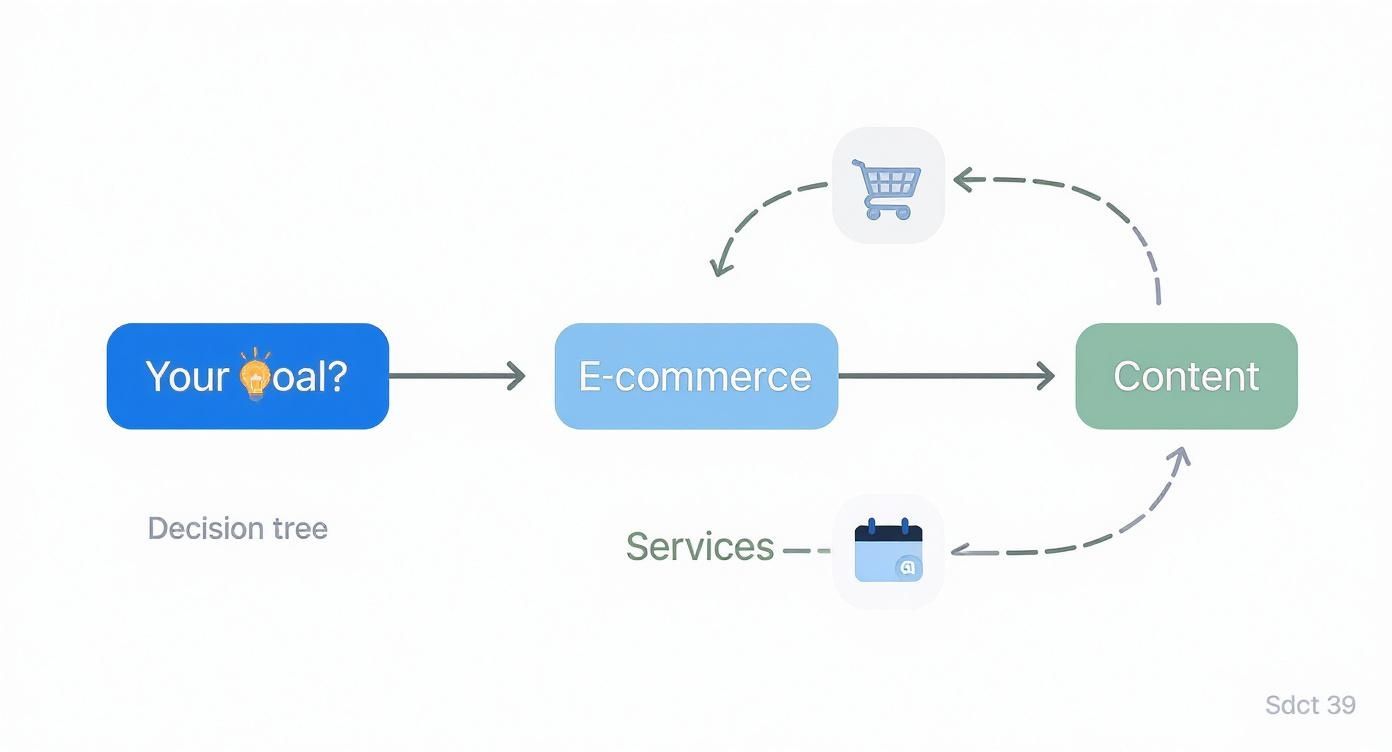
As the graphic highlights, e-commerce businesses should lean toward tools with strong automation, whereas service-based companies can often succeed with simpler newsletter and scheduling features.
How Do I Migrate My Existing Email List?
Don’t worry, this is easier than it sounds. Nearly every platform has a straightforward import tool, usually letting you upload a simple CSV file of your contacts.
But here’s a pro tip: before you migrate, clean your list. This is the perfect opportunity to remove subscribers who haven’t opened an email in months. Starting fresh with an engaged list protects your sender reputation on the new platform and sets you up for a much smoother transition.
Ready to elevate your email marketing with a strategy built for growth? The team at Raven SEO offers expert guidance to help businesses like yours choose and implement the perfect platform. Start your journey with a no-obligation consultation today!