


Getting new clients for your law firm boils down to a simple idea: be visible where they are looking. And these days, they’re looking online. This guide will walk you through building a strong digital presence, starting with a focused practice area and a professional website that turns visitors into actual leads. The goal is to establish your firm as the obvious, trusted expert for a specific legal problem.
Build a Digital Foundation That Attracts Clients
Before a potential client can hire you, they have to find you. With over a third of legal searches starting on Google, your digital presence is your modern-day storefront. Having a website isn’t enough; you need a strategic digital foundation designed to attract and engage your ideal clients.

This foundation starts with getting crystal clear on who you are and who you serve.
Define Your Niche to Stand Out
The legal field is crowded. The American Bar Association reports over 1.3 million active lawyers in the U.S. alone. If you try to be a generalist for everyone, you compete with all of them. The most effective way to get more law clients is to specialize.
When someone faces a stressful legal issue—like a commercial lease dispute or a child custody battle—they aren’t searching for a “general lawyer.” They’re looking for an expert who deeply understands their specific problem.
By niching down, you can:
- Reduce Competition: You shrink your pool of direct competitors from thousands to a more manageable number.
- Target Your Messaging: Your marketing can speak directly to the fears and goals of a specific audience.
- Build Perceived Expertise: You become the go-to authority in your chosen area, which builds trust instantly.
A firm that only handles DUI cases for commercial truck drivers has a much clearer value proposition than a firm that handles “all criminal and traffic matters.”
Your Website Is Your Most Valuable Asset
Once your niche is defined, your website becomes the command center for all your client acquisition efforts. It’s not just a digital brochure; it’s a 24/7 marketing and intake machine. A poorly designed, slow, or confusing website will send potential clients straight to your competitors.
A professional, well-optimized online presence is essential for any law firm that wants to compete today. Your website is often the first impression a potential client has, and it must communicate value and build trust immediately.
To ensure your website is built to convert visitors into clients, it must provide a seamless user experience. People seeking legal help are often stressed and impatient; any friction will cause them to leave. For a deeper look, check out our detailed guide on website design best practices.
Essential Elements of a High-Converting Law Firm Website
Every element on your site should guide the visitor toward contacting you. While aesthetics are important, functionality and user experience are what truly drive inquiries. Aim for a clean, professional design that prioritizes clarity over flashy, distracting animations.
Here’s a checklist of the essential features your website needs to maximize client inquiries.
| Website Element | Why It’s Critical for Getting Clients |
|---|---|
| Mobile-Responsive Design | Most local searches happen on mobile devices. If your site is hard to use on a phone, you will lose leads. |
| Clear Calls-to-Action (CTAs) | Tell visitors what to do next. Use prominent buttons like “Schedule a Free Consultation” so they don’t have to think. |
| Visible Contact Information | Your phone number and a simple contact form should be easy to find on every page, especially in the header and footer. |
| Professional Attorney Bios | Introduce your team with high-quality photos and bios that highlight expertise and build a personal connection. |
| Client Testimonials & Case Results | Social proof is powerful. Showcasing positive reviews and successful outcomes builds instant credibility. |
By mastering these foundational elements, you create a digital platform that actively works to bring new clients through your door. To further streamline your outreach, you might explore tools like an AI client finder.
Dominate Local Search to Connect with Nearby Clients
For most law firms, the best clients are local. When someone in your city has an urgent legal problem, they’re likely searching online for “personal injury lawyer near me” or “divorce attorney in [Your City].”
Winning these local searches is one of the most direct ways to generate a steady stream of high-quality cases. This is achieved through local SEO, and your primary tool is your Google Business Profile.

Transform Your Google Business Profile Into a Client Magnet
Your Google Business Profile (GBP) is the info box that appears in Google Maps and search results. Many attorneys set it up and forget it, which is a significant mistake. A fully optimized GBP is a client-generating machine.
Treat your profile with care and fill out every section accurately and strategically.
- Select Precise Categories: Instead of “Law Firm,” choose specific categories like “Personal Injury Attorney,” “Family Law Attorney,” or “Estate Planning Attorney” to signal the types of cases you handle.
- Write a Compelling Description: Use the available space to describe your firm, highlight your niche expertise, and explain why you’re the right choice.
- Utilize GBP Features: Keep your profile active. Use Google Posts for firm updates and the Q&A section to answer common questions from potential clients.
A complete and active profile signals to Google that you are a relevant, legitimate business, which boosts your visibility. For a more detailed walkthrough, our guide provides steps on how to optimize your Google Business Profile.
The Power of Consistency with NAP and Citations
Your firm’s information appears across many online directories like Avvo, Justia, and Yelp. Search engines use these listings to verify your business details. Inconsistencies can hurt your local search rankings.
This is where NAP consistency is crucial. Your firm’s Name, Address, and Phone number must be identical everywhere online. Even a small difference, like “Street” versus “St.”, can confuse search algorithms.
Think of each consistent online mention, or “citation,” as a vote of confidence. The more consistent votes you have across reputable directories, the more Google trusts you as an established local business.
Building these citations is a foundational task for any local SEO campaign. It ensures that potential clients get the right information wherever they find you, building trust with both people and search engines.
Encourage Reviews to Build Unshakable Trust
Online reviews are the modern-day word-of-mouth referral. Potential clients place immense trust in the experiences of others, making reviews a powerful factor in their decision-making process.
A steady stream of recent, positive reviews on your Google Business Profile signals quality and trustworthiness. However, happy clients are busy and often forget to leave a review unless you make it easy for them.
Create a simple system to ask for reviews. The best time to ask is when satisfaction is highest, such as right after securing a favorable ruling. A simple follow-up email with a direct link to your GBP review page can be very effective. Automating this process helps you capture positive feedback that will attract more clients.
Create Content That Answers Questions and Builds Trust
Getting a potential client to your website is only half the battle. Once there, you must convince them you’re the right choice. This is where your content strategy becomes a vital tool for building trust and proving your expertise.

Today’s clients want answers, not a sales pitch. When you create content that addresses their legal questions, you become a trusted advisor, not just another law firm.
Uncover What Your Clients Are Actually Asking
The best content strategies start with listening. Understand the specific questions, fears, and problems of your ideal clients. This involves research, not guesswork.
Use keyword research tools to see what people are typing into Google. Look for long-tail keywords—longer, more conversational search queries. Instead of targeting a broad term like “divorce lawyer,” you might find value in answering questions like “how is child custody determined in Maryland.”
Answering these specific questions:
- Brings highly qualified visitors to your site.
- Demonstrates your deep understanding of your practice area, building immediate credibility.
This targeted approach ensures your content speaks directly to the people you want as clients.
Your blog and practice area pages are your digital front line. Every article should be a clear, helpful answer to a real question, written in simple language that a non-lawyer can understand.
When you consistently provide value, you build a foundation of trust. This is a key part of establishing your authority online. To do this well, familiarize yourself with Google’s standards by exploring the power of E-E-A-T for crafting high-quality content.
Develop Content That Serves and Converts
Once you know the questions, create the answers. A smart content strategy uses various formats to meet potential clients where they are.
Build a resource library that showcases your expertise:
- In-Depth Practice Area Pages: These should be comprehensive guides that walk a potential client through the legal process and explain common challenges.
- FAQ Sections: Create dedicated pages that answer the top questions you hear during consultations.
- Client-Focused Blog Posts: Each post should solve one specific problem, like “What to Do Immediately After a Slip and Fall Accident.”
This content also fuels your social media. Surprisingly, 71% of lawyers globally report that social media generates leads. Sharing helpful articles on platforms like LinkedIn or Facebook helps you connect with people in a relatable way, building credibility long before they need to hire an attorney.
Amplify Your Reach with Paid Ads and Referrals
SEO and content marketing are long-term strategies. But sometimes, you need clients now. A balanced approach combining immediate paid outreach with the power of human relationships can accelerate your growth.
By using both Pay-Per-Click (PPC) ads and a solid referral network, you have two powerful tools. One puts you in front of people actively searching for a lawyer, while the other delivers high-quality cases from trusted sources.
Get in Front of Active Searchers with PPC
When someone has a pressing legal issue, their first move is often a Google search. PPC advertising lets you place your firm at the top of search results for specific keywords. You connect with potential clients at the exact moment they need help.
This is one of the fastest ways to get new cases. A well-managed PPC campaign can have your phone ringing in days, not the months it might take for SEO to deliver results.
The secret to a winning legal PPC campaign isn’t a massive budget; it’s precision. Focusing on specific, long-tail keywords brings in more qualified leads at a lower cost.
To make your ad budget work for you, focus on these three things:
- Hyper-Targeted Keywords: Instead of broad, expensive terms like “personal injury lawyer,” target phrases like “motorcycle accident attorney in Baltimore.” You’ll face less competition and attract people with a specific problem you can solve.
- Compelling Ad Copy: Your ad must stand out. Speak directly to the searcher’s problem and offer a clear solution, such as “Free Case Evaluation” or “No Fee Unless We Win.”
- Dedicated Landing Pages: Send ad traffic to a custom landing page built for that specific ad. The message should match the ad, and the call-to-action should be unmissable.
Running a great campaign takes work, but the payoff is immediate access to people who need you right now. For a deeper dive, our guide on Google Ads best practices is a great place to start.
Build a Powerful Professional Referral Network
While ads offer speed, nothing beats the quality of a referred client. Referrals remain one of the best ways to get high-value cases.
When a client comes from a trusted professional—like an accountant or another lawyer—they arrive with built-in trust. Building a strong referral network requires actively cultivating genuine, two-way relationships.
Think strategically about who your ideal clients talk to before they talk to you. For example:
- A family law attorney should connect with marriage counselors and financial planners.
- A real estate lawyer should build relationships with real estate agents and mortgage brokers.
- A business litigation attorney should get to know CPAs and commercial bankers.
The goal is to be the first person they think of when a legal problem in your niche arises. Stay on their radar with regular, valuable communication to turn acquaintances into reliable sources of new business.
Turn Your Leads into Retained Clients
All your marketing efforts lead to this critical moment: a potential client reaches out. This is where the goal of “getting clients” becomes a real opportunity.
However, a phone call or form submission is just the starting line. The real challenge is turning that inquiry into a signed retainer agreement. Many firms invest heavily in generating leads only to lose them due to a slow or disorganized intake process.
The Critical Importance of Speed
In the legal world, time is everything for a client in distress. When someone needs a lawyer, they want help now. A delay of even a few minutes can send them back to Google to call the next firm.
The data is clear: rapid response is essential. Research from ALM Global’s 2025 study found that law firms responding to inquiries within the first five minutes see a 400% higher conversion rate.
One personal injury firm I know cut its average response time from 45 minutes to under 30 seconds using an AI-powered intake system, resulting in a 40% jump in client conversions. Immediacy has a direct impact on your bottom line.
This infographic breaks down a simple two-part approach to client growth, combining proactive advertising with relationship-driven referrals.
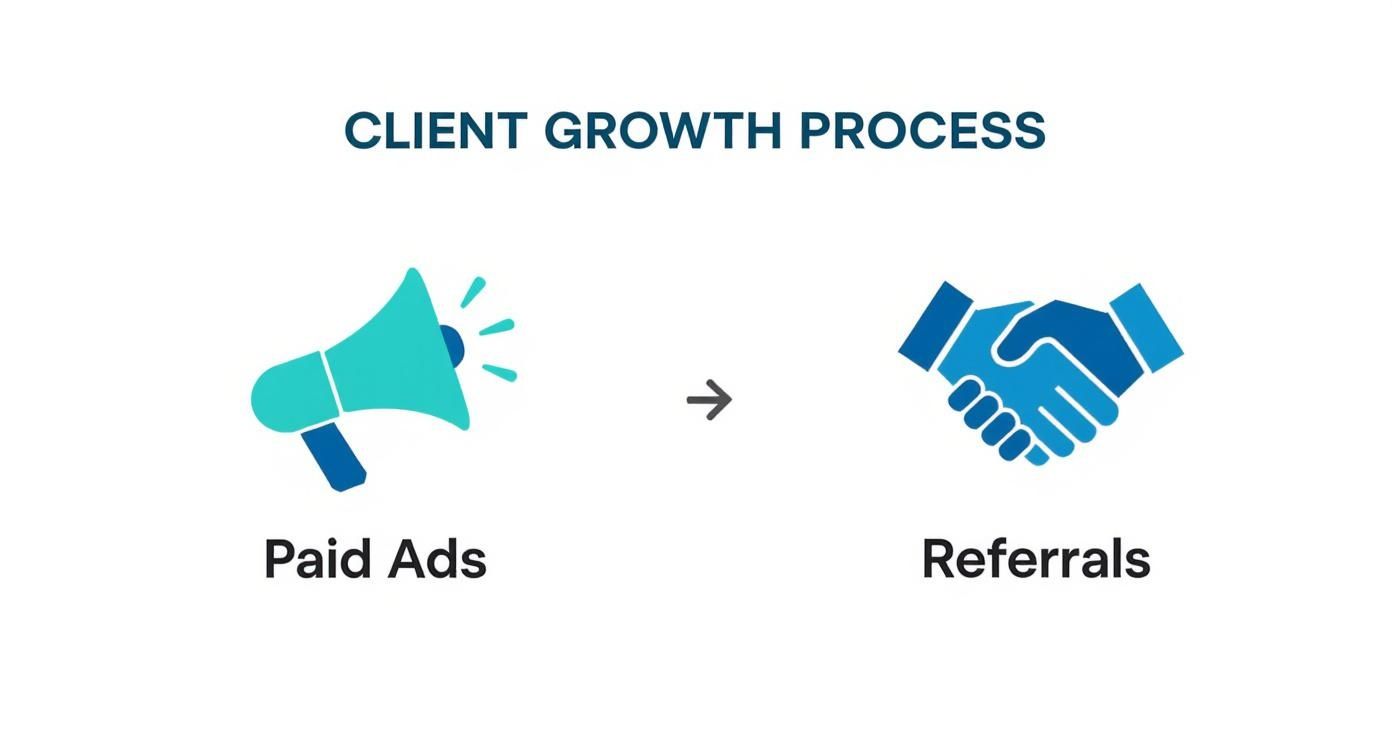
As the visual shows, winning new business is about generating immediate leads from ads and cultivating long-term trust through your professional network.
Designing a Streamlined Intake System
A winning intake process is a deliberate system that your entire team follows. The goal is to make the experience smooth for the potential client while efficiently gathering the information your firm needs.
Your intake process is the first tangible experience a person has with your law firm. It must be designed to reduce their anxiety and build confidence.
A solid system ensures no lead is lost and every person who reaches out feels valued. A great intake system must include:
- Dedicated Intake Personnel: The person handling initial contact should be trained for this role, demonstrating empathy, patience, and skill in asking the right questions.
- A Standardized Intake Form: Use a consistent script or form to capture essential information like contact details, a summary of the legal issue, and key dates.
- Immediate Acknowledgment: Every inquiry should receive an instant reply, confirming receipt of their message and setting expectations for when they’ll hear back.
A great way to ensure you never miss an opportunity is to build a chatbot for lead generation on your website, which can handle initial inquiries 24/7. You can also explore more strategies on our blog about how to increase website conversions.
Training Your Team for Empathy and Efficiency
The person handling your intake is the voice of your firm. Their tone and approach shape a potential client’s perception of your practice. It is vital they are trained not just to gather facts, but to build rapport.
Coach them on active listening and showing empathy. They need to communicate with clarity and confidence. The goal isn’t just to screen a lead; it’s to make that person feel understood and certain they’ve called the right place.
Finally, have a structured follow-up protocol for leads you don’t connect with on the first attempt. A simple sequence of calls and emails can dramatically increase your contact rate and turn more leads into retained clients.
Your Questions, Answered
Here are answers to some of the most common questions we hear from attorneys about getting clients.
How Long Does It Take to See SEO Results?
The honest answer is: it depends. SEO is a long-term investment that builds over time.
For a new website, you’re looking at 6 to 12 months before you see meaningful results for competitive keywords. If your site has some existing authority, you might see movement in as little as 3 to 6 months.
The timeline depends on:
- Competition: Ranking for “personal injury lawyer” in a major city is much harder than ranking for “equine law attorney” in a smaller town.
- Consistency: SEO rewards consistent effort. Sporadic activity leads to sporadic results.
- Technical Health: A slow website that isn’t mobile-friendly will hinder your progress.
Think of SEO like investing in real estate. The work you do today builds equity that pays you back with a steady stream of clients for years to come.
Is Social Media Really Effective for Lawyers?
Yes, but think of it as a brand-building and relationship-nurturing tool. You’re unlikely to land a major client from a single Facebook post.
Social media humanizes your practice. Sharing helpful articles, showing your firm’s personality, and engaging with the community builds trust and keeps you top-of-mind.
For example, LinkedIn is excellent for professional networking and B2B referrals. Platforms like Facebook can be great for consumer-facing practice areas like family law or estate planning, where you can become a familiar, trusted face in the community.
What’s the Best Way to Ask for Client Reviews?
Getting a steady flow of 5-star reviews is vital. The key is to make asking a seamless part of your client offboarding process.
Timing is everything. The best time to ask is right after a big win when your client is happiest, such as:
- When you announce a favorable ruling.
- After their settlement check is delivered.
- At their real estate closing.
Keep the ask simple and personal. Send a direct email thanking them and explaining how their feedback helps others in a similar situation. Most importantly, provide a direct link to your Google Business Profile review page to make it as easy as possible.
Should I Focus on Blogging or Paid Ads First?
This depends on your immediate needs versus your long-term goals.
- Choose Paid Ads (PPC) if: You need leads today. PPC campaigns can get you in front of people actively searching for an attorney within days.
- Choose Blogging (SEO) if: You’re building a sustainable asset for the long term. Each high-quality blog post can attract clients for years, delivering a high return on investment.
Ideally, a mature marketing strategy uses both. PPC provides immediate lead flow while your blog and SEO strategy build the organic foundation for long-term growth.
Ready to stop waiting for clients and start attracting them? The expert team at Raven SEO specializes in creating data-driven marketing strategies that help law firms like yours get found online. We build the digital foundation you need to increase visibility, drive qualified leads, and grow your practice. Schedule your no-obligation consultation today and let’s create a roadmap for your success.