

Writing an SEO-friendly blog post is a balancing act. You’re creating content that needs to impress search engines while also genuinely connecting with and helping a human reader. The entire process is an educational journey that boils down to a few key things: solid keyword research, figuring out what people really want when they search (user search intent), structuring your article in a logical way, and writing high-quality, readable content that nails the user’s query.
Build Your Foundation with Pre-Writing SEO Strategy
The best SEO blog posts aren’t just written; they’re engineered. The real work starts long before you type the first sentence. This foundational stage is all about moving past simply collecting keywords and digging into the why behind every search. It’s like creating a blueprint that ensures your content isn’t just keyword-stuffed, but is genuinely helpful and educational from the ground up.
Skipping this step is the difference between an article that gets lost in the noise and one that becomes a reliable source of organic traffic. And the payoff is huge—businesses that blog consistently see 55% more website traffic than those that don’t. It’s clear that a well-planned, educational approach really works.
Understanding True User Intent
The absolute bedrock of any great SEO post is nailing user intent. You have to figure out what a person is actually trying to accomplish with their search. Are they just looking for information? Are they ready to buy something? Or are they still weighing their options? If you get this wrong, your content will fall flat, no matter how beautifully written it is. This is a core part of making your content educational—giving people what they actually came for.
Search intent usually breaks down into a few main types:
- Informational: The user is hunting for knowledge. Think searches like “how to,” “what is,” or “guide.”
- Navigational: The user knows where they want to go and is just using Google to get there (e.g., “Raven SEO blog”).
- Transactional: The user has their wallet out and is ready to buy. These searches often include words like “buy,” “discount,” or “price.”
- Commercial Investigation: The user is in the research phase right before a purchase, comparing different products or services. Keywords here often look like “best,” “review,” or “vs.”
Grasping user intent isn’t just about matching keywords. It’s about solving the problem that triggered the search in the first place. When you solve that problem, you earn the reader’s trust—and Google rewards you for it.
Sometimes a visual helps make this click. This decision tree shows how you should think differently about informational searches versus transactional ones.
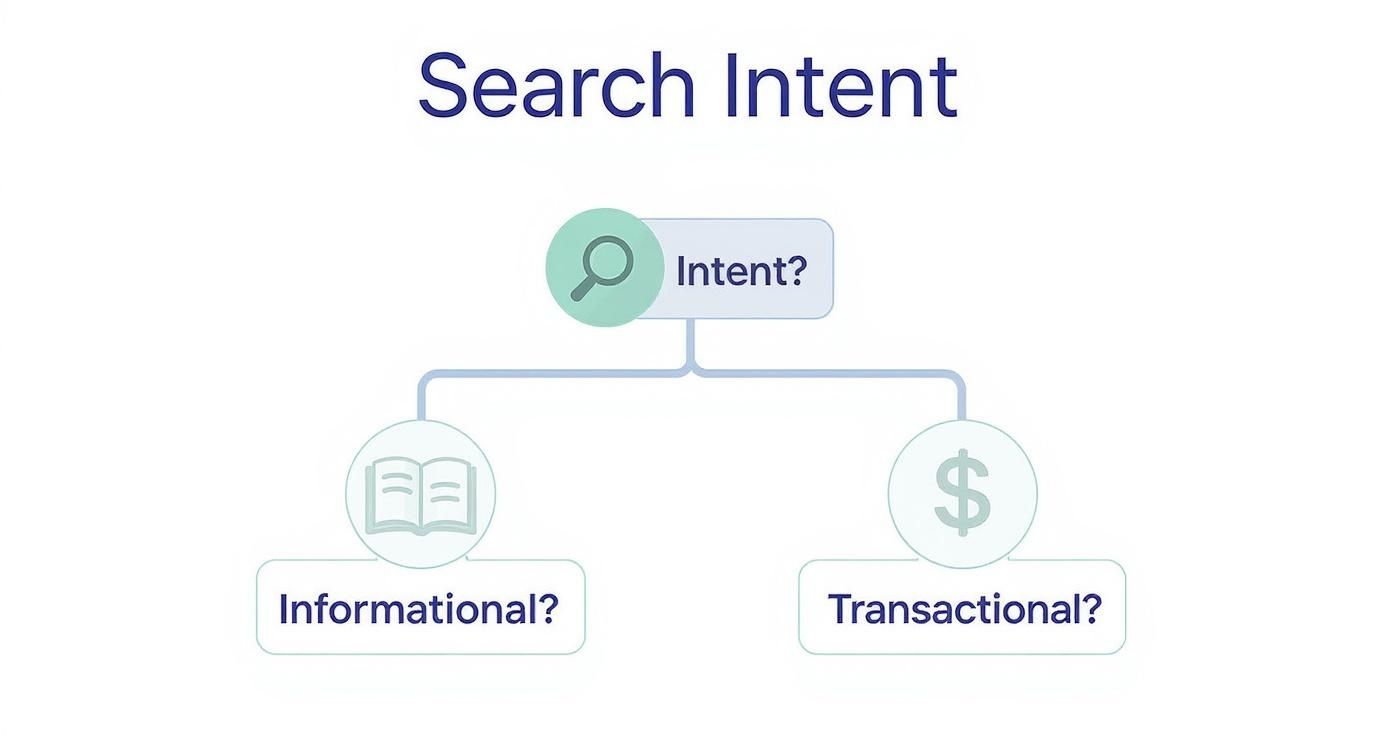
As you can see, your content strategy needs to fork depending on whether someone is seeking knowledge or is ready to make a purchase.
To help you align your content with what users are looking for, here’s a quick-reference table.
Matching Search Intent with Content Format
Use this table to align user search intent with the most effective content format for your SEO-friendly blog post.
| Search Intent Type | Common Keyword Modifiers | Ideal Content Format |
|---|---|---|
| Informational | how to, what is, guide, tips, why | How-to guides, tutorials, listicles, checklists, explainer articles |
| Commercial Investigation | best, top, vs, review, comparison | Product comparisons, in-depth reviews, “best of” lists, case studies |
| Transactional | buy, price, discount, for sale, coupon | Product pages, service pages, pricing pages, direct sales landing pages |
| Navigational | [brand name], [brand name] login | Homepage, About Us page, specific feature pages, login portals |
Mapping your content format directly to the search intent is a simple but powerful way to ensure you’re giving the user exactly what they came for.
Mastering Keyword Research and Analysis
Once you’ve got a handle on intent, it’s time to find the actual words and phrases people are typing into Google. This means finding a main “primary” keyword and a handful of more specific, related terms. Honestly, great keyword research is non-negotiable. If you’re new to this, you can get up to speed quickly with a step-by-step guide to keyword research.
Your goal here is to find that sweet spot: terms with a decent amount of search volume that aren’t impossibly competitive. A smart keyword strategy will include a mix of:
- Primary Keyword: This is the big topic of your article (e.g., “how to write seo friendly blog posts”).
- Long-Tail Keywords: These are longer, more specific phrases. They’re less competitive and often convert better because the intent is so clear (e.g., “seo blog post checklist for beginners”).
- Semantic Keywords (LSI): These are simply related concepts and terms that give Google more context about your content (e.g., “on-page SEO,” “meta description,” “readability”).
For a really deep dive into this crucial first step, you might want to check out our detailed guide on https://raven-seo.com/how-to-do-keyword-research/.
Analyzing Competitor Content for Gaps
The final piece of your pre-writing puzzle is a bit of digital reconnaissance. Look at what’s already ranking on the first page for your target keyword. Don’t just skim these articles—dissect them to understand what makes them successful.
I always ask myself these questions:
- What topics or subheadings do all the top articles cover? (These are table stakes.)
- What questions are they not answering completely?
- Is there a unique angle, perspective, or personal experience I can bring to this?
- How are they using visuals, data, or examples? Can I do it better?
This analysis is how you find “content gaps.” These are your golden opportunities to create something more thorough, more valuable, and more comprehensive than what’s already out there. By identifying and filling these gaps, you’re giving Google a very compelling reason to rank your post higher than the competition.
Alright, you’ve done the heavy lifting—you know your audience and you’ve got your keywords. Now comes the fun part: turning that blueprint into a piece of content that both people and search engines will love.
This is where the real magic happens. It’s about crafting an experience that pulls readers in with a killer headline, hooks them with a relatable intro, and keeps them scrolling with clear, valuable writing. Let’s break down how to nail this balance.

Crafting Headlines That Demand a Click
Think of your headline as your one shot to stand out on a crowded search results page. It has to be more than just a title; it needs to be a powerful magnet, blending your target keyword with a promise the reader can’t ignore. A great headline makes someone feel like your article is the exact answer they’ve been searching for.
To get this right, focus on a few key ingredients:
- Lead with the Keyword: Try to place your main keyword naturally near the beginning of the title. This is a dead-simple, direct signal to Google about what your content is about.
- Sprinkle in Power Words: Words like “Ultimate,” “Proven,” “Step-by-Step,” or “Essential” instantly create a sense of authority and make your content feel more valuable.
- Add Numbers (Especially Odd Ones): There’s a reason you see so many numbered lists. Headlines like “7 Actionable Tips for…” consistently get higher click-through rates than a generic “How to…” headline.
- Keep It Short and Sweet: Aim to keep your title tag under 60 characters. Anything longer gets chopped off in the search results, which weakens its punch.
For example, “Guide to SEO Blog Posts” is okay, but “The Ultimate Guide to Writing SEO Friendly Blog Posts in 2024” is miles better. It’s specific, includes the keyword, and screams comprehensive value.
Writing an Introduction That Hooks the Reader
Once someone clicks, the clock is ticking. You have about three seconds to convince them they’re in the right place. Ditch the fluffy, “in today’s digital world…” intros and get straight to the point.
Acknowledge their problem right away, tell them how you’re going to solve it, and give them a reason to keep reading. This is also a perfect spot to drop your primary keyword again, reinforcing your topic’s relevance for search engines from the get-go.
The best introductions act as a contract with the reader. They promise a specific value—like actionable steps or a clear solution—and the rest of the article must deliver on that promise to build trust and keep them engaged.
Structuring Your Post for Maximum Readability
Let’s be honest: nobody likes reading a giant wall of text. How you structure your content is just as important as the words you use, especially for making it easy to read. Google’s algorithms reward content that delivers a good user experience, and scannability is a huge piece of that puzzle.
Use a clear hierarchy of headings and subheadings (H2s, H3s, etc.) to break up your content. These act like signposts, guiding readers through the article and letting them find exactly what they need.
And please, keep your paragraphs short. I’m talking one to three sentences, max. This creates tons of white space, making the content feel less intimidating and way easier to digest, especially on a phone. A clean structure is a win-win: it’s easier for people to read and for search engine crawlers to understand.
Weaving in Keywords and Building Topical Depth
As you write, your primary keyword should pop up naturally in your headline, intro, a few subheadings, and within the body copy. But modern SEO has moved way beyond just repeating a single phrase over and over. Now, it’s all about showing you have a deep, comprehensive understanding of the topic.
This is where semantically related keywords come into play. These are simply the related concepts and terms that naturally come up when discussing your main topic. If you’re writing about “how to write seo friendly blog posts,” you’d also be talking about:
- On-page SEO
- Meta descriptions
- Readability score
- Internal linking
- Content structure
Sprinkling these terms throughout your article shows Google the full context of your content. It signals that you’re an authority, not just someone skimming the surface. One of the best ways to signal authority is to build real expertise. Our guide on the power of E-E-A-T can help you craft high-quality content that builds that crucial trust.
Speaking of depth, don’t be afraid of length. One analysis found that pages ranking in the top 10 on Google have an average of 1,447 words. This isn’t about adding fluff just to hit a word count; it’s about providing a complete, satisfying answer that fully solves the user’s problem. You can discover more insights about these SEO statistics on searchatlas.com.
Nailing Your On-Page SEO
Even the most brilliant content needs a solid technical foundation to rank. Think of on-page SEO as all the behind-the-scenes work that signals quality and relevance to search engines. It’s how you make sure your amazing blog post actually gets seen.
This process involves fine-tuning several key elements that work together to tell Google exactly what your page is about. From the little snippet people see in the search results to the structure of your links, every optimization plays a part in how both users and algorithms perceive your content.

As Google shows here, search engines are constantly organizing the world’s information to give people the best answers. Your on-page SEO efforts are the signals that help them understand where your content fits in.
Crafting Compelling Meta Titles and Descriptions
Your meta title and description are your first—and maybe only—chance to make an impression on the search results page. They are your sales pitch, the thing that convinces someone to click your link instead of the nine others staring back at them.
A great title tag should be under 60 characters and include your main keyword, preferably toward the beginning. While the meta description isn’t a direct ranking factor, it has a huge impact on your click-through rate. It needs to be a punchy summary of your post (under 160 characters) that includes your keyword and gives people a compelling reason to learn more. For a deeper dive, check out our guide on how to write meta descriptions.
Key Takeaway: Treat your meta title and description like ad copy. Their job isn’t just to describe—it’s to sell the click. A higher click-through rate can signal to Google that your page is a great result, which can help boost your rankings over time.
Creating Clean and Descriptive URL Slugs
The URL slug is the part of the web address that comes after the final slash (like in /seo-blog-post-checklist). A clean, simple URL is just easier for people and search engines to understand. It’s another small clue about what your page is all about.
Here are a few best practices I always follow:
- Keep it short and sweet: Ditch unnecessary words like “a,” “the,” or “is.”
- Include your primary keyword: The slug should be a stripped-down version of your topic.
- Use hyphens to separate words: This is the standard that search engines read best.
For example, a post titled “10 Essential Steps for Writing SEO Friendly Blog Posts” is much better off with a URL like .../write-seo-friendly-blog-posts, not the clunky .../10-essential-steps-for-writing-seo-friendly-blog-posts.
Optimizing Images for Search and Accessibility
Images aren’t just there to make your post look good; they’re valuable SEO assets. Every single image you use should be optimized to improve page speed, make the user experience better, and even give you a chance to rank in Google Images.
First things first, compress your images. Try to get every file under 100kb. This simple step makes a massive difference in how fast your page loads, which is a confirmed ranking factor. Next, give your images descriptive file names before you upload them. Instead of IMG_1234.jpg, use something like on-page-seo-optimizations.jpg.
Finally, always add descriptive Alt Text. This is a short sentence that tells search engines and screen readers what the image shows. It’s also a perfect spot to naturally include your target keyword or a related phrase. For example, a good Alt Text for an image of a checklist would be “A checklist showing the steps for how to write SEO friendly blog posts.” If you’re looking for more specific tactics, resources like these 10 SEO tips for SaaS companies can offer some practical guidance.
Driving Growth with a Post-Publish Promotion Plan
Hitting “publish” isn’t the finish line. Honestly, it’s more like the starting gun. A perfectly written, beautifully optimized blog post is only useful if people actually see it. This is where your post-publish plan comes in—a set of actions designed to give your new content the momentum it needs to attract readers and start climbing the search rankings.
Your job immediately shifts from creator to promoter. This means actively pushing your content out across different channels and then, just as importantly, diving into the data to see what’s actually working. Without this step, even the best content can get lost in the noise.

Jumpstarting Your Content Promotion
Right after you publish, you need to get your article in front of the right eyeballs. Don’t just sit back and wait for Google to find it. You have to give it an initial push to generate that early traffic and social signals, which can hint to search engines that your content is valuable.
Here are a few promotion tactics that are both effective and totally manageable:
- Share on Relevant Social Channels: Post your article where your target audience hangs out. But don’t just copy-paste. Tailor the message for each platform—a professional tone for LinkedIn, a conversational question for X (formerly Twitter), and a visually engaging story for Instagram.
- Notify Your Email List: Your email subscribers are your most engaged audience, hands down. Send them a dedicated email announcing the new post. This not only drives immediate traffic but often sparks those valuable first shares. We have a whole guide on how to cultivate connections and drive growth with your email list if you want to dig deeper.
- Repurpose Key Insights: Turn your blog post into micro-content. Pull out a key statistic for a tweet. Create a simple infographic for Pinterest. Or, record a short video explaining a core concept for TikTok or YouTube Shorts. This extends the life and reach of your original work.
Pro Tip: Don’t just “spray and pray.” Find 2-3 specific communities or forums (like relevant subreddits or industry Slack channels) where you can share your post as a genuinely helpful resource. The key is to add value to the conversation, not just drop a link and run.
Using Data to Measure and Refine Your Strategy
Promotion gets your content out there, but analytics tell you if it’s actually working. Tools like Google Analytics and Google Search Console are non-negotiable for understanding what happens after you publish. They give you the insights you need to measure success and make smarter decisions for future content.
Using data strategically is critical. With Google handling around 8.5 billion searches every single day, the potential for traffic is massive. Yet, so many marketers aren’t using their data effectively. One report found that while 87% of marketers admit analytics are their most underused asset, only about 30% actually let data guide their SEO strategies. You can gain a huge edge just by paying attention to the numbers.
This data-driven approach is how you turn a single blog post into a long-term asset that keeps working for you.
Key Metrics to Track in Google Search Console
Think of Google Search Console (GSC) as your direct line of communication with Google. It tells you exactly how your content is performing in search results.
Here’s what you need to keep a close eye on:
- Impressions: This is how many times your post appeared in a search result. High impressions but low clicks? That might mean your title or meta description isn’t compelling enough.
- Clicks: This one’s simple—the number of times people actually clicked on your post from the search results. This is your raw organic traffic.
- Average Click-Through Rate (CTR): This is your clicks divided by your impressions. A low CTR is a big red flag that your “sales pitch” on the SERP needs some work.
- Average Position: This is your average ranking for specific keywords. Tracking this over time shows whether your content is moving up the ladder or slipping down.
By checking GSC regularly, you can spot which keywords you’re ranking for (sometimes ones you didn’t even target!) and find posts that are performing well but could do even better with a few tweaks. This information is gold for refining your strategy on how to write SEO friendly blog posts in the future.
Your Reusable SEO Blog Post Checklist
If you want to create content that consistently ranks, you can’t just wing it. You need a repeatable process. Following a checklist takes the guesswork out of the equation and makes sure you nail every critical optimization step, every single time. This educational framework helps ensure nothing gets missed.
Think of this as your pre-flight check before you launch a new article. It’s broken down into the key phases of content creation, from the initial strategy all the way through to promoting your post after it’s live.
Phase 1: Pre-Writing and Strategy
This is where you lay the groundwork for a successful post. Get this part right, and the rest of the process becomes infinitely smoother and more effective.
- Identified one primary keyword: You have a single, clear target that perfectly matches your content’s main topic.
- Found 3-5 secondary keywords: You’ve gathered related long-tail terms to build topical depth and context.
- Analyzed user search intent: You know exactly what users are looking for (a how-to guide, a list, a comparison) and you’re ready to deliver.
- Reviewed top 3 competitor articles: You’ve scoped out what’s already ranking and identified content gaps you can exploit.
- Created a detailed content outline: You have a solid structure with H2s and H3s that will guide the reader logically through the topic.
Phase 2: Writing and Formatting
With your plan locked in, it’s time to shift gears to creating compelling, easy-to-read content that satisfies both your audience and the search engine bots.
- Crafted a keyword-focused headline: Your H1 title is punchy, under 60 characters, includes the primary keyword, and begs to be clicked.
- Wrote a hook-driven introduction: Your opening paragraph hits on the reader’s pain point and naturally includes the primary keyword.
- Maintained short paragraphs: No paragraph is longer than three sentences. White space is your friend.
- Used hierarchical headings (H2s, H3s): The content is broken down into logical, scannable sections for easy reading.
- Included visuals with Alt Text: Every image has descriptive, keyword-relevant Alt Text and is compressed for lightning-fast loading.
A great blog post isn’t just well-written; it’s well-architected. The visual structure—headings, short paragraphs, lists, and images—is just as crucial as the words themselves for keeping readers engaged and on the page.
Phase 3: On-Page and Technical SEO
This is where you handle the behind-the-scenes tweaks that signal relevance and quality to search engines, making sure your content is easy for them to find, crawl, and understand.
- Optimized the meta title and description: They are within the character limits, feature the keyword, and act as a compelling “ad” on the search results page.
- Created a clean URL slug: The URL is short, sweet, contains the primary keyword, and is free of fluff.
- Added strategic internal links: You’ve woven in 2-4 relevant internal links to other cornerstone content on your site. Mastering this is crucial, and you can learn more about how internal linking is your website’s secret weapon for SEO and user experience.
- Implemented basic Schema markup: You’ve added Article schema to give search engines better context about what your content is.
Of course, managing all these moving parts is a lot easier with the right toolkit. Different tools serve different purposes, from the initial research to checking in on performance down the road.
Essential SEO Tool Comparison
A good set of tools can make or break your workflow. Here’s a quick breakdown of some popular options that help you through the various stages of writing an SEO-friendly blog post.
| Tool Category | Free Option Example | Paid Option Example | Primary Use Case |
|---|---|---|---|
| Keyword Research | Google Keyword Planner | Ahrefs / Semrush | Finding keywords, analyzing competition, and understanding search volume. |
| Content Optimization | Hemingway Editor | Clearscope / Surfer SEO | Improving readability and ensuring comprehensive topic coverage. |
| Performance Tracking | Google Search Console | Moz Pro | Monitoring keyword rankings, organic traffic, and technical issues. |
| Image Optimization | TinyPNG | Adobe Photoshop | Compressing image files to improve page load speed. |
Having a mix of these tools at your disposal will give you the data and insights you need to consistently create top-performing content.
Phase 4: Post-Publish and Promotion
Hitting “publish” isn’t the finish line. The work you do immediately after your article goes live gives it the initial push it needs to start gaining traction.
- Submitted URL to Google Search Console: You’ve asked Google to index the new page to speed up the discovery process.
- Shared on 2-3 key social media channels: The post has been shared with custom-tailored messaging for each platform’s audience.
- Sent to your email subscriber list: Your most engaged fans have been notified that there’s fresh content waiting for them.
- Set a reminder to check analytics in 30 days: You have a plan to circle back, review performance, and identify opportunities for updates or improvements.
Quick Answers to Common SEO Blog Post Questions
Even with a solid plan, a few questions always seem to pop up when you’re getting into the rhythm of writing for SEO. Let’s clear up some of the most common ones so you can keep moving forward with confidence.
How Often Should I Refresh My Old Blog Posts?
This is a great question. A good rule of thumb is to audit your most important, traffic-driving posts at least once a year. For content in fast-moving industries like marketing or tech, you might need to bump that up to every six months.
But this isn’t just about changing the publication date and calling it a day. When you revisit a post, you’re looking for opportunities to make it genuinely better.
- Can you add new data, insights, or examples?
- Are there any statistics or product mentions that are now outdated?
- Can you link out to newer articles you’ve published on the topic?
- Could the images use a refresh, or could you embed a helpful video?
These kinds of meaningful updates show Google your content is still the most valuable, up-to-date resource on the topic, which can help protect—and even boost—its rankings.
What’s the Real Difference Between a Keyword and a Topic?
It’s easy to get these two mixed up, but understanding the difference is key to a modern, effective SEO strategy.
Think of it this way: a keyword is the specific query someone types into Google, like “best running shoes for flat feet.” It’s the literal search term.
A topic, on the other hand, is the broader subject that keyword belongs to. In this case, the topic could be “running shoe technology” or “foot support for athletes.”
Here’s the crucial shift in thinking: Stop chasing single keywords. Your goal should be to build topical authority. When you create a whole cluster of articles covering a topic from every important angle, you’re signaling to Google that you’re an expert. That makes it easier for all of your related posts to rank.
Honestly, How Long Does It Take for a New Post to Rank?
Ah, the million-dollar question. In SEO, patience isn’t just a virtue; it’s a requirement. While there’s no magic number, you can generally expect a new blog post to take anywhere from three to six months to start gaining real traction for its target keywords. Sometimes it’s faster, but often, it takes even longer.
This timeline isn’t random. It’s influenced by a few key factors:
- Your Website’s Authority: A well-established site with a strong history and lots of quality backlinks will see results much faster than a brand-new blog.
- The Keyword’s Difficulty: It’s going to take a lot more time and effort to rank for a super competitive term than it will for a less competitive, long-tail keyword.
- Your Content and Promotion: A truly outstanding piece of content that you promote effectively will naturally climb the ranks faster than something that’s just “good enough.”
The most important thing is consistency. Keep publishing high-quality, helpful content, and the results will come. Don’t get discouraged if you don’t see a traffic spike overnight. SEO is a long-term investment, and it pays off for those who stick with it.
Ready to stop guessing and start ranking? The team at Raven SEO specializes in creating data-informed SEO strategies that drive real business growth. Whether you need help with keyword research, content creation, or a full-service digital marketing plan, we’re here to help you get found online. Schedule your no-obligation consultation today at https://raven-seo.com.