


So, how do you tell the difference between genuinely helpful, human-led content and the endless stream of AI-generated “fluff”? It really comes down to looking for a unique perspective, an authentic voice, and verifiable experience. These are the qualities that algorithms still can’t fake, making them the clearest signals of human authorship.
The Growing Challenge of AI Content Fluff
In a world overflowing with information, the line between real insight and automated filler has become dangerously thin. The rise of sophisticated AI tools means anyone can mass-produce content that looks plausible but often lacks any real substance or originality. This low-quality, repetitive material is what many are now calling AI fluff or “AI slop.”
For marketers and business owners, leaning on this kind of content is a huge risk. It doesn’t just fail to connect with your audience; it can actively harm your brand’s credibility. In fact, a recent report found that over 82% of Americans can spot AI-generated content, and finding it often lowers their opinion of the brand.

Why Spotting AI Fluff Is Harder Than You Think
Telling human and machine-written text apart isn’t always easy. A groundbreaking study from the Communications of the ACM revealed that people detect AI-generated content with just a 51% accuracy rate—basically a coin toss. This stat alone highlights the urgent need for a smarter, more strategic way to audit content.
This challenge only gets bigger as AI models become more advanced. Knowing what to look for is the first step in protecting your brand and making sure your content actually delivers value. The evolution of models like Google Gemini is a clear signal that search engines are doubling down on rewarding nuanced, truly helpful content. You can prepare your SEO strategy for the future of search to stay ahead of the curve.
Human Insight vs. AI Fluff at a Glance
Before diving into a full audit, it helps to have a simple framework. The table below offers a quick comparison of the defining traits that separate genuinely human content from the kind of filler that AI often produces. Think of it as your initial gut check.
| Characteristic | Human-Led Content (High Value) | AI-Generated Fluff (Low Value) |
|---|---|---|
| Perspective | Offers a unique point of view, personal anecdotes, or original analysis. | Regurgitates commonly known facts and generic information. |
| Tone & Voice | Has a distinct, consistent, and authentic brand voice that builds connection. | Sounds robotic, overly formal, or inconsistent from one paragraph to the next. |
| Experience | Demonstrates real-world experience, case studies, and practical examples. | Lacks specific details, verifiable claims, or evidence of hands-on knowledge. |
| Structure | Features a logical narrative flow with clear transitions and a compelling argument. | Often contains repetitive sentence structures and disjointed ideas. |
| Accuracy | Cites credible sources, includes proprietary data, and is factually sound. | May contain subtle inaccuracies, outdated information, or “AI hallucinations.” |
This table provides a high-level overview, but it’s a great starting point for training your eye to spot the difference between content that connects and content that just fills a page.
Spotting the Telltale Signs: Stylistic and Semantic Red Flags
The first real step in separating human-driven content from AI-generated fluff is training your eye to catch the subtle linguistic giveaways. While AI has gotten scarily good at mimicking human writing, it often leaves a trail of stylistic and semantic breadcrumbs. These are the red flags that tell you a machine, not a person with actual experience, is doing the talking.
Think of yourself as a content detective. You’re not hunting for a single smoking gun but rather a pattern of oddities and inconsistencies. When you see enough of them together, they point to a distinct lack of a human touch. The content might be grammatically flawless, but it just feels… hollow. It’s missing the natural rhythm and personality that defines authentic writing.
The stakes are higher than you might think. A global study from Bynder found that while people appreciate AI for its speed, a massive 52% will bounce from content they even suspect is AI-generated. That’s a huge risk to your conversions. The tricky part? The same study found that only about 50% of people can reliably spot AI copy, which means a lot of brands are probably damaging their credibility without even realizing it.
Unnatural Language and a Robotic Tone
One of the most common signs of AI fluff is an overly formal, almost robotic tone. The writing often reads like a textbook—technically correct but completely drained of personality. You’ll see complex words where simple ones would have worked better and sentences constructed with a predictable, uniform precision.
Real writers, on the other hand, have a natural cadence. They mix up sentence lengths, use contractions, and sometimes bend the rules of grammar for effect. The result is a far more conversational and engaging read.
Here are a few specific tonal red flags to keep an eye out for:
- Zero Enthusiasm: The content describes a topic without a hint of passion, curiosity, or a unique point of view. It’s just facts, presented without any excitement or useful context.
- Constant Hedging: AI models love non-committal phrases like “it can be said,” “it is often considered,” or “one might argue.” Humans with genuine expertise tend to make more direct, confident statements.
- A Shifting Voice: The tone might change awkwardly from one paragraph to the next. This is a classic side effect of stitching together content from different AI prompts without a heavy editing hand.
Pro Tip: Read the content out loud. If it sounds stiff, unnatural, or like something a robot would say in a cheesy sci-fi movie, that’s a huge signal it needs a human rewrite. Authentic writing has a rhythm you can feel when you speak it.
Repetitive Structures and Recycled Phrases
Another dead giveaway is repetition. AI models, especially older or less sophisticated ones, tend to lean on the same sentence structures and transitional phrases again and again. You might see paragraph after paragraph kicking off with “Additionally,” “Furthermore,” or the dreaded “In conclusion.”
This isn’t just about the words, though. The repetition can also show up in the structure of the ideas. An AI-generated article might list three benefits of something, with each paragraph following the exact same formula: topic sentence, a short explanation, and a concluding thought. Humans tend to weave their ideas together more organically.
This kind of structural monotony makes for an incredibly boring read. For a deeper dive, you can learn more about readability and using lists to create engaging content right here on our blog.
Vague Claims and Missing Details
Finally, you need to scrutinize the content for specificity. Human-led content is almost always rich with details, anecdotes, and real-world examples that prove the author knows their stuff. AI fluff, in contrast, is typically filled with vague, generic statements that sound plausible but offer zero real substance.
A particularly nasty problem with AI content is fabrication. A clear understanding AI hallucination is critical for anyone auditing content for authenticity. This is when the AI confidently states something as fact that is either completely wrong or entirely made up.
As you read, ask yourself these questions:
- Does this piece include any specific data, statistics, or case studies?
- Are there personal stories or anecdotes that show firsthand experience?
- Are the claims backed up by credible sources, or are they just presented as fact?
If the content dodges specifics and leans on broad generalizations, it’s a classic sign of low-value AI fluff. True expertise always shines through in the details—and that’s something AI still struggles to fake.
Putting a Content Authenticity Audit into Practice
Knowing the red flags of AI content is one thing. Actually putting that knowledge to work is something else entirely. It’s time to move from theory to a hands-on playbook for auditing any piece of content to see if it has real human authorship and substantive value.
This isn’t about plugging text into a tool and blindly accepting its score. It’s a manual review process that hinges on critical thinking and a healthy dose of skepticism. The whole point is to ask the right questions. Does the content tell a logical, compelling story, or does it feel like a random collection of facts? Are the claims specific and backed by evidence, or are they just vague, feel-good statements?
A structured approach is the only reliable way to tell human-led insight apart from AI-generated fluff. Here’s a simple three-step flow to guide your manual analysis.
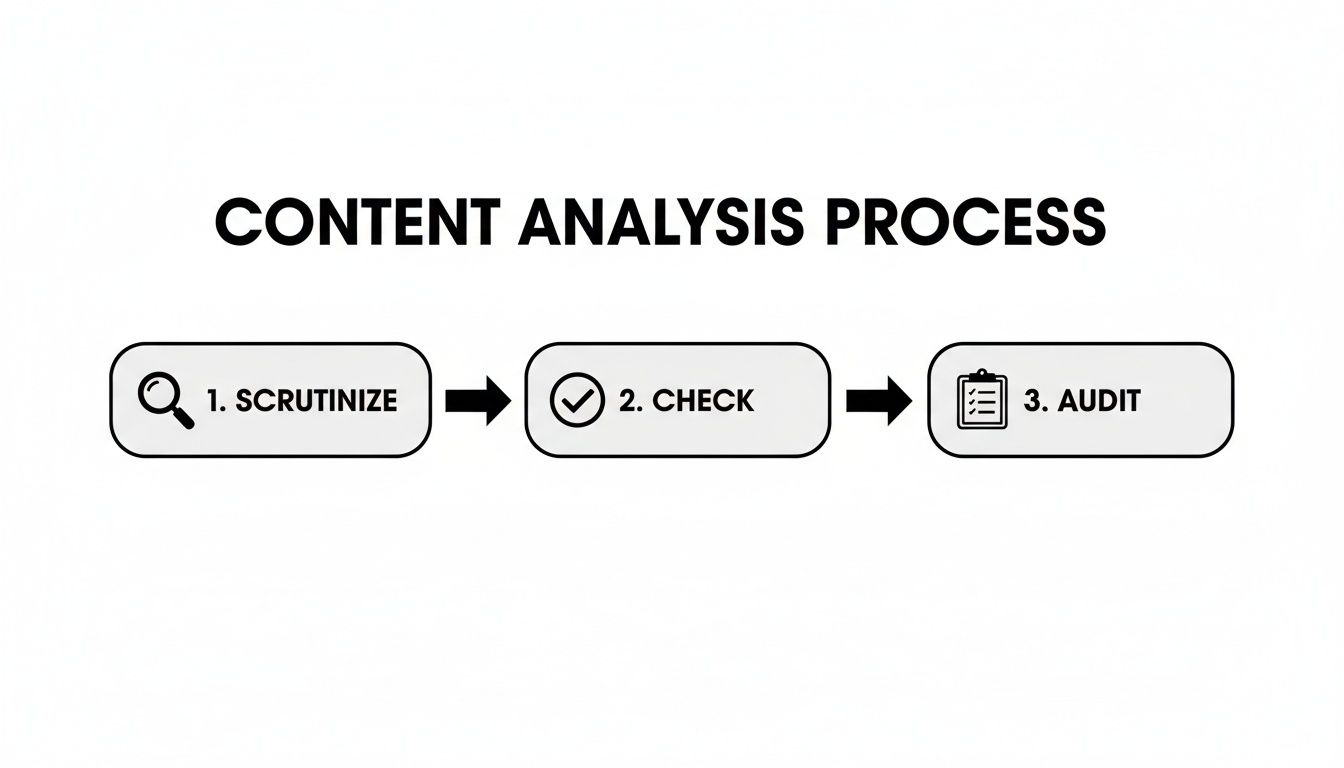
This process puts the human reviewer back in the driver’s seat, where careful scrutiny and verification lead to a final audit decision you can stand behind.
Fact-Checking and Source Verification
The first practical step in your audit is to become a relentless fact-checker. AI-generated content often presents information with an air of authority, but a quick check can reveal that the so-called “facts” are outdated, misinterpreted, or just plain wrong.
Start by pulling out the key claims made in the article. Look for specific numbers, stats, or big declarative statements. Then, fire up your search engine and try to verify them against reputable sources. If an article about marketing trends cites a statistic, can you find the original study it came from? More importantly, does that study actually say what the article claims it does?
A few things to watch for:
- Check the Dates: AI models often pull from older data. A huge red flag is when content presents information from two or three years ago as if it just happened.
- Question Vague Attributions: Be very wary of phrases like “studies show” or “experts say” without a single link or citation. Real, authentic content is proud to show its sources.
- Look for Contradictions: Sometimes, AI content will contradict itself within the same article. That’s a dead giveaway of sloppy, automated assembly.
Evaluating Through the E-E-A-T Lens
Google’s E-E-A-T (Experience, Expertise, Authoritativeness, Trustworthiness) framework is more than just an SEO buzzword; it’s a brilliant lens for your authenticity audit. It’s a gut check to see if the content shows real-world knowledge or just rehashes what’s already on page one of Google.
A human writer with firsthand experience will drop in details, anecdotes, and nuances that an AI simply cannot invent. Think about it: an article about fixing a leaky faucet written by an actual plumber will have specific tips and warnings that a generic AI article would never include. Expertise isn’t just about what is said, but how it’s said.
The “Experience” signal is your secret weapon for spotting AI fluff. An AI can summarize expertise from a million articles, but it can’t fake lived experience. Ask yourself: “Could any random person with access to Google have written this, or does it feel like it came from someone who has actually been there and done that?”
This is exactly why you can’t rely on detection tools alone. An NIH-backed study found that humans are pretty bad at spotting AI text, with just 19% accuracy. And while detectors do better, they’re far from perfect—sometimes misreading up to 92.5% of pure AI text as human-written. This just drives home the need for a manual review focused on E-E-A-T.
Your Practical Authenticity Checklist
To make this process less subjective, use a checklist. It helps turn a gut feeling into a more objective evaluation. For every piece of content you review, run through these questions and give a simple “yes” or “no.”
- Does the author have a verifiable identity and credentials? Look for an author bio with links to a LinkedIn profile or other publications. An anonymous or generic byline is a major warning sign.
- Does the content include unique data or original insights? This could be proprietary research, a customer case study, or just a fresh take on existing data.
- Are there specific, real-world examples or anecdotes? Vague, generic examples scream “I’ve never actually done this.”
- Is the tone consistent and on-brand? A choppy or inconsistent tone can mean the piece was stitched together from multiple AI prompts.
- Are the sources cited credible and relevant? Check the links. Do they go to authoritative domains, or just other generic blogs?
- Does the article have a clear, logical flow? Or does it jump between topics with jarring transitions?
Using a checklist like this helps you make a confident call. If a piece of content fails on multiple points, it’s likely AI fluff that needs a major human overhaul—or to be scrapped entirely. This is more important than ever, especially with algorithm updates like Google’s June 2024 Spam Update actively targeting low-value content.
Using AI Detection Tools to Guide Your Judgment
While your own eyes and intuition are the gold standard for sniffing out AI fluff, the right technology can be a huge help. Think of it as a second set of eyes, flagging potential issues you might have otherwise missed. Weaving AI content detectors and plagiarism checkers into your workflow gives you a solid first pass, letting you audit content much more efficiently.
But here’s the crucial part: you have to approach these tools with the right mindset. Their scores should never be the final verdict on a piece of content. Instead, see them for what they are—a signal. They’re simply a reason to roll up your sleeves and dig deeper with your own human judgment.
Interpreting AI Detector Probability Scores
When you plug some text into an AI detector, it’ll spit back a “probability score”—something like “98% likely to be AI-generated” or “20% human-written.” These numbers are incredibly misleading if you take them as gospel. They aren’t a statement of fact. They’re a statistical likelihood based on the patterns the tool was trained to find.
False positives are a very real problem. I’ve seen human writers who just happen to have a very structured, formal style get flagged with a high AI score. On the flip side, a heavily edited AI draft can sometimes skate by with a high “human” score.
The best way to use a high AI score is as an invitation for a closer manual review, not as a reason for immediate rejection. All it’s really telling you is, “Hey, this piece has some of the predictable patterns of AI writing. You should probably scrutinize it more carefully for the red flags we’ve already discussed.”
This perspective turns the tool from a judge into a helpful assistant that just helps you prioritize what to look at first.
Strengths and Weaknesses of Detection Tools
Knowing what these tools are good at—and where they completely fall short—is the key to using them effectively. They can be a powerful ally in the process of separating human-led content from AI-generated fluff.
What They’re Good At:
- Pattern Recognition: They are excellent at spotting the monotonous sentence structures, predictable phrasing, and other linguistic quirks common in machine-generated text.
- Speed and Scale: A detector can zip through a 2,000-word article in seconds, making it a super-efficient way to get an initial read on a large volume of content.
- Plagiarism Flagging: Many of these tools also check for plagiarism, which is vital for catching content that’s been lifted directly from other websites.
Where They Falter:
- Lack of Nuance: They have zero ability to assess the quality of the ideas, the authenticity of the voice, or whether there’s any real experience behind the words (E-E-A-T).
- Easily Fooled: The more sophisticated AI models, especially when paired with heavy human editing, can often produce text that flies right under the radar.
- False Positives: As I mentioned, they can incorrectly flag human-written content, especially if it’s very formal or follows a rigid structure.
On top of that, the methods for effective AI content analysis are constantly changing, which means our own methods for judging content need to keep evolving, too.
Beyond Detectors: Using Search to Uncover Originality
Here’s a powerful technique that works beautifully alongside AI detectors: using advanced search operators to check for originality yourself. This manual check can often uncover scraped or spun content that automated tools might miss.
It’s a surprisingly simple but effective tactic.
Just take a unique-sounding sentence or phrase from the article—something that isn’t a common saying—and pop it into a Google search surrounded by quotation marks.
For example, searching for “the symbiotic relationship between keyword density and user intent” will show you if that exact phrase appears anywhere else online. If you get a bunch of exact matches from other blogs, that’s a massive red flag. It’s a dead giveaway that the content is either unoriginal, spun from a common source, or part of a mass-produced campaign.
This simple check is a perfect example of using technology to augment your expertise, not replace it.
From AI Fluff to High-Performing Content
So you’ve found some AI-generated fluff on your website. Don’t hit delete just yet. Instead of seeing it as a problem, think of it as a rough draft—a lump of clay waiting to be shaped. The real opportunity here is to transform that generic base into a high-performing asset that actually connects with readers and climbs the search rankings.
This is all about injecting the very things AI can’t replicate: personality, firsthand insights, and your authentic brand voice. By layering human experience and creativity over an AI-generated foundation, you can scale up content production without sacrificing the quality that builds real trust and authority. This hybrid approach is how you win at content today.

A Workflow for Enriching AI Drafts
Treating an AI draft as a final product is where so many brands go wrong. A structured enrichment workflow is your quality control, ensuring every piece of content is genuinely valuable before it ever goes live. It’s how you turn a generic article into something that truly stands out.
Here’s a practical workflow to humanize your AI-assisted content:
- Inject Your Brand Voice: Start by rewriting key sections to sound like you. Are you authoritative and professional, or casual and conversational? An AI draft is a blank slate; it’s your job to give it a personality that resonates with your audience.
- Add Original Insights: This is the most crucial step. What unique perspective can you bring to the table? Do you have proprietary data, a compelling customer story, or a contrarian opinion that challenges the status quo? This is what separates thought leadership from recycled information.
- Strengthen with Specifics: Go through and replace every vague statement with concrete examples, personal anecdotes, or real-world case studies. Instead of saying “good communication is important,” share a specific story about how a communication breakdown created a real problem and how you solved it.
- Refine the Narrative Flow: Read the piece out loud. Does it have a clear beginning, middle, and end? Make sure your transitions are smooth and that the core argument builds logically from one point to the next.
This hands-on editing is how you build authority. For a deeper dive, check out our guide on the power of E-E-A-T in crafting high-quality content that both users and search engines love.
Actionable Editing Techniques to Humanize Text
Beyond the high-level workflow, a few specific editing tactics can instantly elevate AI-generated text. These small changes add up fast, creating a much more engaging and trustworthy piece of content.
- Rewrite Passive Sentences: AI models love the passive voice (“The ball was thrown by him”). Flip these sentences to the active voice (“He threw the ball”). It makes your writing more direct, confident, and much easier to read.
- Vary Sentence Structure: AI often produces paragraphs where every sentence is the same length, which is incredibly monotonous. Break this up by mixing short, punchy statements with longer, more descriptive ones to create a natural rhythm.
- Incorporate Quotes and Testimonials: Add quotes from industry experts, your company’s leaders, or satisfied customers. This not only adds a ton of credibility but also introduces different voices and perspectives into the article.
Key Takeaway: The goal isn’t just to fix errors. It’s to infuse the content with a human soul. Your final piece should feel like it was written by someone who has lived and breathed the topic, not just summarized it.
ROI Analysis: Editing AI Drafts vs. Writing From Scratch
For many of us, the choice isn’t between using AI and not using it; it’s about how to use it effectively. Deciding whether to elevate an AI draft or write from scratch often comes down to a simple return on investment analysis.
The hybrid approach strikes a compelling balance. A 2023 HubSpot study found that while purely AI-generated articles had 35% lower engagement than human-led content, an AI-assisted workflow could boost efficiency by 20%. This tells us the sweet spot is using AI for the grunt work and saving your human talent for the high-value finishing touches.
Here’s a look at how the two approaches stack up.
ROI Analysis: Editing AI Drafts vs. Writing From Scratch
| Factor | Editing AI Drafts (Hybrid Approach) | Writing From Scratch (Human-Only) |
|---|---|---|
| Time Investment | Moderate. Faster initial draft, but still requires significant time for editing and enrichment. | High. Demands extensive time for research, outlining, writing, and editing from zero. |
| Cost | Lower. Reduces the hours needed for initial research and writing, lowering overall project cost. | Higher. The entire process relies on skilled (and more expensive) human hours. |
| Scalability | High. Allows teams to produce a larger volume of high-quality content much more quickly. | Low. Production volume is completely limited by the capacity of your human writers. |
| SEO Potential | High, if done correctly. Quality, originality, and E-E-A-T are layered in during the human edit. | High, assuming the writer is skilled and creates a valuable, well-optimized piece. |
| Authenticity | Depends entirely on the quality of the human editing and enrichment phase. | Inherently high, as it originates directly from a human perspective and voice. |
Ultimately, transforming AI fluff is about smart resource allocation. By letting AI handle the initial groundwork, your team can focus its creative energy where it truly matters: adding the unique insights and authentic voice that no machine can replicate.
Frequently Asked Questions
As AI’s role in content keeps evolving, it’s only natural to have a few questions. Here are some straight-talking answers to the queries we hear most often from marketers and business owners trying to navigate this new terrain.
Can Google Detect AI Content and Will My Site Be Penalized?
The short answer is, it’s complicated. Google’s real concern isn’t who or what created the content—it’s whether the content is helpful and high-quality. Their official line is that they reward valuable content, period, whether it was made by a human, AI, or a mix of both.
Where you run into trouble is using AI to churn out low-quality fluff at scale just to manipulate search rankings. That kind of spammy approach is a direct violation of Google’s policies on scaled content abuse, and it will get penalized. The key is to use AI as a tool to assist a human expert, not as a shortcut to flood the internet with generic articles.
Are AI Content Detection Tools Ever 100% Reliable?
Absolutely not. We can’t stress this enough: AI content detectors are not 100% reliable and should never be the final judge. We’ve seen countless studies (and our own tests confirm) that these tools produce both false positives (flagging human work as AI) and false negatives (missing obvious AI text).
Think of these tools as an initial screening process. A high AI score is just a signal that a piece needs a much closer look from a human editor. The final call must always come from a skilled person who can properly evaluate the content’s quality, nuance, and genuine value to a reader.
What Is the Best Way to Use AI for Content Creation?
The smartest, most sustainable approach is a hybrid model. Let AI do the heavy lifting on supportive tasks like brainstorming topics, drafting initial outlines, or summarizing dense research. But once that foundation is laid, a human expert must take the driver’s seat.
Your expert needs to edit heavily for accuracy, inject your unique brand voice, weave in personal stories or original data, and make sure the final piece offers a perspective that can’t be found anywhere else.
Think of AI as your research assistant, not the final author. That mindset ensures you preserve the authenticity and quality that builds real trust with your audience and search engines.
To see how this applies to the latest search technologies, take a look at our guide on SEO for generative AI search for more strategies.
How Can I Train My Team to Spot AI Fluff?
Getting your team to tell the difference between quality content and generic AI fluff isn’t just about sending a memo. It takes a mix of clear standards and hands-on practice.
- Build a Strong Style Guide: Start with a detailed guide that nails down your brand’s unique voice, tone, and point of view. This becomes the gold standard that every piece of content is measured against.
- Hold Side-by-Side Workshops: Run training sessions where you review great human-written articles right next to generic AI examples. Point out the specific differences in detail, rhythm, and tone.
- Create a Red-Flag Checklist: Give your team a simple checklist of common AI tells, like repetitive sentence structures, a strangely formal tone, or a total lack of concrete examples.
- Run Hands-On Audits: Have team members audit existing content and present what they find. Talking through real-world examples is the absolute fastest way to build this critical skill.
With consistent practice and clear benchmarks, you can empower your whole team to become sharp, effective content auditors.
At Raven SEO, we help businesses rise above the noise with content strategies built on authenticity and real performance. If you’re ready to create content that builds trust and gets results, we’re here to build a practical roadmap for your success.