

Want to create social media content that actually gets noticed? Before you even think about captions or hashtags, you need a rock-solid foundation. This is the strategic groundwork that separates brands that make an impact from those just adding to the digital noise.
Your Foundation for Scroll-Stopping Content
Too many businesses jump straight into posting, hoping for the best. That’s a recipe for inconsistent messaging, wasted time, and results that fall flat. This section is your blueprint for doing it right.
We're moving past the guesswork. It's time to build a strategy that turns your social media from a daily chore into a real growth engine for your business.
Understand Who You're Talking To
The secret to creating content that people love? Knowing exactly who you're talking to. Generic content that tries to appeal to everyone ends up appealing to no one. To make posts that truly connect, you have to get inside your audience's head and understand their problems, what drives them, and even what their day looks like.
For a local business, this means getting granular. If you run a café in Baltimore's Fells Point, your audience isn't just "coffee drinkers." It’s a mix of remote workers needing a quiet corner with Wi-Fi, tourists looking for an authentic local treat, and neighborhood regulars grabbing their morning brew. Each one wants something different from you.
- Dig into your current customers: Who are the regulars? What do they talk about? What keeps them coming back? These are your best source of intel.
- Use your platform analytics: Instagram and Facebook offer a treasure trove of demographic data about your followers—age, gender, location, and when they’re most active online.
- Listen to the community: What questions pop up in local Facebook groups or on community forums? What problems are people trying to solve that your business is perfectly positioned to help with?
By creating detailed customer personas, you can craft messages that speak directly to their needs. A post for the remote worker might highlight your blazing-fast Wi-Fi and ample outlets, while one for the tourist could feature your handcrafted, locally sourced pastries.
Set Meaningful Social Media Goals
Engaging content is great, but it always needs to serve a business purpose. "Getting more likes" isn't a business goal; it's a vanity metric that doesn't pay the bills. Your objectives need to be specific, measurable, and tied directly to your company's bottom line.
A contractor in Silver Spring might set a goal to generate 10 qualified leads per month through their Facebook page. A boutique in Frederick, on the other hand, could aim to increase online sales from Instagram by 15% this quarter. For a deeper dive into setting these kinds of objectives, check out our guide on the basics of social media marketing.
Clear goals bring focus to your content. If your goal is lead generation, you'll want to create more client testimonials and posts that send people to a "Request a Quote" page. If it's brand awareness, you might focus on fun, shareable, behind-the-scenes content. To really get this right, understanding the principles of how to create engaging social media content is non-negotiable.
Establish Your Core Content Pillars
Once you know your audience and what you want to achieve, it's time to define your content pillars. Think of these as the 3-5 core themes or topics your brand will own. They are your North Star, ensuring every single post feels on-brand, relevant, and reinforces what makes you special.
Content pillars are the cure for the "what should I post today?" scramble. They keep your feed from feeling random and chaotic. For a real estate agent in Annapolis, these pillars might look like this:
- Local Market Insights: Posts breaking down housing trends, neighborhood guides, and investment opportunities in the area.
- Homeowner Tips: Valuable content like home maintenance advice, DIY staging ideas, or renovation inspiration that helps people, whether they're buying or not.
- Client Success Stories: Testimonials and posts celebrating happy clients at their new homes to build trust and social proof.
- Community Spotlight: Highlighting local events, businesses, and the Annapolis lifestyle to showcase true local expertise.
This framework gives you a repeatable system. You can plan to create one post for each pillar every week, giving your audience a balanced mix of promotional, educational, and community-focused content that keeps them hooked and coming back for more.
Focus Your Firepower: Choosing the Right Platforms and Formats
You've defined your audience, goals, and content pillars. Now comes the critical decision: where and what do you actually post? Spreading your team thin across every social media platform is one of the most common ways small businesses drain their marketing budget for little to no return.
The key isn't to be everywhere; it's to be where it counts. You need to focus your energy on the platforms your Maryland audience genuinely uses and create the content formats they love to consume.
Not all platforms are created equal, especially when you're a local business. A visual-first platform like Instagram is a goldmine for a restaurant in Ocean City showing off its fresh seafood, while a community-oriented platform like Facebook might be the perfect fit for a service business in Towson sharing client success stories. The goal is to show up where your customers already are.
This is where your strategy's foundation comes into play.
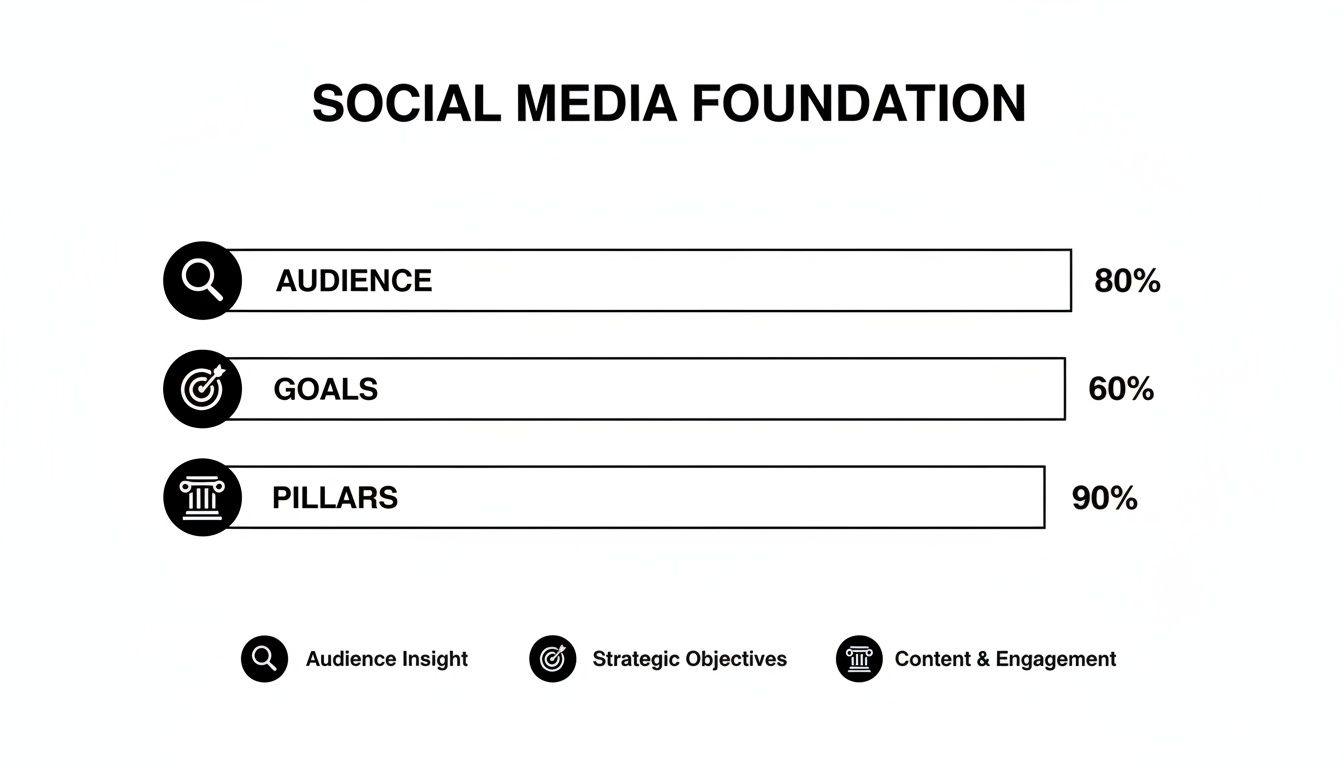
As you can see, a deep understanding of your audience and clear content pillars are the most crucial parts of your strategy. They’re the bedrock for every choice you make about platforms and formats.
Prioritizing Platforms for Your Maryland Business
Where does your ideal customer hang out online? A Gen Z crowd in College Park is probably scrolling through TikTok and Instagram, while established homeowners in Bethesda might be more active in niche Facebook Groups. Don't guess. Use the audience research you’ve already done to make an informed decision.
A great place to start is with a quick social media audit to get a baseline of where you are now and what's already working (or isn't).
The best approach is to master one or two primary platforms where your audience is most concentrated. It's far more effective to build a strong, engaged community on Facebook and Instagram than to have a weak, sporadic presence on five different networks.
Once you’ve picked your core platforms, it's time to zero in on the content formats that will stop the scroll and bring your brand's story to life.
Embracing High-Impact Content Formats
The days of just posting a single photo with a quick caption are long gone. Today's algorithms—and audiences—reward dynamic, value-packed content. And right now, the undisputed champion of engagement is short-form video.
The data doesn't lie. Video consistently crushes other formats across the board. On a platform like Threads, for example, video posts see a median engagement rate of 5.55%. That's significantly higher than the 4.55% for images and just 2.79% for text-only posts.
This trend holds true everywhere. On Instagram, Reels and carousels can drive 44% more interactions than a single static image. Meanwhile, a Facebook Live video often pulls in four times the engagement of a standard link post. The message is clear: if you’re not creating dynamic content, you’re leaving engagement on the table.
The table below breaks down which formats are winning on today's most important platforms.
Content Format Performance by Platform
| Platform | Top Performing Format | Average Engagement Uplift vs. Standard Post | Best For |
|---|---|---|---|
| Reels | ~44% | Behind-the-scenes content, tutorials, trend participation | |
| Live Video | ~300% | Q&As, event coverage, major announcements, community building | |
| TikTok | Short-Form Video | ~35% | Authentic, trend-driven content, educational "how-to" clips |
| Carousels (PDFs) | ~55% | Sharing industry insights, case studies, step-by-step guides | |
| Threads | Video Posts | ~25% | Quick updates, real-time thoughts, community engagement |
This data shows a clear pattern: interactive and video-centric content consistently outperforms static posts. By aligning your creation efforts with these top-performing formats, you significantly increase the odds that your message will not only be seen but also acted upon.
Here are the formats you should be focusing on:
Short-Form Video (Reels, TikToks, Shorts): This is non-negotiable in today's market. And it's not just about dancing. A contractor in Bethesda could film a killer time-lapse of a kitchen remodel. A coffee shop in Canton can get hundreds of views just by showing the perfect latte "pour shot." These quick, authentic glimpses are what stop the scroll.
Carousel Posts: Think of carousels as mini-guides or storytelling powerhouses. Use them to break down a process, showcase a "before and after" transformation, or share a list of tips. For instance, a home organizer in Dundalk could create a carousel titled "5 Steps to a Clutter-Free Pantry," with each slide offering one tangible piece of advice.
User-Generated Content (UGC): Why not let your happiest customers do your marketing for you? A local brewery in Frederick can reshare photos from patrons enjoying a flight in the taproom (always give credit!). This is authentic social proof, and it builds trust more effectively than any polished ad ever could.
Interactive Stories (Polls, Q&As, Quizzes): Use your Instagram or Facebook Stories to spark a conversation. A real estate agent could run a simple poll asking, "Which of these Annapolis waterfront homes is your dream house?" It’s a low-effort way for users to engage, and it gives you valuable feedback while boosting your post's visibility in the algorithm.
By strategically aligning your chosen platforms with these high-performing formats, you create a focused, powerful content engine. This ensures every single post has a clear purpose and the best possible chance of resonating with your local Maryland audience—turning passive scrollers into engaged followers and, ultimately, loyal customers.
Crafting Posts That Capture and Convert
A killer visual might stop the scroll, but it's the words you write that turn a casual viewer into a loyal customer. Your caption, hook, and call to action are where the real work happens—it's how you build a connection, spark a conversation, and ultimately, drive results for your business.
Think of this as your guide to writing social media copy that actually works. We're moving past the generic advice to give you the specific formulas and frameworks you need to make your posts impossible to ignore.

Writing Hooks That Stop the Scroll
You have maybe three seconds to earn someone's attention on social media. That first line of your caption—the hook—is your single most important piece of copy. If it doesn't immediately grab them, they're gone.
Forget boring, fluffy introductions. A great hook needs to be sharp, spark curiosity, or touch on a pain point your audience feels right now.
Here are a few proven formulas for writing irresistible hooks:
- Ask a provocative question: "Are you making this common mistake with your Maryland garden?"
- Make a bold, contrary statement: "Why we tell our clients not to renovate their entire kitchen."
- Start with a relatable struggle: "That feeling when you know your website is losing you customers."
- Use a number-based promise: "3 simple ways to boost your home's curb appeal before summer."
The goal is to create an "information gap"—you introduce an idea so intriguing that the reader feels they have to keep reading to get the full story.
Developing Your Authentic Brand Voice
Before you write another word, you have to know who you are. Your brand voice is the personality behind your posts, and research shows that 34% of people find a lack of personality just as off-putting as dull content.
Are you the witty, clever friend? The wise, trusted expert? The warm, encouraging neighbor? For a local Maryland business, sounding like a genuine part of the community is a huge advantage.
Think about how you want customers to feel when they read your posts. For example, a Baltimore-based coffee shop might use a "hip, friendly neighbor" voice—conversational, maybe a little cheeky, and full of local flavor. In contrast, a financial advisor in Towson would likely adopt a "calm, authoritative expert" voice that is professional, reassuring, and clear. Knowing your voice is foundational, and if you need help defining your audience first, check out our guide on how to create buyer personas.
Crafting Captions That Drive Conversation
Once your hook has done its job, the rest of your caption needs to deliver on that initial promise. This is where you provide real value, tell a compelling story, and build a genuine connection with your audience.
Huge walls of text are the enemy of engagement. Keep your paragraphs short—just one to three sentences is perfect. Use emojis to add personality and break up the text. Most importantly, write to start a dialogue. For some great thought-starters, check out these actionable social media content suggestions.
A social media post is not a monologue; it's the start of a dialogue. Your goal isn't just to broadcast a message but to invite your community to participate in it.
The best captions often include one of these elements:
- Storytelling: Share a client success story, a behind-the-scenes moment, or the "why" behind your business.
- Educational Tips: Offer quick, valuable advice that solves a real problem for your audience.
- Direct Questions: End your post by asking for opinions or experiences to encourage comments and get the conversation flowing.
Writing Calls to Action That Actually Work
Every single post should have a purpose. Your call to action (CTA) is where you clearly guide your follower to take that next step. But if it feels too pushy or salesy, it can be a major turn-off.
The key is to make your request feel like a natural, valuable next step.
Instead of a generic "Click the link in bio," try framing your CTA around the benefit to the user.
Weak CTA: "Visit our website."
Strong CTA: "Ready to transform your space? Tap the link in our bio to book your free consultation."
Weak CTA: "Shop now."
Strong CTA: "See the full spring collection and find your new favorite outfit. Link in bio!"
Your CTA should be the logical conclusion to the value you just provided. You've earned their attention with a great post; now give them a clear and compelling reason to take that next step on their journey with your brand.
Building a Sustainable Content Creation Workflow
Knowing what makes a great post is one thing. Actually producing that content day in and day out is a whole different ballgame. For busy business owners, the relentless pressure of social media often leads to burnout, inconsistent posting, and results that just don't move the needle.
The answer isn’t to work harder; it’s to build a smarter system. A sustainable workflow transforms social media from a reactive, daily chore into a proactive, manageable process. This is how you finally stop scrambling for ideas and start building real momentum. We'll walk you through the exact methods we use at Raven SEO to help our clients maintain a powerful online presence without the daily stress.

Embrace Content Batching
The single most effective strategy for staying consistent is content batching. Instead of trying to brainstorm, create, and publish a new post every single day, you dedicate focused blocks of time to knock out similar tasks all at once.
This approach is pure productivity science. By focusing on one type of task—like filming all your videos for the month in one afternoon— you minimize the mental drain of switching gears and stay in a creative flow. The result is higher quality content produced in a fraction of the time.
A typical batching workflow could look like this:
- Session 1 (Ideation): Block out one hour to brainstorm all your post ideas for the next month, making sure they align with your content pillars.
- Session 2 (Creation): Dedicate an afternoon to creating all the visual assets. This is when you film your Reels, design your carousel graphics, and shoot your photos.
- Session 3 (Writing & Scheduling): In a final session, write all your captions, research your hashtags, and schedule everything to go live using a social media management tool.
With just a few focused sessions, you can have an entire month's worth of engaging content locked, loaded, and ready to go.
Use a Content Calendar to End the Scramble
A content calendar is your strategic roadmap. It gives you a bird's-eye view of what you're posting and when, ensuring you have a balanced mix of content that hits your business goals. Most importantly, it completely eliminates the daily "what do I post?" panic.
Your calendar doesn't need to be fancy—a simple spreadsheet or a Trello board works just fine. It allows you to plan ahead for key dates, promotions, or even local Maryland events. For a deeper dive into organizing your ideas, our guide on how to create a content calendar provides a step-by-step framework perfect for small businesses.
The key is to use it to plan with purpose. This strategic foresight allows you to build mini-campaigns, tell cohesive stories, and make your feed feel intentional, not random.
Work Smarter with Content Repurposing
Creating great content takes serious effort. The good news? Every piece you create is an asset that can be used again and again. Content repurposing is the art of taking one core piece of content and slicing it into dozens of smaller social media posts.
This strategy amplifies your best ideas and dramatically extends the lifespan of your hard work.
Don't think of it as just one video or one blog post. Think of it as a goldmine of potential content. A single 10-minute video can be broken down into multiple engaging social media content ideas.
Here's a real-world scenario for a Maryland contractor:
- Core Content: You film a 15-minute video walking through a recent kitchen renovation project in Bethesda.
- Repurpose into Reels/TikToks:
- Clip a 30-second time-lapse of the demolition.
- Create a dramatic "before and after" reveal video set to trending audio.
- Pull a 60-second clip where you explain a specific design choice, like why you chose quartz countertops.
- Repurpose into a Carousel Post:
- Design a "5 Features of This Dream Kitchen" carousel using high-quality photos from the project.
- Repurpose into a Static Post:
- Share a stunning photo of the finished kitchen with a glowing client testimonial in the caption.
- Repurpose into Stories:
- Use the "poll" sticker to ask your audience, "Which of these two cabinet hardware styles do you prefer?"
From just one video shoot, you've generated a week's worth of high-quality, engaging content. This is the secret to building a workflow that is not just effective, but truly sustainable.
Measuring What Matters and Optimizing for Growth
If you're putting time and money into creating content but not tracking what happens next, you're operating on hope, not strategy. It's a common mistake, but it's the one thing that keeps businesses from getting real, predictable results from their social media.
This is where we move past guesswork and into growth. The goal is to turn your social media channels from a content-posting chore into a reliable source of leads and sales. At Raven SEO, this data-driven approach is a non-negotiable part of any successful campaign.
Moving Beyond Vanity Metrics
It's easy to get a thrill from seeing a high follower count or a post that gets hundreds of likes. But do those numbers actually put money in your bank account? Usually not. These are called vanity metrics for a reason—they look good on the surface but often lack real business substance.
To get serious about growth, you have to shift your focus to the metrics that signal genuine customer interest and action. These are the Key Performance Indicators (KPIs) that connect your social media activity to your bottom line.
- Reach vs. Impressions: Reach is how many unique people see your content. Impressions are the total times it was seen (one person could see it multiple times). If you have high impressions but low reach, it means a small group of people are seeing your content over and over.
- Engagement Rate: This is the percentage of your audience that actually interacts with your posts (likes, comments, shares, saves). It’s a direct measure of how much your content is resonating.
- Website Click-Through Rate (CTR): This shows how many people clicked the link in your bio or post to visit your website. It's the critical first step in turning a follower into a customer.
- Conversion Rate: This is the ultimate goal. It tracks how many of those website visitors completed a valuable action, like filling out a contact form, calling your business, or making a purchase.
A post with 20 likes that results in two qualified leads is infinitely more valuable than a viral post with 5,000 likes that generates zero business. Focusing on action-oriented metrics is how you treat social media like a business tool, not a popularity contest.
Using Native Analytics to Your Advantage
You don't need to invest in expensive third-party software right away. Every single social media platform provides a surprisingly powerful set of built-in analytics tools for free. This is your command center for understanding performance.
For example, Instagram Insights will show you which posts get the most saves—a huge clue that you’re creating valuable, evergreen content people want to reference later. Facebook’s analytics can tell you the age, gender, and location of the people engaging with you, helping you confirm if you're hitting your target audience.
This data is also crucial for spotting major industry shifts. For instance, TikTok's absolute dominance in engagement isn't just a trend; it's a fundamental change in where brands should invest. By 2025, TikTok’s average engagement rate hit 3.70%—a staggering 49% jump in just one year. Some brand accounts are seeing median rates as high as 27.6%.
Think about that: Large brands on TikTok now generate more than twice the interactions of Instagram and over 20 times that of Facebook. This data changes the entire calculation of where your budget and effort should go.
The Power of A/B Testing
Once you start looking at your data, you can start making it better. The best way to do this is through A/B testing, also known as split testing. It sounds technical, but it’s a simple concept: you create two versions of a post with one small difference to see which one performs better.
This isn’t about a massive strategic overhaul. It’s about making small, smart tweaks to steadily improve your results over time.
Here are a few A/B tests you can run right now:
- Test Your Hook: Post the same image or video twice. For one, use a question as the hook ("Struggling with curb appeal?"). For the other, use a statement ("3 simple tips to boost your curb appeal."). See which one gets more comments and clicks.
- Test Your Visual: Try a post with a high-quality photo against one with a short, dynamic video or a well-designed graphic. Measure which format earns a higher engagement rate.
- Test Your Call-to-Action (CTA): In one post, tell people to "Click the link in bio." In a second, identical post, try "Send us a DM to get started." Track which one drives more direct inquiries.
By constantly testing, measuring, and applying what you learn, you stop guessing and start building a strategy based on what your audience actually wants. This approach ensures your content doesn't just look good—it delivers real, measurable growth for your business. For a deeper look at tying all your marketing efforts together, check out our guide on how to measure digital marketing success.
Frequently Asked Questions About Engaging Social Content
Even with a solid plan in place, the day-to-day realities of social media marketing can bring up a lot of questions. As a business owner, you’re likely wondering about the nitty-gritty details that turn a good strategy into great results.
Here, we’re cutting through the noise to give you direct, no-fluff answers to the most common questions we hear from businesses trying to master their social media game.
How often should a business post on social media?
There isn't a one-size-fits-all answer, but here's the golden rule: consistency always beats frequency. For a small business, a great starting point is 3-5 high-quality posts per week on your primary platform, whether that's Facebook or Instagram. This keeps your brand visible without leading to creative burnout.
If you're using faster-moving platforms like TikTok, you might aim for shorter, more frequent videos—maybe 5-7 times a week. The real goal is to find a rhythm you can stick with for the long haul.
Three great posts published every single week are far more effective than seven posts one week followed by two weeks of silence. Use your analytics to see when your audience is most active online and schedule your posts to meet them there.
This kind of discipline is what builds momentum and sets audience expectations, both of which are absolutely critical for growth.
What's the best way to get more comments and shares?
Getting engagement is a two-way street. If you want more comments and shares, you have to create content that actively invites people to participate.
- Ask direct questions: Instead of just broadcasting information, try asking your audience for their opinion or experience. "What's the best hidden gem in our city?" or "Debate time: which of these designs do you prefer?"
- Create highly shareable content: Think about what provides value to your community. A list of "Top 5 Dog-Friendly Patios in Our County" or a guide to the best spots for fall colors is content people will share to look like a savvy insider.
- Run a giveaway that requires engagement: A contest where commenting or sharing is the price of entry is a tried-and-true tactic for spiking visibility and interaction in a short amount of time.
Above all, you must reply to every single comment. When your followers see that you’re listening and responding, your account transforms from a simple broadcast tool into a genuine community hub.
Do I need expensive equipment for good social media video?
Absolutely not. In today's social media landscape, authenticity often carries more weight than slick production value. Your smartphone is, without a doubt, the most powerful content creation tool you own.
Users on platforms like Instagram Reels and TikTok often prefer videos that feel real and relatable, not polished, corporate-style ads. Your focus should be on two simple things:
- Good Lighting: This is non-negotiable. Natural light is your best friend—and it's free. Just set yourself up near a window when you record.
- Clear Audio: Muffled, noisy audio is an instant scroll-stopper. A simple clip-on microphone, which you can find for under $30, will make a 100% difference in your audio quality.
An inexpensive tripod can also be a game-changer for stabilizing your shots. But ultimately, success hinges on the value of your content and the authenticity of your delivery, not the price of your gear.
How do I find trending audio or topics for my content?
Staying on top of trends is essential for getting discovered, especially on video-heavy platforms. The best way to do this is to become an intentional user of the platforms yourself.
Set aside 10-15 minutes each day to scroll your "For You" or "Reels" feed. Don't just consume the content—analyze it. Look for repeating sounds, video formats, or inside jokes and challenges.
Both TikTok and Instagram have features to help you. When editing a video, you can browse a library of sounds and easily spot a "trending" icon next to the most popular clips.
A pro-tip for local businesses is to listen for local trends. Incorporating a timely reference to a big sports game, a popular new restaurant, or a major local festival can make your content feel instantly more relevant and shareable to your target audience.
Following other creators and businesses in your niche is also a fantastic way to see what's working and get inspired for your own content calendar.
Ready to stop guessing and start growing your business with a social media strategy that works? The team at Raven SEO specializes in creating data-driven marketing roadmaps for businesses just like yours. Book your no-obligation consultation today and let's build a plan to get you noticed.