

Creating a buyer persona isn’t just a marketing exercise; it’s about getting into the heads of your best customers. The process involves digging into your audience to truly understand their demographics, goals, daily challenges, and what really motivates them. We’re talking about combining real data from customer interviews, surveys, and website analytics to build a fictional—but deeply realistic—profile of the person you’re trying to reach.
Why Generic Customer Profiles No Longer Work
Let’s be honest—the old method of defining customers as “Females, 35-50, living in Baltimore” is a relic. It’s lazy. This shallow approach tells you who your customers are demographically, but it reveals absolutely nothing about why they buy.
In a world where personalization is king, this kind of generic profile leads to marketing that feels completely irrelevant and gets tuned out immediately.
Today’s customers don’t just buy products; they buy solutions to their problems and shortcuts to their goals. A simple demographic sheet can’t capture the nuances of their daily struggles, their professional ambitions, or what keeps them up at night. Without this deeper insight, your messaging, content, and product roadmap are just shots in the dark.

The Shift from Demographics to Motivations
The real magic happens when you understand your audience’s intent. You need to know what they’re trying to accomplish when they go looking for a solution like yours. A well-crafted buyer persona bridges that gap by zeroing in on psychographics—the attitudes, values, and motivations that actually drive behavior.
A buyer persona is not just a document; it’s a strategic asset. It transforms abstract data into a relatable story, giving your entire team a clear picture of the human being they are trying to help.
This shift from “who” to “why” is critical for a few key reasons:
- Smarter Content Strategy: You can create blog posts, videos, and social media content that hits on your persona’s specific pain points and answers their real questions.
- Higher Conversion Rates: When your ad copy and landing pages speak directly to a customer’s true needs, they’re far more likely to take action.
- Better Product Development: Personas often reveal deep frustrations with existing solutions, guiding your team to build features people will actually pay for.
The table below breaks down just how different a modern persona is from the outdated profiles of the past.
Modern Buyer Persona vs Outdated Profile
This table highlights the key differences, showing how a modern persona moves beyond surface-level data to capture the actionable insights needed for effective marketing.
| Component | What It Reveals |
|---|---|
| Goals & Aspirations | What success looks like for them, personally and professionally. |
| Challenges & Pain Points | The specific obstacles and frustrations they face daily. |
| Motivations | The underlying “why” that drives their search for a solution. |
| Watering Holes | Where they hang out online—blogs, forums, social platforms. |
| Communication Style | The tone and language that resonates most with them. |
| Common Objections | Why they might hesitate to buy from you. |
As you can see, the focus is squarely on the psychological drivers, not just the demographic facts.
Understanding the “why” behind a customer’s actions is the heart of modern marketing. You can learn more about how this works by exploring search intent, the secret ingredient to Google success, which is fundamental to building personas that actually work.
A Real-World Example of Transformation
Think about a small e-commerce business selling high-quality, ergonomic office chairs. Initially, their marketing targeted “office managers” and “small business owners” with generic ads about comfort and price. Sales were flat.
After just a few customer interviews, they built a detailed persona named “Remote Riley.” Riley wasn’t just an “office manager”; he was a newly remote freelance developer battling back pain after 10-hour coding sessions. He valued long-term health over a bargain price, devoured reviews on tech blogs, and was tired of chairs that looked cool but offered zero real support.
Armed with this insight, the company flipped its strategy on its head.
They started creating blog posts like “The 5 Best Chairs for Developers with Back Pain,” ran targeted ads on tech forums, and featured testimonials from other remote workers. The result? A 40% increase in qualified leads in just three months. All because they stopped shouting at a generic profile and started having a conversation with Riley.
Laying the Groundwork for Persona Research
Before you even think about customer interviews or surveys, the most critical work happens right inside your own office. A powerful buyer persona isn’t just a creative writing exercise—it’s built on a bedrock of shared internal knowledge and clear goals.
Getting this prep phase right ensures your research is sharp, efficient, and actually aligned with what your business needs to accomplish. It’s the difference between a persona that sits in a drawer and one that drives real strategy.
The first step? Break down the walls between your departments. A customer’s journey isn’t siloed; it weaves through sales, marketing, and customer support. Getting these teams in a room together is non-negotiable. Each one holds a unique piece of the customer puzzle.
Assemble Your Internal Insights Team
Think of this group as your persona task force. You’re bringing together the people who talk to customers at every stage of the relationship, from the first inquiry to the post-purchase support ticket. Their combined perspectives will give you a much richer starting point than marketing could ever dream up on its own.
- Your Sales Team: These are your front-line communicators. They hear every objection, know what triggers a purchase, and understand the competitive pressures your prospects are up against.
- Your Customer Support Team: These folks talk to customers after the sale. They have a deep well of knowledge on common frustrations, how people really use your product, and the problems customers are trying to solve.
- Your Marketing Team: This group has the data. They know which content resonates, what keywords people use to find you, and how different customer segments behave on your website.
Bringing these voices together gives you a 360-degree view of your customer before you even start looking externally. This initial huddle helps you form smarter hypotheses and ask much better questions down the line.
Define Your Key Research Questions
With your dream team assembled, it’s time to figure out what you actually want to learn. Vague goals like “get to know our customers” are useless. Your research questions have to be tied directly to specific business objectives.
Start by grilling your internal experts.
- Ask Sales: “What are the top three objections you hear on a sales call? What’s the one feature that consistently helps close the deal?”
- Ask Customer Support: “What’s the most common ‘how-to’ question you get? What are the most unexpected ways customers are using our product?”
- Ask Marketing: “Which blog posts or case studies generate the most qualified leads? What patterns do you see in the customer journey right before they buy?”
These conversations will quickly highlight the biggest gaps in your team’s understanding of your audience, pointing you exactly where you need to dig deeper. To complement these foundational steps, you might find this a comprehensive guide to creating buyer personas helpful.
Segment Your Existing Customer Base
Not all customers are the same. Trying to create a single, one-size-fits-all persona is a recipe for a generic profile that helps no one. The final piece of groundwork is to slice up your existing customer base to identify distinct groups.
You can start by digging into your data. Your analytics, for instance, can reveal crucial behavioral differences. Our guide on understanding Google Analytics 4 key reports for data-driven insights can show you exactly where to find this information.
The most effective buyer personas are living documents, continuously refined with fresh data. Investing in this process is directly linked to business performance.
The results speak for themselves. According to one report, more than 60% of companies that updated their buyer personas within the last six months blew past their lead and revenue goals. It’s a clear sign that deeply understanding your customer leads to tangible growth.
Getting Real Data About Your Audience
Now that you’ve done your internal homework, it’s time to get your hands on the raw materials for your buyer personas. This is the fun part—where you stop guessing and start listening. We’re moving from what we think we know to what our customers actually tell us, mixing real human stories with cold, hard data.
The goal is to blend these two worlds together to create a full, three-dimensional picture of your customer. The whole process hinges on knowing how to conduct user research in a way that pulls out honest, unfiltered insights. You’ll want to use a few different methods; relying on just one can give you a skewed view of reality.
Uncovering the ‘Why’ with Qualitative Research
Qualitative research is all about stories. It’s where you dig into the motivations, feelings, and frustrations that drive your customers’ decisions. Numbers can tell you what people are doing, but this kind of research tells you why they’re doing it. This is where you’ll find the real pain points and goals that data alone can’t explain.
Nothing beats a good old-fashioned customer interview. Seriously. A direct 15-20 minute conversation can give you more useful information than a survey with a thousand responses. The trick is to create a comfortable space where people feel they can be completely honest.
When you reach out, skip the corporate jargon. A simple, personal email usually gets the best response:
Subject: Quick chat about your experience with [Your Product/Service]?
Hi [Name],
My name is [Your Name], and I’m on the team here at [Your Company]. We’re always trying to better understand our customers’ needs, and your perspective would be a huge help.
Would you be open to a 15-minute call next week to share a bit about your experience? This isn’t a sales call—just a conversation to help us improve. As a small thank you, we’d be happy to offer a [Incentive, e.g., $25 gift card].
Thanks for your time,
[Your Name]
During the actual interview, your best friends are open-ended questions. Instead of asking, “Do you like our product?” try something like, “Can you walk me through the last time you used our product?” That simple change shifts the conversation from a simple yes/no answer to a detailed story about their real-world workflow, frustrations and all.
Digging into the ‘What’ with Quantitative Data
While interviews give you the “why,” quantitative data gives you the “what.” This is where you look at the numbers—the measurable, hard data—to spot patterns and trends across your entire audience. Your own website analytics are an absolute goldmine for this.
Tools like Google Analytics show you exactly how people are interacting with your site. You can see which pages they visit, how long they stick around, and where they tend to leave. This data is perfect for either backing up what you hear in interviews or challenging your assumptions. One of the best ways to figure out what your users are interested in is by looking at the search terms they use on your site. This ties directly into knowing how to do keyword research. To really nail this down, check out our guide on how to do keyword research.
For instance, take a look at a standard Google Analytics dashboard showing where users come from.
Right away, this tells us a story. Organic Search is the top driver of new users, which means our SEO efforts are crucial for attracting our ideal customer. We can also see that Referral traffic is bringing in a good chunk of people, suggesting that our partnerships or mentions on other sites are paying off.
Customer surveys are another fantastic quantitative tool. Platforms like SurveyMonkey or Typeform let you ask multiple-choice or scale-based questions to a large group of people quickly. This is perfect for gathering demographic data or measuring satisfaction at scale. Just remember to keep your surveys short and to the point to get the most responses.
A Real-World Scenario: Putting It All Together
Let’s imagine a SaaS company that sells project management software. From their customer interviews, they keep hearing that users absolutely love their daily task-tracking features. Based on this qualitative feedback, the team assumes their users are mostly focused on managing their day-to-day to-do lists.
But then they jump into their Google Analytics and spot something weird. The most visited support page on their entire site is “How to Create a Project Timeline Report.” This quantitative data point doesn’t quite line up with what they’ve been hearing.
So they dig a little deeper, looking at user flow reports. They see a clear pattern: a lot of users go from the main dashboard straight to the reporting section and then leave the site. The behavioral data is showing a disconnect.
To solve the puzzle, they send out a targeted survey asking users specifically about their reporting needs. The results are a bombshell: 73% of respondents said that while they use the daily task tracking, their main goal is to generate high-level progress reports for their bosses. The reporting feature was a struggle to use, but it was so critical for their job that they kept trying to make it work.
The interviews missed this crucial insight because people talked about their daily activities, not their ultimate objectives. By blending the conversational insights from interviews with the hard data from analytics and surveys, the company uncovered a major pain point—and a massive opportunity. They immediately prioritized a redesign of their reporting features, which led to a huge jump in user retention.
This is exactly how you build a buyer persona that reflects the whole customer story, not just part of it.
Alright, you’ve done the legwork. You’re now staring at a mountain of interview transcripts, survey responses, and analytics reports. It can feel a little overwhelming, like you have all the puzzle pieces but no idea what the final picture looks like.
This is where the real magic happens. You’re about to transform all that raw data—the scattered notes, numbers, and quotes—into a clear, cohesive story that your entire team can get behind.
This isn’t about running complex algorithms. It’s about pattern recognition. You’re looking for the recurring themes, the shared frustrations, and the common goals that connect the dots and tell the story of your ideal customer. It’s time to stop collecting and start synthesizing.
This visual breaks down how you move from gathering raw data to the analysis that will form the backbone of your persona.
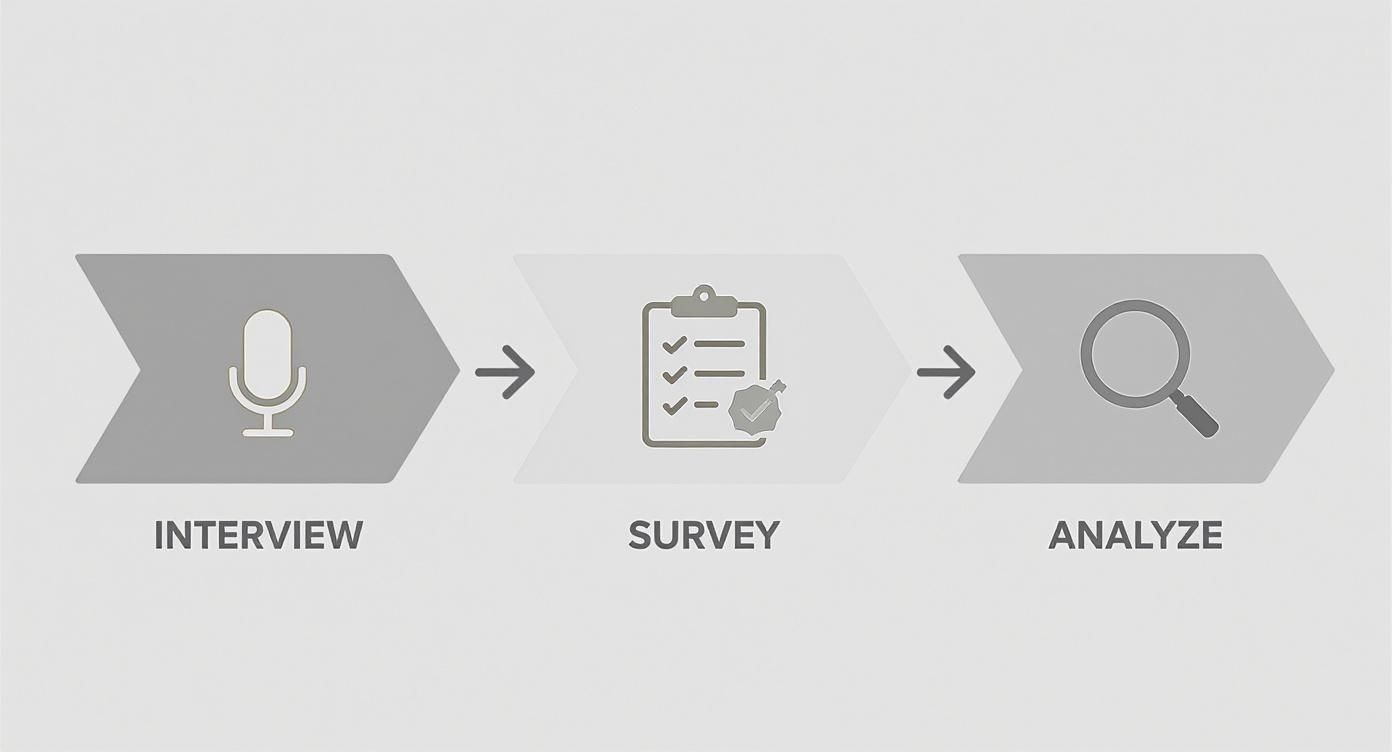
As you can see, each step logically flows into the next, turning all those inputs into insights you can actually use.
Finding the Patterns in Your Data
The first step in making sense of everything is to start grouping similar ideas. Think of it like sorting LEGO bricks by color and shape before you start building. A simple spreadsheet or even a wall of sticky notes works perfectly for this.
Start looking for the common threads that pop up across your different research methods. Did three different interviewees all complain about the same clunky software? Does your website analytics show a huge drop-off on the exact page your survey respondents called “confusing”? These overlaps are pure gold.
You’ll want to create clusters of information around a few key topics:
- Recurring Pain Points: Group every mention of specific challenges or frustrations.
- Stated Goals: Collect all the quotes and survey answers that talk about what your customers are trying to achieve.
- Behavioral Trends: Note common actions you see, like “Checks industry blogs daily” or “Prefers video tutorials over written guides.”
- Direct Quotes: Pull out the most powerful, emotionally charged quotes you can find. The ones that perfectly capture a feeling or a problem.
This sorting process is what helps the bigger picture start to emerge from all the scattered details. To help you choose the best way to analyze this data, consider the different methods available.
Choosing Your Persona Analysis Method
| Analysis Method | Best For | Example Tool or Technique |
|---|---|---|
| Thematic Analysis | Identifying recurring themes in qualitative data like interviews. | Highlighting and grouping similar quotes in a spreadsheet or using a tool like Dovetail. |
| Affinity Mapping | Visually organizing a large volume of unstructured ideas. | Writing individual insights on sticky notes and clustering them on a whiteboard. |
| Quantitative Analysis | Finding statistical trends in survey or analytics data. | Using Google Analytics to identify the top traffic sources or Excel to graph survey responses. |
| Cross-Tabulation | Comparing two or more variables from survey data. | Analyzing how responses to “Biggest Challenge” differ between company sizes. |
Ultimately, a mix of these approaches often yields the richest insights, allowing both qualitative stories and quantitative data to inform your persona.
Building Your Persona Document
With your patterns identified, you’re ready to start structuring the actual persona document. The goal here isn’t to create a dry data sheet; you’re building a relatable character. Give them a name, find a stock photo that fits, and start writing their story. This is what makes the persona memorable and helps your team think of them as a real person.
A well-crafted persona document should feel like a biography, not a spec sheet. It needs to tell the story of your customer’s professional life, making their goals and challenges feel immediate and real.
Let’s build out an example for a fictional B2B software company. We’ll call our persona “Marketing Manager Maria.”
Example Persona: “Marketing Manager Maria”
- Name: Marketing Manager Maria
- Job Title: Marketing Manager at a mid-sized tech company (100-250 employees).
- Demographics: 34 years old, lives in a major city, holds a Master’s in Marketing.
This basic information sets the stage. But now it’s time to add the details that make Maria a three-dimensional character.
Adding Depth and Detail
This is where you weave in all those qualitative insights you uncovered. You’re answering the why behind her actions. Her backstory, motivations, and daily headaches are what make her relatable and, more importantly, what will inform your strategy.
- Backstory: Maria has been in marketing for eight years, working her way up from an entry-level coordinator. She’s ambitious and data-driven but feels stretched thin managing a small team on a tight budget.
- Goals: Her primary goal is to prove the ROI of her team’s marketing efforts to the executive team. She also wants to implement a more efficient content workflow to free up her team for more strategic projects.
- Challenges: Maria struggles with disjointed marketing tools that don’t integrate well. She spends hours each week manually pulling data to create reports, which she calls her “biggest time-sink.”
This context is absolutely crucial. Knowing she needs to prove ROI tells you that case studies and data-heavy content will hit the mark. Understanding her frustration with manual reporting highlights a key pain point your product could solve. A strong content strategy is vital for reaching personas like Maria, which you can learn more about by exploring effective blogging and content marketing.
Finally, you need to know where to find her online.
- Watering Holes (Where she gets info): She follows industry leaders on LinkedIn, listens to marketing podcasts during her commute, and subscribes to newsletters from sources like MarketingProfs and HubSpot.
With all these elements combined, “Marketing Manager Maria” is no longer an abstract concept. She’s a tangible character with clear needs, making it infinitely easier for your marketing, sales, and product teams to make decisions that will genuinely help her.
Bringing Your Buyer Personas to Life in Your Strategy
A beautifully crafted buyer persona is worthless if it just collects dust in a shared drive. The real magic happens when you pull it out of the theoretical and make it a daily tool that informs every single customer-facing decision your business makes.
This is where you bridge the gap between research and results. It’s how you turn deep customer understanding into smarter marketing, more effective sales calls, and better products. A persona isn’t a final deliverable; it’s a compass for your entire organization.
You’ll know you’ve succeeded when your teams start asking, “What would ‘Marketing Manager Maria’ think of this?” That’s the moment they stop marketing to a faceless crowd and start creating experiences for a specific person with real challenges and goals.

Weaving Personas Into Your Marketing Fabric
For marketers, a detailed persona is the ultimate creative brief. Every pain point, goal, and online “watering hole” you identified is a goldmine of inspiration, ensuring your content is genuinely helpful and placed where your audience will actually see it.
Let’s go back to “Marketing Manager Maria.” We know her biggest challenge is proving the ROI of her team’s efforts. This one insight can fuel an entire content strategy.
- Blog Topics: Instead of generic posts, you can create hyper-relevant articles like “5 Free Templates for Your Next Marketing ROI Report” or “How to Convince Your CFO to Increase Your Marketing Budget.”
- Ad Copy: Your ad copy can speak directly to her frustration. Imagine an ad that reads, “Tired of manual reporting? Automate your marketing ROI in minutes.”
- Email Campaigns: You can build nurture sequences around her goals, offering case studies and data-backed guides that help her look like a hero to her executive team.
This approach transforms your marketing from a broadcast into a conversation. You’re not just selling a product; you’re providing solutions to Maria’s most pressing problems, which drastically improves engagement and lead quality.
Empowering Your Sales Team with Persona Insights
Your sales team is on the front lines, and a well-defined persona is like giving them a cheat sheet for every call. Understanding a prospect’s motivations and potential objections before the conversation even begins is a massive advantage.
When your sales reps know they’re talking to a “Maria,” they can tailor their entire approach.
A persona allows your sales team to move beyond a generic product pitch and focus on a consultative sale. They can anticipate needs, speak the customer’s language, and build rapport much faster.
This means they can tweak their sales pitches to highlight the features that solve Maria’s specific ROI-reporting headache. When she brings up budget concerns, they’re prepared with value-driven arguments about time saved and improved efficiency—things they know are her key motivators. This deep understanding is crucial for improving close rates, and you can find more strategies with these conversion rate optimization tips to further boost performance.
Guiding Product Development with Real Frustrations
Perhaps the most powerful application of buyer personas is in product development. Your persona’s challenges and frustrations are a direct roadmap for what you should build next. Sure, customer feedback is valuable, but a persona provides the context behind that feedback.
If Maria consistently complains about “disjointed tools” and “manual data pulling,” your product team has a clear mandate.
Persona-Driven Feature Prioritization:
- Identify the Core Problem: Maria’s frustration with manual reporting is the primary pain point.
- Brainstorm Solutions: The team can explore new dashboard features, automated report generation, or integrations with other marketing tools.
- Prioritize Based on Impact: A feature that directly solves her biggest “time-sink” gets moved to the top of the development backlog.
This process ensures you’re not building features in a vacuum. You’re creating solutions that directly address the validated needs of your ideal customer, leading to higher product adoption and happier users.
The impact of this approach is significant. For example, a fintech banking app used personas to refine its pricing and marketing, leading to a projected 29% revenue growth and a 15% increase in new customers simply by tailoring the experience to specific user needs. By integrating personas across marketing, sales, and product development, you create a cohesive customer experience that drives tangible business growth.
Keeping Your Personas Relevant and Effective
Creating your buyer personas is a huge milestone, but it’s definitely not a “set it and forget it” kind of task. Think of them as living documents, not a project you finish and file away. Why? Because markets shift, customer behaviors change, and technology is always evolving how people find and interact with businesses.
To keep your marketing sharp, you have to revisit and refresh your personas regularly. An outdated persona is just as useless as having no persona at all. It can lead you down the wrong path, causing you to create irrelevant content, miss out on new opportunities, and slowly lose touch with the very people you’re trying to reach.
Setting a Cadence for Persona Audits
As a good rule of thumb, you should plan on a full persona audit at least once a year. This carves out dedicated time to check your assumptions against a year’s worth of fresh data and real customer interactions.
However, some events should trigger an immediate review, no matter where you are in your annual cycle.
You’ll want to audit your personas right after:
- A major market shift: Think about new competitors popping up, big economic changes, or new industry regulations that affect your customers.
- Launching a new product or service: This could easily attract a completely new type of customer you haven’t defined yet.
- Receiving unexpected customer feedback: If your sales and support teams start hearing new challenges or goals from customers, it’s a huge sign that something has changed.
- Noticing a dip in key metrics: If engagement or conversion rates for a specific persona start to drop off, it’s a clear signal that their needs might be shifting.
This proactive approach makes sure your understanding of the customer never goes stale. It keeps your entire team aligned with the real-world needs of your audience as they are today, not as they were a year ago.
Tracking the Effectiveness of Your Personas
So, how do you know if your personas are actually working? The answer is tying them directly to measurable business outcomes. A solid persona-driven strategy doesn’t just “feel” right; it produces real results that show up in your analytics and on your bottom line.
The ultimate goal of a buyer persona is to drive meaningful action. If your personas aren’t leading to better marketing, more effective sales, and a smarter product, then they are just a theoretical exercise.
The data backs this up. Research has shown that using buyer personas can boost marketing’s ability to target leads by a whopping 73%. It doesn’t stop there—businesses that integrate personas into their sales process see a 14% increase in client retention and a 19% increase in revenue growth. These numbers highlight the direct impact well-crafted personas have on the business. You can read the full research on buyer persona statistics to learn more.
To track this impact yourself, you need to monitor a few key performance indicators (KPIs) for each persona:
- Conversion Rates: Are the landing pages and special offers designed for “Marketing Manager Maria” converting better than your generic, one-size-fits-all pages?
- Content Engagement: Do the blog posts and videos that speak directly to a persona’s pain points get more comments, shares, and a longer time on page?
- Lead Quality: This is a big one. Ask your sales team for their honest feedback. Are the leads coming from persona-targeted campaigns better informed and more likely to close?
- Sales Cycle Length: When you really nail a persona strategy, it should actually shorten the sales cycle because prospects feel understood and their objections are handled proactively.
By regularly checking these metrics, you create a powerful feedback loop. The data tells you exactly what’s working and what isn’t, giving you the insights you need to guide your next persona audit and ensure your whole process is focused on measurable growth.
Ready to stop guessing and start connecting with your ideal customers? The team at Raven SEO specializes in creating data-driven digital marketing strategies that get results. From local SEO to full-funnel content marketing, we build roadmaps designed to increase your visibility, traffic, and conversions. Start your journey with a no-obligation consultation today!