
It’s one of the most frustrating moments in eCommerce: a customer finds a product they love, adds it to their cart, and then… vanishes. This isn’t just random behavior—it’s a clear signal that something in your process broke the buying spell.
Figuring out the “why” behind cart abandonment is the first real step to plugging the leaks in your sales funnel. This guide will walk you through educational, easy-to-implement strategies to keep customers on a smooth path from interest to purchase confirmation.
The Real Reasons Shoppers Abandon Carts
This isn’t a small problem. The average cart abandonment rate across the globe is a staggering 70% to 78%. For every ten shoppers who are interested enough to add an item to their cart, seven or eight of them will walk away without paying.
Recent data paints an even starker picture, pushing the worldwide average to 78.77%. These numbers can swing with the seasons, too, often peaking in August and hitting their lowest point in the busy holiday shopping month of December. This isn’t just a minor drip; for many online stores, it’s a flood of lost revenue.
Common Cart Abandonment Triggers
So, what’s really going on in the customer’s mind? It usually boils down to friction and mistrust at the worst possible moment. A shopper can be genuinely excited about a product, but that excitement dies the second they hit an unexpected wall.
These roadblocks are often painfully simple, yet powerful enough to stop a sale dead in its tracks. To get a better handle on this, it’s worth digging into the 5 common reasons why customers abandon their carts and seeing how they apply to your store.
Key Takeaway: Every abandoned cart tells you a story. It might be about a surprise shipping fee, a confusing form, or a payment page that didn’t feel secure. Your job is to listen to these stories and solve the problems they reveal.
A Quick Diagnostic Guide
Pinpointing exactly where your checkout process is failing is crucial. While every store has its unique quirks, the reasons people leave are remarkably consistent. Think of these friction points like a page with a sky-high bounce rate—it’s a loud and clear sign that something needs to be fixed.
Before we get into the heavy-duty strategies, let’s start with a quick diagnostic of the most common culprits and some immediate fixes you can put in place.
Top Cart Abandonment Reasons and Quick Fixes
This table is your starting point. It breaks down the biggest pain points shoppers experience and gives you a practical first step for each. Use it to find your biggest opportunities for a quick win.
| Abandonment Reason | Impact on Shopper | Actionable Quick Fix |
|---|---|---|
| Unexpected Costs | Causes sticker shock and erodes trust. | Display a shipping calculator on the cart page itself. |
| Forced Account Creation | Creates frustration and an unnecessary barrier. | Always offer a prominent “Guest Checkout” option. |
| Complex Checkout | Leads to confusion and decision fatigue. | Reduce form fields to only the absolute essentials. |
| Lack of Trust Signals | Raises security concerns at the payment step. | Add SSL certificates and accepted payment logos. |
By addressing these core issues, you’re not just tweaking your checkout; you’re fundamentally improving the customer experience and rebuilding trust. These simple fixes can have an immediate and measurable impact on your sales.
Find and Fix Your Checkout Funnel Leaks
You can’t fix a leak you can’t find. If you’re serious about reducing cart abandonment, you have to use data to uncover exactly where your customers are dropping off. Guesswork is a recipe for wasted time; a data-driven approach gives you a clear roadmap for what to fix.
Your investigation always starts with your analytics platform. Tools like Google Analytics 4 (GA4) are essential for visualizing the customer journey and pinpointing the biggest leaks in your checkout funnel. It’s all about turning raw numbers into an actionable story.
Uncovering the Story in Your Data
The funnel exploration report in GA4 is your best friend here. It lets you map out a step-by-step breakdown of your entire checkout process. You can define each stage—from viewing the cart, to entering shipping details, and finally, hitting the payment page. This report will show you the precise percentage of users who bail at each step.
Imagine you find that 90% of users who add an item to their cart proceed to the first step of checkout, but only 40% make it past the shipping information page. That’s a massive red flag. It tells you the problem is almost certainly a surprise shipping cost or a clunky address form. For a deeper dive into making sense of these reports, our guide on understanding Google Analytics 4 is an excellent resource.
Pro Tip: Don’t just look at the overall funnel. Segment your data by device type (mobile vs. desktop), traffic source, or even country. You might discover that mobile users abandon carts at twice the rate of desktop users, pointing to a poor mobile experience that needs urgent attention.
It’s also crucial to remember that abandonment rates can be all over the map. They vary significantly by region, industry, and device, but understanding these benchmarks helps you tailor your strategy. For instance, the Middle East and Africa see the highest rates at 93%, while North America is a bit lower but still significant at roughly 76%. On the industry side, sectors with higher price points and longer decision times, like home furnishings (78.65%) and jewelry (81.68%), face the biggest hurdles.
Going Beyond Numbers with Qualitative Insights
While analytics tells you what is happening, it rarely explains why. That’s where qualitative tools come in, adding that much-needed human element to your data.
Tools like Hotjar or Microsoft Clarity offer features like session recordings and heatmaps. Session recordings are literal videos of users interacting with your site. Watching a few recordings of users who abandoned their carts is an eye-opening experience. You might see someone repeatedly trying to click a broken button or getting frustrated with a form field that won’t accept their input.
This infographic shows a simplified flow of common friction points, from high costs to forced account creation.
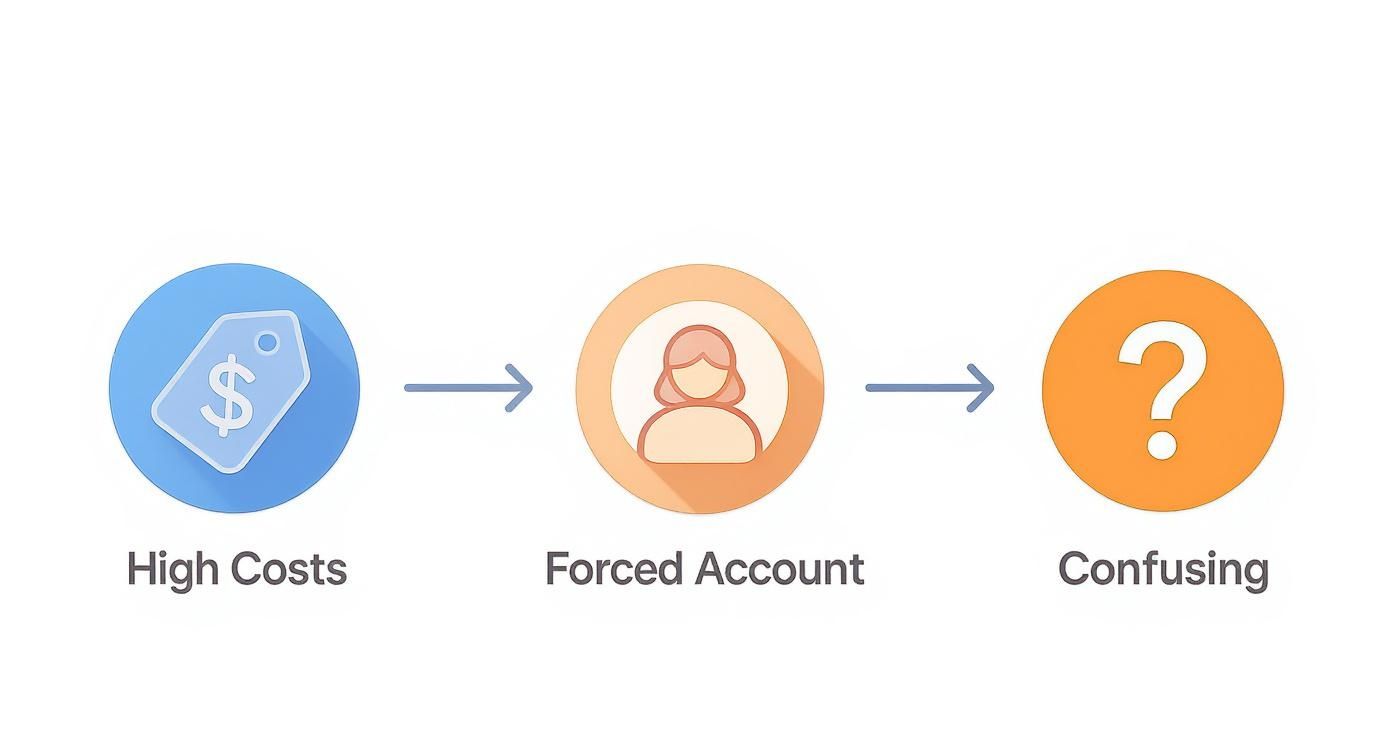
This visual really highlights how each step can become a point of failure, turning an eager buyer into just another abandoned cart statistic.
Heatmaps complement this perfectly by showing where users click, move their mouse, and scroll. A heatmap of your cart page might reveal that no one is clicking on your “secure checkout” badge, meaning it isn’t building the trust you thought it was.
By combining the hard numbers from your analytics with these qualitative insights, you get a complete view of your checkout funnel’s health. You can identify the biggest leaks and understand the exact reasons behind them. This is how you make targeted fixes that have a real impact on your bottom line and help you reduce cart abandonment for good.
Create a Frictionless Checkout Experience
Once you’ve spotted where shoppers are dropping off, the next move is to pave a smoother path to purchase. A long, confusing, or sketchy-looking checkout is the fastest way to lose a sale, no matter how much someone wants your product. This is your chance to turn a moment of high friction into a seamless, confidence-building experience.
The guiding principle here is simple: remove barriers. Every extra field, every unnecessary click, and every flicker of doubt is a potential exit ramp. Your job is to make clicking “Pay Now” feel like the easiest, most natural next step.
Embrace the Guest Checkout
Forcing a customer to create an account before they can buy is one of the most common—and damaging—mistakes in eCommerce. Research consistently shows that 24% of shoppers will ditch their cart if you make them create an account. Think about it from their side: they’re ready to hand over their money, but you’re stopping them to fill out paperwork.
A guest checkout option is non-negotiable. It respects the customer’s time and their desire for a quick, painless transaction.
- Make it the default: Don’t tuck the guest checkout option away. It should be the most obvious, can’t-miss choice on the page.
- Offer account creation after the sale: You can always offer to save their details for next time on the order confirmation page. The hard part is over, the transaction is complete, and they’re far more likely to agree.
By letting users check out as guests, you cater to first-time buyers and anyone in a hurry, instantly dissolving a massive point of frustration.
Simplify and Streamline Your Forms
Nobody enjoys filling out long forms. When someone is trying to make a purchase, every single field you ask them to complete adds to their mental load and kills their forward momentum. You have to be ruthless here. Only ask for the absolute essentials needed to process and ship the order.
Key Insight: Treat every form field as a potential conversion killer. If you can get the information from another source (like auto-filling the city and state from a zip code) or it’s not strictly necessary for fulfillment, get rid of it.
This is especially critical for mobile users, where tapping away on a tiny screen is tedious. A checkout that feels fine on a desktop can be a nightmare on a phone. That’s why it’s so important to learn how to optimize your website for mobile to ensure the experience is just as smooth everywhere.
This screenshot shows a clean, single-page checkout that keeps form fields to a minimum and maintains momentum.
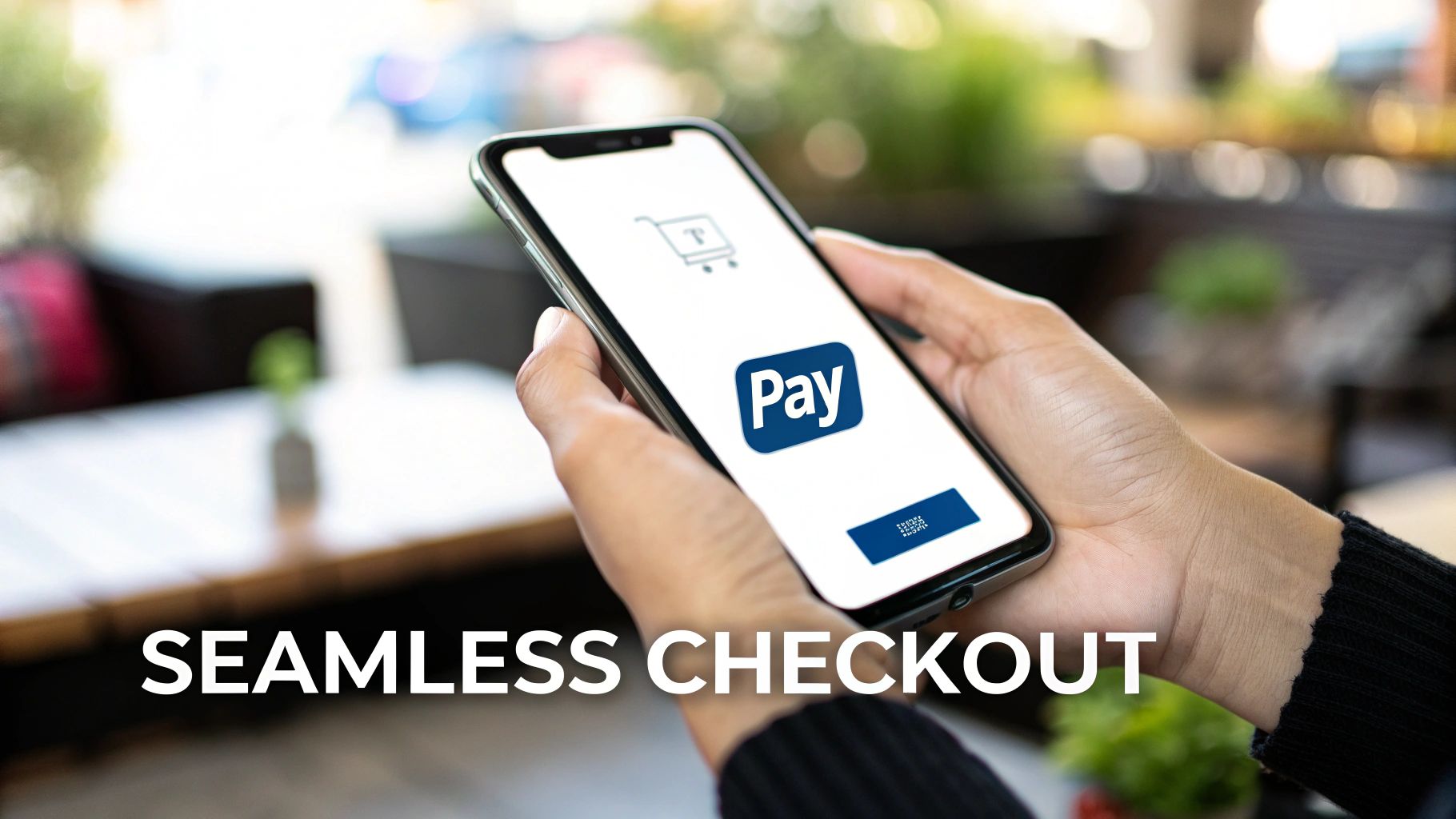
Notice the generous white space and clearly labeled fields. It guides the user’s eye right to the “Pay” button without any distractions.
Build Confidence with Trust Signals
As a customer gets to the final hurdle—entering their payment information—their sensitivity to security skyrockets. This is the moment they need reassurance that their personal and financial data is safe. You can build this confidence by strategically placing trust signals throughout the checkout page.
These are the visual cues that signal “you’re safe here.”
- SSL Certificate: The little padlock icon and “https://” in the URL bar. This is table stakes for a secure website.
- Payment Logos: Show the logos of the payment methods you accept (Visa, Mastercard, PayPal, Apple Pay). These familiar icons provide instant credibility.
- Security Badges: Including badges from well-known security firms like McAfee or Norton shows your site is actively monitored against threats.
- Clear Policies: Make your return policy, money-back guarantees, and shipping info easy to find. Linking to them in the checkout footer is a great way to do it.
By weaving these elements directly into your checkout flow, you answer the customer’s unspoken questions about security and legitimacy. This makes them feel comfortable enough to complete their purchase, turning a hesitant visitor into a happy customer.
Build Trust with Upfront Pricing and Transparency
Let’s be honest: the single biggest reason a customer abandons a full cart is sticker shock. That jarring moment when taxes and shipping fees suddenly appear at the very last step is a massive conversion killer and a major blow to trust. If you want to stop bleeding sales at the finish line, you have to kill the surprises and commit to total transparency.
This means showing your customers the real total cost as early as possible. Unexpected costs are the number one reason for cart abandonment, with research showing that about 48% of online shoppers in the United States ditch their carts because of surprise fees. Globally, 41% of shoppers point directly to high delivery fees as their reason for bailing. The message is crystal clear: hidden costs destroy buyer confidence. You can explore the full research on cart abandonment statistics to see just how deep this problem runs.
Take a look at this. It’s a cart page with a shipping calculator built right in, giving the user a clear cost estimate before they even start the checkout process.
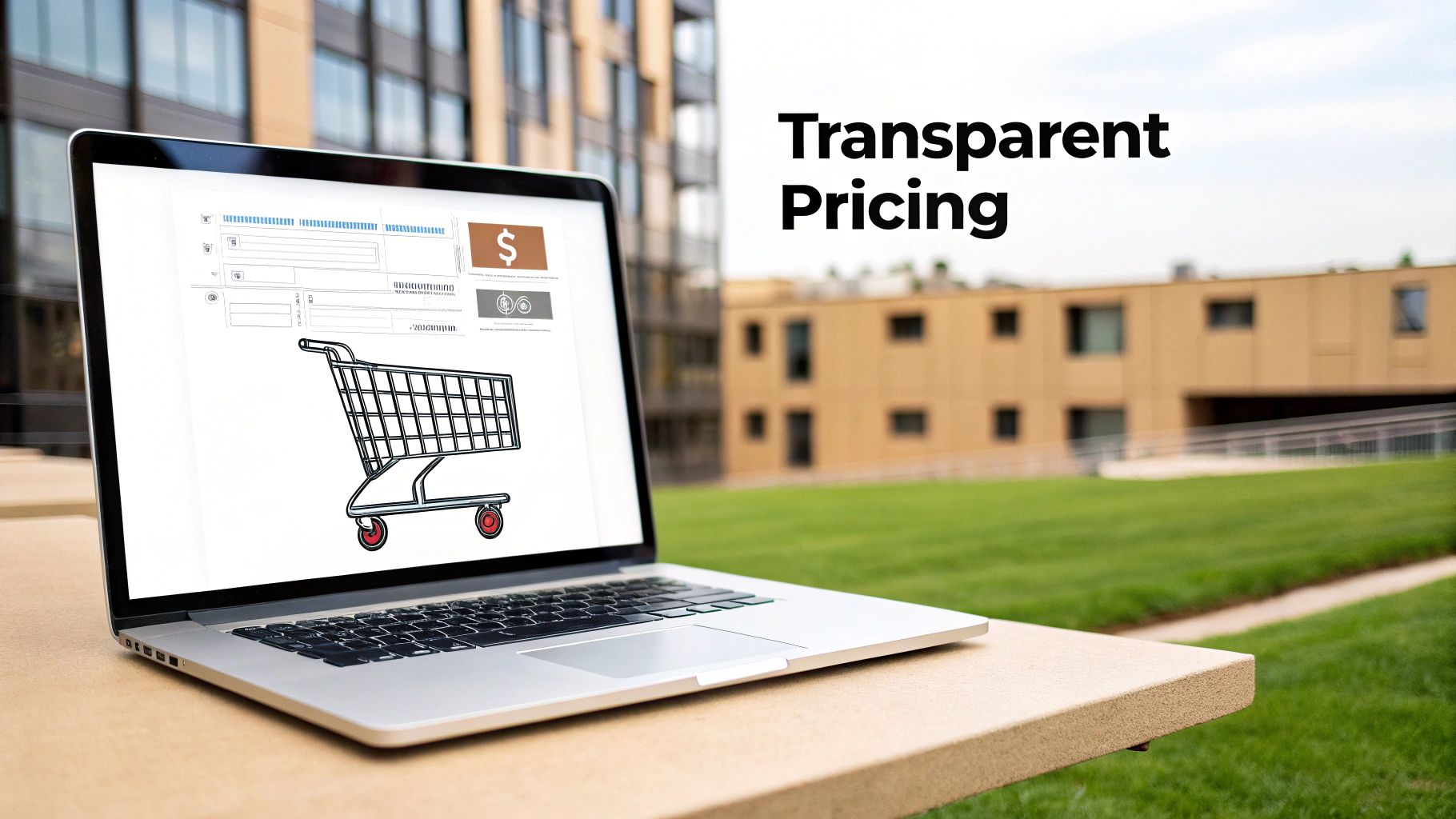
This simple feature flips a moment of potential anxiety into an opportunity to build confidence. You’re respecting the customer by giving them all the information they need to make a solid decision.
Clearly Communicate Your Shipping Strategy
Being upfront isn’t just about showing the numbers; it’s about making your shipping policies dead simple to understand. Customers appreciate clarity. They will often choose a store with a straightforward policy over one with confusing, variable rates that feel like a math problem.
You should test a few different shipping models to see what really clicks with your audience:
- Free Shipping Threshold: This is a classic for a reason. Offer free shipping on orders over a set amount (like “$50 and over”). It’s a powerful incentive that not only pushes people to complete their purchase but can also bump up your average order value.
- Flat-Rate Shipping: Charge one single, predictable fee for all orders. This takes all the guesswork out of the equation and makes the cost incredibly easy to communicate across your entire site.
- Real-Time Carrier Rates: For businesses with products that vary wildly in weight and size, this can be the fairest approach. Just make sure the calculator is integrated early in the process—ideally on the cart page itself.
Whichever model you land on, display it proudly. A banner at the top of your site shouting “Free Shipping on All Orders Over $75” is infinitely more effective than burying the details on a forgotten shipping policy page.
Pro Tip: If you offer free shipping, make it a celebration. Display a dynamic message in the cart like, “You’re only $12 away from free shipping!” This gamifies the experience just enough to encourage customers to toss one more item in their cart.
Extend Transparency Beyond Just the Price
True transparency goes beyond dollars and cents. It’s about setting clear expectations for the entire experience after the purchase. Answering a customer’s unspoken questions before they even have to ask them is the hallmark of a brand people trust. You can learn more about building this kind of credibility by reading our guide on the power of E-E-A-T in crafting high-quality content.
This means making key information impossible to miss.
Delivery Estimates and Return Policies
Don’t make your customers dig around for crucial information. State your estimated delivery windows right there on the product or cart page. A simple line like “Usually ships in 2-3 business days” works wonders for managing expectations and preventing that post-purchase anxiety.
Likewise, your return policy should be straightforward and easy to find. A link in your website’s footer is standard practice, but why not summarize it on the cart page, too? Something as simple as “Easy 30-Day Returns” can provide the final bit of reassurance a hesitant buyer needs to click “complete purchase.”
By being completely open about all aspects of the transaction, you shift the dynamic. It’s no longer just a sale; it’s the start of a trusted relationship. You show customers you have nothing to hide, which makes them feel secure and respected. This is how you not only slash your cart abandonment rate but also build a loyal customer base.
Win Back Shoppers with Smart Remarketing
An abandoned cart isn’t a lost sale. Not yet, anyway. Think of it as a warm lead—someone who liked a product enough to add it to their cart. Often, a simple distraction or a flicker of hesitation is all that stood between you and a completed purchase. This is where smart remarketing comes in, acting as a gentle nudge to bring them back.
The goal isn’t to be aggressive. It’s about reopening the conversation in a way that feels like helpful customer service. With the right strategy, you can pull a surprising number of these “lost” sales back from the brink.
Crafting the Perfect Automated Email Sequence
When it comes to cart recovery, email is still king. A well-timed, automated email sequence is your most powerful tool for winning back shoppers. The secret is to build a series of messages that gradually escalate in tone and incentive, moving from a simple reminder to a more compelling reason to buy now.
This isn’t about blasting a single, generic “you forgot something” email. It’s about building a multi-step campaign that addresses different levels of hesitation over a few days. For some great real-world examples to get your own ideas flowing, you can check out these various email marketing campaign examples.
Key Takeaway: A great cart abandonment sequence should feel like a helpful conversation, not a series of demands. Each email needs a clear purpose, whether it’s reminding, reassuring, or making an offer they can’t refuse.
The timing and content of each email are critical. Get it wrong, and you’re just annoying them. Get it right, and you’re closing sales while you sleep.
Here’s a simple yet powerful three-part email sequence that’s a fantastic template to get you started.
Effective Cart Abandonment Email Sequence
| Timing | Purpose | Key Content / Call-to-Action | |
|---|---|---|---|
| Email 1 | 1 Hour After | A gentle, low-pressure reminder. | Frame this as customer service. Think subject lines like, “Did you run into trouble?” and include a clear, direct link back to their cart. |
| Email 2 | 24 Hours After | Re-engage with urgency or social proof. | Highlight customer reviews for the item or mention that it’s a popular product. A subject line like “Your favorite item is selling fast!” can work wonders. |
| Email 3 | 48-72 Hours After | The final, incentive-based offer. | If they still haven’t checked out, it’s time to make a compelling offer. A small discount or free shipping can be the final push they need to close the deal. |
This structured approach respects the customer’s space while giving you the best possible chance to recover that sale.
Expanding Beyond the Inbox
Email might be your primary weapon, but a multi-channel remarketing strategy is how you truly dominate. By meeting customers on the platforms they’re already scrolling through, you keep your brand top-of-mind and give them multiple, easy paths back to their cart.
Think of it as creating a helpful echo. When a shopper sees the exact product they were just looking at pop up on their social feed, it reinforces their initial interest and makes clicking back to your site feel like a natural next step. For a deeper dive into this and other recovery methods, you can explore more strategies to reduce cart abandonment and win back sales.
Use Exit-Intent Popups Strategically
An exit-intent popup is your last line of defense before a visitor is gone for good. This tech tracks mouse movement and triggers a message the moment a user is about to leave your site. This is your chance to make one final, compelling offer.
- Don’t just offer a discount: While 10% off is a classic for a reason, sometimes free shipping is an even bigger motivator. Test different incentives to see what your audience responds to.
- Ask a question: A popup that asks, “Have a question before you go?” and connects to a live chat can solve last-minute problems and save a sale on the spot.
Run Retargeting Ads on Social Media
Retargeting ads are a game-changer. They let you show your products to people who have already visited your site, and platforms like Facebook and Instagram are incredibly good at this. You can even set up dynamic ads that show the exact product the shopper left behind.
Seeing that specific item again in their social feed is a powerful visual reminder. It keeps your product in their mind and makes it ridiculously easy for them to click through and finish what they started. This persistent, gentle presence across multiple channels is how you win back shoppers and turn hesitation into revenue.
Your Top Questions, Answered
Even with the best game plan, some specific questions always pop up when you’re fighting cart abandonment. Let’s tackle a few of the most common ones to help you fine-tune your approach and make decisions with confidence.
What’s a Good Cart Abandonment Rate to Aim For?
This is a common question, and the answer is… it depends. While you’ll see industry averages floating around 70-78%, getting fixated on a universal number is a trap. A “good” rate is entirely relative to your industry, product type, and price point.
Instead of chasing someone else’s benchmark, the real goal is to beat your own number, month after month. Focus on consistent, incremental reduction. Can you get below 60%? Absolutely. But real success is measured by progress, not perfection. Use the tactics in this guide to steadily chip away at your own baseline rate.
How Soon Should I Send the First Cart Abandonment Email?
Timing is everything here, and you need to act fast. The sweet spot for that first recovery email is within one hour of the cart being abandoned. At this point, the purchase is still fresh in their mind, and a gentle nudge can be all it takes to bring them back.
The key is how you frame it. This first message shouldn’t be a hard sell. It should feel like helpful customer service. A simple, “Having trouble checking out?” or “Did something go wrong?” works wonders. Save the discounts for later.
Key Insight: The goal of the first email is to be helpful and jog their memory. The goal of subsequent emails is to create an incentive. This tiered approach respects the customer’s journey and maximizes your chances of conversion without immediately giving away margin.
Do Exit-Intent Popups Offering Discounts Hurt Profit Margins?
They can—if you do it wrong. But a strategic, tested approach is almost always a net positive. The mistake many stores make is slapping a huge, generic discount on a popup for every single visitor who tries to leave. This just trains your customers to wait for a deal and can devalue your brand.
A much smarter way to do it is by offering a more modest but still compelling incentive. Think 10% off or, even better, free shipping. The perceived value of free shipping is often much higher than its actual cost to you.
The revenue you recover from a sale that would have otherwise vanished almost always outweighs the small cost of that discount. The trick is to test different offers and find that perfect balance that motivates buyers without gutting your profits.
Ready to turn those abandoned carts into loyal customers? The team at Raven SEO specializes in building data-driven strategies that optimize your entire customer journey, from the first click to the final sale. Get in touch with us today for a no-obligation consultation and let’s create a practical roadmap to boost your revenue.