

Trying to boost online sales without a solid plan is like trying to build a house in a sandstorm. You can have the fanciest tools and the best materials, but without a strong foundation, everything is just going to collapse. Forget the quick hacks and shiny new tactics for a moment. Real, sustainable growth starts with the unglamorous but absolutely essential groundwork.
This guide isn’t about launching a flashy ad campaign overnight. It’s about a methodical, educational preparation. It means shifting your mindset from “how can I sell this?” to “who am I helping and why?” It also means looking at your competitors not as enemies to be copied, but as a source of market intelligence, revealing the exact gaps you can fill.
Building a Foundation for Sustainable Sales Growth
Before you even think about scaling up, you need to pour the concrete for a rock-solid foundation. Chasing advanced strategies without getting the basics right is a recipe for wasted time and money. The real work—the work that actually moves the needle—starts here.
Truly Understand Your Ideal Customer
Too many businesses stop at surface-level demographics. Age, location, gender… that’s table stakes. To really connect and drive sales, you have to go deeper. What are the nagging problems that keep your customers up at night? What’s the real motivation behind their purchase? Where do they hang out online when they’re not looking to buy something?
Think about it this way: a company selling ergonomic office chairs isn’t just targeting an “office worker.” Their ideal customer is a “remote professional struggling with back pain after hours of non-stop Zoom calls.” That tiny shift in perspective is a game-changer. It transforms everything from your ad copy to your product descriptions, making them resonate on a much deeper level.
“The first step to increasing sales is to stop selling and start helping. When you genuinely understand and solve a customer’s problem, the sale becomes the natural conclusion of that relationship.”
When you get this right, you move beyond listing features and start talking about real-life benefits. That’s how you build a connection that leads to a sale.
Analyze Your Competition to Find Opportunities
Looking at your competitors isn’t about mimicry; it’s about strategic reconnaissance. You’re looking for the holes in their strategy, the gaps they’ve left wide open for you to march through. Dig into their product lineup, their pricing, and, most importantly, their customer reviews.
- What are customers complaining about? Their 1-star reviews are a goldmine. They are literally a roadmap telling you how to build a better product or offer a superior service.
- Which channels are they ignoring? If your biggest rivals are all-in on Instagram but have zero presence on Pinterest, you might have just found an untapped well of potential customers.
- What’s their brand voice? If everyone in your space sounds formal and corporate, a more personal, friendly, and human tone could make you stand out immediately.
Diving into these proven actions to increase product sales can offer more perspective on how these core strategies directly impact your bottom line. The goal isn’t to be just another player in the market—it’s to carve out a unique space that you can own.
This entire process can be visualized as three core pillars holding up your sales foundation: deeply understanding your customer, dissecting the competition, and perfecting your website.
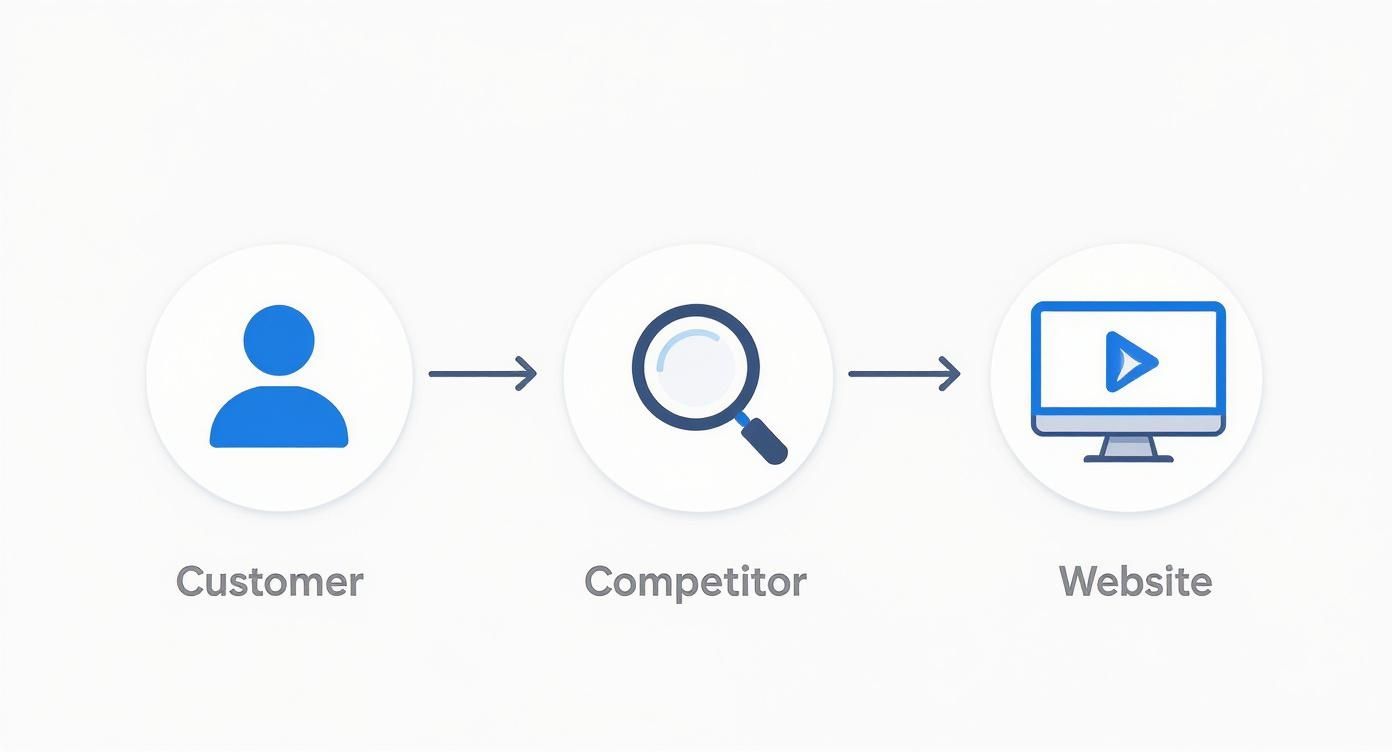
Each of these pillars supports the others, creating a powerful feedback loop that constantly refines and strengthens your overall game plan.
To bring these foundational ideas together, here’s a quick summary of how they work in concert to drive business growth.
Core Pillars for Increasing Online Sales
A summary of the foundational elements essential for boosting e-commerce revenue and their primary business impact.
| Strategy Pillar | Key Focus Area | Primary Impact |
|---|---|---|
| Customer Insight | Deeply understanding pain points, motivations, and behaviors. | Creates resonant marketing, improves product-market fit. |
| Competitive Analysis | Identifying market gaps, weaknesses, and untapped channels. | Informs unique value proposition, reduces market risk. |
| Technical Optimization | Ensuring site speed, mobile usability, and security are flawless. | Builds trust, reduces friction, and maximizes conversions. |
Focusing on these three areas creates a stable platform for every other marketing effort you’ll undertake.
Nail the Technical Groundwork
Your website is your digital storefront, and technical glitches are the silent killers of sales. A slow, insecure, or confusing site will send potential customers running to your competitors before they even see what you have to offer. There are three non-negotiable areas you have to get right:
- Site Speed: This is critical. A mere one-second delay in your page load time can slash conversions by 7%. Your site has to be lightning-fast, on both desktop and mobile.
- Mobile-Friendliness: We live on our phones. By 2025, mobile e-commerce is projected to hit an incredible $710 billion in the U.S. alone. If your website isn’t a dream to use on a small screen, you’re leaving a massive amount of money on the table.
- Security: An SSL certificate (the “https://” in your URL) is no longer optional. It’s a baseline requirement for building trust. It encrypts sensitive data and signals to customers that their personal and payment information is safe with you.
By focusing on these foundational elements first, you create a stable launching pad for real growth. For a more comprehensive look at building a cohesive strategy, our guide on digital marketing best practices ties all these concepts together. This holistic approach ensures that every bit of time and money you invest in marketing delivers the biggest possible punch.
Mastering SEO to Attract High-Intent Buyers
Search Engine Optimization (SEO) is your most direct path to customers who are already looking for what you sell. Forget the old-school tricks like keyword stuffing. Modern SEO is all about understanding your customer and creating a valuable, relevant, and seamless user experience.
It’s the art of perfectly aligning your website with what real people are typing into Google.
When you get this right, you build a powerful engine that drives a steady stream of high-quality, free traffic to your online store. This isn’t just about getting more eyeballs on your site—it’s about attracting the right visitors who are ready to pull out their wallets.

Uncovering Customer Language Through Keyword Research
The entire foundation of a winning SEO plan is built on knowing the exact words and phrases your ideal customers use. This process, called keyword research, lets you peek inside their heads to uncover their pain points, questions, and buying signals. You’re not just guessing what they’re searching for; you’re using data to find out for sure.
For example, a shop selling athletic footwear might think “running shoes” is the golden keyword. But solid research will almost always uncover more specific, high-intent phrases like “best running shoes for flat feet” or “lightweight marathon training shoes.”
Targeting these “long-tail” keywords connects you with buyers who have a very specific need and are much closer to making a purchase.
A key part of this process is understanding not just what people search for, but why. This is the core of user intent, the driving force behind every single Google search.
Nailing this is critical for attracting actual buyers, not just casual browsers. You can dive deeper into decoding the “why” behind every search by learning how search intent is the secret ingredient to Google success. This alignment ensures your content directly solves a user’s problem, which is a surefire way to increase online sales.
Crafting Pages That Rank and Persuade
Once you know the language your audience uses, it’s time to create content that speaks directly to them. For any ecommerce business, this boils down to your product and category pages. Each one needs to be a finely tuned sales tool.
Your goal is to weave your target keywords into these pages in a way that feels completely natural and never sacrifices readability. Here’s where to focus:
- Product Descriptions: Ditch the boring spec sheet. Tell a story that highlights the benefits and shows how the product solves your customer’s problem. Use your keywords, but always, always write for the human on the other side of the screen first.
- Category Pages: These pages are SEO goldmines for organizing your products and targeting broader keywords. Add a short, helpful introduction at the top of the page that explains what the category offers and why your products are the best choice.
- Title Tags and Meta Descriptions: This is your first impression in the search results. Make them irresistible and include your main keyword to practically beg for the click.
This approach turns every page into a double-threat: a magnet for Google and a compelling sales pitch for your visitors.
Demystifying Technical SEO for Better Visibility
While your content is the star of the show, the technical health of your website is the stage it performs on. Technical SEO is all about optimizing the behind-the-scenes stuff to help search engines find, crawl, and understand your site more easily. It might sound intimidating, but a few key areas deliver a massive impact.
One of the most important elements is your site structure. A logical, easy-to-navigate site helps both users and search engines find what they need. A simple hierarchy is usually best: your homepage links to major categories, which then link to subcategories and individual product pages. Think of it as drawing a clear map for Google to follow.
Another powerhouse tool is schema markup. This is a snippet of code you add to your site that gives search engines extra context about your pages. For an online store, this is huge. You can use it to highlight key info right in the search results, like:
- Product price
- Availability (in stock/out of stock)
- Customer ratings and reviews
These enhanced listings, known as “rich snippets,” make your website stand out from the competition, which can dramatically boost your click-through rate. By making these small but mighty technical tweaks, you make it much easier for those high-intent buyers to find you, trust you, and choose you.
Optimizing Your Website for Maximum Conversions
Getting traffic to your website is only half the job. The real work—the part that actually grows your business—is turning those visitors into paying customers. This is the world of Conversion Rate Optimization (CRO), and it’s all about methodically tweaking your site to increase online sales.
It’s less about guesswork and more about understanding the psychology of your shoppers. By digging into how they think and what they want, you can refine every single element, from your product pages all the way to that final “Buy Now” button. A well-optimized site doesn’t just look pretty; it actively guides people toward making a purchase.
Creating High-Impact Product Pages
Think of your product pages as your best digital salespeople. They need to be sharp, informative, and convincing enough to make a visitor feel like your product is the exact solution they’ve been searching for. A blurry photo and a generic, one-line description just won’t do the trick anymore.
Each product page should be a complete sales pitch. Start with stunning, high-resolution photos that show off your product from every conceivable angle. Better yet, include a quick video of the product in action. Then, pair those visuals with copy that sells the benefits, not just the features. Don’t just tell them the backpack has “water-resistant fabric”; tell them it “keeps your laptop safe and dry during an unexpected downpour.”
And of course, every page needs a crystal-clear call-to-action (CTA). Make that “Add to Cart” button pop with a contrasting color and use action-oriented text that feels urgent and moves the user forward. For a deeper dive into making your site both beautiful and effective, these website design best practices are a perfect complement to any CRO effort.
Dissecting and Streamlining the Checkout Process
The checkout is where an incredible number of sales go to die. In fact, research shows that nearly 70% of online shopping carts are abandoned. Why? More often than not, it’s because of a clunky, confusing, or untrustworthy checkout experience. Every single step you can remove or simplify will directly boost your bottom line.
Here are the most common friction points to hunt down and eliminate:
- Forcing account creation: This is a classic conversion killer. Always, always offer a guest checkout option.
- Surprise costs: Be completely transparent about shipping fees, taxes, and any other charges right from the start. Unexpected costs are the #1 reason people abandon their carts.
- Long and complex forms: Only ask for what you absolutely need to process the order. Keep forms short and sweet, and enable auto-fill wherever you can.
The goal is a checkout process that feels seamless, transparent, and totally secure. You build trust by displaying security badges and offering multiple payment options, making the customer feel confident they’re making a smart purchase from a reputable business.
With projections showing that 2.77 billion people will shop online in 2025, creating a frictionless experience is more critical than ever. This isn’t just about making a sale today; it’s about building the kind of smooth, satisfying experience that brings customers back.
Using A/B Testing to Discover What Works
So, how do you really know if changing your button color from blue to green will make a difference? You test it. This is where A/B testing (or split testing) comes in, and it’s the true engine of CRO. The process is simple: you create two versions of a page (Version A and Version B), show each to a different group of visitors, and see which one performs better.
You can test almost anything you can think of:
- Headlines and subheadings
- Button text, colors, and placement
- Product images and videos
- Page layouts and navigation flow
- Pricing structures and special offers
The golden rule is to test just one thing at a time. This scientific approach takes the guesswork out of optimization and empowers you to make decisions based on real data. Over time, all those small, incremental wins start to compound, leading to a major lift in your online sales. This methodical approach is vital on any platform; for example, many online sellers find success by applying proven strategies to boost Amazon conversion rates, which are built on these same core principles of testing and refinement.
Using Paid Advertising for Immediate Sales Impact
While SEO is your long game for building sustainable, organic growth, paid advertising is your express lane. Think of it as turning on a faucet for highly targeted traffic, giving you instant visibility and—just as importantly—a ton of valuable market data right away. This isn’t about burning cash; it’s about making smart, surgical investments to get in front of customers the very moment they’re ready to pull out their wallets.
Paid ads place your brand directly in front of people actively hunting for a solution. This gives you a potent way to increase online sales from the get-go by intercepting buyers mid-search and pointing them straight to your digital front door.
Capture High-Intent Buyers with Search Ads
When someone types “waterproof hiking boots for women” into Google, they aren’t just window shopping. They have a specific need and are deep into the buying cycle. This is precisely where search ads prove their worth. By bidding on those exact keywords, you can land your product right at the top of the search results, capturing that peak buying intent.
For e-commerce, Google Shopping ads are an absolute must. These visual ads feature your product image, price, and brand name directly in the search results, making it dead simple for shoppers to compare their options. This format is so effective it accounts for a staggering 76.4% of all retail search ad spend. Running these campaigns helps you compete on a level playing field, even with the big-name brands.
Of course, to get the most out of your budget, you need to set up your campaigns correctly. To get the technical roadmap for building profitable campaigns from the ground up, it’s worth exploring the latest Google Ads best practices.
Target Ideal Audiences on Social Media
If search ads are about capturing existing demand, social media ads are about creating it. Platforms like Facebook and Instagram have incredibly granular targeting that lets you dial in on your perfect audience based on their interests, online behaviors, and demographics.
Want to target people who follow your top competitors? You can do that. How about users who have shown an interest in hobbies related to your product, or even those who live within a 5-mile radius of your brick-and-mortar shop? Easy.
The trick to winning on social media is creative that stops the scroll. You need eye-catching visuals—think high-quality images or snappy, engaging videos—paired with ad copy that speaks directly to a viewer’s problem or desire. For example, a business selling custom pet portraits could target Facebook users in dog breed-specific groups or Instagram users who follow famous pet influencers. That level of precision ensures every ad dollar is spent reaching people who are primed to be interested in what you sell.
Remember, social media is a visual-first environment. Your creative isn’t just supporting your message; it is the message. Invest in high-quality imagery and video to make an immediate impact.
Bring Back Lost Customers with Smart Retargeting
So, what about all those people who visit your site, add a product to their cart, and then vanish without a trace? That’s where retargeting comes in. By placing a tracking pixel on your website, you can serve targeted ads to these “warm” leads as they browse other sites or scroll through their social media feeds.
This strategy is incredibly effective because you’re no longer marketing to a cold audience. You’re talking to people who have already raised their hands and shown interest in your brand. It’s the digital equivalent of a friendly, helpful nudge.
But effective retargeting isn’t about being creepy or aggressive. It’s about crafting subtle campaigns that remind potential customers why they were interested in the first place. Here are a few proven ways to do it:
- Dynamic Product Ads: These automatically show the person the exact product they were just looking at on your site.
- A Gentle Nudge: Offer a small incentive, like 10% off or free shipping, to coax them back to complete their purchase.
- Showcase Social Proof: Run an ad that features a glowing customer testimonial or a 5-star review for the product they left behind.
This kind of targeted follow-up can be the final push a customer needs, helping you recover sales that would have otherwise been lost for good.
Driving Repeat Business with Email and Social Media
Here’s a simple truth that anchors any profitable online business: it costs five times more to attract a new customer than to keep an existing one. It’s a statistic worth repeating. Your most valuable assets aren’t one-time buyers; they’re the people who already know you, trust your products, and are ready to come back for more.
So, how do you keep them coming back? You nurture those relationships. Email and social media are your direct lines to turn a single purchase into lasting loyalty. This isn’t about endlessly chasing new leads; it’s about making the most of the customers you’ve already won.
Building Your Email Marketing Machine
Email marketing consistently delivers one of the highest ROIs of any channel out there. It’s a direct line to your customers that you own, completely free from the unpredictable whims of social media algorithms. The goal is to build an automated system that talks to customers at just the right moment.
Kick things off with a compelling welcome series for new subscribers. This is your chance to make a stellar first impression. Don’t just blast them with a coupon; use it to tell your brand story, show off your most popular products, and set the stage for the value you’re about to deliver to their inbox.
Your welcome series should feel less like a sales pitch and more like the start of a helpful conversation. It’s your opportunity to build a relationship before you ever ask for a second sale.
Once they’re welcomed, automation is your best friend. A well-timed abandoned cart series, for example, is a must-have. These gentle reminders can recover a surprising percentage of lost sales, sometimes with just a little nudge or a small incentive to finish the purchase.
Segmenting Your Audience for a Personal Touch
Sending the same generic email to everyone on your list is a fast track to the unsubscribe button. The real power of email is in segmentation—carving up your audience into smaller, more focused groups based on what they’ve done and what they’re interested in. This is how you send messages that feel genuinely helpful, not intrusive.
Consider these powerful ways to segment your list:
- Purchase History: Group customers by what they’ve bought before. If someone bought a tent from you last summer, they’re probably a great candidate for an email about new sleeping bags come spring.
- Browsing Behavior: Target people who have looked at specific products but never pulled the trigger. A simple, low-pressure “Did you see something you liked?” email can be remarkably effective.
- Customer Lifecycle: Create different paths for new customers, repeat buyers, and folks who haven’t purchased in a while. A “we miss you” campaign with a special offer can be a great way to reignite interest from lapsed customers.
By personalizing your communication, you’re showing customers you’re paying attention. For a deeper dive into these strategies, check out our guide on the modern approach to growing your email list. This targeted approach is a cornerstone of any strategy designed to increase online sales.
Building a Community on Social Media
Social media isn’t just a digital billboard for your products. It’s a space to build a genuine community around your brand. To really connect, you need to spark conversations and invite your followers to become part of your story.
One of the best ways to do this is with user-generated content (UGC). Actively encourage customers to post photos and videos of them using your products. When you feature the best submissions on your feed (with permission, of course!), you get a stream of authentic content and build powerful social proof. Nothing sells a product better than seeing real people loving it.
It’s also crucial to understand the bigger picture. In 2025, global ecommerce sales from China, the United States, and Western Europe are projected to total more than $5.17 trillion. This shows just how important it is to tailor your social media strategy to fit different regional trends and preferences.
Finally, treat your social channels like your customer service frontline. Respond to comments and questions quickly and publicly. When you handle a customer’s issue with grace in a public forum, you’re not just helping one person—you’re showing every single follower that you care. That’s how you turn followers into loyal, lifelong advocates for your brand.
Frequently Asked Questions About Increasing Online Sales
When you’re digging in and trying to boost your e-commerce performance, a lot of questions pop up. Let’s tackle some of the most common challenges and questions business owners face when they’re working to increase online sales.

How Quickly Can I Actually See an Increase in Online Sales?
The timeline for seeing a real jump in sales really depends on the path you take. Different strategies work on different schedules, and the smartest plan almost always involves a mix of short-term tactics and long-game plays.
Paid ads, like Google Ads or Facebook Ads, can bring in traffic and sales almost right away. The catch? You need a consistent budget to keep that fire lit.
On the flip side, organic strategies like SEO and content marketing are long-term investments. You might not see huge results for three to six months, but the growth you get is far more sustainable and compounds over time.
Conversion rate optimization (CRO) can sometimes give you quick wins, especially if you find and fix a glaring issue like a broken checkout button. But really, it’s best to think of CRO as an ongoing process of refining and improving. The most effective approach combines those quick-win tactics for immediate cash flow with long-term strategies for solid, sustainable growth.
What Is the Single Most Important Metric I Should Track?
While seeing total revenue go up is the ultimate goal, the most insightful metric for understanding the real health of your business is your Conversion Rate. This number tells you exactly what percentage of your website visitors are actually turning into customers.
Lots of traffic but a low conversion rate is a massive red flag. It’s a sign that something is off with your website experience, your pricing, or your offer itself. Improving this one metric can dramatically increase your sales without needing a single extra visitor.
Of course, other metrics are vital to watch, too:
- Average Order Value (AOV): This shows you how much customers spend per transaction, on average. Bumping up your AOV is a powerful way to boost revenue from the traffic you already have.
- Customer Lifetime Value (CLV): This measures a customer’s total worth to your business over their entire relationship with you. A high CLV is a sign of great customer loyalty and retention.
Together, these KPIs paint a full picture of your performance, getting you past simple traffic counts to focus on what actually drives profit.
Do I Need a Huge Budget to Increase My Online Sales?
Absolutely not. While a big budget can definitely speed things up with paid advertising, some of the most powerful strategies for increasing online sales are surprisingly low-cost. Often, your time and effort are more valuable than a huge ad spend.
For instance, SEO requires an investment of time, but it can deliver a steady stream of free, high-intent traffic for years. Email marketing consistently delivers one of the highest returns on investment in the game, letting you nurture customer relationships and drive repeat sales for minimal expense.
“Many businesses over-focus on expensive acquisition channels while ignoring the goldmine in their existing audience. The key isn’t always spending more; it’s being smarter with the resources you already have.”
Building an engaged community on social media or encouraging user-generated content are also fantastic, cost-effective ways to build trust and social proof. The secret is to be strategic. Focus your energy on the channels that best fit your brand and your audience, rather than trying to be everywhere at once.
Should I Focus on Getting New Customers or Keeping Existing Ones?
This is the classic business dilemma, and the honest answer is you need both. However, a common mistake is pouring almost all your resources into acquiring new customers while neglecting the incredible value of the ones you already have.
Think about this: it can cost five times more to attract a new customer than to keep an existing one.
Your current customers have already shown they trust you by making a purchase. They are your most likely source of future revenue, period.
Focusing on retention through top-notch customer service, loyalty programs, and personalized communication is how you boost your Customer Lifetime Value (CLV). This creates a much more stable and predictable revenue stream. A smart growth model uses acquisition to fill the funnel, then uses strong retention strategies to maximize the value of every single customer that comes through.
At Raven SEO, we specialize in creating practical roadmaps that help businesses increase visibility, traffic, and conversions. Our team combines best-practice execution with clear communication to build sustainable growth across all your digital channels. Get in touch today for a no-obligation consultation.