

If you’re wondering how to improve your Google ranking, the answer is a focused effort in four key areas. It’s not about a secret trick; it’s about building a solid foundation that proves your site’s value to both Google and, more importantly, the people using it.
A Practical Framework for Higher Google Rankings
Let’s be honest, trying to climb the Google ladder can feel overwhelming. But it doesn’t have to be. Instead of getting lost in algorithm updates and chasing trends, the most reliable path to the top is mastering the fundamentals.
Think about it from Google’s perspective: its entire business model relies on giving people the best possible answers. Your job is to be that best answer. This means everything you do—from the words you write to the code on your site—should focus on delivering a great user experience and showcasing your expertise. SEO isn’t just a box to check; it’s an essential part of a strong digital presence.
The infographic below lays out the four pillars that hold up any successful SEO strategy. You’ll see how they all work together to achieve that coveted top spot.
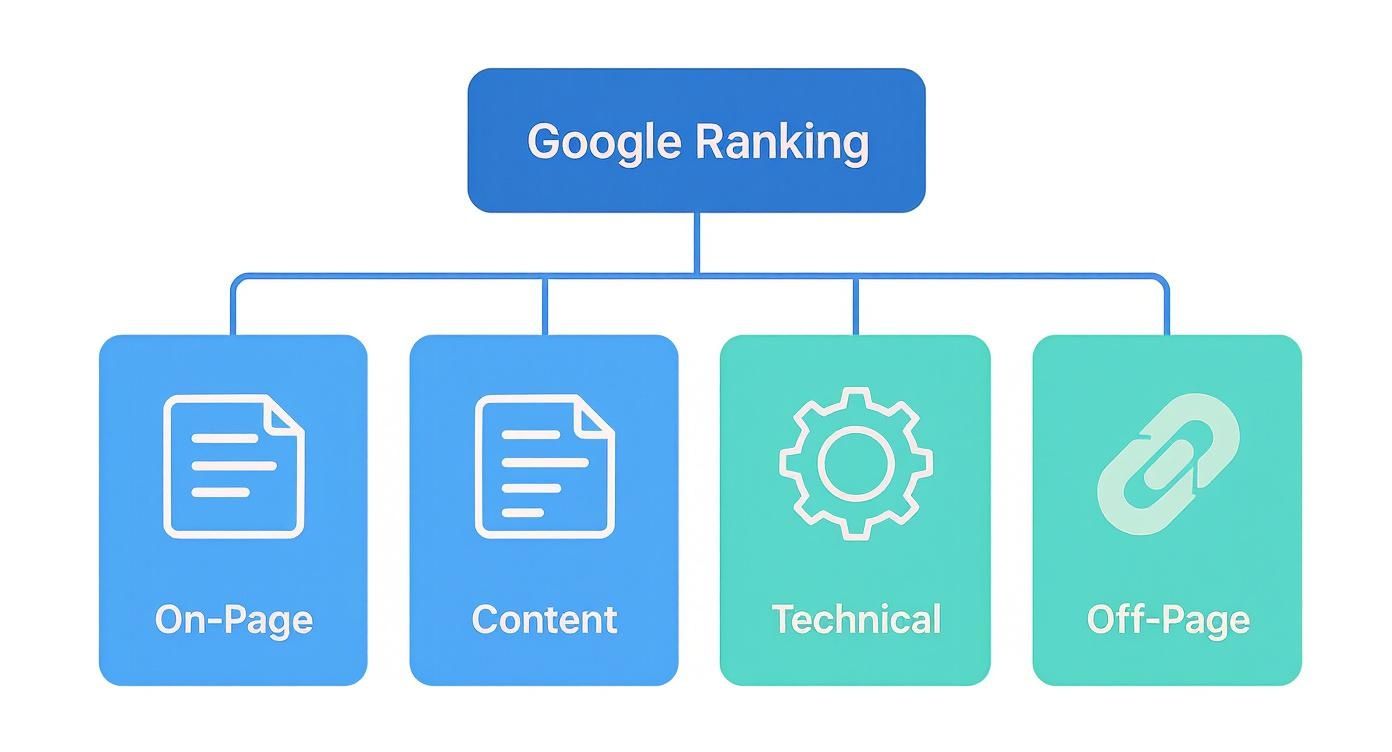
As you can see, On-Page, Content, Technical, and Off-Page SEO are the building blocks. Get these right, and you’re well on your way.
Understanding the Core SEO Pillars
To make real progress, it’s important to understand how each of these pillars supports the others. They don’t work in isolation; they create a powerful combined effect that signals authority and quality to Google. Mastering them is central to modern digital marketing best practices.
Here’s a quick overview to give you a high-level strategic roadmap for what we’ll be diving into.
Core Pillars for Improving Your Google Ranking
| SEO Pillar | Primary Goal | Key Actions |
|---|---|---|
| Content | Satisfy user intent with high-quality, relevant information. | Keyword research, long-form content creation, E-E-A-T signals. |
| On-Page SEO | Make your content easy for search engines to understand. | Title tags, meta descriptions, header tags, internal linking. |
| Technical SEO | Ensure your website is crawlable, fast, and secure. | Site speed optimization, mobile-friendliness, sitemaps. |
| Off-Page SEO | Build authority and credibility across the web. | Backlink acquisition, brand mentions, local SEO citations. |
This table shows how each piece of the puzzle fits together. Excelling in just one area won’t cut it. You need a balanced approach.
Let’s break down what each of these really means in practice:
- Content Quality: This is the heart of your SEO. Your content must be genuinely helpful and solve the searcher’s problem completely. In my experience, a comprehensive 2,000-word article that covers a topic inside and out will almost always outperform a brief 500-word post.
- On-Page SEO: This involves optimizing the elements people see on your page—titles, headings, images, and internal links. It’s your chance to give Google clear signals about your page’s topic, making it easier for them to rank it for the right searches.
- Technical SEO: Think of this as the foundation of your house. It’s the behind-the-scenes work that ensures your site is fast, secure (HTTPS is a must), and easy for search engine bots to crawl and index. A site with technical issues can frustrate users, and Google takes that seriously.
- Off-Page SEO: This is where you build your site’s reputation. It’s mostly about earning backlinks from other high-quality, relevant websites. Each link acts like a vote of confidence, telling Google that others trust your content.
A winning SEO strategy isn’t about being perfect in one pillar. It’s about building a strong, balanced performance across all four. That’s what drives sustainable, long-term growth in search rankings.
By dedicating time to these core elements, you’re not just chasing rankings—you’re building a valuable, long-lasting asset for your business. In the sections ahead, we’ll get into the specific, actionable steps you can take for each one.
Create Content That Google and Readers Actually Want
If you want to improve your Google rankings, you have to think beyond just stuffing keywords into a page. The content you create is the cornerstone of your SEO, and today, that means one thing: solving the searcher’s problem better than anyone else.
The game has changed. SEO used to feel like a purely technical checklist. Now, it’s all about delivering real value and proving you know what you’re talking about through the content you publish.
This means you need a solid grasp of what your audience is really looking for. From there, you have to present that information in a way that’s engaging for people and crystal clear for search engine bots. It’s about becoming the go-to resource in your field.
First, Nail the Search Intent
Before you start writing, you must figure out why someone typed a keyword into Google. This is called search intent, and it’s the most critical piece of the content puzzle.
Are they looking for a quick definition? A detailed product comparison? A step-by-step tutorial? The easiest way to find out is to search for your keyword and see what’s already ranking on page one. That’s your roadmap.
For example, if the top results for “how to fix a leaky faucet” are all videos and how-to guides packed with images, a long essay on the history of plumbing won’t rank. You have to match the format and depth that Google has already determined users want.
Structure Your Content for Scanners
Let’s be real: people don’t read online, they scan. Hitting them with a giant wall of text is the fastest way to send them to the “back” button, which tells Google your page wasn’t a good answer.
Break things up. Use clear, descriptive subheadings (like the ones here). Use short paragraphs, bullet points, and numbered lists to make your key points easy to find.
Your job is to make it incredibly easy for a visitor to find the exact piece of information they came for. A well-structured page keeps people around longer, signaling to Google that you’ve got a high-quality result.
This isn’t just for your human readers. A logical structure with proper H2 and H3 tags helps search engines understand the hierarchy of your content, making it easier for them to rank you for the right searches.
Live and Breathe the E-E-A-T Framework
Google wants to show its users content from sources that have real Experience, Expertise, Authoritativeness, and Trustworthiness. This is what they call the E-E-A-T framework. It’s not a single ranking factor you can tweak, but rather a set of principles that heavily influence their algorithms.
So, how do you show E-E-A-T? You build it right into your content.
- Show Your Experience: Don’t just tell, show. Include original case studies, personal stories, or your own photos and videos. Reviewing a product? Post a picture of you actually using it.
- Demonstrate Expertise: Go deeper than the surface-level information everyone else is saying. Offer original data, unique insights, or detailed explanations that prove you’re an expert.
- Build Authoritativeness: Add author bios with credentials. Get mentions and links from other respected sites in your niche. Consistently publish high-quality content on a core set of topics.
- Establish Trustworthiness: Make your contact information easy to find. Cite your sources. Add customer testimonials. And of course, having a secure website (HTTPS) is non-negotiable.
If you’re serious about creating content that wins in the long run, you really need to understand the power of E-E-A-T. It’s a game-changer for anyone trying to earn meaningful rankings today.
Quality Is the Ultimate Ranking Factor
For a long time, the SEO world was obsessed with backlinks as the most important part of ranking. While they’re still incredibly important, the focus has shifted. In 2018, content quality and its ability to satisfy user intent officially overtook backlinks as the top ranking factor.
The focus now is on earning links from relevant, authoritative sites—not just collecting them. Google has gotten too smart to fall for low-quality link schemes.
This means your primary mission should be to create the single best resource on the internet for your chosen topic. When your content is truly exceptional, the backlinks and social shares will start to happen naturally. Creating genuinely valuable content isn’t just a good idea; it’s the most sustainable SEO strategy there is.
Master On-Page SEO for Immediate Impact
If great content is the heart of your SEO strategy, then on-page optimization is the brain. It’s how you tell Google exactly what your content is about and why it deserves to rank. These are the tangible tweaks and adjustments you can make right now to see a direct impact.
Think of it this way: your title tag and meta description are your billboard on the search results page. They’re your one shot to grab someone’s attention and convince them to click on your result instead of the nine others on the page. Getting this part right is one of the fastest ways to improve your Google ranking.

Nail Your Title Tags and Meta Descriptions
Your title tag is, without a doubt, one of the most critical on-page factors. It’s the clickable headline in the search results, and it has to do a lot of heavy lifting.
A winning title tag is short and sweet (aim for 50-60 characters), includes your main keyword early, and is enticing enough to make someone want to click. A generic title like “Blog Post” is a wasted opportunity. Something like “How to Improve Your Google Ranking | 10 Easy Tips” is infinitely better.
While your meta description doesn’t directly influence your rankings, it’s your marketing copy. This is your chance—in about 155-160 characters—to sell the click. It should back up the promise of your title and give a clear reason why a searcher should visit your page over anyone else’s.
Create a Clear Hierarchy with Header Tags
Header tags (H1, H2, H3) are your best friends for creating a logical flow. They break up long text into scannable sections, which is essential for keeping readers on your page.
- The H1 Tag: Think of this as the title of your book. Each page gets one H1, and it should clearly state the page’s main topic, often mirroring the title tag.
- H2s and H3s: These are your chapters and subheadings. Use H2s for the main sections and H3s to break down points within those sections.
This isn’t just for looks. A clean structure helps Google’s crawlers understand how your content is organized, signaling that you’ve created a user-friendly, well-thought-out resource.
The Untapped Power of Internal Linking
Don’t overlook internal links. These are simply links that point from one page of your site to another, and they are SEO gold. For starters, they are crucial for user navigation, guiding visitors to more of your great content and keeping them on your site longer.
They also help search engines find new pages and, more importantly, understand the relationships between your content. A well-placed internal link can also pass authority—or “link juice”—from a powerful page to a weaker one, giving it a helpful boost.
Pro Tip: Always use descriptive anchor text for your internal links. Instead of a lazy “click here,” link a specific, relevant phrase like “our complete guide to technical SEO.” This gives both users and Google a much clearer idea of where that link is going.
Don’t Let Images Slow You Down
Images are great for engagement, but unoptimized images can kill your page speed—and page speed is a huge ranking factor. Always compress your images before uploading them. You want to shrink the file size as much as possible without making your photo look pixelated.
And please, use descriptive Alt Text. Alt text is what shows up if an image fails to load, and it’s what screen readers use for visually impaired users. For SEO, it’s another chance to tell Google what your page is about. Instead of “image123.jpg,” a good Alt Text for the image above would be something like: “SEO specialist performing on-page optimization to improve Google ranking.” See the difference?
Of course, on-page SEO goes beyond just content. The overall user experience is huge. For more on that, check out this guide to effective website design and UX for SEO, which covers how branding and conversions play a role.
Build Authority That Google Respects
If your on-page SEO is how you talk about yourself, off-page SEO is all about how others talk about you. Specifically, we’re talking about backlinks.
Think of backlinks as votes of confidence. When another reputable website links to your page, it’s sending a strong signal to Google that your content is credible, trustworthy, and valuable. This kind of external validation is a massive factor in climbing the search rankings.
The whole game, often called link building, is about earning these endorsements to build real authority. Forget chasing hundreds of random, low-quality links. In SEO, quality crushes quantity every single time. One solid link from a respected industry blog is worth more than a hundred links from irrelevant sites nobody has ever heard of.

Create Assets People Actually Want to Link To
The most sustainable way to build authority is to create content so good that people can’t help but share and reference it. We call these “link-worthy assets” because their value does most of the hard work for you.
Don’t just write another blog post. Think bigger. Create a resource that genuinely solves a problem or provides unique insight for your audience.
Here are a few types of linkable assets that consistently work:
- Original Data and Research: Run a survey, analyze industry data, or compile unique stats. Journalists and bloggers love citing fresh data, and your study can quickly become the go-to source on a topic.
- The Ultimate Guide: Create the most comprehensive, practical, and well-designed guide on a subject. If it’s truly the best resource out there, it will naturally attract links from others looking for an authoritative reference.
- Free Tools and Templates: A simple online calculator, a downloadable checklist, or a useful template can be an absolute link magnet. They provide immediate value and are easy to share.
When you create something genuinely useful, other people in your space will find it and link to it. That’s how you build a powerful, organic backlink profile that lasts.
Master the Art of Smart Outreach
Of course, creating an amazing asset is only half the job. You have to let the right people know it exists. That’s where smart, strategic outreach comes in. The goal is to find relevant websites that would genuinely benefit from your content and then craft a personalized message that actually gets read.
Forget about those generic, mass-emailed templates. They scream “spam” and get deleted instantly. Your outreach has to show you’ve done your homework.
A successful outreach email isn’t about begging for a link. It’s about offering value. You’re sharing a resource you honestly believe will help their audience, and the link becomes a natural byproduct of that exchange.
When you’re prospecting for sites, look for non-competitors who write for the same audience. Read a few of their recent articles. Do they link out to other resources? In your email, mention something specific you enjoyed about their work before you even think about introducing your own content. Then, briefly explain why your resource is a great fit for their readers. It’s that simple.
Proven Techniques for Earning Quality Links
Beyond creating big assets, there are several active strategies you can use to build your backlink profile. These are tried-and-true methods that, when done right, can give your site’s authority a serious boost. For a deeper dive, Raven SEO has a great guide on how to build backlinks naturally.
For now, here are two of my favorite tactics.
Guest Blogging on Reputable Sites
This involves writing an article for another website in your niche. In return for providing them with excellent, original content, you typically get an author bio with a link back to your site. It’s a true win-win: they get free content, and you get a high-quality, relevant backlink and exposure to a brand-new audience. The key is to be picky—only write for respected blogs that are a perfect match for your expertise.
Broken Link Building
This is a clever and highly effective technique. You start by finding a broken link on another website (one that leads to a 404 error page). Then, you email the site owner, give them a friendly heads-up about their broken link, and suggest your own content as a fantastic replacement. You’re not just asking for something; you’re helping them fix an issue on their site. That makes them far more likely to add your link.
Running a Critical Technical SEO Health Check
While everyone obsesses over content and backlinks, it’s the technical side of SEO that truly forms the bedrock of your site’s performance. Think of it as the engine under the hood. If that engine is sputtering, even the most beautifully designed car isn’t going anywhere.
A technical health check is your diagnostic tool. It ensures search engines can actually find, crawl, and understand your website without hitting frustrating roadblocks. If you’re serious about climbing the Google rankings, this isn’t optional.
Start with Speed and Mobile-Friendliness
Let’s be blunt: a slow website is a dead website. Page speed and how well your site works on a phone aren’t just “nice-to-haves”; they are core ranking factors. Google’s own data reveals that when a page load time jumps from 1 second to 3 seconds, the chance of a visitor leaving skyrockets by 32%.
And with over 60% of all web traffic now coming from mobile devices, a clunky mobile experience is a surefire way to get pushed down in the search results. A slow site doesn’t just annoy users—it sends a clear negative signal to Google.
Your website’s speed is one of the first impressions you make. A fast, responsive site tells both users and Google that you are professional and care about the user experience, which is a massive trust signal.
Fortunately, you don’t have to guess what’s slowing you down. A great place to start is Google’s own PageSpeed Insights. It gives you a detailed report card for both mobile and desktop, pointing out exactly what needs fixing.
This report tells you where to focus your energy, whether it’s compressing images, speeding up your server, or getting rid of code that blocks the page from loading.
Guide Google with Sitemaps and Robots.txt
You can’t just hope Google stumbles upon all your important pages. You have to hand them a map. That’s exactly what an XML sitemap does—it’s a simple file that lists all the key URLs on your site, telling search engines what you want them to crawl and index.
On the flip side, a robots.txt file tells them which areas to stay away from. This is perfect for blocking things like admin login pages, duplicate content, or internal search results you don’t want showing up in Google. A properly set up robots.txt file also keeps Google from wasting its “crawl budget” on unimportant pages.
Here’s the simple breakdown:
- XML Sitemap: Your friendly invitation to Google, saying, “Hey, these are the important pages—please take a look!”
- Robots.txt: Your polite bouncer, saying, “Thanks, but these areas are off-limits.”
Getting these two files right is a fundamental step in making your site easy for search engines to understand. For a deeper dive, check out our guide on the 5 essential technical checks for a new website.
Secure Your Site with HTTPS
Security isn’t just an IT issue; it’s an SEO issue. HTTPS encrypts the connection between a user’s browser and your website, and Google has long confirmed it as a ranking signal. It might be a small one, but it matters.
More importantly, that little padlock icon in the address bar is a huge trust signal for visitors. When a browser flags a site as “Not Secure,” it’s an instant turn-off for potential customers. If your site is still on HTTP, making the switch should be your number one priority.
Maintain a Logical URL Structure
Finally, take a look at your URLs. They should be clean, logical, and easy for both people and search engines to read. A well-crafted URL gives you a clue about what the page is about before you even click it.
Just look at the difference:
- Bad URL:
raven-seo.com/index.php?category_id=12&article=4567 - Good URL:
raven-seo.com/blog/technical-seo-health-check
The second one is instantly clear. It uses relevant keywords and has a logical hierarchy. It’s a small detail, but a clean URL structure improves the user experience and makes your site’s architecture more transparent to Google, helping you build a stronger foundation for ranking.
Got Questions About Climbing the Google Ladder? We’ve Got Answers
Even when you have a solid plan, SEO can feel like a moving target. It’s natural to have questions pop up along the way. Getting clear on the answers will help you set realistic expectations and focus your energy where it truly counts.
How Long Does It Really Take to See Results?
This is the million-dollar question every client asks, and the honest answer is: it depends. There’s no switch to flip for instant SEO success. While you might notice small bumps from on-page tweaks in a few weeks, significant, lasting rank improvements usually take 4 to 12 months of consistent effort.
What makes the timeline so variable? It boils down to a few key things:
- Your Starting Point: A well-established website with years of authority will see momentum much faster than a brand-new domain.
- The Competition: Trying to rank for “best credit cards” is a completely different ballgame than “emergency plumber in Toledo.” The tougher the competition, the longer the climb.
- Your Commitment: The resources you invest—whether that’s time spent creating incredible content or a budget for link building—will directly affect your progress.
SEO is a marathon, not a sprint. The real win isn’t a temporary spike in traffic; it’s building a trusted resource that brings in steady, sustainable growth for years to come.
Can I Actually Improve My Ranking for Free?
Absolutely. While paid tools can speed up research, the most powerful SEO activities are completely free. Your biggest investment is your time and expertise.
Think about it: creating genuinely helpful, in-depth content doesn’t cost anything but your knowledge. The same goes for mastering the fundamentals of on-page SEO, like writing compelling title tags and structuring your articles for readability. Even manual link-building outreach can be done without spending a cent.
Plus, fantastic tools like Google Search Console give you a goldmine of data for free. If you want to dig deeper, check out these expert Google Search Console tips from our free guide to uncover hidden opportunities.
What’s the Single Most Important Google Ranking Factor?
If I had to bet on one thing, it’s this: high-quality content that satisfies user intent. At its core, Google’s mission is to give people the best possible answer to their questions. If your page fulfills that promise better than anyone else, you’ve laid the strongest foundation for ranking.
Everything else—technical health, backlinks, site speed—is there to support and amplify that great content. You can have a technically flawless site with a thousand backlinks, but if the content is thin and unhelpful, it’s just not going to stick on page one.
Does My Website’s Design Affect My Google Ranking?
Yes, but indirectly. Google’s bots don’t have an opinion on your color scheme, but a poor user experience will sink your rankings. A confusing layout, painfully slow-loading pages, or a design that breaks on mobile phones will send visitors running for the back button.
This behavior signals to Google that users aren’t finding what they need. Metrics like a high bounce rate or low “time on page” tell the algorithm your content isn’t engaging. So, a clean, fast, and intuitive design is crucial—it keeps people on your site long enough to appreciate the awesome content you’ve created.
Ready to stop guessing and start ranking? The team at Raven SEO builds practical roadmaps to increase your website’s visibility, traffic, and conversions. Get in touch today for a no-obligation consultation and let’s build a strategy that works for your business.