

Measuring return on marketing investment (ROMI) is a surprisingly simple calculation on the surface: subtract your marketing costs from the revenue generated by marketing, then divide that by your total marketing costs.
But that simple formula holds the key to transforming your marketing efforts from a line item on the expense sheet into a predictable, profit-driving engine. It tells you exactly how much revenue each marketing dollar generates.
Why ROMI Is Your Most Important Marketing Metric
Let’s be real—marketing budgets are always under a microscope. Every dollar needs to be justified, and vague promises of “brand awareness” just don’t fly in the boardroom anymore.
This is where measuring return on marketing investment becomes your superpower. It completely reframes the conversation from costs to contributions.
Instead of seeing marketing as an isolated expense, ROMI frames it as a direct investment in business growth. When you can confidently show that for every $1 you spend, the company gets $5 back, you’re not just running campaigns; you’re building a revenue machine. That clarity is what earns trust from leadership and unlocks bigger budgets.

From Cost Center to Revenue Driver
For years, marketing was often pigeonholed as a “cost center”—a necessary but expensive part of doing business. The true financial impact was often murky, especially for activities that didn’t lead to an immediate sale. ROMI completely shatters this perception by connecting specific marketing actions to tangible financial results.
This data-driven approach gives marketing leaders the power to:
- Justify Budget Requests: Armed with solid ROMI data, you can build an undeniable business case for more investment, showing exactly what the expected return will be.
- Optimize Campaign Spending: By seeing which channels deliver the highest returns, you can strategically shift funds from underperforming areas to your most profitable campaigns. For example, understanding the return on investment of SEO helps justify putting resources into a powerful long-term strategy.
- Build a Culture of Accountability: When the whole team is focused on ROMI, every decision gets measured against its potential to drive revenue. This fosters a much more strategic and results-oriented mindset.
The ability to demonstrate tangible value is no longer a ‘nice-to-have’ for marketers; it is a critical function for strategic growth and securing a seat at the leadership table.
The Growing Demand for Measurable Results
The pressure to prove marketing’s worth isn’t just an internal feeling; it’s a massive industry trend. The demand for accountability has never been higher.
In fact, as of 2025, a staggering 83% of marketing leaders consider demonstrating ROI their top priority. That’s a huge leap from just 68% back in 2020. This 15-percentage-point jump shows a fundamental shift in thinking: marketing is now viewed as a core business investment that absolutely must justify its costs.
What this means is that marketers who master the art of measuring ROMI aren’t just more effective—they are infinitely more valuable to their organizations. They can speak the language of the C-suite, confidently tie their work to the bottom line, and lead their companies toward more profitable growth. The rest of this guide will give you the practical framework to do just that.
Setting the Stage for Accurate ROMI Measurement
Jumping straight into calculations without a solid plan is like building a house without a foundation—the results are bound to be shaky and unreliable. Before you can get a meaningful figure for your return on marketing investment, you need to lay some essential groundwork. This initial effort ensures every dollar you track is tied directly to a clear business outcome.

The entire process kicks off by establishing crystal-clear marketing objectives. Fuzzy goals like “increase brand awareness” or “get more leads” are impossible to measure with any real accuracy. Instead, every single campaign needs a specific, quantifiable target that connects directly to your company’s bottom line.
Define Your Objectives with the SMART Framework
The best way I’ve found to create measurable goals is by using the SMART framework. It’s a simple but incredibly powerful tool that forces you to define exactly what success looks like before you even start a campaign.
Here’s how it breaks down:
- Specific: Your goal needs to be unambiguous. Instead of “improve social media,” a specific goal would be “increase qualified leads from LinkedIn.”
- Measurable: You have to be able to track your progress with real numbers. For example, “increase qualified leads from LinkedIn by 25%.”
- Achievable: The goal should be realistic given your resources and timeline. A 25% increase is ambitious but possible; a 500% increase might be setting yourself up for failure.
- Relevant: The objective must align with bigger business goals, like boosting overall sales revenue.
- Time-bound: Give yourself a clear deadline. “Increase qualified leads from LinkedIn by 25% in Q3.”
This simple exercise transforms a vague idea into a concrete target. Once you know you’re aiming for a 25% lift in leads from a specific channel within a set timeframe, you have a solid benchmark for measuring your return. Before diving into the ROMI formula itself, it’s worth understanding the broader landscape of advertising effectiveness, as detailed in this guide to Mastering Advertising Effectiveness Measurement.
Assign Monetary Value to Your Conversions
With your goals set, the next critical step is to assign a dollar value to every conversion. This is where a lot of businesses stumble, especially when they’re dealing with actions that aren’t a direct sale. But trust me, attributing value here is essential for an accurate ROMI calculation.
Some conversions are easy. If an e-commerce campaign leads to $5,000 in direct sales, that’s your revenue figure. Simple. But what about all the actions that happen earlier in the customer journey?
These “micro-conversions” still hold significant value because they move a prospect one step closer to becoming a paying customer. For a deeper dive on this, check out our guide on how to measure digital marketing success. You need to figure out the worth of actions like:
- A lead magnet download
- A webinar sign-up
- A contact form submission
- A free trial request
Don’t just track the final sale. Assigning a value to every step in your marketing funnel gives you a much richer, more accurate picture of your total marketing-generated revenue.
A practical way to do this is by working backward from a sale. For instance, if you know that 1 out of every 10 webinar attendees becomes a customer with an average order value of $500, then each webinar sign-up is worth $50 ($500 / 10). If 1 in 20 people who download an e-book eventually buy, then each download is worth $25. This straightforward math connects your top-of-funnel activities directly to the bottom line.
Calculate Customer Lifetime Value
For an even more powerful way to measure ROMI, you need to look beyond the first purchase and calculate your Customer Lifetime Value (CLV). CLV represents the total revenue you can reasonably expect from a single customer over the entire course of their relationship with your business.
Knowing your CLV helps you see the long-term return of your marketing. A campaign might look like it has a low initial return, but if it brings in customers who make repeat purchases for years, its true ROMI is much, much higher.
You don’t need complicated software to get a basic CLV. A simple formula works just fine:
(Average Purchase Value) x (Average Purchase Frequency) x (Average Customer Lifespan)
Let’s say a customer spends an average of $100 per purchase, buys 4 times a year, and sticks with you for 3 years. Their CLV is $1,200 ($100 x 4 x 3). When you start using CLV instead of single-purchase revenue in your ROMI calculations, you get a far more strategic and accurate view of your marketing’s true impact.
Breaking Down the Core ROMI Formula
At its heart, the math for measuring your return on marketing investment isn’t all that complicated. The core formula is straightforward, but it’s powerful. It gives you a clear percentage that tells you one simple thing: is your marketing making you money?
The formula looks like this: (Revenue Attributable to Marketing – Marketing Costs) / Marketing Costs
You’ll usually multiply the result by 100 to get a nice, clean percentage. A positive number means you’re in the green; a negative one means you’re losing money on that campaign. Simple, right? The real challenge, and where most people get tripped up, is figuring out what numbers to plug in for “costs” and “revenue.”
What to Include in Your Marketing Costs
To get an honest ROMI figure, you have to look beyond just what you spent on ads. A truly comprehensive view of your marketing costs is the only way to get a real picture of your total investment. Forgetting to track certain expenses will artificially inflate your return, giving you a false sense of success that can lead to bad decisions down the road.
Your “Marketing Costs” should be a complete tally of every single dollar spent to get your campaign off the ground and in front of customers.
Here’s a checklist to get you started:
- Direct Ad Spend: This is the obvious one—the money you pay directly to platforms like Google, Meta, or LinkedIn for your ads.
- Agency and Freelancer Fees: If you’re outsourcing any part of your marketing, from SEO to content creation, those retainer or project fees are a core marketing cost.
- Marketing Technology and Software: Don’t forget the subscriptions for your tools. This includes your email platform, CRM, social media schedulers, analytics software, and any other tech that makes your marketing engine run.
- Content Creation Costs: Account for any money spent producing assets, like graphic design work, video production, or fees for stock photography.
- Team Salaries: This is so often overlooked, but it’s critical. You should attribute a portion of your marketing team’s salaries to the campaign’s cost, proportional to the time they spent working on it.
By adding all of these pieces up, you move from a surface-level guess to a genuinely accurate financial analysis of what you’re putting in.
Accurately Attributing Revenue
The other side of the coin, revenue, demands just as much attention. Pinning sales directly to specific marketing efforts is where many businesses get stuck. Luckily, modern tools have made this much easier than it used to be.
Using platforms like Google Analytics is essential for connecting what happens on your website back to the source. Proper tracking lets you see which channels—organic search, paid ads, social media, or email—are actually driving the most valuable actions. For a deeper dive, check out our guide to understanding Google Analytics 4 key reports for data-driven insights.
To really nail your calculations, it helps to see how experts approach the details. For a more comprehensive guide on this, I’d recommend reading up on how to measure marketing ROI the right way. It’s a great breakdown of the nuances involved.
A classic mistake is giving 100% of the credit to the very last click. A customer might see a social media ad, read a blog post a week later, and then finally click a Google Ad to make a purchase. All those touchpoints played a role in the sale, and a good attribution model helps you assign credit where it’s due.
A Real-World ROMI Calculation Example
Let’s walk through a practical scenario to see how this all comes together. Imagine an e-commerce brand that sells handcrafted leather goods runs a targeted Instagram ad campaign for one month to promote a new line of wallets.
Here’s how we can break down the ROMI calculation for this specific campaign in a clear, easy-to-follow table.
Sample ROMI Calculation for an E-commerce Campaign
| Metric | Description | Value |
|---|---|---|
| Instagram Ad Spend | Direct cost paid to Meta for running the ads. | $2,000 |
| Content Creation | Cost for the product photoshoot and promotional video. | $500 |
| Team Salary (Portion) | A portion of the marketing manager’s salary for their time. | $1,000 |
| Software Subscription | Pro-rated cost of the social media scheduling tool. | $50 |
| Total Marketing Costs | The sum of all expenses related to the campaign. | $3,550 |
| Attributed Revenue | Total sales directly generated from the Instagram campaign. | $15,000 |
| Gross Profit | Revenue minus the total marketing costs. | $11,450 |
| ROMI | (Gross Profit / Total Marketing Costs) x 100 | 322.5% |
Let’s plug those numbers into the formula to see how it works step-by-step.
1. Calculate Total Marketing Costs:
The brand added up everything: the $2,000 ad spend, $500 for content, $1,000 of team time, and $50 for software. Their total investment was $3,550.
2. Track Attributed Revenue:
Using their e-commerce and analytics platforms, they tracked all sales that came directly from clicks on the Instagram campaign. Over the month, those ads generated $15,000 in wallet sales.
3. Apply the ROMI Formula:
- Formula: ($15,000 – $3,550) / $3,550
- Calculation: $11,450 / $3,550 = 3.225
- ROMI Percentage: 3.225 x 100 = 322.5%
This means for every $1 the brand invested in this campaign, they generated $3.23 in profit. That’s a clear, compelling number that proves the campaign was a huge success and justifies putting more budget into that channel in the future.
Making Sense of Marketing Attribution Models
In a perfect world, a customer would see your ad, click it, and buy immediately. Simple. But we all know the real customer journey is a winding road.
A potential customer might first see your brand in a Facebook post, then read a blog article a week later after a Google search, and finally click a link in your email newsletter to make a purchase. With so many touchpoints, a huge challenge arises: who gets the credit?
This is where marketing attribution models come into play. Think of them as different rulebooks for assigning value to the various touchpoints that lead to a sale. Picking the right one is absolutely critical for figuring out which of your marketing channels are actually making a difference.
The core idea is to understand how your revenue connects back to your spending, which is the heart of calculating your Return on Marketing Investment.
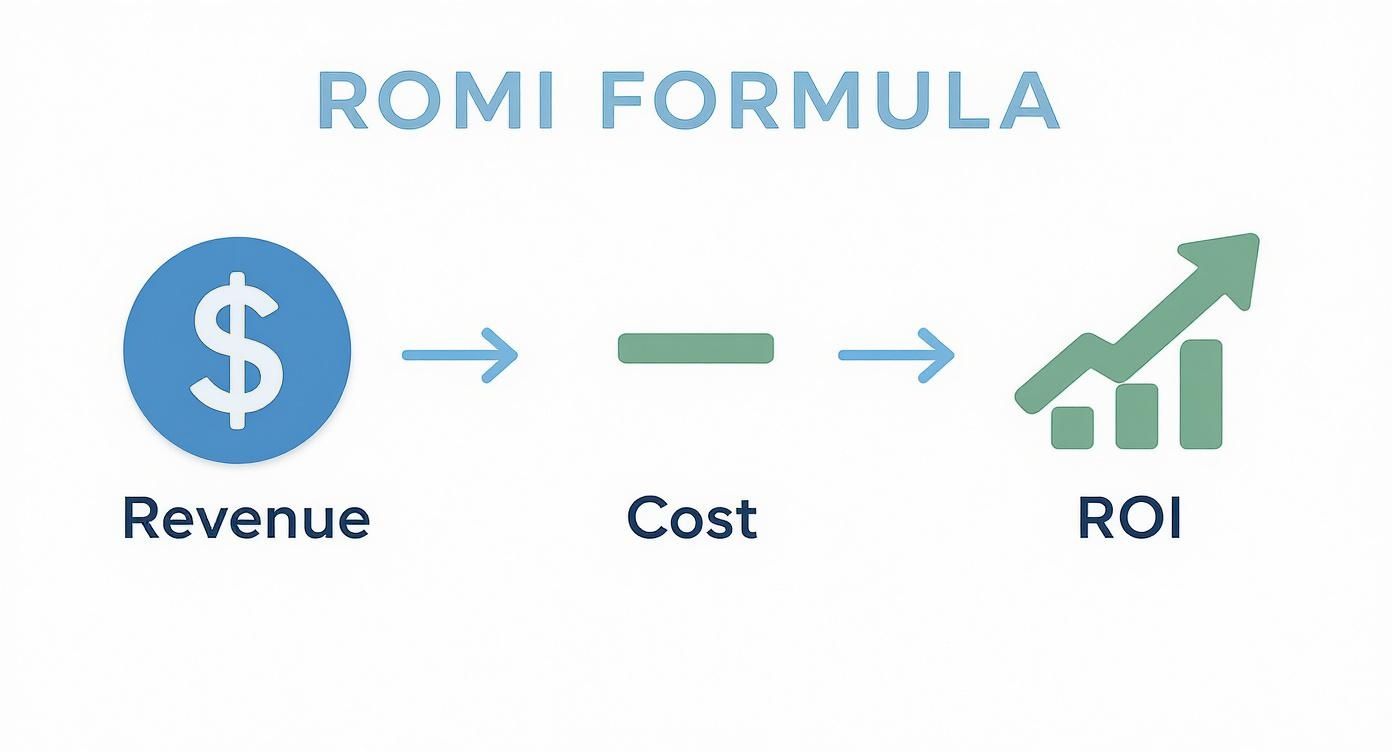
This formula seems straightforward, but accurately defining the “Revenue” part for each channel depends entirely on your attribution model. Let’s break down the most common approaches.
Single-Touch Attribution Models
The easiest way to get started is by giving 100% of the credit to a single, decisive touchpoint. While these models are simple to set up and understand, they paint an incomplete picture of the customer’s journey.
There are two main types:
- First-Touch Attribution: This model gives all the credit to the very first interaction a customer had with you. It’s great for understanding which channels are bringing new people into your orbit. If your main goal is awareness or top-of-funnel lead generation, this model can give you some quick insights.
- Last-Touch Attribution: The polar opposite. This model assigns all the credit to the final touchpoint right before the conversion. It’s best for figuring out what’s closing the deal. E-commerce businesses with short sales cycles often lean on this one, as that last click is usually the final push needed for a purchase.
The biggest flaw with single-touch models is their massive blind spot. They completely ignore every other interaction, which can lead you to undervalue the channels that assist in the middle of the journey, nurturing leads toward a final decision.
Multi-Touch Attribution Models
To get a more balanced and realistic view, most businesses eventually move to multi-touch attribution. These models recognize that multiple interactions contribute to a sale and spread the credit around. They give you a much more nuanced look at how all your marketing channels work together as a team.
Here are a few of the most popular multi-touch models:
- Linear Model: This is the simplest of the bunch. It splits the credit equally across every single touchpoint. If a customer saw a blog post, a Facebook ad, and an email before buying, each one gets 33.3% of the credit. It’s a solid starting point if you believe every interaction plays an equal role.
- Time-Decay Model: This model gives more credit to the touchpoints that happened closer to the sale. The interaction right before the purchase gets the most credit, while the very first touchpoint gets the least. It’s especially useful for businesses with longer sales cycles, as it puts a bigger emphasis on what finally got the customer to pull the trigger.
- U-Shaped (Position-Based) Model: This hybrid model gives the most credit to two critical moments: the first touch that created awareness and the touch that generated the lead. It often gives 40% of the credit to each of those, then splits the remaining 20% among all the other interactions in between.
Choosing the right approach is a huge step toward accurately measuring what’s working. For businesses ready to dig deeper than these basic models, our guide on cross-channel marketing attribution offers a more advanced look at these concepts.
Ultimately, there’s no single “best” model—it all depends on your business goals, sales cycle, and customer behavior. My advice? Start simple. A last-touch or linear model is often enough to begin gathering data. As your marketing gets more sophisticated, you can experiment with more advanced models to get an even clearer picture of your ROI.
Measuring ROI Across Different Marketing Channels
Calculating your overall marketing return is a great starting point, but the real insights come from zooming in on individual channels. Not every platform is created equal. What drives incredible returns for one business might completely fall flat for another.
Understanding the unique ROI story of each channel is how you shift from simply spending a budget to strategically investing it.

Naturally, different channels need different measurement approaches. The metrics that matter for a fast-paced paid ad campaign are worlds away from what you’d track for a long-term content marketing strategy. By applying a channel-specific lens, you can uncover hidden opportunities and trim the fat with confidence.
The Unbeatable ROI of Email Marketing
When it comes to delivering consistent and frankly staggering returns, email marketing remains in a class of its own. It’s a channel you fully own, giving you a direct line of communication with an audience that has already raised their hand to hear from you. This is precisely why it performs so well.
Year after year, email marketing proves its worth, delivering an average ROI of $42 for every $1 spent. That’s a remarkable 4,200% return, making it one of the most cost-effective channels available to any business.
To get a clear picture of its ROI, you need to track:
- Costs: This includes the monthly fee for your email service provider (like Mailchimp or Klaviyo), any money spent on template design, and the time your team spends writing and managing the campaigns.
- Revenue: Use your platform’s built-in conversion tracking or simple UTM parameters in your links to directly attribute sales that come from clicks within your emails.
Calculating ROI for Content and SEO
Content marketing and SEO are the marathon runners of the marketing world. Their path to ROI is less direct, but the value is immense and long-lasting. A single, well-crafted blog post can attract organic traffic and generate leads for years after you hit “publish.”
Because of this long-tail effect, measuring the return requires looking beyond immediate sales. The key is to focus on metrics that show how your content influences the entire sales pipeline.
Instead of just tracking the final sale, assign value to actions like:
- Lead Generation: How many new subscribers or demo requests did a specific piece of content generate?
- Lead Quality: Of those new leads, what percentage turned into Marketing Qualified Leads (MQLs) or even Sales Qualified Leads (SQLs)?
- Assisted Conversions: In Google Analytics, you can see how often a blog post or guide showed up as a touchpoint in a customer journey that eventually led to a sale.
For content and SEO, the goal is to measure cumulative value over time. Don’t judge a blog post’s worth after one week; analyze its performance over six months or a year to see its true financial impact.
Tracking Returns from Paid Advertising Channels
Paid channels like Google Ads and social media advertising offer the most direct and immediate ROI tracking. These platforms are built around performance metrics, making it relatively straightforward to connect your ad spend directly to tangible outcomes.
Your success here boils down to meticulous tracking and relentless optimization.
For platforms like pay-per-click (PPC), the metrics that matter most are:
- Return on Ad Spend (ROAS): This is your north star. It shows you the gross revenue generated for every single dollar you spend on ads.
- Cost Per Acquisition (CPA): This tells you exactly how much it costs, on average, to acquire one new customer through your campaigns.
- Conversion Rate: This measures the percentage of people who click your ad and actually complete the goal you set, whether that’s making a purchase or filling out a form.
Effectively managing these metrics is the difference between a profitable campaign and a money pit. For anyone looking to sharpen their strategy, our guide on Google Ads best practices offers actionable tips for improving campaign performance.
By breaking down your marketing mix and analyzing each channel’s performance, you can make smarter, data-driven decisions that fuel sustainable growth.
Got Questions About Marketing ROI? We’ve Got Answers.
Even with a solid framework, you’re going to hit some snags when you start measuring your return on marketing investment. It’s just part of the process. This last section is all about tackling those common sticking points with direct, no-fluff answers. Think of it as your quick-reference guide for the real world of ROI tracking.
How Often Should I Actually Be Checking My Marketing ROI?
There’s no single right answer here—it all comes down to the rhythm of the specific marketing channel you’re looking at. If you try to measure a long-term play like SEO on a weekly basis, you’ll just drive yourself crazy with misleading data. You have to match your review schedule to the channel’s natural pace.
For channels that move fast and can burn through a budget in days, you need to be checking in more often.
- Weekly Reviews: This is perfect for paid ad campaigns on platforms like Google Ads or Meta. The feedback loop is quick, letting you spot trends, shift your budget, and tweak ad creative before you waste serious cash.
- Monthly or Quarterly Reviews: This cadence is much better suited for long-term investments like SEO and content marketing. These strategies are all about building value over time, so looking at them weekly is pointless. A monthly or quarterly check-in gives you a strategic, high-level view of how they’re impacting traffic, leads, and revenue.
What’s a “Good” Return on Marketing Investment, Anyway?
This is the million-dollar question, and the honest-to-goodness answer is: it depends. There isn’t some magic number that works for every business. A “good” ROMI is tied directly to your industry, your business model, and most importantly, your profit margins. A software company with high margins can do just fine with a lower ROMI, while an e-commerce store with razor-thin margins needs a much higher return to stay profitable.
That said, a generally accepted benchmark for a solid return is a 5:1 ratio. This means you’re bringing in $5 in revenue for every $1 you spend. If you’re hitting a 10:1 ratio, that’s considered exceptional.
But here’s the real secret: the goal isn’t to hit some arbitrary industry number. The real goal is to consistently improve your own ROMI. A good return is one that makes your business profitable and gets a little better month after month.
How Can I Measure ROI for Things Like Brand Awareness?
It can feel a bit abstract trying to measure the return on campaigns that aren’t built to drive immediate sales—like brand awareness initiatives—but it’s definitely doable. You just have to shift your focus from direct revenue to valuable proxy metrics. These are the top-of-funnel signals that tell you the campaign is working to capture attention and build brand recognition.
Instead of looking for sales, you should be measuring the lift in metrics like these:
- Branded Search Volume: Are more people typing your company’s name directly into Google?
- Website Direct Traffic: Are you seeing an increase in visitors who type your URL straight into their browser?
- Social Media Engagement: Track the growth in followers, shares, comments, and overall reach.
- Share of Voice: How often is your brand being mentioned online compared to your competitors?
By tracking these numbers before, during, and after your campaign, you can clearly demonstrate its impact. While you can’t always slap a hard dollar value on it, showing a 30% jump in branded searches is powerful proof that your investment is working.
What Are the Best Tools for Tracking Marketing ROI?
You don’t need a massive, expensive tech stack to get started. In fact, most businesses can get surprisingly far with free or low-cost tools they probably already have access to. The trick is to start simple and only bring in more advanced platforms as your needs actually demand them.
For most small to medium-sized businesses, this is the starter toolkit you need:
- Google Analytics: This one is non-negotiable. It’s the most powerful free tool out there for tracking website traffic, seeing how users behave, and attributing conversions back to where they came from.
- Spreadsheets: Never underestimate a well-organized Google Sheet or Excel file. It’s the perfect place to consolidate your costs, track revenue from different channels, and run your final ROMI calculation.
- Platform-Specific Analytics: The dashboards inside Google Ads, Meta Business Suite, and your email marketing platform are treasure troves of channel-specific data.
As you grow, you might graduate to more integrated solutions. CRMs and marketing automation platforms like HubSpot or Salesforce offer more sophisticated, all-in-one attribution and reporting that can give you a much deeper view of your entire customer journey.
Ready to stop guessing and start measuring the true impact of your marketing? The team at Raven SEO specializes in creating data-driven strategies that deliver measurable results. We’ll help you track your ROI, optimize your campaigns, and turn your marketing into a predictable revenue engine. Get in touch today for a no-obligation consultation.