
Figuring out your exact Twitter ads cost can feel like trying to hit a moving target. There’s no simple price list to consult. Instead, X (formerly Twitter) operates on a live auction system. This means the price you pay depends on your goals, your target audience, and how much competition you’re up against at that moment.
This guide provides an educational breakdown of how X advertising works, making it easy to read and understand. As a general rule, you can expect to pay anywhere from $0.50 to $4.00 per result. But what counts as a “result” is entirely up to you—it could be a click, a new follower, or a specific engagement on your tweet.
Breaking Down the Average Twitter Ads Cost
Understanding what you’ll spend on X ads starts with one simple question: What are you trying to accomplish? Different goals come with different price tags.
The platform gives you a whole menu of ad types to choose from. You can run Promoted Ads to get more eyeballs on a specific tweet, or you could launch Follower Ads designed specifically to grow your audience. This flexibility is at the heart of the X advertising model.
This variety lets you align your spending directly with your business objectives, a core principle of any smart paid advertising strategy. The goal isn’t just to throw money at the platform; it’s to invest it where it will generate the most value for your brand.
Average Twitter Ad Costs by Campaign Goal
To give you a clearer picture, here’s a quick, easy-to-read rundown of typical cost benchmarks you can expect for different campaign goals on X.
| Campaign Objective | Average Cost Per Result (USD) |
|---|---|
| Promoted Tweet Engagements | $0.38 – $2.00 per engagement |
| Follower Campaigns | $1.50 – $4.00 per follower |
| Website Clicks/Conversions | $0.50 – $3.50 per click |
| App Installs | $1.00 – $5.00 per install |
| Video Views | $0.01 – $0.06 per view |
These numbers give you a solid starting point for budgeting and show how competitive the platform can be, especially for objectives like video views.
The official X Ads platform is built around these goals, guiding you through the setup process.
As you can see, the interface prompts you to choose a specific goal right from the start, whether it’s “Website traffic” or “Engagements.” This choice directly shapes how the platform spends your budget and what you’ll ultimately pay for each result.
How the Twitter Ad Auction Actually Works
To get a real grip on your Twitter ads cost, you have to understand how the platform decides what you’ll pay. It’s not a simple price tag. Think of it more like a lightning-fast auction for a spot on a user’s timeline. The moment someone opens X, an auction kicks off to decide which ads they’ll see.
Your ad’s success in this split-second battle isn’t just about who throws the most money at it. X uses what’s called a “second-price auction.” This means if you win, you don’t actually pay what you bid. Instead, you pay just $0.01 more than the next-highest bidder. It’s a clever, educational system designed to keep prices competitive.
Winning the Bid: It’s Not Just About Your Wallet
Two things really decide whether you win this auction: your bid and your ad quality score.
Your bid is simple: it’s the most you’re willing to shell out for a specific action, like a click or a new follower. The ad quality score, however, is X’s judgment call on how relevant and engaging your ad will be to the people you’re trying to reach.
Here’s the kicker: a top-notch, relevant ad can actually beat out a competitor with a higher bid. This setup is great because it rewards advertisers for making compelling content, not just for having the deepest pockets. It’s a core principle you’ll find on most pay-per-click platforms; our guide on Google Ads best practices shows how similar ideas work over there.
Core Pricing Models
When you build a campaign, you get to choose how you pay based on what you want to achieve. It’s like deciding whether to pay for groceries by the item or for the whole cart—each approach fits a different goal. These are the main models:
- Cost Per Engagement (CPE): You pay any time a user interacts with your ad—a like, reply, retweet, click, or follow. This is your go-to for sparking conversation and interaction.
- Cost Per Mille (CPM): This one’s straightforward. You pay a flat rate for every 1,000 times your ad is shown (impressions). It’s perfect for brand awareness campaigns where just getting eyeballs on your ad is the win.
- Cost Per Click (CPC): You only pay when someone clicks a link in your ad. This is the ideal model for driving traffic directly to your website.
One of the biggest shake-ups impacting these costs has been the massive drop in the cost-per-thousand impressions (CPM). Before the platform’s acquisition in October 2022, X’s CPM hovered around $5.77. By October 2023, it had plunged over 75% to just $0.51.
This volatility has unexpectedly made X one of the most budget-friendly social media platforms out there, especially for advertisers who want to maximize their reach. You can see how these ad prices compare across different platforms on Statista.com. Getting these fundamentals down gives you the power to make smarter, more cost-effective moves for your campaigns.
The 6 Key Factors Driving Your Ad Spend
Ever wonder why some advertisers seem to pay pennies for results while others shell out dollars for the exact same thing? Your final Twitter ads cost isn’t pulled out of a hat. It’s the direct result of several key factors playing out in X’s super-fast ad auction.
Think of it like adjusting the settings on a high-end camera. Small tweaks to the aperture, shutter speed, and focus can totally change the final picture. In the same way, adjusting the levers of your ad campaign can have a huge impact on your budget. Let’s break down the six most important factors you can actually control in this easy-to-read section.
Your Audience Targeting and Bidding Strategy
Who you’re trying to reach is one of the biggest cost drivers, period. A broad, general audience might be cheaper to reach per person, but a highly specific, in-demand group—like CEOs in the tech industry—will have way more advertisers competing for their attention. That competition drives up the price.
This is exactly where knowing how to create buyer personas becomes so valuable. A well-defined persona helps you target effectively without getting so narrow that your costs go through the roof. For a deeper dive, check out our guide on how to create buyer personas to really nail down your approach.
Your bidding strategy works hand-in-hand with your targeting. You can let X’s algorithm bid automatically to squeeze the most results from your budget, or you can set a manual bid to control the absolute maximum you’re willing to pay per action. Automatic bidding is a great starting point, while manual bidding offers more precise control for experienced advertisers aiming for a specific cost-per-acquisition.
Ad Quality and Competition
X, just like every other platform, rewards high-quality, engaging ads with lower costs. It’s that simple. An ad that gets a ton of likes, retweets, and clicks signals to the algorithm that users actually find it relevant. This “quality score” gives your ad a serious edge in the auction, often letting you win placements even against people bidding more than you.
The infographic below shows how your bid and ad quality combine to determine what you ultimately pay.
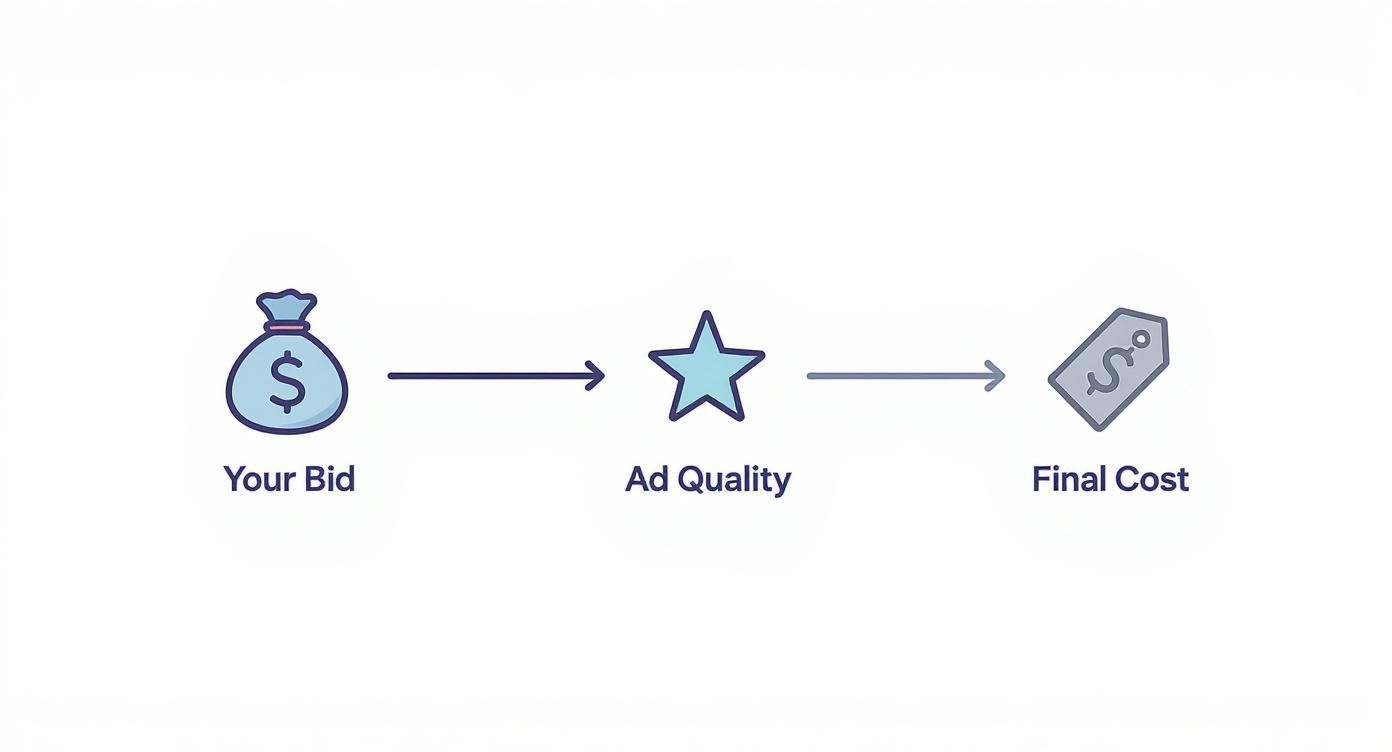
As you can see, a strong quality score can effectively lower what you need to bid. This makes engaging, well-designed creative a powerful cost-saving tool.
Of course, competition also plays a massive role. Trying to advertise during major holidays like Black Friday or a global event like the World Cup means more advertisers are bidding, which drives up costs. If your budget is tight, think about running campaigns during less competitive “off-peak” times.
Ad Format and Placement
Finally, what you show and where you show it matters. Different ad formats come with different costs and are built for different goals.
- Video Ads: Often have a very low cost-per-view, making them excellent for broad awareness campaigns where you just need to get eyeballs on your brand.
- Image Ads: These are great for driving clicks to a website or a landing page, with costs that vary based on the creative and the call-to-action.
- Carousel Ads: Let you showcase multiple products or features in a single ad unit. Perfect for e-commerce or telling a short story.
Ad placement refers to where your ad appears on the platform, like in user timelines, search results, or on profiles. While you have less direct control over this, the platform’s algorithm will work to optimize placements based on where your ad is most likely to perform well.
By mastering these six elements, you can take direct control over your ad spend and start making smarter, more efficient investments.
Proven Strategies to Lower Your Twitter Ad Costs
Knowing what drives your Twitter ads cost is one thing. Turning that knowledge into a playbook that actually saves you money? That’s the real goal.
Now, let’s get tactical. It’s time to roll up our sleeves and look at the proven, educational strategies you can use to squeeze more value out of every single dollar you spend on the X platform.
Forget looking for a single magic bullet. Optimizing your campaigns is all about making smart, continuous adjustments. Each of the tactics below is a lever you can pull to boost efficiency and drive better results without having to inflate your budget.
Run A/B Tests on Your Creatives
One of the quickest ways to bring down your costs is to get your Ad Quality Score up. And the single best way to do that? Consistent A/B testing. This is where you pit different versions of your ad creative against each other to see what truly connects with your audience.
- Why it works: The X algorithm actively rewards high-quality, engaging ads with a better quality score. That score directly lowers what you pay to win the ad auction.
- How to do it: Set up two identical ads, but change only one variable between them. You could test a different headline, a new image, a shorter video, or a punchier call-to-action to see which one delivers a lower cost-per-result. Finding killer creative is key, and looking over different ad copy examples is a great way to get the ideas flowing.
Use Negative Keywords to Refine Targeting
Telling X who you want to see your ads is important. But telling it who you don’t want to see them is just as critical for your budget.
Negative keywords act as a filter, preventing your ads from appearing in irrelevant searches or conversations. This simple step stops you from burning cash on clicks from people who were never going to be your customer in the first place.
Example: A Baltimore-based law firm that handles business contracts might add “criminal” and “divorce” as negative keywords. This ensures their budget is spent reaching users looking for their specific corporate services, not those needing legal help they don’t provide.
Schedule Your Ads for Peak Hours
Your ideal customer isn’t scrolling through X 24/7, so why should your ads run around the clock? Ad scheduling, sometimes called “dayparting,” lets you focus your spend on the specific days and times your audience is most active and ready to engage.
This means you can hit pause on campaigns during the late-night hours or over the weekend if your data shows that engagement plummets. That budget then gets redirected right back into your peak performance windows. Simple, but so effective.
Leverage Powerful Retargeting Campaigns
Reaching out to users who have already shown an interest in your brand is one of the most cost-effective moves you can make. These “warm” audiences—people who’ve visited your site, watched your videos, or liked your past tweets—are miles ahead of cold traffic and much more likely to convert.
Of course, to make sure this budget is spent wisely, it’s crucial to steer clear of common Twitter marketing mistakes that can accidentally drive up your costs.
By creating campaigns specifically for these users, you can serve them tailored messages that gently guide them down the sales funnel. The best part? This approach almost always comes with a significantly lower cost-per-acquisition than trying to win over a brand-new audience.
Measuring Success Beyond Basic Clicks
Getting a low cost per click feels like a win, but does it actually move the needle for your business? To really know if your X campaigns are working, you need to shift your focus from simply spending less to investing smarter. This educational section explains how to look past surface-level metrics like clicks and impressions to see the real impact.
Your journey starts inside the X Ads dashboard. Think of this as your command center for tracking the key performance indicators (KPIs) that connect your ad spend to actual business results.
The dashboard gives you a clean, easy-to-read overview of how people are responding to your campaigns. This snapshot helps you quickly see which ads are driving meaningful actions, making it much easier to prove the bottom-line value of your efforts.
Moving From Cost to Profitability
Two of the most important metrics for proving that value are Return On Ad Spend (ROAS) and Cost Per Acquisition (CPA). They answer the two questions every business owner cares about: Are we making money from this? And how much does it cost us to get a new customer?
- Cost Per Acquisition (CPA): This tells you exactly how much you’re spending to land a new customer. The formula is simple: Total Ad Spend ÷ Number of New Customers.
- Return On Ad Spend (ROAS): This shows how much revenue you’re generating for every dollar you put in. You calculate it like this: Total Revenue from Ads ÷ Total Ad Spend.
While the platform has seen its share of changes, the potential for savvy advertisers is still huge. As of 2025, X still has a potential ad reach of 586 million monetizable monthly active users—a massive audience ready to be engaged.
Mastering these metrics is the key to understanding your campaign’s financial success. To get a better handle on this, digging into resources on measuring social media ROI can arm you with proven strategies that actually drive results.
By keeping a close eye on CPA and ROAS, you can confidently justify your ad budget and make data-driven decisions that fuel real growth. For more details on this topic, check out our guide on how to measure digital marketing success.
Common Questions About X Ad Costs
When you’re diving into the world of X ads, a few questions always seem to pop up first. Let’s clear the air and get you some straight, easy-to-read answers so you can set the right expectations for your campaigns.
What Is a Good Starting Budget for Twitter Ads?
For most businesses just getting their feet wet, a budget between $15-$25 per day is a solid starting point. Think of it as a small-scale experiment. It’s enough to get meaningful data on what’s clicking with your audience without having to make a huge financial leap of faith right out of the gate.
Run your ads for a week or two, see how they perform, and then you can confidently decide whether to dial the budget up or pull it back.
How Long Until I See Results from My Ads?
You’ll start seeing data almost immediately. Things like impressions and clicks will show up within hours of your campaign going live. But that’s just the surface-level stuff.
When it comes to the results that really matter—like leads or sales—you need to give it a bit more time. It usually takes a few weeks of consistent testing and tweaking to really hit your stride. Patience is key here, along with making smart, data-driven adjustments as you go.
Do I Need a Large Following to Run Successful Ads?
Not at all. This is one of the biggest myths out there. One of the best things about advertising on X is that your follower count has very little to do with your success.
The platform’s targeting tools are powerful enough to let you zero in on your ideal customers based on their interests, demographics, and what they talk about online. It completely levels the playing field, allowing even the smallest accounts to reach the right people.
Ready to stop guessing and start getting results from your paid advertising? The team at Raven SEO specializes in creating data-driven ad campaigns that maximize your budget and deliver real growth. Schedule your no-obligation consultation today!