

The most important search metric for many brands is no longer the click.
A business can lose traffic and still gain market presence if AI systems keep citing it in answers. That sounds backwards until you look at how search behavior is changing. AI Overviews reached 1.5 billion monthly users and appear for over 16% of searches in the US, while position #1 Google results see a 34.5% lower click-through rate when an AI Overview is present (Ahrefs). The old scoreboard is fading.
That doesn't mean SEO is dead. It means the objective has changed. Strong brands still need rankings, crawlability, and useful content. But the practical question now is different: when ChatGPT, Gemini, Perplexity, Copilot, or Google AI Overviews generate an answer, does your brand appear as a trusted source inside that answer?
That is what AI Visibility Strategy is built to solve.
The Great Search Shift From Clicks to Citations
Search used to reward the page that won the click. Generative search often rewards the brand that wins the citation.

When AI answers become the interface, users don't always need to visit ten blue links. They ask one question and get a synthesized response. The source brands still matter, but their value shows up earlier in the journey, inside the answer itself.
Why traffic alone is now a weak signal
A business owner looking only at sessions in GA4 can miss what is happening. If your brand becomes part of AI-generated recommendations, you may gain awareness, trust, and assisted conversions before a user ever lands on your site.
That's why the shift from SEO to AI Visibility Strategy isn't cosmetic. It's operational. Your team has to measure whether your business is being referenced, summarized, and selected.
Practical rule: In generative search, trust is the new ranking signal users actually see.
The question many owners ask next is whether this trend replaces search entirely. It doesn't need to for the economics to change. If you're thinking through the broader implications, this analysis of whether generative AI will replace search engines and SEO is a useful companion read.
What changes for the business side
The old mindset was linear:
- Rank well
- Earn the click
- Convert the visit
The new path is more layered:
- Be understood by AI systems
- Be cited as a trusted source
- Be remembered when buyers act later
This is why the gap between traditional SEO reporting and real-world brand discovery keeps widening. A clean way to think about that shift is to compare classic optimization with answer-first search, which Raven explains in its look at AEO vs SEO in 2026.
If your competitors are still reporting success only through rankings and traffic, they're looking at a partial picture. Search is moving from destination pages to decision surfaces. Brands that adapt first will own more of those surfaces.
What Is AI Visibility Strategy
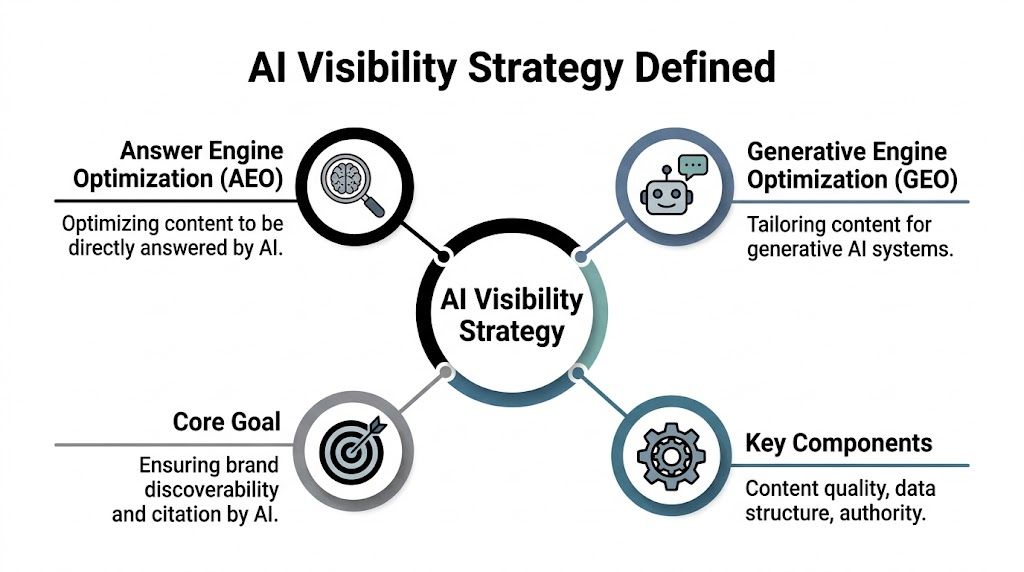
AI Visibility Strategy is the process of making your brand easy for AI systems to find, understand, trust, and cite.
Traditional SEO was a lot like getting listed in the phone book. You wanted your page to appear when someone searched a category. AI Visibility is closer to becoming the business a well-informed concierge recommends by name.
The outcome is different
SEO asks, "How do I rank?"
AI Visibility asks, "Why would a machine trust my brand enough to include it in an answer?"
That difference matters. A page can rank without becoming especially memorable. A cited brand usually has clearer signals. Its facts are easier to verify. Its expertise is easier to interpret. Its identity is more consistent across the web.
AEO and GEO in plain language
You'll hear two related terms often:
- Answer Engine Optimization (AEO) focuses on getting your information selected for direct answers, summaries, and AI Overviews.
- Generative Engine Optimization (GEO) focuses on shaping how generative systems interpret and reference your brand across conversational interfaces.
In practice, most companies need both.
AEO helps when Google or another system extracts a concise answer. GEO matters when a model synthesizes multiple sources and decides who to mention, how to frame the topic, and which brands belong in the recommendation set.
What AI Visibility Strategy includes
A workable strategy usually covers these areas:
| Area | What it means in practice |
|---|---|
| Entity clarity | Your brand name, services, locations, and experts are consistently defined |
| Structured data | Schema markup helps machines parse what each page represents |
| Citable content | Pages answer real questions in clear, extractable language |
| Authority signals | Your brand appears in credible places beyond your own website |
| Consistency | Listings, reviews, social profiles, and site content reinforce the same facts |
A strong AI presence isn't built by gaming prompts. It's built by reducing ambiguity.
That last point matters more than many realize. AI systems are bad at giving brands the benefit of the doubt. If your brand data is inconsistent, your content is vague, and your service pages don't clearly explain what you do, the model has no reason to select you.
For a more tactical breakdown of how that work connects to content and technical SEO, Raven's guide to SEO for generative AI search is a useful next step.
How AI Engines Find and Cite Your Brand
AI systems don't "rank" sources in the same way a classic search engine does. They retrieve, compare, validate, and synthesize. That means your brand has to survive multiple checks before it earns a mention.

In practice, this process is messy. One engine may love your site structure and ignore your reviews. Another may lean heavily on third-party sources and barely use your own pages.
The signals that usually matter most
AI engines tend to look for a blend of machine-readable structure and off-site confirmation. The common patterns include:
- Clear entity signals that define who you are, what you sell, and where you operate
- Consistent business facts across your site, directories, maps, and major profiles
- Structured page types such as articles, services, products, authors, and FAQs
- Topical completeness so the model doesn't need to guess what your page covers
- Corroboration from other sources that align with your own claims
A lot of companies still assume backlinks do most of the work here. They don't. Research shows that brand citation rates can vary by up to 9x across the eight major AI search engines, and there's only a 45% overlap between brands that perform well in traditional local search and those appearing in AI recommendations (2News press release citing GenOptima findings).
That is the multi-engine visibility gap. It's one of the biggest strategic mistakes in this space. Teams test ChatGPT once, see a decent result, and assume they're covered. They aren't.
Why one-engine testing fails
Each engine pulls from different systems and applies different retrieval logic. So a page structure that helps Copilot may not produce the same effect in Perplexity or Gemini.
Use this as a basic diagnostic lens:
- If ChatGPT cites you but Gemini doesn't, check how Google-facing entities and page structure are expressed.
- If Perplexity cites third-party reviews instead of your site, your owned content may be too thin or too self-referential.
- If AI Overviews skip your category pages, your schema and on-page clarity may be too weak for extraction.
For teams trying to understand the technical side better, schema is still one of the cleanest places to start. Raven has a straightforward guide to schema markup and search visibility.
This short overview gives a useful visual summary of how modern AI search behavior differs from standard indexing and ranking.
The Two Pillars of an AI-Citable Brand
Most AI visibility work gets overcomplicated. At the strategic level, it comes down to two pillars: brand authority and structured data.
If either one is weak, your results will be unstable.
Pillar one is brand authority
AI systems need evidence that your brand deserves to be named. Not just indexed. Named.
Research shows brand search volume has the strongest correlation (0.334) with LLM citations, while traditional signals like backlinks are much weaker. The same research found that adding structured elements like statistics can increase visibility by 22%, and quotations can increase it by 37% (The Digital Bloom).
That changes what "authority" means in practice.
It isn't only domain strength. It's whether your brand appears to AI systems as a recognizable, referenced, specific source on a topic.
What tends to help:
- Expert-led pages with named authors, real experience, and useful depth
- Consistent positioning so your service descriptions don't change from page to page
- Brand demand generated by PR, podcasts, reviews, social discussion, and branded search
- Third-party reinforcement from directories, community mentions, citations, and reputable profiles
What tends not to work:
- Thin service pages written only for keywords
- Blog posts that summarize everyone else's opinions
- Generic "ultimate guides" with no original point of view
- Content farms built to publish volume without expertise
Pillar two is structured data
Authority tells AI why you matter. Structured data tells AI what it's looking at.
Schema markup acts like a translator between your website and the systems parsing it. It clarifies whether a page is an article, a local business profile, a service, an author, a product, or an FAQ. It also helps connect entities such as people, companies, locations, and topics.
Your site shouldn't make a model infer basic facts that you could declare directly.
A frequent misstep for many otherwise credible brands is evident. They have strong services, good reputation, and years of content, but their site architecture leaves too much ambiguity. A person can interpret the page. A machine has to parse it.
A practical benchmark is simple. If a non-expert had to identify your main services, locations, experts, and differentiators in a few seconds, could they do it? If not, the page is probably under-structured for AI as well.
For content teams, this is also where trust and expertise frameworks still matter. Raven's resource on E-E-A-T and high-quality content fits directly into this pillar.
Auditing Your Brand's Current AI Readiness
Most brands don't need a reinvention. They need a sober audit.
The fastest way to assess AI readiness is to look for friction. Where does your brand become unclear, inconsistent, or hard to verify?
Start with data integrity
AI models synthesize fragmented information and often surface the worst signals rather than averaging them, which is why businesses need Generative Engine Optimization that keeps listings, hours, and services accurate everywhere (SOCi)).
That single idea explains many bad AI outputs. If your website says one thing, your Google Business Profile says another, and Yelp still shows old service details, the model may choose the conflicting version.
Use this checkpoint list:
- Core business facts. Is your name, category, location data, phone, and service scope consistent across your site and major listings?
- Hours and availability. Are seasonal changes, closures, and special hours updated everywhere?
- Service specificity. Do your pages explain what you do, not just broad marketing claims?
- Location detail. If you're multi-location, does each location page stand on its own with accurate local information?
Then review the website itself
Your site has to be readable by both people and machines. That means structure matters almost as much as copy quality.
Check these areas:
- Schema coverage. Do your article, service, product, FAQ, organization, and author pages use appropriate markup?
- Page hierarchy. Are your headings logical, or do pages jump between ideas without clear sectioning?
- Extractability. Can an AI system identify the direct answer near the top of the section, or is the page all throat-clearing?
- Author credibility. Are experts named and described, or does the content appear anonymous?
- Freshness discipline. Are outdated claims, old screenshots, and retired offers still live?
Finally, audit your own prompts
Ask the engines what a customer would ask:
- Who are the best providers in your category?
- What does your brand do?
- How do you compare with competitors?
- Which locations or services do you offer?
- Why would someone choose you?
Document what each engine says. Then compare that against your intended positioning.
If you want a technical review that focuses on machine access rather than traditional rankings alone, Raven offers a focused look at AI agent crawlability audits.
The point of the audit isn't to admire your website. It's to find every place where a model could misunderstand you.
A Practical Roadmap to Becoming AI-Citable
A good AI Visibility Strategy isn't a one-time project. It's a sequence.
The order matters because teams often jump straight to content production before they fix data confusion and technical ambiguity. That creates more pages, not more trust.
Phase one fixes the foundation
Start by removing contradictions.
That includes your website, location data, review profiles, map listings, and key social properties. If your business serves multiple regions, standardize how services, hours, and attributes are described across every location.
Then clean up the website:
- Implement schema on core templates
- Clarify service pages with direct language and specific outcomes
- Tighten internal linking so important pages are easy to discover
- Assign ownership for updates so stale data doesn't linger
This is also the phase where a platform or agency can help unify the work. Teams use a mix of internal QA, analytics tools, crawler reviews, and AI visibility software. If you're comparing platforms, this roundup of LLM optimization tools for AI visibility is a practical place to start. Some brands also use structured data audits from providers such as Raven SEO to check whether key pages are machine-readable enough for citation workflows.
Phase two creates citable content
Now build pages that answer the questions buyers ask.
Not every page needs to be long. It needs to be precise. In many cases, a strong service page with clean headings, concise answers, and real expertise is more citable than a bloated article.
Use a simple content filter:
| Keep doing | Stop doing |
|---|---|
| Publish pages that solve a defined question | Publish generic trend posts with no unique value |
| Add expert perspective and concrete details | Rephrase competitor content |
| Use quotes, stats, and structured sections where appropriate | Hide the answer beneath long introductions |
Phase three builds brand memory
This is the least technical phase and often the hardest.
You need more places on the web that confirm your relevance. That can come from better reviews, expert commentary, useful videos, consistent profile management, category-specific directories, and brand-led educational content. The point isn't noise. It's recognizability.
Measure the right outcomes
The Invisible Success Paradox is where many teams sabotage themselves. Only 40.58% of AI citations come from Google's top 10 organic results, and organic CTR can drop 61% on AI-dominated queries, which means brands can gain AI presence while analytics show declining search traffic (Ziptie)).
So don't kill a working strategy because GA4 reports fewer clicks.
Track a wider set of outcomes:
- Citation presence across major AI engines
- Prompt coverage for brand, category, comparison, and question queries
- Branded search behavior
- Lead quality from organic and assisted journeys
- Conversion paths where AI may have influenced the decision before the visit
Start Your AI Visibility Journey with Raven SEO
The shift to AI search doesn't remove the need for SEO. It raises the standard for what SEO has to accomplish.
A site now needs to rank, yes. It also needs to be interpretable, consistent, and citation-ready. That means your content, schema, brand signals, and listings all have to work together. If one layer breaks, your AI visibility becomes unreliable.
For business owners, the practical challenge is time. Teams often don't have spare bandwidth to test prompts across engines, review schema coverage, clean up service page ambiguity, and reconcile fragmented listings at the same time. That's why the first move should be diagnostic, not speculative.
Raven SEO approaches this through an AI visibility audit. The goal isn't to produce a flashy score and stop there. The goal is to identify where your brand is being understood correctly, where it's being missed, and where conflicting signals are lowering your chances of citation.
That kind of review is useful for:
- Small businesses that rely on service-area trust
- eCommerce teams that need stronger product and category clarity
- Multi-location brands managing inconsistent location data
- Professional practices where authority and credibility shape selection
- Marketing leaders who need reporting beyond rankings and sessions
A no-obligation consultation is the sensible first step because AI Visibility Strategy isn't solved by one plugin or one new article. It requires coordinated fixes. Once those are in place, your organic work becomes more durable across both search engines and AI systems.
Frequently Asked Questions About AI Visibility
Is AI Visibility Strategy replacing traditional SEO
No. Traditional SEO is still the base layer. Your site still needs crawlability, clear architecture, useful content, and solid technical health. What's changed is the business outcome you're optimizing for. Ranking without citation visibility is becoming less complete.
Does every business need schema markup
Not every page needs the same schema, but most serious businesses need structured data on their core page types. If your site includes services, articles, products, FAQs, locations, or expert contributors, schema helps AI systems interpret those assets with less guesswork.
Should we focus on ChatGPT first
It's fine to start there for testing, but it shouldn't be your only benchmark. Different engines retrieve and cite information differently. A business that appears in one engine may be weak in another, especially if its off-site signals and data structure are uneven.
How do I know whether AI visibility is helping if traffic drops
Look beyond sessions. Falling clicks can coexist with stronger brand presence in AI answers. Review branded search trends, assisted conversions, lead quality, and whether your brand appears in category, comparison, and recommendation prompts. If you're only watching organic traffic, you'll miss part of the picture.
What kind of content gets cited most often
The most citable content is usually the clearest content. It answers a real question, defines terms directly, includes verifiable detail, and shows real expertise. Pages that bury the answer, overuse vague marketing language, or lack clear ownership are harder for AI systems to trust.
Is AI Visibility Strategy only for enterprise brands
No. In some ways, smaller firms have an advantage because they can move faster. A focused business with strong service pages, consistent listings, credible reviews, and clean schema can become highly visible in a niche. Large companies often struggle because their data is fragmented across teams, systems, and locations.
If your brand needs a practical starting point, Raven SEO can help you assess where you stand, where AI engines are misunderstanding your business, and which fixes matter first. The fastest path to better AI visibility usually starts with clarity, not more content.