
Search changed faster than most marketing teams expected. Nearly 60% of all Google searches now end without a click, and voice search accounts for approximately 50% of all searches according to Atak Interactive’s overview of SEO, GEO, AEO, and AIO. That one shift forces a hard reset in how businesses think about visibility.
The old playbook centered on rankings, traffic, and sessions. The new one still needs those basics, but it also demands something else. Your brand has to become a source that AI systems can extract, trust, and cite.
That’s the debate inside AEO vs SEO 2026. It isn’t about replacing SEO with a trendy acronym. It’s about adapting to a search environment where users often get the answer before they ever visit your site.
The End of Search As We Knew It
Google’s own behavior has changed the economics of search. More results now answer the question on the results page, inside an AI summary, or through a voice response before a visit ever happens. That shifts the goal from winning a click to becoming the source those systems quote.
The practical impact is bigger than many leadership teams realize. A page can rank, get indexed, and still lose visibility if AI systems cannot extract a clear answer, connect it to a known entity, or verify the claim against other trusted sources.

Why the old traffic model is breaking
Search used to reward the best page for a query. AI-assisted search often rewards the clearest, most structured, and easiest-to-cite passage across many pages. That is a different contest.
For businesses, this creates a measurement problem as much as a visibility problem. Analytics platforms are built to report visits, conversions, and assisted paths. They are much weaker at showing when your content shaped an answer, earned a citation, or influenced a buying decision before the user ever reached your site.
Your website now has to serve multiple jobs at once:
- Convert human visitors: Give buyers the detail, proof, pricing, and next steps they need.
- Feed answer engines: Present facts, definitions, comparisons, and step-by-step guidance in extractable formats.
- Support entity recognition: Make it easy for systems to connect your brand, products, authors, and claims.
- Hold up under verification: Publish information that matches what credible third-party sources say about you.
That last point matters more than many SEO guides admit. Large language models do not evaluate authority the way a human editor does, and model behavior differs by provider. Comparing systems like OpenAI vs Anthropic is useful because citation habits, response style, and safety constraints can affect which brands get surfaced and how.
Practical rule: If a useful answer is buried in fluff, spread across five paragraphs, or disconnected from schema, AI systems are less likely to use it.
What businesses need to change first
The first move is not replacing SEO. It is expanding the operating model.
Keep the technical SEO basics. Crawlability, internal links, page speed, and strong topical coverage still matter because they help discovery and indexing. Then add the layer many teams have ignored: answer-focused page structure, schema that clarifies entities and relationships, and off-site brand signals that confirm you are a trustworthy source.
ROI calculations can be tricky. AEO work often improves branded search lift, assisted conversions, and sales efficiency before it shows up as a clean spike in organic sessions. Teams that only measure last-click traffic will underinvest in the very assets AI systems prefer to cite.
A practical starting point is to review how AI-generated search experiences are changing result layouts and user behavior. This analysis of Google Gemini and the future of search gives useful context for teams still reporting on rankings and clicks as if that were the whole picture.
Defining the Two Search Paradigms
SEO and AEO overlap, but they don’t operate with the same objective.
SEO is still the discipline of improving visibility in traditional search results so users discover your pages and click through. It rewards technical access, relevance, and page quality. The classic outcome is a visit.
AEO focuses on making your content usable inside AI-generated answers, summaries, and conversational interfaces. The classic outcome is a citation, mention, or answer inclusion.
What SEO is actually doing
SEO is a competition for discoverability inside ranked results. You build pages that search engines can crawl, index, understand, and rank. Then you improve those pages so users choose them.
A simple way to consider it:
- SEO wins the shelf position
- SEO drives the visit
- SEO supports organic demand capture
- SEO still underpins technical visibility
This is why SEO doesn’t disappear in 2026. It still supplies the underlying infrastructure.
What AEO is actually doing
AEO is about becoming the source an AI system feels confident using. That changes how content should be shaped.
Instead of asking only, “Can this page rank?” you ask:
- Can this section answer a question directly
- Can a model extract the key point without confusion
- Can the brand behind this answer be verified
- Can the answer be grounded in structured context
Google AI Mode has already surpassed 2 billion monthly active users across more than 200 countries and territories, and analysts project traditional search volume could decline by as much as 25% in 2026 as answer engines absorb more query volume, according to Lasso Up’s analysis of SEO, AEO, and GEO.
That scale matters. AEO is no longer a niche tactic.
A practical analogy
SEO is like competing to place your book at the front of the store. AEO is like making sure the editor quotes your book in the summary everyone reads.
The businesses that adapt fastest usually stop arguing over labels and start mapping user behavior. If your audience also compares AI ecosystems directly, this guide on OpenAI vs Anthropic is useful context because different models and search experiences can surface and synthesize information differently.
SEO gets you indexed and surfaced. AEO increases the odds that your content becomes the answer itself.
Comparing SEO and AEO Across Key Criteria
The cleanest way to understand AEO vs SEO 2026 is to compare them against the decisions businesses make. Teams don’t need theory. They need clarity on goals, metrics, tactics, and content design.
| Criteria | SEO | AEO |
|---|---|---|
| Primary goal | Drive users to website pages through ranked visibility | Get cited, summarized, or mentioned inside AI-generated answers |
| Primary outcome | Clicks and sessions | Citations and answer presence |
| Discovery mechanism | Search engines match queries to indexed pages | AI systems synthesize responses from trusted, extractable sources |
| Content style | Comprehensive pages optimized for search intent and navigation | Answer-first sections designed for direct extraction and clarity |
| Core technical layer | Crawlability, indexing, internal links, page speed | Schema, entity clarity, passage structure, citation readiness |
| Main success lens | Rankings, impressions, CTR, traffic | Share of Model, citation frequency, answer visibility |
| Best use case | Capturing demand across informational, commercial, and transactional searches | Winning visibility when users don’t click and consume the answer in-platform |
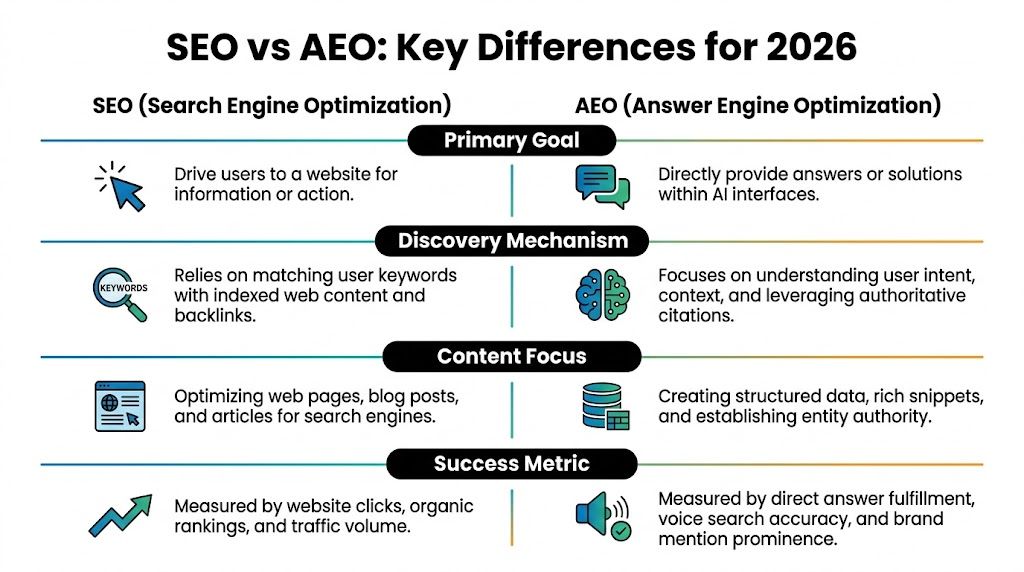
Primary goal
SEO aims to earn a position. AEO aims to earn inclusion.
That sounds subtle, but it changes execution. A page built only to rank can still fail in AI search if the answer is buried, ambiguous, or unsupported by structure. A page built for answer extraction often leads with the direct response and then expands into detail.
Key metrics
Often, many teams keep measuring the wrong thing.
In 2026, AEO performance leans on Share of Model, which measures how often a brand appears in AI-generated summaries. Benchmark data cited by Yotpo’s AEO vs SEO strategy analysis shows top-performing sites reaching 25-40% SoM in competitive categories. The same source notes that citation frequency correlates 3.2x more strongly with mid-funnel conversions than click-through rates, while AI Overviews push organic links about 1,200 pixels down on mobile SERPs.
That doesn’t kill CTR as a metric. It changes its role.
For practical measurement, teams should monitor:
- SEO metrics: Rankings, impressions, CTR, organic traffic
- AEO metrics: Citation frequency, answer inclusion, SoM, AI Overview presence
- Shared business metrics: Brand search lift, assisted conversions, lead quality
- Visibility metrics: Above-the-fold presence and whether the user sees your brand before scrolling
If your team is building for generative discovery specifically, this resource on SEO for generative AI search helps connect classic SEO work to citation-focused visibility.
Core tactics
SEO tactics usually focus on the page as a whole. AEO tactics often focus on the extractable section inside the page.
SEO leans on:
- Technical health: Crawlability, indexability, mobile performance
- Keyword intent mapping: Matching pages to clear search behavior
- Internal linking: Reinforcing topic relationships
- Authority building: Earning references and relevance over time
AEO leans on:
- Answer-first formatting: Put the direct answer high on the page
- Schema markup: Help systems interpret entities, FAQs, and procedures
- Entity consistency: Keep business information clear across the web
- Citation readiness: Make facts easy to extract and hard to misread
The page that ranks isn’t always the page that gets cited. In AI search, extractability matters as much as relevance.
Content focus
SEO can tolerate a slower build. AEO usually can’t.
Long introductions, vague claims, and fluffy transitions work against answer extraction. The strongest AEO pages tend to use direct subheads, concise answers, clean lists, and structured support underneath.
That doesn’t mean every page should become robotic. It means each page should contain at least one machine-friendly answer target.
The Strategic Shift From Clicks to Citations
A website used to be the center of the search journey. Increasingly, it’s the evidence layer underneath the answer.
That changes how buyers form trust. Instead of searching, clicking, comparing, and reading multiple pages, many users now ask one detailed question and accept a synthesized response. The platform owns the interaction. Your brand earns influence only if it appears inside that response.

How the customer journey changes
Consider a homeowner asking a voice assistant for the best local roofer after storm damage. They won’t review ten pages. They want a direct recommendation or shortlist.
Now consider a business owner asking an AI system how to choose an employment lawyer. Again, they may get a synthesized answer with criteria, cautions, and a few cited brands.
In both cases, the user still may visit a site later. But the first impression happened before the click.
That has two consequences:
- Brand perception forms earlier: AI mention equals perceived legitimacy.
- Mid-funnel influence grows: Buyers use AI summaries to narrow options.
- Website traffic may drop while qualified intent improves: Fewer visits can still mean stronger leads.
- Trust shifts to source visibility: If AI systems cite you consistently, users infer authority.
Why citations now matter more than many rankings
A ranking still has value. But a high ranking under a dominant AI layer can become less visible than marketers expect.
Citation changes the game because it puts your brand inside the answer the user consumes. This is why structured data is no longer a technical afterthought. It helps systems disambiguate your business, your services, your authorship, and your content relationships. If you need to tighten that layer, this guide to schema markup and search visibility is a strong starting point.
When AI answers compress the research phase, the cited brand often enters consideration before the clicked brand.
What doesn’t work anymore
Some habits from older SEO workflows now underperform in an AEO environment:
- Burying the answer: Long intros make extraction harder.
- Publishing generic category pages: They rarely offer enough substance to cite.
- Treating schema as optional: That leaves machines guessing.
- Relying on rank reports alone: They miss answer-layer visibility.
Businesses that adapt stop optimizing only for the visit. They optimize for the moment of recommendation.
Your Practical Roadmap for AI Visibility in 2026
Brands do not need a full rebuild to compete in AI search. They need a staged operating plan that keeps SEO intact while improving how machines identify, interpret, and cite their content.

The practical goal is simple. Make the brand easy to verify, easy to extract, and easy to attribute.
Step 1 Build entity clarity first
AI systems cite brands they can identify with confidence. If your company name, services, authors, locations, and proof points are inconsistent across the site, you create ambiguity before content quality even enters the picture.
Start by tightening the signals that define the business:
- Organization identity: Keep your business name, service descriptions, contact details, and key differentiators consistent.
- About and author pages: Show who is responsible for the content and why they are qualified to speak on the topic.
- Service alignment: Match each page to a real capability, not a broad keyword target.
- Cross-platform consistency: Keep company details aligned across directories, profiles, and reference sites.
I see this problem often with small and mid-sized businesses. The issue is rarely a lack of effort. It is that the brand is described five different ways across six different places.
Step 2 Audit for citation readiness
A standard SEO audit will not catch several of the issues that suppress AI visibility. Citation readiness is a different review process.
It asks practical questions. Can an AI system find the answer fast? Can it quote a section without needing the rest of the page for context? Can it connect the claim to a known business, author, product, or service?
Review pages for:
- Answer placement: Put the core answer near the top of the relevant section.
- Passage independence: Write paragraphs that still make sense when extracted on their own.
- Schema coverage: Use FAQ, HowTo, Organization, Article, and other relevant types where they clarify meaning.
- Freshness: Update core commercial and informational pages when details change.
- Attribution signals: Make authorship, publication dates, and company ownership clear.
At Raven SEO, our audits have shown that schema implementation by itself can improve AI mentions when the underlying page is already credible and well-structured. The trade-off is that schema does not rescue thin content or weak topic coverage. It works best after the page itself is worth citing.
For teams that need a technical review, this guide on auditing your site for AI agent crawlability covers the discoverability side in more detail.
Step 3 Restructure content for extraction
Many teams stall because it forces editorial discipline. That discipline pays off.
Pages that earn citations usually make retrieval easy. They answer a specific question, use headings that mirror search intent, and keep each section self-contained enough to stand alone in a generated answer.
A practical rewrite checklist looks like this:
- Question-led headings: Reflect the way real buyers phrase problems.
- Direct answers first: Lead with the conclusion, then support it.
- Modular sections: Keep sections tight enough to quote without extra cleanup.
- Scannable formatting: Use lists, tables, definitions, and labeled subsections where they improve clarity.
8 Essential Generative Engine Optimization Strategies for 2026 is a useful companion read if you want more tactical examples.
One warning here. Teams that stay fixated on backlinks as the primary answer often miss the higher-return work. Cleaner answers, stronger entity signals, and better page structure usually produce faster gains in AI visibility than another round of generic link building.
A short walkthrough helps here:
Step 4 Implement structured data where it changes understanding
Structured data matters most on pages where a machine could misread intent, ownership, or page type.
Prioritize markup on:
- Service pages, where you need to clarify the business offering and its relationship to the company.
- FAQ sections, where direct answer extraction is the goal.
- How-to content, where steps and sequencing matter.
- Author-led educational content, where expertise and attribution affect trust.
Do not treat schema as a volume exercise. More markup is not better if it is generic, outdated, or disconnected from the page. The right implementation clarifies meaning. Poor implementation adds noise and creates maintenance debt.
Step 5 Measure influence, not just visits
This is the part many AEO guides skip because the reporting is harder than classic SEO.
AI visibility often affects demand before it shows up as a click. The result is a measurement problem, not a value problem. Teams need to track whether AI surfaces are increasing branded search, improving lead quality, and lifting assisted conversions across direct, organic, and sales-assisted channels.
Useful indicators include:
- Growth in branded search demand
- Lead quality from organic and direct sessions
- Priority-page appearances in AI summaries and answer surfaces
- Assisted conversions influenced by pages that are frequently cited
- Sales feedback on prospect familiarity before the first visit or demo
This marks the transition from clicks to citations. SEO still supports discovery, crawling, and ranking. AEO adds the systems, structure, and measurement model needed to get cited when AI compresses the research journey.
Frequently Asked Questions About AEO and SEO
Is SEO dead in 2026
SEO still does the base work. It helps search engines and AI systems crawl, interpret, and trust your site.
What changed is the outcome you optimize for. In classic search, the goal was often the click. In AI search, the goal is also citation, inclusion, and recall. A company with weak technical SEO, thin topic coverage, or unclear page structure will struggle in both environments. A company with strong SEO but no answer-ready content or structured entity signals will still miss visibility in generative results.
How do you measure AEO ROI if users don’t click
Start with influence, not last-click attribution.
AEO often creates demand before a visit shows up in analytics, so teams need a measurement model that connects AI visibility to downstream business outcomes. The practical reporting shift is to track assisted conversions, branded search lift, direct traffic quality, and sales signals such as prospects mentioning your brand or repeating language from AI answers before the first meeting.
Useful indicators include:
- Growth in branded search volume
- Higher conversion rates from direct and organic return visits
- Citation presence for priority pages in AI summaries
- Assisted conversions involving pages built for answer extraction
- Sales feedback that buyers already understand your category, offer, or differentiators
The trade-off is simple. AEO reporting is less tidy than SEO CTR reporting, but it maps better to how buying journeys now work.
What tools and reports should teams start using
Keep your current SEO stack, then add a layer for AI visibility checks and content governance.
That means tracking indexation, rankings, impressions, and organic landing pages as usual. It also means reviewing whether your priority pages are being cited in AI answers, whether structured data is valid and current, and whether your content is written clearly enough for extraction without becoming generic. Teams that publish at scale should also tighten editorial review. Weak AI-assisted copy can dilute authority fast. This guide on how to differentiate human-led content from AI-generated fluff is useful if quality control is becoming a bottleneck.
What kinds of pages should be optimized first
Start where citation visibility can affect pipeline, not where content production feels easiest.
For most businesses, that means:
- Core service pages
- High-intent product or solution pages
- FAQ pages tied to real buyer objections
- Explainer pages that answer pre-sales questions in direct language
These pages usually produce the clearest ROI because they sit close to evaluation and purchase. They also give you the best place to add and maintain structured data with a clear business purpose, rather than marking up every page on the site and creating maintenance work with no reporting path.
If your business needs a practical path into AI search, Raven SEO can help you assess where your current visibility stands and what to fix first. The team focuses on AI-ready technical SEO, structured data, and digital architecture that supports sustainable growth in a search environment shaped by citations, summaries, and conversational discovery.