

Structured data is essentially a standardized code you add to your website that translates your content into a language search engines can instantly understand. Think of it like adding a detailed table of contents to a book—it explicitly tells Google what each page is about, whether it's a product, a local business, or an upcoming event. This clarity is what helps your site earn those eye-catching rich results in search.
What Is Structured Data: Your SEO Superpower

Imagine your website is a book and Google is trying to read it. Without any guidance, Google reads the words but might completely miss the deeper context. Is that address on your contact page your actual business location or just a mention? Is that number a price or a model number?
Structured data removes all of this guesswork.
It’s a special bit of code added to your website that acts as a translator, organizing your content into a neat, standardized format. This process makes your information machine-readable, ensuring search engines understand not just what your content says, but also what it means. To fully appreciate its power, it’s helpful to first understand the broader concept of what is Search Engine Optimization.
The Language of Search Engines
This "language" of structured data comes from a shared vocabulary called Schema.org. Think of Schema.org as a universal dictionary created by search engines like Google, Bing, and Yahoo. It provides a massive library of predefined terms and properties that you can use to label your content.
For example, you can use schema to specify:
- This page describes a "LocalBusiness."
- Its "telephone" number is X.
- Its "openingHours" are Y.
By using this common vocabulary, you’re not just hoping search engines figure things out; you’re giving them precise instructions. These specific labels are crucial because they directly power the enhanced search results that help businesses stand out from the crowd. If you're new to these concepts, you can demystify more technical terms in our essential SEO glossary for website owners.
To put it simply, structured data is your direct line of communication with search engines. Here’s a quick breakdown to help you grasp the core ideas.
Structured Data At a Glance
| Concept | What It Means for Your Business |
|---|---|
| Structured Data | A special code on your website that translates your content into a language Google understands. |
| Schema.org | The "dictionary" of terms used in that code, created by search engines themselves. |
| Rich Results | The eye-catching search results you get (like star ratings and prices) when you use structured data. |
| JSON-LD | The modern, recommended format for adding this code to your website. |
Ultimately, implementing this code is all about making your business easier to find and more appealing to click on in search results.
This approach is a total game-changer for visibility. Shockingly, even though millions of websites use schema markup, only about 30% of all websites have actually adopted it. This creates a massive opportunity for small and medium-sized businesses, like those served by Raven SEO in Baltimore, to outperform competitors who aren't using this powerful tool.
How Structured Data Unlocks Rich Results
Now that we know structured data is basically a translator for search engines, let’s get to the fun part: its single most powerful benefit is earning rich results. These are the eye-catching, visually souped-up search listings that practically jump off a crowded results page, making your website impossible to scroll past.
Instead of just the classic blue link, structured data gives Google the context to show star ratings, product prices, event dates, or even those handy FAQ dropdowns right on the results page. This little bit of extra info gives a searcher immediate value, often answering their question before they even have to click. For any business, that’s a massive competitive edge.
From Blue Links to Business Magnets
Think of a standard search result as a boring business card—just a name and a link. A rich result, on the other hand, is like a full-color brochure that instantly shows off your best features. It communicates value on the spot, builds a little bit of trust, and gives users a real reason to choose your listing over all the others.
These enhanced snippets don't just look better; they perform miles better. Pages that earn rich results consistently see a much higher click-through rate (CTR) than their plain-Jane counterparts. One major study found rich results pulled in an average 82% higher CTR compared to standard search listings. It's a similar story in e-commerce, where Shopify stores using Product schema often see a 25-40% higher CTR by flashing prices and reviews directly in the search results. You can discover more insights about these schema markup statistics to see the full impact for yourself.
"Implementing structured data is one of the most effective ways to increase your organic click-through rate. It transforms your search listing from a simple link into a compelling advertisement for your content, attracting more qualified traffic."
By giving this information upfront, you’re not just getting more clicks—you’re getting better clicks. You attract people who are genuinely interested in what you have to offer, which leads to more meaningful engagement, lower bounce rates, and better on-site metrics all around.
Building Trust and Authority with E-E-A-T
Beyond just grabbing clicks, structured data is a powerful way to signal your website's quality directly to Google. It’s a perfect match for the principles of E-E-A-T (Experience, Expertise, Authoritativeness, and Trustworthiness), which have become absolutely critical for ranking well.
Here’s a quick breakdown of how it connects:
- Expertise: When you use
Articleschema with anauthorproperty, you’re connecting your content to a real person, helping Google establish their expertise on the topic. - Authoritativeness:
Organizationschema clearly defines who your business is, neatly tying your website, logo, and social profiles into one cohesive brand identity. - Trustworthiness: Nothing builds trust faster than social proof.
ReviewandProductschema that display real customer ratings and transparent pricing give potential customers an immediate reason to trust you.
By spoon-feeding this information to Google in a language it loves, you make it incredibly easy for the search engine to validate your credibility. This tight alignment with E-E-A-T sends a strong signal that your website is a reliable source of information, which is exactly what Google wants to show its users.
Future-Proofing Your SEO for AI Search
The payoff for structured data goes way beyond today's search results. Search engines are leaning more and more on artificial intelligence to generate direct answers, and having well-organized data is becoming non-negotiable. AI-powered features, like Google's AI Overviews, are designed to pull information directly from clearly structured, authoritative sources.
When you implement schema markup today, you're essentially formatting your content to be easily digested and used by these next-generation search technologies. This is how you ensure your website remains a primary source of information, even as the way people search for answers continues to change. To get a better handle on this shift, check out our guide on SEO for generative AI search.
In an AI-driven results page, the goal is shifting from earning a click to earning a citation—becoming the trusted source an AI Overview or large language model quotes and attributes directly. Structured data is what makes that possible: it turns your expertise into machine-readable facts an AI can verify and tie back to your brand. To go deeper on building this kind of authority, see our guide on schema markup for AI and how to define your brand entity with organization schema markup.
Make no mistake: structured data is no longer just a nice-to-have. It’s a foundational piece of any forward-thinking SEO strategy.
Choosing the Right Schema for Your Business
With a whole universe of schema types out there, figuring out where to even start can feel like a chore. The secret is to ignore the noise and focus on the structured data that directly helps you hit your business goals. Not all schema is created equal, and being smart about which types you implement first will give you the biggest bang for your buck.
For most businesses, especially local shops and e-commerce stores, a small handful of schema types do most of the heavy lifting. Think of these as the essential building blocks. By putting them in place, you’re spoon-feeding search engines the exact details they need to show off your business in the most eye-catching ways.
This flowchart breaks down how structured data works its magic, acting as the crucial translator between your website's code and the fancy rich results you want to see on Google.
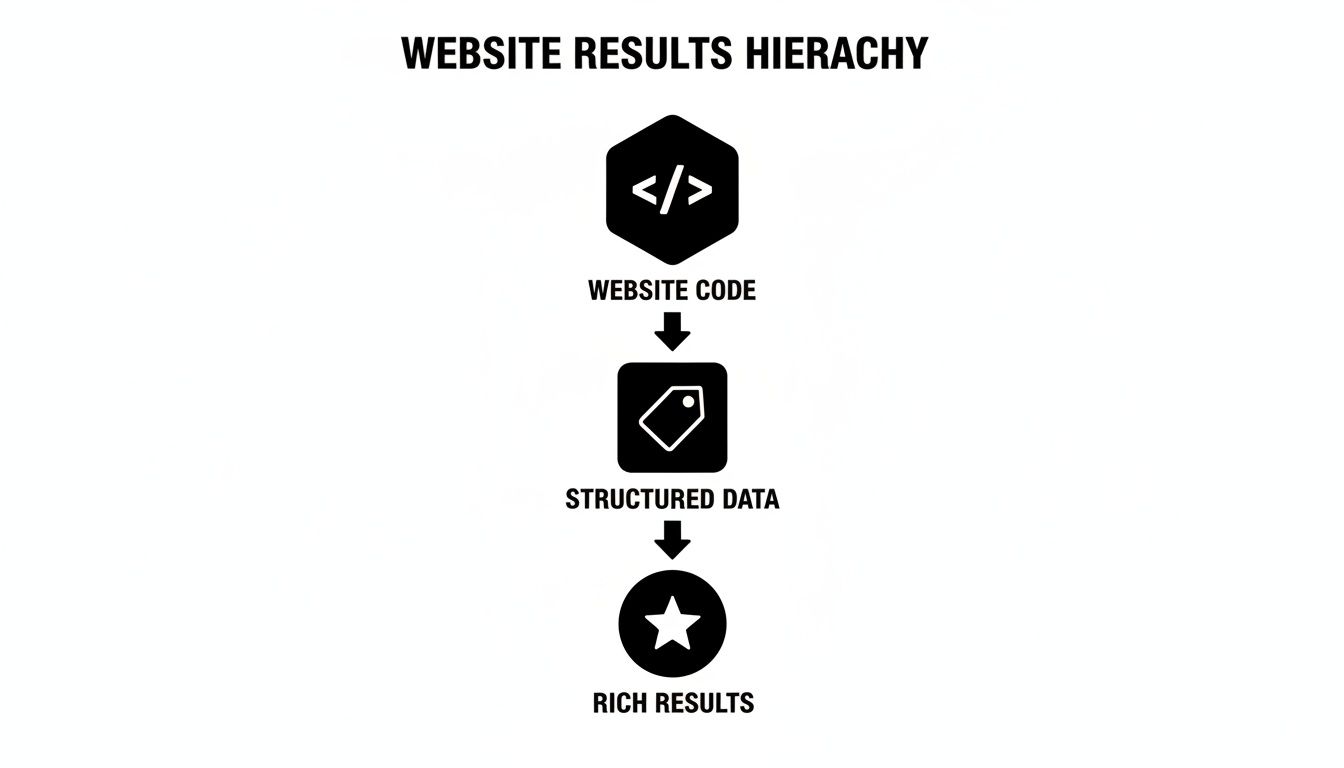
As you can see, your site's code is just the starting point. It's the structured data markup that turns that code into a language Google understands, empowering it to create those valuable rich snippets that get all the clicks.
To help you prioritize, here’s a quick rundown of the most common and effective schema types we recommend for our clients.
Top Schema Types for Your Business
| Schema Type | Primary Benefit | Ideal For |
|---|---|---|
LocalBusiness |
Boosts visibility in local map packs and "near me" searches by providing NAP data. | Any brick-and-mortar business, from restaurants and retail stores to service-area pros. |
Product |
Displays price, availability, and star ratings directly in search results to attract buyers. | E-commerce stores and any business selling specific items online. |
FAQPage |
Answers common customer questions directly in the SERP, establishing authority. | Businesses that want to own their niche and provide immediate answers. |
Review |
Shows off your aggregate star rating, building instant trust and social proof. | Any business that collects customer reviews and wants to showcase their reputation. |
Article |
Helps content get featured in "Top Stories" carousels, amplifying its reach. | Businesses that use blogging and content marketing to attract an audience. |
Let's dive a little deeper into what makes each of these so powerful.
LocalBusiness Schema for Main Street Dominance
For any business with a physical address or a defined service area, LocalBusiness schema is absolutely non-negotiable. Think of this markup as your digital neon sign. It clearly tells Google your name, address, phone number (NAP), and operating hours. It's the technical foundation for getting found in the local map pack and winning those critical "near me" searches.
When you implement LocalBusiness schema, you're helping Google confidently fill out your Knowledge Panel. This gives potential customers instant access to directions, contact info, and business hours without any guesswork. It's step one for any local store, restaurant, or service provider in places like Baltimore. For maximum impact, this schema needs to work hand-in-hand with a perfectly optimized Google Business Profile. You can learn more in our complete guide on Your Google Business Profile A Local SEO Powerhouse.
Product Schema for E-commerce Success
If you sell anything online, Product schema is your single most important SEO tool. This piece of code lets you broadcast vital shopping information—like price, availability, and reviews—directly on the search results page. It's the magic behind those listings with gold stars and pricing that make a product stand out from the crowd.
By marking up your product pages this way, you give shoppers the key details they need to make a decision before they even click. This naturally attracts more serious, high-intent buyers, which can have a huge positive impact on both your click-through and conversion rates.
Using
Productschema turns a standard blue link into a miniature billboard for your item. That level of transparency builds instant trust and gives you a massive leg up on competitors who are still just plain text.
FAQPage Schema to Own Your Niche
Find yourself answering the same customer questions day in and day out? FAQPage schema is the perfect way to turn that repetition into a serious SEO advantage. This markup lets you display your questions and answers in an interactive, dropdown format right inside the search results.
Not only does this take up significantly more real estate on the page (pushing competitors down), but it also instantly positions your brand as an authority. By providing direct, clear answers, you satisfy user intent on the spot, driving highly qualified traffic from people who know you have the solution they need.
Review Schema for Building Social Proof
In today's market, customer reviews are everything. Review schema is what makes sure your hard-won reputation gets the attention it deserves. This markup enables Google to show your aggregate star rating—that classic 1-to-5 scale—right there in your search listing.
This single visual cue is one of the most powerful forms of social proof you can have. A high star rating is a universal sign of trust and quality, making searchers far more likely to click on your result, even if you rank a spot or two below a competitor.
Article Schema to Amplify Your Content
For any business that invests in content marketing, Article schema is a must. It helps search engines understand the nitty-gritty details of your blog posts, guides, or news releases, such as the headline, author, publication date, and featured image.
When implemented correctly, Article schema makes your content eligible for special treatment, like inclusion in Google's "Top Stories" carousel and other news-focused features. This visibility boost reinforces your expertise and solidifies your authority in your field.
Getting strategic with these schema types is what separates businesses that just have a website from those that dominate their market online. For local businesses, LocalBusiness schema alone can boost visibility in local searches by 30%. And considering that 72.6% of Google's first-page results now feature schema, not using it is like intentionally giving your competitors a head start. These numbers make it crystal clear why mastering structured data is no longer optional for any serious business.
A Simple Guide to Implementing Structured Data
Getting structured data onto your website sounds a lot more technical than it actually is. You definitely don’t need to be a developer to get the hang of it.
While the code itself can look a bit intimidating, the process is surprisingly manageable, especially because Google’s recommended format, JSON-LD, is designed to be straightforward. Think of it as a self-contained instruction manual that you add to your page. It works behind the scenes and doesn't mess with the visible content your visitors see.
This approach is a game-changer. Instead of having to weave code into your existing website structure, you just add a simple script to the head or body of your page. Our goal here is to demystify the process and give you a clear, actionable plan.
A Five-Step Implementation Plan
Getting started is all about being methodical. When you have a clear roadmap, you can pinpoint what needs to be done, generate the code, and double-check that it all works correctly. This organized approach takes the guesswork out of the equation.
The entire process really boils down to five key steps:
- Pinpoint Your Content: First things first, identify the most important pages you want to enhance. This could be your core product pages, your company contact page, key services, or your most popular articles.
- Select the Right Schema: Next, match that content to the right schema type from the Schema.org library. For a product page, you’ll use
Productschema. For a contact page, you’ll useLocalBusiness. It's pretty intuitive. - Generate the Code: You don't have to write this stuff from scratch. There are excellent free tools like Google's Structured Data Markup Helper that will walk you through it, asking for the right info and building the JSON-LD script for you.
- Add the Script to Your Site: Copy the code that the tool generates and paste it into the
<head>section of your page's HTML. Most modern website platforms and content management systems make this step easy. - Test and Validate: This last step is non-negotiable. Use a validation tool to make sure search engines can read your new markup correctly and that there are no errors holding you back.
Using Tools to Make It Easy
Manually writing schema code is a task best left to the pros. For everyone else, there are fantastic tools and plugins that do all the heavy lifting for you, turning what seems like a complex job into a simple one.
For example, many content management systems offer powerful plugins that can automate most of this process right from your dashboard. You can explore solutions like Rank Math's structured data features, which handles a lot of this for you. For more specific tasks, like marking up a frequently asked questions page, you can even use our free FAQ schema generator to create perfect code in seconds.
Once you have your code, the most crucial step is to validate it. Google provides a free Rich Results Test tool just for this purpose.
The screenshot below shows exactly what you're looking for—a successful validation in the tool.
That green checkmark is your confirmation. It means Google can correctly parse your code and your page is officially eligible to earn rich results.
Key Takeaway: Implementation isn't about becoming a coding expert. It's about knowing the steps, using the right tools to generate the code, and validating your work to ensure it’s error-free.
While these steps make the process manageable, ensuring a flawless execution across an entire website requires expertise. An expert partner like Raven SEO can handle all the technical details, creating a customized structured data strategy that aligns with your business goals and gets you the visibility you deserve.
How to Test and Validate Your Structured Data
Okay, so you’ve implemented your structured data. That’s a huge first step, but the job isn't quite done yet. Without testing, you're essentially flying blind. You have no way of knowing if search engines can actually understand your code, or if a single misplaced comma is holding you back from earning those valuable rich results.
Thankfully, Google provides some excellent, free tools that take all the guesswork out of the process.

Think of validation as proofreading your work before turning it in. It’s the final check that confirms your instructions are clear, correct, and ready for Google to process. Making this a mandatory part of your workflow is what turns effort into real-world SEO results.
Using the Rich Results Test for Immediate Feedback
The first tool you should absolutely bookmark is Google’s Rich Results Test. This is your go-to for quick, on-the-spot checks. You just pop in a URL or paste your code snippet, and it gives you an instant analysis.
In a matter of seconds, the tool will tell you two crucial things:
- Is your markup valid? It flags any show-stopping errors (like missing required properties) and gives you warnings about things you could improve.
- Is your page eligible for rich results? Best of all, it shows you a preview of how your listing could actually look in the search results.
Seeing that green checkmark is a great feeling. It means you’re good to go. This immediate feedback makes it perfect for double-checking a new page before it goes live or troubleshooting a specific problem.
Monitoring Your Entire Site with Google Search Console
While the Rich Results Test is perfect for a single page, Google Search Console is your command center for the big picture. It gives you a site-wide view of how all your structured data is performing over time.
Head over to the "Enhancements" section in your Search Console account. There, you'll find dedicated reports for every type of structured data Google finds on your site—Products, FAQs, Reviews, you name it.
These reports track:
- The total number of pages with valid structured data.
- Any pages with errors that are preventing them from qualifying for rich results.
- Pages with warnings or opportunities for improvement.
This ongoing monitoring is so important. Website updates or plugin changes can sometimes break existing code without you realizing it. Search Console is your safety net, alerting you to these issues so you can jump in and fix them fast.
By regularly checking these reports, you can stay ahead of any problems and ensure your eligibility for rich results remains intact. If you want to get more comfortable with this powerhouse tool, check out our guide on Google Search Console tips for SEO success.
Combining quick spot-checks with the Rich Results Test and long-term monitoring in Search Console gives you total control, making sure all your hard work pays off with better visibility.
Ready to Put Your Structured Data to Work?
We’ve covered a lot of ground, showing how structured data is less of a technical chore and more of a direct line of communication with search engines. It turns your website from a simple collection of pages into an organized library of information that Google can instantly understand and feature. This is the key to unlocking those eye-catching rich results, boosting your visibility, and earning more clicks from the customers you actually want.
But getting it right is a game of precision. From picking the perfect schema types to implementing the code without a single error, the technical details can make or break your success. One tiny mistake can leave your site invisible to search engines, keeping that powerful competitive advantage just out of reach. This is where expertise really counts.
Let Raven SEO Build Your Winning Strategy
Instead of getting tangled in the complexities of JSON-LD, let the experts behind our technical SEO services design and manage a structured data strategy that gets results. We don’t just plug in basic code; we build a comprehensive plan that aligns directly with your business goals—whether that’s driving more local foot traffic, boosting e-commerce sales, or cementing your brand as the go-to authority in your industry.
Our process is built for impact:
- We start with a thorough audit to find the highest-impact schema opportunities for your specific website.
- Our team provides expert implementation of the most relevant schema types, following all best practices.
- We use continuous testing and validation to ensure your code is always flawless and up-to-date.
- Finally, we monitor performance to track the real-world impact on your traffic, rankings, and leads.
A well-executed structured data strategy isn’t just about making search engines happy. It’s about building a smarter, more resilient foundation for your entire digital presence and future-proofing your site for the next wave of search, from AI-driven answers to voice commands.
Let's talk about how we can make your website Google's first choice. Contact Raven SEO today for a no-obligation consultation and see how a professional structured data plan can deliver measurable growth for your business.
Common Questions About Structured Data
Jumping into the world of structured data always brings up a few questions. Let's tackle some of the most common ones that come up when you start getting your hands dirty with implementation.
How Long Does It Take for Structured Data to Show Up in Search Results?
This is the big one, but the honest answer is: there's no set timeline. After you've added the code and checked it for errors, Google has to recrawl your pages. This process can take anywhere from a few days to several weeks.
Even with a perfect implementation, rich results aren't guaranteed. Google decides whether to show them based on a bunch of factors, like the specific search query, the user's location, their device, and your site's overall quality and authority.
Can I Use Multiple Types of Structured Data on the Same Page?
Absolutely! In fact, you should. Layering multiple schema types on a single page is a best practice because it paints a much richer, more complete picture for search engines.
Think about a product page on an e-commerce site. It could easily use:
- Product schema for the item's name, price, and stock status.
- Review schema to pull in those all-important customer ratings.
- FAQPage schema for a Q&A section answering common questions.
Each type describes a different piece of the page, and together they create a far more detailed and useful profile for Google.
Will Incorrect Structured Data Hurt My Rankings?
Having broken or incorrect structured data is highly unlikely to get you a direct ranking penalty. What it will do is stop you from getting the rich results you’re after, meaning you'll miss out on the extra visibility and clicks.
The real risk comes from using structured data deceptively—like marking up content that isn't actually visible to users. That kind of spammy tactic could earn you a manual action from Google. This is exactly why testing your code with tools like the Rich Results Test is a non-negotiable step.
Is Structured Data the Same as Schema Markup?
These terms get thrown around a lot and are often used to mean the same thing, but there's a small technical difference. Here’s an easy way to think about it:
Structured data is the overall concept of organizing information in a way search engines can understand. Schema.org is the specific vocabulary you use to label that information. Schema markup is the actual code (like JSON-LD) you add to your site to put that vocabulary to work.
They're all just different parts of the same process, working together to make your content machine-readable. If you want a focused primer on the vocabulary itself, our guide on what schema markup is breaks down the most common types and exactly how to use them.
And with AI's growing role in search, this has never been more important. Recent analysis shows that a solid structured data implementation can boost the chances of getting a rich snippet by 40-60%, as it directly feeds features like knowledge panels and AI-powered overviews. For local Maryland businesses, using Article, Review, and HowTo schemas is a powerful way to support E-E-A-T signals—a critical on-page factor that helps you stand out in an AI-driven search world. You can read the full analysis on structured data and Google to get a deeper look.
Do I Need a Developer to Add Structured Data?
Not always. Many WordPress plugins and CMS tools can generate basic schema for you, and free tools like Google's Structured Data Markup Helper handle simple cases well. But for robust, error-free markup—especially when you're connecting several schema types into a single knowledge graph for your brand—a technical SEO specialist is strongly recommended. Professional implementation prevents the syntax errors that quietly disqualify you from rich results, and it makes sure your structured data actually maps to your business goals instead of just sitting in your code.
Ready to put the power of structured data to work for your business? At Raven SEO, we specialize in building and implementing custom strategies that boost visibility, drive qualified traffic, and generate more leads. Start with a free website audit and we'll build a practical structured-data roadmap for your success.