
A brand can rank well and still disappear inside AI answers.
That sounds backwards until you look at how search exposure is shifting. Answer Engine Optimization (AEO) works by placing content directly inside AI-generated answers rather than positioning pages within ranked result lists, shifting exposure from page placement to answer placement in systems like ChatGPT, Google AI Overviews, and Perplexity, as explained in this overview of AEO. If your company data is vague, inconsistent, or hard for machines to verify, an AI system may skip you even when your site has strong traditional SEO signals.
Organization schema markup sits at the center of that change. It doesn't just help Google understand who you are. It gives search engines and AI systems a machine-readable identity layer they can cross-check against the rest of the web. That changes the job of schema from a technical add-on into infrastructure for brand authority.
The Shift from Clicks to Citations
Traditional SEO trained marketers to chase rankings, snippets, and visits. That model still matters, but it no longer captures the full picture of visibility. AI systems increasingly summarize, synthesize, and cite. In that environment, the question isn't only whether your page ranks. It's whether your brand becomes a source the model trusts enough to mention.
Why answer placement changes the game
A ranked result asks a user to click. An AI answer often doesn't.
That creates a harder competitive environment for brands that rely on being "found later" through a list of links. In AEO, your content, entity signals, and supporting data need to be structured so AI systems can ingest and reuse them accurately. That's why answer placement has become a more useful operating concept than position tracking for many queries.
Practical rule: If a model can't confidently identify who published the content, it won't confidently cite the brand.
Many old schema guides often miss this point. They focus on rich results and knowledge panels. Those still matter, but the stronger use case today is machine-readable brand clarity. Teams that are adapting well are shifting from page optimization to entity optimization.
A good primer on that broader shift is the MyMentions AEO playbook, which helps frame why brands need content and technical signals that work inside conversational systems, not just classic search results. For businesses mapping that transition into an execution plan, an AI visibility strategy should start with structured data, entity consistency, and publishable evidence across the web.
What gets lost when brands think only in rankings
A page can be well written, crawlable, and optimized, yet still leave major ambiguity:
- Who owns this content: The brand may not be explicitly connected to the page.
- Which profiles are official: Search systems may find multiple social or directory profiles and hesitate.
- Whether company details match elsewhere: Conflicting address, naming, or ownership signals dilute trust.
That ambiguity matters more in AI search because answer engines compress decisions. They don't always show ten options and let the user choose. They select, summarize, and move on.
The practical takeaway is simple. SEO aimed at clicks is no longer enough by itself. Brands now need a verifiable identity layer that supports citations.
What Is Organization Schema and Why It Matters Now
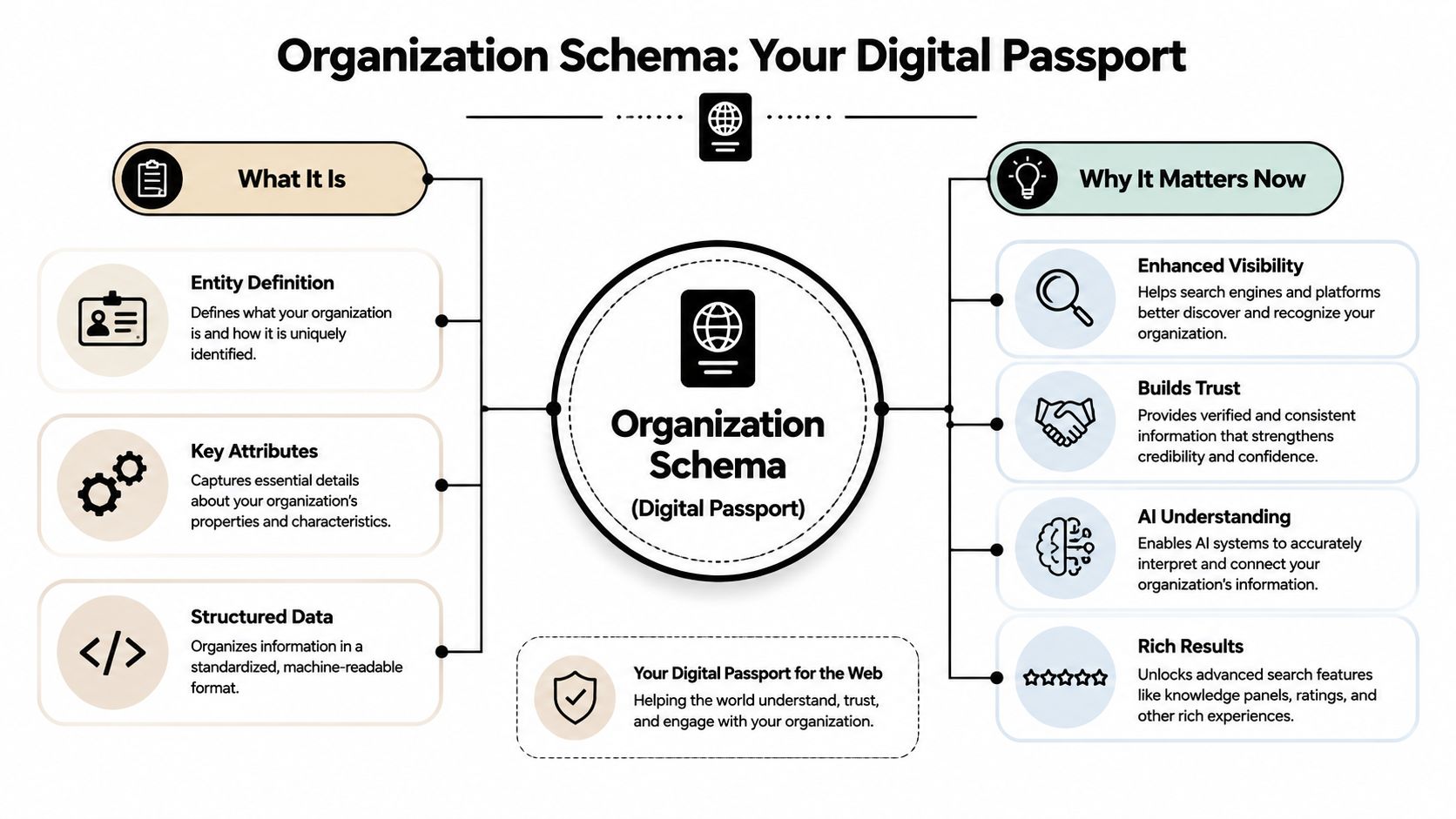
Organization schema markup is the machine-readable definition of your company. It states who the organization is, which website represents it, which profiles are official, and how other entities on the site connect back to that source of truth.
That used to be treated as a Knowledge Panel tactic. It is now much more important than that.
AI systems do not evaluate brands the way a human reviewer does. They compress evidence from your site, public profiles, citations, and entity references, then decide whether your company is identifiable enough to mention with confidence. If your organization data is vague, inconsistent, or missing, the model has to infer too much. That is where attribution breaks.
What the markup actually does
At a practical level, Organization schema gives machines a stable company record they can reuse across pages and systems. It can include your brand name, legal name, website, logo, contact points, sameAs profile URLs, address details, and identifiers that help separate your company from similarly named businesses.
Schema.org documents Organization as the broad parent type for companies, institutions, nonprofits, and other formal entities in its Organization specification. That breadth is exactly why it matters. For many brands, this is the top-level entity object that everything else should reference.
The strategic value is not the markup itself. The value is consistency.
A clean Organization object helps search engines and LLM-connected systems confirm that your homepage, author bios, product pages, press mentions, and social profiles all describe the same entity. That is a stronger signal than isolated on-page optimization because it reduces ambiguity at the entity level. If you need a broader technical baseline, Raven SEO's guide to schema markup for improving search visibility covers the implementation fundamentals.
Why it matters more now
Older guides framed Organization schema around enhanced search features. That advice is incomplete. The bigger shift is from ranking pages to getting your brand cited, summarized, and attributed correctly by AI systems.
In that environment, Organization schema works like the root node of your brand graph. Your Article, Product, LocalBusiness, Person, and WebSite markup can all point back to it through shared identifiers and references. That connected structure gives machines a better basis for deciding that your content came from a known organization, not just a domain with text on it.
There is a trade-off here. Adding basic markup is easy. Maintaining entity consistency across rebrands, subdomains, location pages, social profiles, and third-party listings is harder. That harder work is what outdated guides usually skip, and it is often the difference between being understood and being ignored.
A simple way to evaluate its role
| Function | What it does |
|---|---|
| Identity | Defines the company as a distinct entity |
| Reference | Establishes a persistent source other schema objects can point to |
| Verification | Confirms official profiles, site ownership, and brand details |
| Disambiguation | Helps systems separate your organization from similar names |
If your site publishes expertise but never defines the organization behind it in a consistent structured format, AI systems have a weaker basis for attribution. Organization schema closes that gap by giving machines a clear entity record to trust and reuse.
Building Your Brand Entity with Core Schema Properties
The fastest way to get organization schema markup wrong is to think in terms of "adding some code" instead of "defining an entity." The implementation should describe a real business in a way machines can parse cleanly and connect across pages.
Google-supported implementations typically use JSON-LD in the <head>. The technical baseline is straightforward, but precision matters—it is one piece of our broader structured data and technical SEO work.
Start with the required skeleton
Technical specifications require three core JSON-LD keys: @context, @type, and @id, and every implementation should pass Google's Rich Results Test before deployment. Those aren't optional details. They are the minimum structure that tells search systems what vocabulary you're using, what entity you're defining, and how that entity can be referenced elsewhere.
A practical starter pattern looks like this in concept:
- @context identifies the Schema.org vocabulary.
- @type defines the entity type, such as Organization or a more specific subtype.
- @id creates a persistent unique identifier that other schema objects can reference.
The properties that do the real work
Once the skeleton is in place, the next layer is what improves machine understanding.
- name and legalName: Use the public-facing brand name and, where relevant, the legal company name. This helps reduce ambiguity between brand identity and corporate registration.
- url and logo: These reinforce the canonical website and the primary visual identity.
- sameAs: List official social profiles and other authoritative brand pages.
- contactPoint: Use it when you want support, sales, or customer service contact details to be machine-readable.
- Identifiers: If applicable, include business identifiers that support external verification.
If your company has a physical presence, use the most specific applicable subtype instead of the generic Organization. An ecommerce brand may fit OnlineStore. A company serving a location may fit LocalBusiness. That added specificity gives search systems better context and aligns with Google's recommendation to use the most precise type available.
Field note: Generic markup is better than no markup. Specific markup is better than generic markup when it accurately reflects the business.
Build for connection, not isolation
The strongest implementations don't leave organization schema markup sitting alone on the homepage with no relationships. They use @id as a stable root so other entities can connect back to it.
For example:
- Article schema can point its publisher to the Organization entity.
- Person schema can associate authors or executives with the same root organization.
- Product or service markup can connect commercial pages to the parent brand.
That structure is the basis of entity-based SEO. If you want the broader strategic view, entity-based SEO is the discipline that turns isolated metadata into a coherent knowledge graph.
What works and what doesn't
A short decision table helps here:
| Works | Doesn't work well |
|---|---|
| One clean, validated JSON-LD implementation | Duplicate or conflicting schema from themes and plugins |
| Specific business subtype when accurate | Defaulting to Organization for every business model |
Stable @id reused across related markup |
New identifiers created randomly on different pages |
Official profile URLs in sameAs |
Linking to unofficial directories or fan pages |
| Validation before publish | Pushing live code with warnings and syntax issues |
Plugins can help with the basics. Manual JSON-LD usually gives better control when a company needs precise identifiers, cleaner graph relationships, or advanced brand architecture.
Beyond the Basics Signals for AI Visibility
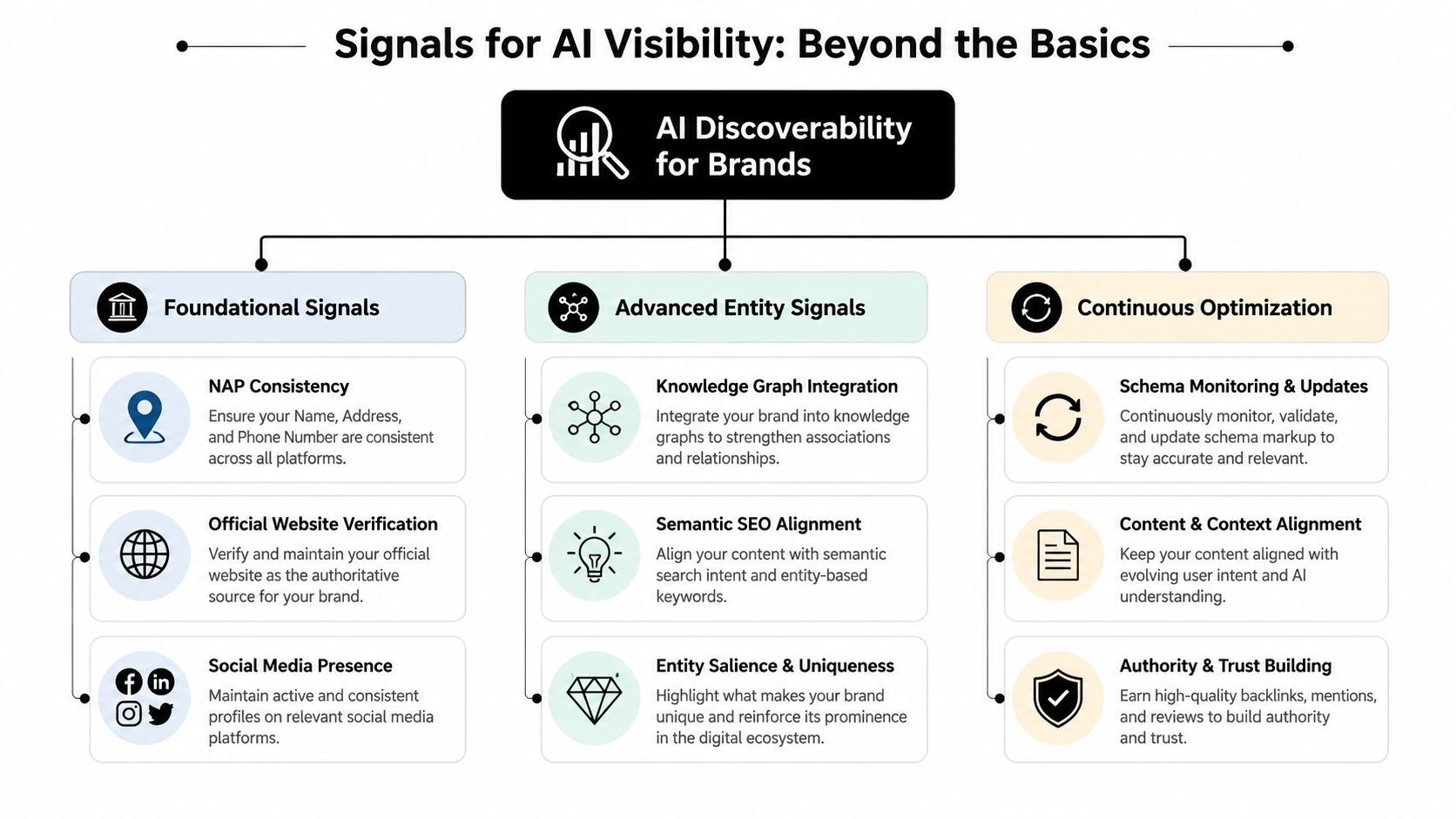
Organization schema stopped being a "rich results" tactic a while ago. For AI visibility, it functions more like a canonical identity layer. If that identity is vague, inconsistent, or weakly corroborated, large language models are less likely to cite your brand with confidence.
That is the shift many older guides miss. They focus on getting recognized by search engines. The harder and more valuable problem is getting resolved correctly by AI systems that synthesize answers from many sources at once.
sameAs is an entity resolution signal
The sameAs property helps machines connect your site to the rest of your official footprint. Done well, it reduces ambiguity. Done poorly, it spreads it.
Schema.org defines sameAs as a way to indicate that the current item is the same as a thing described on another URL in its sameAs property documentation. That sounds simple, but the implementation details matter. Use official profiles only. Keep brand naming aligned across those profiles. Remove dead accounts, redirects, and legacy pages that no longer represent the company.
Three patterns cause trouble fast:
- Unofficial URLs in
sameAs: reseller pages, directory listings you do not control, and old social accounts - Brand mismatches across platforms: one company name on the site, another on LinkedIn, a third in app stores
- Stale references: acquired brands, retired sub-brands, or redirected profile URLs left in place
The practical test is straightforward. If an AI system compares your homepage, LinkedIn page, Crunchbase profile, YouTube channel, and company registry entry, would it conclude they all describe the same organization without hesitation?
A useful companion read is this AI search optimization guide, which explains why machine-readable consistency now matters as much as traditional ranking signals.
Identifiers separate serious implementations from basic ones
Older organization schema advice usually stops at name, logo, and social links. That still matters, but it is not enough for brands operating in competitive, high-trust categories.
Formal identifiers give AI systems stronger ways to confirm identity across the web. Depending on the company, that can include iso6523Code, leiCode, duns, tax IDs published in official registries, or other recognized business identifiers supported by Schema.org's Organization type documentation. The trade-off is accuracy. If an identifier is outdated, mismatched, or attached to the wrong legal entity, it creates more confusion than trust.
Many implementations break when marketing teams publish schema for the brand name on the website, while legal, finance, and partner systems use a different entity name or parent company record. AI models do not care which department was responsible. They just see conflicting entity evidence.
Corroboration matters more than declarations
AI systems do not treat your markup as truth by default. They compare it against public evidence.
That means the strongest signal set is external consistency. Your site, schema, social profiles, author bios, business listings, knowledge bases, and third-party references should reinforce the same organization story. Third-party verification signals often determine whether your brand gets cited accurately or skipped in favor of a competitor with cleaner entity evidence.
A strong setup usually has four traits:
- One clearly defined organization identity
- Official references that match across major platforms
- Verifiable identifiers where appropriate
- Ongoing review when branding, ownership, URLs, or leadership changes
The goal is not to add more fields. The goal is to make your brand easier for AI systems to verify, connect, and cite.
Raven SEOs Practical Roadmap to AI Discoverability
Organization schema projects usually break when teams ship markup once, then leave it untouched while the business keeps changing.
That was often enough in the knowledge panel era. It is not enough if the goal is AI citation. LLMs do not just read the JSON-LD on your homepage. They compare your site against everything else they can associate with the entity, then decide whether your brand is clear enough to reference with confidence.
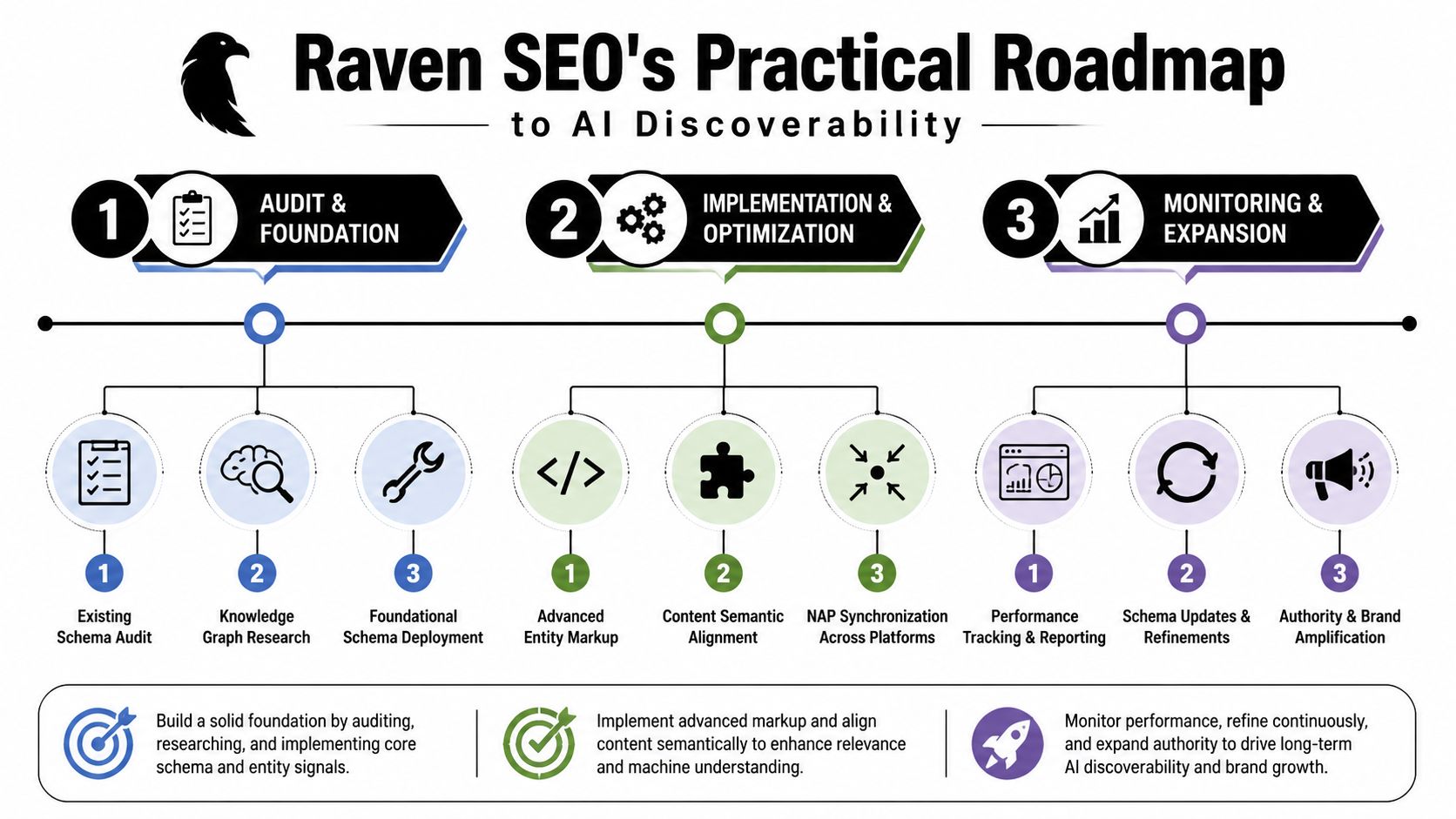
A practical roadmap has three parts: audit the entity, implement the graph correctly, and govern it like a live brand system.
Phase one audit and foundation
Start with entity reality, not markup syntax.
The first review should answer a harder question than "Do we have Organization schema?" It should answer "Are we describing one organization, in one consistent way, across every place an AI system is likely to check?" That includes the main site, social profiles, press mentions, author pages, directory listings, legal naming, and any older domains that still carry brand signals.
A useful foundation audit checks four things:
- Schema output: Is the site publishing one organization object or several overlapping versions from plugins, themes, and custom code?
- Entity consistency: Do brand name, logo, URL, and contact details match across owned properties?
- Graph connections: Do article, person, service, and profile schemas point back to the same root
@id? - Identifier quality: Are you using stable identifiers only where they accurately match the legal or public-facing entity?
For teams that need a disciplined process for technical reviews and stakeholder alignment, this 6-step design process for structured implementation gives a usable model.
Phase two implementation and alignment
Implementation should create one canonical organization entity that other schema objects can reference.
That means choosing the right subtype, setting a stable @id, mapping official profiles carefully, and removing duplicate or contradictory markup. On larger sites, this is usually where the trade-offs show up. A plugin may speed up deployment, but it often produces generic fields or duplicate objects. Manual JSON-LD gives tighter control, but it requires stronger governance and cleaner ownership across SEO, development, and brand teams.
A practical rollout sequence looks like this:
- Define the canonical entity: Confirm the official business name, preferred URL, logo, and any valid identifiers.
- Publish the root organization object: Add the primary JSON-LD on the homepage or About page.
- Connect supporting schema: Reference the same
@idfrom articles, authors, services, and other relevant entities. - Remove conflicts: Audit plugins, templates, and extensions that may output competing markup.
- Validate the graph: Check syntax, property fit, and relationship logic before release.
The goal is not more schema. The goal is a cleaner entity graph that AI systems can verify and reuse.
Phase three monitoring and governance
AI discoverability is won in maintenance.
Organization data drifts unobserved. A rebrand changes the logo. A merger changes the legal name. A social team launches a new profile and leaves the old one live. Support numbers change. A developer adds a plugin that publishes a second organization object without anyone noticing. Each inconsistency weakens entity confidence.
Set a review process for changes in these areas:
- Brand updates: New naming conventions, logos, acquisitions, or parent-child company relationships
- Contact details: Phone numbers, addresses, support channels, or business hours
- Profile management: New social accounts, retired profiles, and URL changes
- Site changes: Theme updates, plugin installs, migrations, and template edits that affect schema output
The operating principle is simple. Structured data belongs in brand governance, not just technical SEO.
Teams that follow this roadmap do more than qualify for search features. They give AI systems a stable, corroborated organization record that is easier to trust, connect, and cite.
Frequently Asked Questions about Organization Schema
Should organization schema markup go on every page
Organization schema belongs where it can define the company clearly and without duplication. In practice, that usually means the homepage or a primary About page, not every URL on the site. Guidance in this review of organization schema placement supports that approach.
For AI visibility, the priority is not repetition. It is a stable entity reference. Publish one authoritative Organization node, give it a persistent @id, and have your Article, Person, Service, and other schema types point back to it. That structure creates a cleaner graph, reduces conflicts, and makes your brand easier for machines to verify across pages.
Sitewide repetition can still make sense in a few cases, especially on platforms that struggle to keep entity references connected. But if the same organization object is being re-declared with slight differences, you are weakening clarity instead of strengthening it.
Should you use a plugin or write JSON-LD manually
The right choice depends on how much control you need.
Plugins work for simple sites that need a fast, baseline implementation. They reduce syntax mistakes and help teams get markup live without developer support. The trade-off is control. Many plugins output generic schema, create overlapping objects, or make it difficult to manage subtype selection, identifiers, and relationship logic across the full graph.
Manual JSON-LD is the better option when structured data supports brand strategy, not just technical hygiene. It gives you control over @id architecture, sameAs selection, parent-child relationships, and cross-references between your organization, authors, products, services, and locations.
A practical rule:
- Use a plugin if the site is small, the entity model is simple, and speed matters more than precision.
- Use manual markup if you care about citation quality, entity consistency, and long-term AI discoverability.
I usually see hybrid setups work best. Let the plugin handle low-risk schema types if needed, but define the core Organization entity manually so it stays clean and consistent.
Is organization schema markup the same as Google Business Profile
Google Business Profile is a listing inside Google's system. Organization schema is the structured entity record published on your own site.
They should align, but they are not interchangeable. Your schema helps search engines and language models understand who the company is, what official identifiers it uses, and which profiles and pages belong to it. Your Google Business Profile supports local trust and platform-specific visibility.
The key is consistency across all official sources. Business name, logo, address, phone number, and profile URLs should match across your site, your Google Business Profile, and your controlled social accounts. Google explains the role of structured data in helping its systems interpret page content in its structured data documentation.
That alignment used to be framed as a way to improve your chances of getting a knowledge panel. The standard is higher now. If AI systems see conflicting brand signals, they are less likely to reuse your organization data confidently in summaries, recommendations, and citations.
If your brand wants to move from being merely indexed to being cited, Raven SEO can help. We build AI-ready websites, structured data systems, and entity-based search strategies that support sustainable growth. Start with a no-obligation consultation and see how your current digital footprint performs in AI-driven search.