
Most advice about entity based SEO still treats it like an advanced add-on to ordinary optimization. Add some schema. Mention related terms. Build a few topic clusters. Then wait for richer results.
That advice is incomplete.
The web that rewarded isolated keyword pages and generic link building hasn't disappeared, but it no longer explains how visibility is earned across AI Overviews, featured snippets, knowledge panels, and conversational search. Search engines and large language models don't just retrieve pages. They try to identify who a brand is, what it offers, what it's associated with, and whether those facts are corroborated across the web.
That changes the operating model for SEO. The target isn't only a click. The target is a citation, a mention, a machine-readable reference inside an answer. A brand that becomes a clearly defined entity has a much better chance of being surfaced when users ask broad, comparative, or high-intent questions.
This is why entity based SEO sits at the center of AI visibility. It's the layer that connects content strategy, structured data, internal architecture, and off-site authority into something machines can interpret with confidence. If your site still treats every page like a standalone keyword asset, you're optimizing for an older version of search.
The Shift from Clicks to Citations
Traditional SEO asked a simple question. How do we rank a page for a phrase?
AI-era search asks a harder one. How does a machine decide your brand is credible enough to include in an answer?
That distinction matters. A ranking model can reward relevance at the page level. A citation model needs something more stable. It needs an identifiable entity with attributes, relationships, and evidence of authority. That's why entity based SEO isn't just another tactic. It's the foundation for how brands become legible to search engines and AI systems.
Why the old playbook breaks down
Keyword mapping still has value. Technical SEO still matters. Links still matter. But by themselves, they don't tell Google, Bing, or an AI assistant what your company is in a durable, verifiable way.
Search behavior has also widened. Users don't always search with neat transactional phrases anymore. They ask compound questions, compare vendors, request recommendations, and expect synthesized answers. In those moments, machines look for structured meaning, not just text matches.
Search visibility used to be about earning a position. Increasingly, it's about earning inclusion in an answer layer.
That shift is why many brands see inconsistent performance even when they publish frequently. They have content, but they don't have a coherent entity footprint.
What AI visibility actually requires
A machine-readable brand usually needs several signals working together:
- Clear identity: Consistent naming, service definitions, authorship, and business details.
- Topical structure: Pages that reinforce a subject area instead of competing with each other.
- Formal markup: Structured data that reduces ambiguity.
- External validation: Mentions, citations, profiles, and references beyond your own domain.
If you want the broader strategic context, Raven SEO has covered that evolution in its analysis of the future of SEO with AI.
The practical implication is straightforward. SEO is no longer just page optimization. It's brand interpretation engineering.
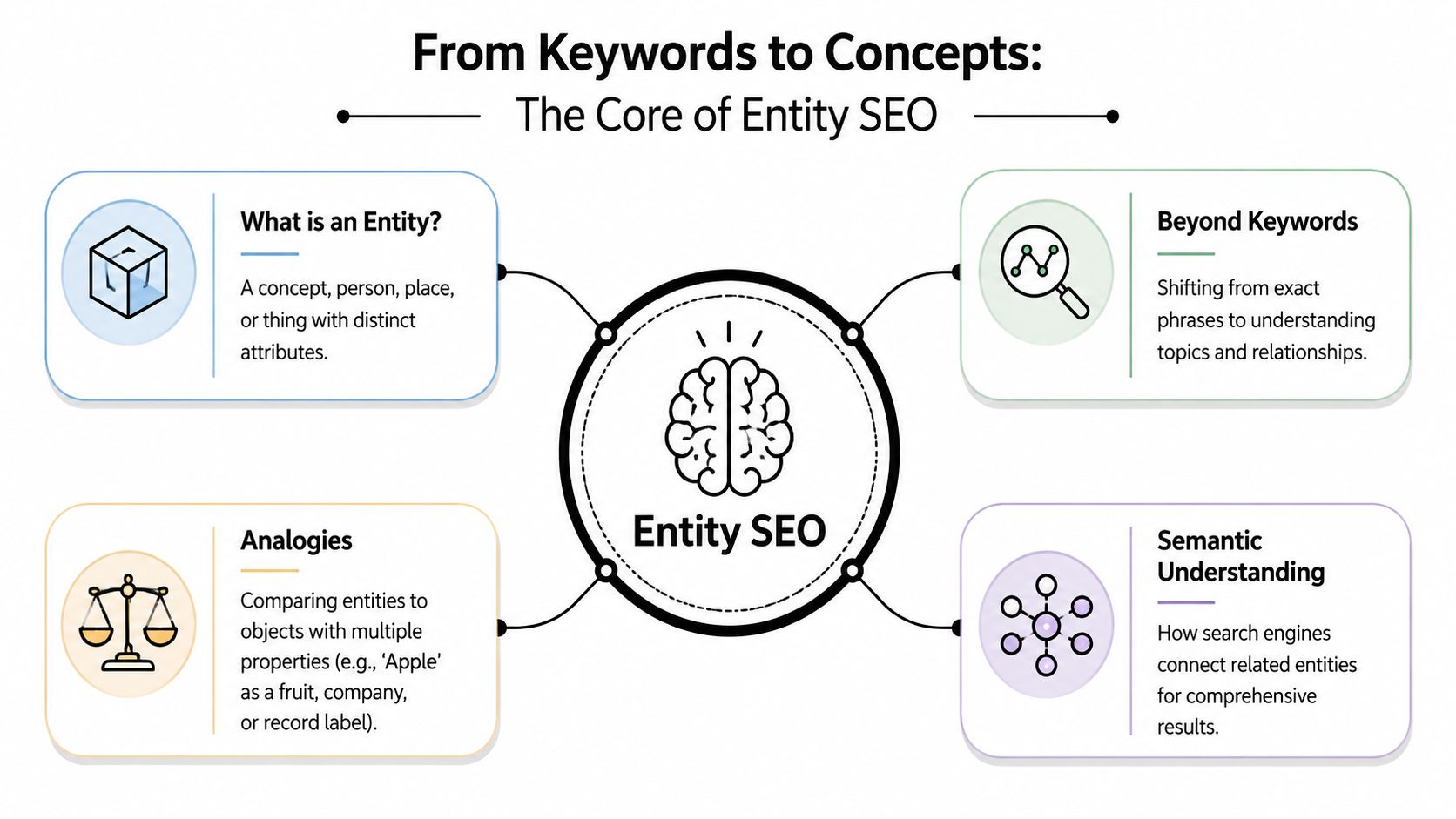
From Keywords to Concepts The Core of Entity SEO
An entity is a recognizable thing. A company. A person. A product. A location. A topic. Entity-based SEO works by optimizing for entities such as brands, products, people, places, and concepts rather than treating pages as isolated keyword containers. Its technical value comes from clearer context through entity identification, contextual relevance, and structured data, which helps algorithms map relationships in a Knowledge Graph and interpret related queries and AI-generated answers, as explained by Ahrefs in its entity-based SEO glossary.
A keyword is just a label. An entity is a defined object with relationships.
The simplest way to think about it
A keyword is your name on a sticky note.
An entity is your full digital passport. It includes your official name, what you do, where you operate, what other entities you're connected to, and enough context for a machine to distinguish you from similar names or adjacent topics.
That distinction becomes obvious with ambiguous terms. A phrase can point to several meanings. An entity resolves that ambiguity by surrounding the term with attributes and connections.
What changes in practice
Once you adopt an entity model, content planning changes.
Instead of publishing disconnected pages for adjacent keyword variants, you build a system around a central concept and the sub-entities attached to it. A national healthcare group might create one primary entity page for a service line, then support it with related pages about procedures, conditions, providers, FAQs, and location-specific variations. Each page reinforces the others.
That approach lines up with how semantic search works. Search engines moved beyond exact-match keywords toward concepts and relationships. In response, practitioners began organizing sites with content clusters and internal linking so engines could infer authority across a subject rather than a single URL. Raven SEO's guide to semantic search optimization goes deeper on that architecture.
What entity SEO is not
It isn't keyword stuffing with fancier language.
It also isn't a plugin-driven exercise where you add schema and assume the problem is solved. Entity SEO changes how you model your site, your brand, and your supporting evidence across the web.
A practical way to separate old SEO from entity SEO is this short comparison:
| Approach | Main unit of optimization | Primary goal |
|---|---|---|
| Traditional keyword SEO | Individual page and phrase | Rank for the searched term |
| Entity SEO | Recognizable thing and its relationships | Be understood across related queries and answer surfaces |
Working rule: If a page can't clearly answer "what entity is this about?" it's usually under-modeled for modern search.
Building Authority Beyond Your Website
Structured data matters, but many teams overestimate what markup can do on its own.
Schema can declare identity. It can't force belief. Search engines still look for corroboration beyond your domain, and that's where many entity strategies weaken. A site may describe itself perfectly while the wider web barely confirms that description.
Why markup alone stalls out
One of the most useful contrarian points in entity SEO is that Google relies on external verification, unlinked brand mentions, directories, and knowledge-graph alignment in addition to markup, as noted in Outpace SEO's discussion of entity SEO. That creates a real strategic trade-off. Should you spend another sprint expanding schema coverage, or should you invest in authority signals that other domains control?
In practice, brands need both. But once the core markup is in place, the next gains often come from corroboration.
The off-site signals that actually help
Search engines try to reconcile your self-description with independent evidence. That usually includes a mix of the following:
- Consistent business references: Your name, offerings, and identity should align across directories, social profiles, and partner pages.
- Unlinked brand mentions: A mention without a backlink can still strengthen recognition if the context is clear.
- Editorial references: Industry publications, association listings, podcast appearances, and conference bios all help define what your brand is associated with.
- Expert identity signals: Author pages, biographies, and bylines matter when your firm wants to be trusted for advice, not just transactions.
This is also where simplistic SEO lore starts to fall apart. For example, many marketers still inherit outdated thinking around semantic relevance and term variation. One useful breakdown of that problem is OneNine's article on LSI keyword myths for marketers, which helps separate real semantic strategy from recycled jargon.
The practical trade-off
If a brand is small or still building recognition, I usually treat schema as table stakes and external corroboration as the differentiator. If the brand is already well known, deeper schema can help clean up ambiguity and support rich surfaces, but it still won't replace public evidence of legitimacy.
A useful checklist for prioritization looks like this:
- Fix first-party consistency first: Your site, profiles, and business details should match.
- Then strengthen third-party trust: Earn mentions where your buyers already look for verification.
- Then deepen relationships: Connect products, services, people, and publications into a coherent entity web.
For brands working on that third layer, Raven SEO has a practical resource on how to build backlinks naturally. The important point isn't link quantity. It's whether the wider web describes your brand in a way machines can trust.
The Language of AI Mastering Structured Data
Structured data is the formal language you use to tell machines what something is.
For many teams, JSON-LD feels technical enough to postpone. That's a mistake. If visible page copy is written for humans, structured data is the parallel layer written for machines. It removes ambiguity and gives search systems a cleaner representation of your business, your people, and your offers.

What good schema actually does
A practical entity-based architecture uses topic clusters, consistent internal linking, and schema markup to reinforce one primary entity per page. Guidance also notes that title tags should stay within about 60 characters and meta descriptions around 155 to 156 characters, while headings and concise sections help search engines surface content in snippets and related SERP features, according to Ignite Visibility's entity SEO guidance.
The point isn't to mark up everything possible. The point is to mark up the right thing clearly.
A basic service page may say "We provide managed IT support." A machine can read that sentence, but it still has to infer whether the page is about an organization, a service, a location, or an article. Schema reduces that guesswork.
What to mark up first
For most brands, the initial priority set is straightforward:
- Organization schema: Official business name, logo, site URL, and profiles.
- Person schema: Founders, physicians, attorneys, authors, or subject experts tied to content.
- Service or Product schema: Core offerings that define commercial intent.
- Article schema: Educational content that connects authorship to expertise.
A clean implementation also pairs schema with strong page structure. One page should emphasize one primary entity. Related entities can appear, but they shouldn't blur the page's purpose.
Practical rule: Don't use schema to compensate for vague copy. First make the page obvious to a human reader, then make it explicit to a machine.
Where teams overcomplicate it
The biggest mistake isn't underuse. It's random use.
I've seen sites stack multiple schema types on one page without a clear hierarchy, producing markup that is technically present but semantically muddy. That rarely helps. Precision helps. Consistency helps. Reusable entity definitions help.
For ecommerce teams, product data quality matters just as much as markup quality. If you're working on catalog visibility, Yassine Malti's piece on product feed optimization is a useful companion because feed structure and entity clarity often support the same commercial surfaces.
If you need the implementation basics, Raven SEO has a practical guide to schema markup for search visibility.
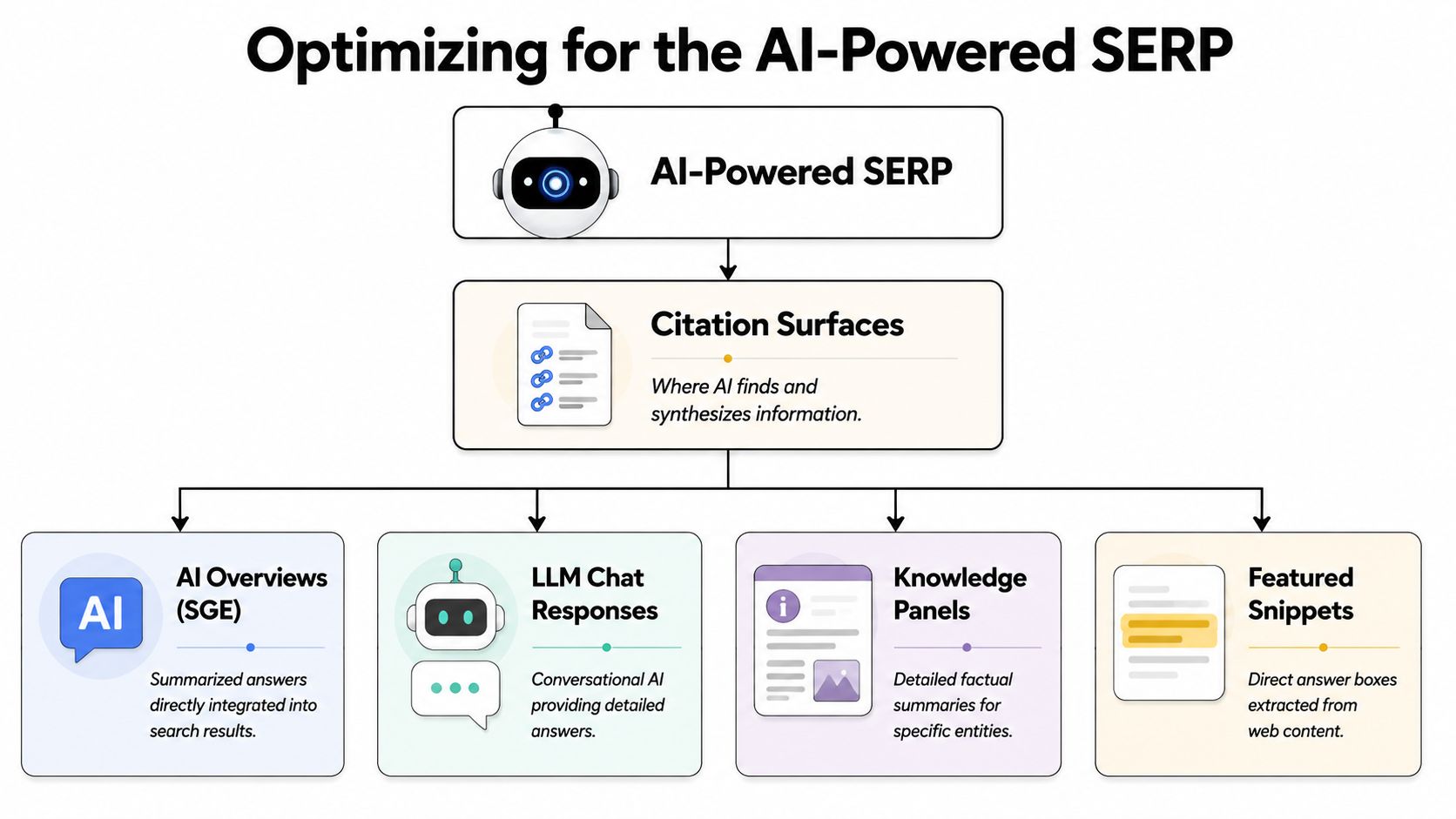
Optimizing for the AI-Powered SERP
The modern SERP isn't one surface anymore. It's a bundle of answer layers.
A user may see an AI Overview, a featured snippet, a knowledge panel, standard organic links, product modules, local results, or some combination of them. In conversational tools, the answer may not look like a SERP at all. But the logic is similar. The system still needs source material it can interpret and trust.
From rankings to citation surfaces
Entity based SEO proves its value. A clearly defined entity can be reused across multiple answer environments because the machine doesn't have to rediscover your identity from scratch on every query.
Featured snippets are an important example. One benchmark reports that entity-optimized content is 50% more likely to appear in featured snippets, and 75% of marketers who adopted entity SEO saw higher rankings for long-tail keywords and topic clusters, according to Nightwatch's entity-based SEO analysis. Those outcomes matter because snippets often feed AI-driven result experiences and conversational search responses.
What AI systems tend to prefer
AI systems need sources that are easy to summarize without distorting meaning. That usually favors content with these traits:
- Defined ownership: The page clearly belongs to a real organization or expert.
- Tight scope: One page answers one main question or covers one main entity.
- Scannable structure: Headings, concise sections, and extractable definitions help.
- Supporting relationships: Internal links and related pages reinforce broader subject authority.
That doesn't mean every page should be short. It means each page should be well structured enough to be interpreted in pieces.
The ROI lens that matters now
A ranking report can still show progress, but it doesn't capture the full picture anymore. Brands should also watch whether their content appears in rich answer formats, whether their definitions get reused, and whether branded queries reveal stronger machine understanding over time.
That's why I frame entity work as visibility infrastructure, not content decoration. It increases the chance that your information can travel from your site into summary layers where the click may or may not happen, but the brand impression certainly does.
For teams adapting their search strategy to this environment, Raven SEO's guide to SEO for generative AI search offers a useful next step.
A traditional ranking can be replaced by another blue link. A machine-readable entity can persist across multiple answer surfaces.
Your Practical Roadmap to AI Visibility
Most companies don't need more disconnected tactics. They need an ordered sequence.
The fastest way to waste time on entity SEO is to jump straight into markup or content production before you've defined the entity model. The roadmap below is the process I use when evaluating whether a brand is ready for AI visibility.
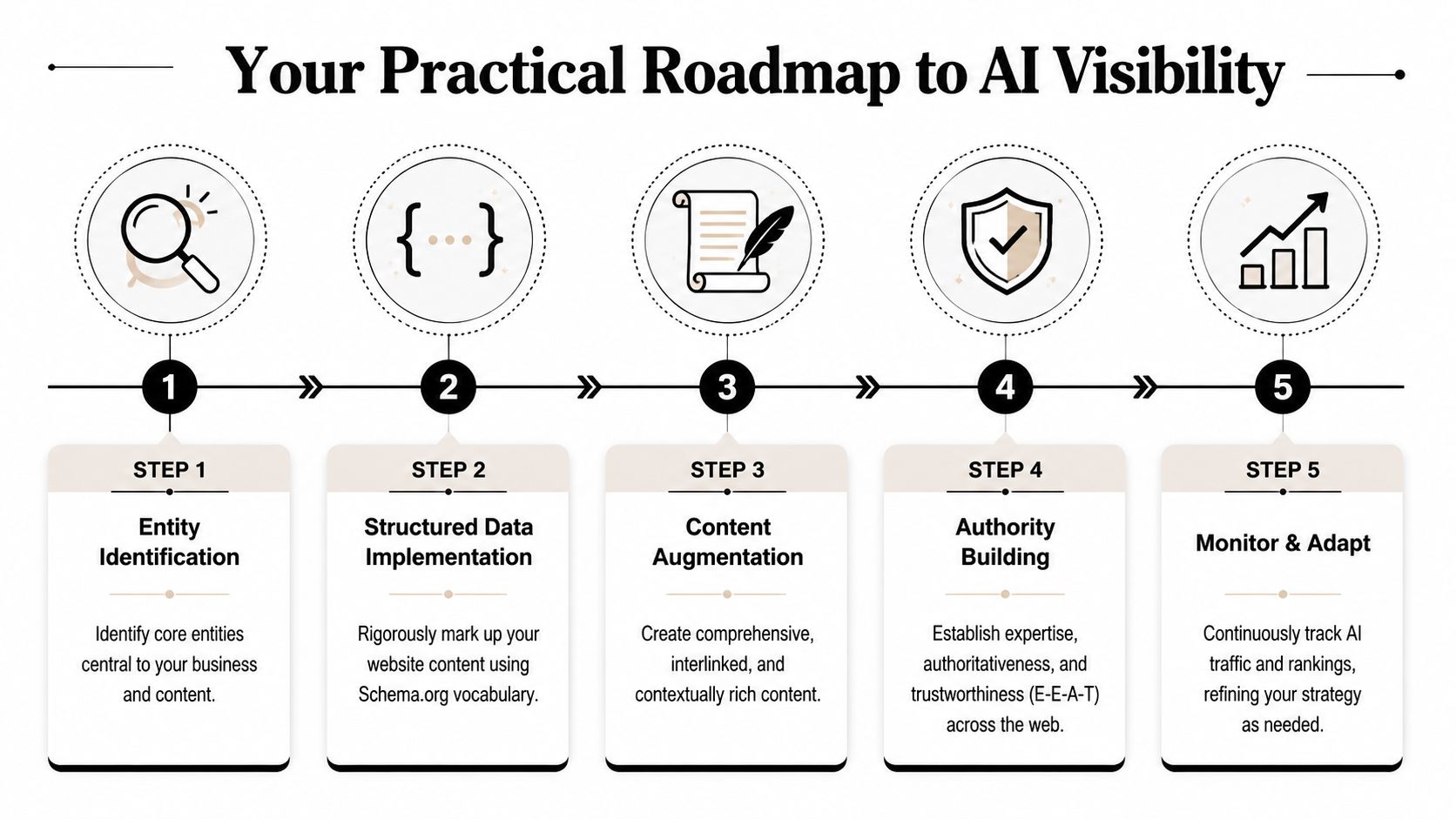
Step 1 Entity audit
Start with identity, not content.
Document the primary brand entity and the most important sub-entities tied to it. That may include services, products, practitioners, locations, software categories, or proprietary frameworks. Then check whether the site names those entities consistently.
Look for common problems:
- Naming drift: The business uses one name on the homepage, another in directory profiles, and a shortened version in schema.
- Offer confusion: Service pages blur together and don't establish distinct commercial entities.
- Weak authorship: Educational content has no credible person attached to it.
Step 2 Schema blueprint
Once the entity inventory is clear, define the schema model before implementation.
This stage isn't about producing the maximum number of properties. It's about deciding which entities deserve standalone definition, where they should live, and how they connect. For some teams, that means Organization, Service, Person, Product, FAQ, and Article. For others, a leaner model is better.
Raven SEO is one option teams can use for this phase when they need technical SEO support, AI-ready site structure, and a current-state audit of their machine-readable brand signals.
Step 3 Authority matrix
Next, map content around core entities instead of keyword fragments.
A simple authority matrix pairs each high-value entity with supporting proof. For example:
| Core entity | Supporting proof |
|---|---|
| Service | Explainer pages, FAQs, comparison content |
| Expert | Author bio, credentials, bylined articles |
| Brand | About page, mentions, directory consistency |
| Product | Product schema, specs, guides, reviews |
Topic clusters become useful, but only when they reinforce a business concept rather than inflate page count.
A short walkthrough helps here:
Step 4 Citation audit
After on-site work, review where your brand appears beyond your domain.
This is less glamorous than publishing content, but it often reveals the biggest trust gaps. Check business profiles, industry directories, press references, association pages, and partner sites. Look for inconsistency, missing coverage, or weak descriptions that understate what the company does.
Clean markup tells machines what you claim. External citations help confirm that claim.
Step 5 Monitoring and refinement
Entity SEO isn't a one-time deployment.
Use Google Search Console to watch cluster-level impressions, clicks, and SERP feature visibility when you're assessing semantic authority. Also monitor how your branded searches evolve and whether key commercial pages start appearing in richer formats. Improvement usually comes from iteration, not one launch.
The Future is Machine-Readable
Entity-based SEO emerged as search engines moved beyond exact-match keywords toward concepts and relationships. They now use content clusters and internal linking to infer authority across a subject, which makes entity SEO a structural discipline rather than a simple keyword tactic, as described in HubSpot's overview of entities in SEO.
That's the larger shift this entire topic points to. The winning brands won't just publish more content. They'll become easier for machines to identify, verify, and reuse.
That means thinking bigger than rankings. It means building a brand that can be interpreted across search, AI summaries, snippets, knowledge panels, and conversational systems without losing clarity. Schema plays a role. Content architecture plays a role. External corroboration plays a role. But the unifying goal is the same. Become a trustworthy, machine-readable entity.
For business leaders, this is less about chasing a trend and more about adapting to a new retrieval model. AI systems need structured meaning. Brands that provide it gain advantage across more surfaces. Brands that don't stay dependent on fragile page-level visibility.
The opportunity is still open. Most sites haven't built this layer well.
If you want a practical assessment of where your brand stands, start with a no-obligation consultation from Raven SEO. The goal is simple: audit your current AI visibility, identify entity gaps, and map the next steps toward a search presence that's built for citations, not just clicks.