
Search marketing is being rebuilt around a new outcome. Citation inside AI-generated answers now matters alongside rankings and clicks.
That shift changes how teams should define visibility. A brand can shape evaluation, shortlist inclusion, and purchase intent before a user ever visits the site. Search still matters. What changes is the unit of value. It is no longer only traffic. It is also whether your content is structured, attributable, and credible enough to be pulled into answer engines.
This is why the future of search engine marketing is not just better SEO. It is a broader operating model that combines classic search performance with AI Engine Optimization, or AEO. The goal is not merely to rank a page. The goal is to become a source that search engines, AI assistants, and conversational interfaces can cite with confidence.
For businesses, the implication is practical. Keep investing in rankings and demand capture, but stop treating clicks as the only proof of search impact. The teams that win in this next phase will measure authority, citation presence, and source readiness, then build content, schema, and brand signals to support all three.
The End of the Click as We Know It
The click is no longer the only outcome that matters in search. A buyer can ask a question, read an AI-generated answer, narrow a shortlist, and form a vendor preference before your analytics platform records anything at all.
That changes the operating model for search marketing. Rankings still matter. Traffic still matters. But if your team treats sessions and last-click conversions as the full picture, you will undercount search influence at the exact moment AI systems are shaping consideration.
The practical shift is straightforward. Search used to reward the page that won the visit. AI-assisted search also rewards the brand that supplies the clearest, most credible answer. Those are related goals, but they are not the same job.
Why old KPIs are starting to miss the point
A common failure pattern looks like this: a company sees stable rankings, then notices softer click-through rates on informational queries, and assumes performance is slipping. In many cases, the query is still being won. The difference is that the answer is being consumed on the results page or inside a conversational interface.
That creates a measurement gap. Brand recall can rise while traffic stays flat. Product comparisons can influence pipeline before a user lands on your site. High-intent questions can produce commercial impact without the clean attribution path search teams relied on for years.
B2B firms, healthcare providers, SaaS companies, and multi-location service brands will feel this first because buyers in those categories research carefully and ask layered questions. If your content helps answer those questions but your reporting only rewards visits, your team may keep funding the wrong assets and miss where search visibility is shifting.
Teams that sell products online are dealing with a version of the same problem. If you need search work tied to revenue outcomes, this guide on how to boost your e-commerce sales with SEO is a useful reference because it connects visibility work to commercial performance.
What businesses should do instead
Use two scorecards.
One should track classic SEO outcomes such as rankings, qualified traffic, conversions, and category page performance. The second should track whether your content is being surfaced, summarized, and reused in answer-driven experiences. That means reviewing pages for clear definitions, direct answers, visible authorship, cited claims, and structure that an AI system can parse without guesswork.
A simple audit question helps: if someone removed your branding from the page, would the answer still read like a reliable source? If the answer is no, the page probably depends too much on design, persuasion, or context and not enough on extractable substance.
For a more focused look at this behavior shift, Raven SEO's guide to optimizing for zero-click searches is a useful next read.
The Shift From Clicks to Citations
The future of search engine marketing is increasingly about citation visibility. That's where AI Engine Optimization, or AEO, becomes useful as a working model.
Traditional SEO asks, “How do we rank this page?” AEO asks, “How do we become the source an AI chooses to reference?” That difference sounds subtle until you start changing content, schema, authorship, and page structure around it.
A helpful analogy is a research paper. A normal search result is one item in the bibliography. An AI citation is the source the paper relies on to explain the topic.
According to SFGATE's search engine marketing trends article, search is shifting from click-based rankings toward citation-based visibility because AI Overviews and conversational engines can answer queries directly on the results page. That makes structured, answer-ready content more valuable than keyword density alone.
Traditional SEO versus AI visibility
| Metric | Traditional SEO (Search Engine Optimization) | AI Visibility (AI Engine Optimization) |
|---|---|---|
| Primary goal | Rank higher in search results | Be cited, summarized, or recommended in AI answers |
| Core unit of value | Clicks to a webpage | Inclusion in an answer layer |
| Content style | Keyword-targeted pages | Clear, modular, answer-ready content |
| Technical focus | Crawlability, indexation, internal links | Parseable structure, entity clarity, citation readiness |
| Best-performing assets | Landing pages, blog posts, service pages | Definitions, FAQs, explainers, comparison blocks, structured data |
| Winning signal | Relevance to a query | Relevance plus trust, clarity, and extractability |
| Main reporting lens | Rankings, traffic, conversions | Mentions, citations, assisted influence, downstream branded demand |
What works and what doesn't
What works:
- Direct answers near the top: Put the clearest response early, then expand with detail.
- Tight topical scope: One page should answer one core problem well before branching.
- Supportive context: Add examples, use cases, and follow-up questions that deepen understanding.
- Consistent terminology: Use the same business descriptors across your site.
What doesn't work:
- Pages written only to hit keyword variants
- Long introductions that delay the answer
- Thin FAQ sections pasted onto unrelated pages
- Vague claims with no proof, no author context, and no corroboration
Being “findable” isn't the same as being “citable.” AI systems reward pages that are easy to interpret, not just pages that exist.
AEO doesn't replace SEO. It sharpens it. The strongest programs now build pages that can win both outcomes: a click when users want depth, and a citation when users want a direct answer.
Understanding the New Search Everywhere Ecosystem
Search no longer happens in one place. People discover brands inside Google results, AI Overviews, conversational engines, video platforms, social search, forums, and community threads. That changes both strategy and governance.
Industry forecasts for 2026 describe this shift as “Search Everywhere Optimization”, where discovery happens across Google, AI Overviews, Bing Copilot, ChatGPT Search, social platforms, video, forums, and community search, according to WSI's 2026 search strategy forecast.

One brand, many discovery surfaces
A user might ask Google for a definition, ask ChatGPT for comparisons, watch a product demo on YouTube, verify reputation in Reddit threads, and check reviews before contacting sales. Those actions used to sit in separate marketing silos. They now function like one extended search journey.
That means your site can't be the only place where your brand identity is coherent.
You need consistency across:
- Core business facts: Company name, services, product names, locations, and contact details
- Category language: The phrases you want associated with your brand
- Expert signals: Named authors, credentials, and thought leadership
- Third-party corroboration: Reviews, mentions, directory listings, and industry references
The operational impact
Search Everywhere Optimization pushes businesses toward a single source of truth. Your website should define the brand clearly, but your wider digital footprint has to reinforce the same message.
A practical example is service information. If your site clearly structures what you do, where you do it, who it's for, and how to contact you, that same information can support visibility across multiple AI and search interfaces. If those details conflict across platforms, systems have less confidence in your brand record.
For teams trying to understand how generative search changes visibility rules, Raven SEO's overview of search generative experience is worth reviewing.
What this means for national brands
National visibility now depends on distributed clarity, not just domain authority. The strongest brands are building content systems that travel well across channels. They don't publish random assets and hope search engines connect the dots. They define entities, standardize language, and reinforce authority everywhere buyers research.
Becoming a Source Through Data Structure and Schema
Most businesses don't lose AI visibility because they lack information. They lose it because their information is hard to interpret.
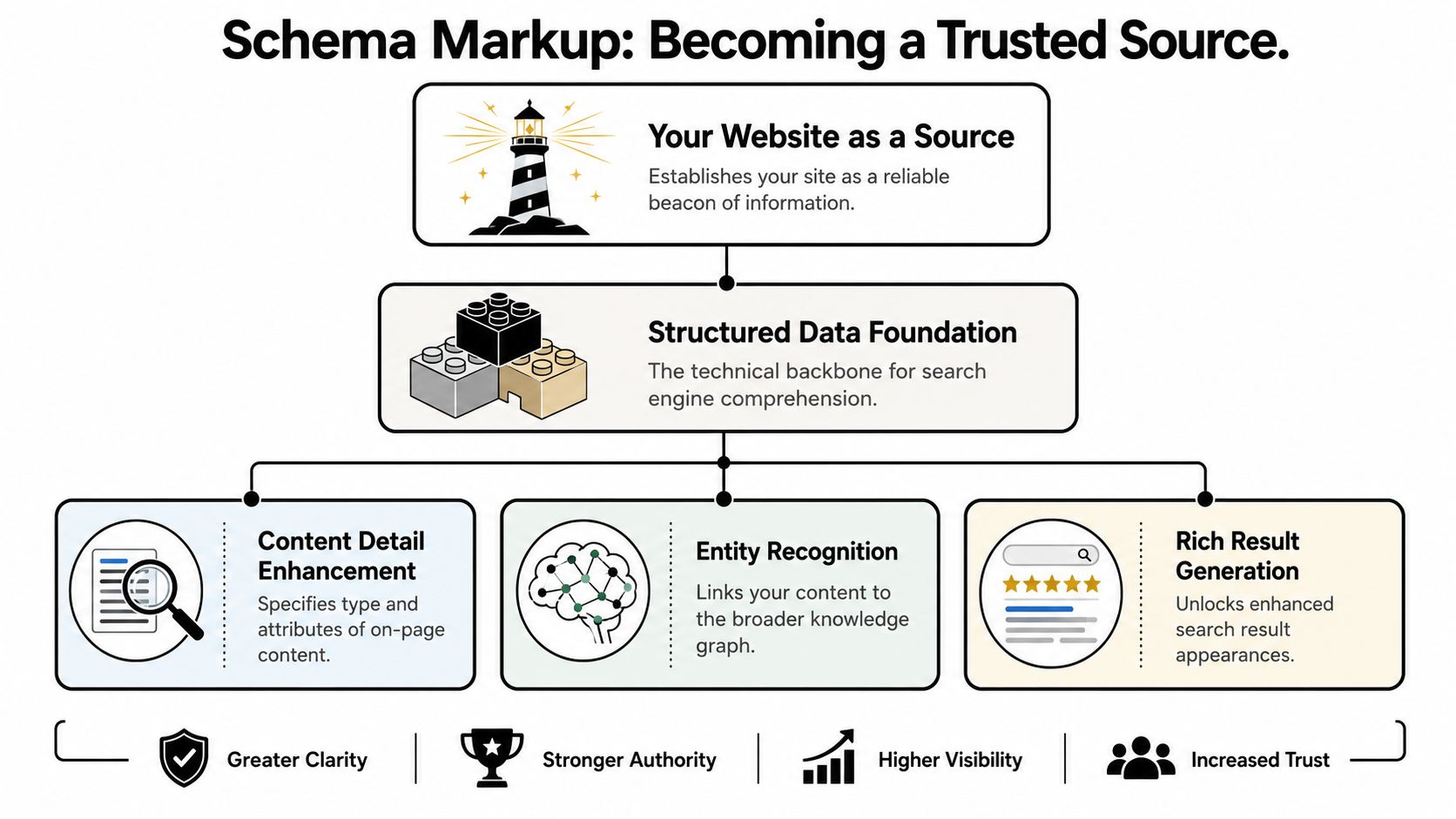
Schema helps fix that. It acts like a standardized label set for your website, turning scattered page content into machine-readable facts. For AI systems, that matters because structured data reduces ambiguity. It tells the system what a page represents, what a product is, who the author is, and which questions are being answered.
Independent industry analysis frames this as a separate optimization problem: brands need structured data, clean entity signals, and authoritative content that AI systems can quote or summarize, as discussed in Basis Technologies' article on AI and the future of search engine marketing.
Think of schema as a label, not a trick
A useful analogy is a nutrition label on packaged food. The food already exists. The label just makes the facts easier to verify.
Schema does the same for digital content. It doesn't make weak pages authoritative. It makes strong pages easier for machines to understand.
Common schema types that matter in AEO work include:
- LocalBusiness: Clarifies business identity, service areas, and contact details.
- FAQPage: Helps define direct question-and-answer pairs.
- Product: Structures pricing context, features, and availability when relevant.
- Article: Clarifies authorship, publication context, and topical focus.
Where businesses usually get this wrong
The common failures aren't exotic. They're boring and expensive.
- Incomplete markup: Teams add basic schema once and never update it.
- Mismatch between page and markup: The code says one thing, the visible page says another.
- Template-level duplication: Every page gets the same generic structured data, which weakens specificity.
- No entity discipline: Brand names, services, and descriptions vary from page to page.
Schema should describe reality. If it tries to decorate or exaggerate reality, it stops helping.
For ecommerce teams working through platform-specific implementation details, Grumspot's Shopify SEO guide offers a practical look at structured data setup in a Shopify context.
A practical schema priority list
Start with pages that shape trust and buying decisions:
- Homepage for organization-level identity
- Primary service or category pages for commercial intent
- Location pages if geography matters
- FAQ content where customers ask repetitive questions
- High-value editorial content that demonstrates expertise
Then validate whether the markup reflects what users see. Schema is not a side project for developers alone. It's a content operations issue, a brand consistency issue, and a search visibility issue at the same time.
If you want a deeper technical foundation, Raven SEO's schema markup guide for search visibility breaks down the essentials.
Building Verifiable Brand Authority for AI Trust
Structured data tells AI systems what your content is. Authority helps those systems decide whether your content should be trusted.
Many businesses often underestimate the problem. They assume authority comes from publishing more pages. In practice, AI systems look for corroboration. If your site says you're an expert, but the wider web barely confirms your existence, your authority profile stays weak.
What verifiable authority looks like
Authority in an AI-driven environment is built from signals that can be checked across sources. That includes:
- Consistent business identity: Your brand name, address, phone details, and core descriptions should align wherever they appear.
- Third-party review presence: Reviews on credible external platforms support trust because they aren't self-published.
- Expert-led content: Real authors with visible expertise give pages stronger context.
- Industry mentions: Coverage, citations, podcasts, directories, and interviews build a broader confidence trail.
- Case-based proof: Detailed examples of work, methodology, and outcomes help establish real-world experience without making inflated claims.
Why E-E-A-T matters more in AI environments
A traditional ranking system can reward relevance and page quality. A generative system also has to decide whether a source deserves to inform an answer. That raises the importance of experience, expertise, authoritativeness, and trustworthiness.
An AI model doesn't “believe” a claim because your headline says it loudly. It looks for alignment. Does the author appear real? Is the company consistently described elsewhere? Do other sites mention the same business in the same category? Are the claims specific and supportable?
Raven SEO's resource on E-E-A-T for AI is useful for teams translating those principles into actual search operations.
What strong brands do differently
Strong brands make it easy for machines and humans to reach the same conclusion.
They typically:
- Publish content under real subject-matter experts
- Keep service descriptions consistent across channels
- Maintain complete profiles on relevant third-party platforms
- Build pages around actual customer questions, not just keyword fragments
- Update outdated claims before they spread inconsistency
If your authority only exists on your own website, it's branding. If it's echoed elsewhere, it becomes trust.
The trade-off most teams avoid
Authority building is slower than technical fixes. You can deploy schema in days. You can't manufacture reputation on demand.
That's why businesses should stop separating SEO, content, PR, reviews, and profile management into disconnected workstreams. In the future of search engine marketing, those disciplines increasingly support the same outcome: becoming a source that AI systems can verify without hesitation.
A Practical Roadmap to Becoming AI-Ready
Most businesses don't need a grand reinvention. They need an audit that shows where their current digital footprint breaks down for machine-readable discovery.
A practical AI-readiness review usually comes down to three layers: data, content, and authority.

Audit one: the data layer
Start with the site's technical truth. This is the layer that tells search systems and AI tools what your business, pages, and offers are.
Ask:
- Is schema present on core pages? Focus on homepage, service pages, product pages, FAQs, and articles.
- Does the markup match visible content? If not, trust degrades.
- Are entities defined consistently? Product names, services, company descriptions, and author identities should not drift.
- Can important facts be extracted easily? Hours, service areas, pricing context, and contact information should be obvious.
This is also the point where many brands realize their CMS templates aren't helping. Structured data often gets bolted on inconsistently, especially across large service libraries or franchise-style page sets.
Audit two: the content layer
Now inspect how your pages answer questions. AI systems prefer content that can be segmented into useful answer units, then expanded with supporting detail.
Look at your pages through these filters:
- Answer-first clarity: Does the page state the key answer early?
- Follow-up readiness: Does it address adjacent questions a buyer will ask next?
- Semantic structure: Are headings logical, specific, and easy to scan?
- Expert framing: Does the content show real-world knowledge, or does it read like generic SEO copy?
A common failure is content that was built to rank for one phrase but never designed to educate. That kind of page may still have value, but it rarely becomes a strong citation candidate.
This video gives useful context on how businesses should think about AI visibility and search adaptation:
Audit three: the authority layer
The final audit asks whether the wider web confirms what your site claims.
Review:
- Third-party mentions: Where does your brand appear beyond your own domain?
- Review footprint: Are customers leaving evidence of satisfaction on external platforms?
- Author credibility: Are named experts associated with your content?
- Brand consistency: Do directories, profiles, and social bios describe the business the same way?
This layer usually reveals the difference between “we have content” and “we have a trusted digital presence.”
Turning the audit into action
A sensible implementation sequence looks like this:
- Fix data accuracy first. Don't optimize around broken inputs.
- Rewrite priority pages for answer quality. Start with your highest-value services or product categories.
- Strengthen corroboration. Clean listings, improve profile consistency, and build external trust signals.
- Measure beyond rankings. Watch branded search demand, assisted conversions, sales conversations, and AI mention patterns where available.
For businesses that want a structured review, Raven SEO's AI readiness assessment is one option for evaluating whether a site is prepared for AI-mediated discovery.
The Future is Conversational and Citable
The future of search engine marketing won't be won by the brand that publishes the most pages. It will be won by the brand that becomes the clearest, most verifiable source.
That means rethinking what “optimization” is. It's no longer just metadata, rankings, and click paths. It's content that answers cleanly, schema that defines meaning, and authority that can be confirmed across the web. In that environment, the best-performing brands won't chase every new platform separately. They'll build a strong source record that travels across all of them.
Some teams are calling this GEO, some AEO, and some AI visibility. The label matters less than the operating model. A useful companion perspective is Constructo Marketing's GEO insights, especially if you're comparing how different practitioners frame generative search strategy.
The practical shift is straightforward. Stop treating search as a contest for blue links alone. Start building for answers, citations, and trust. That's where search is going, and businesses that make this transition early will be easier to discover, easier to trust, and harder to displace.
Raven SEO helps businesses evaluate whether their websites, content, and brand signals are ready for AI-driven discovery. If you want a practical review of your schema, authority footprint, and citation readiness, schedule a no-obligation consultation with Raven SEO.