

Meta Title: B2B Content Marketing Services for the AI Era | Raven SEO
Meta Description: Learn how B2B content marketing services must evolve for AI-first search, citations, schema, and brand authority. Explore the future of visibility with Raven SEO.
Your next buyer may never see your homepage first. An AI assistant may read it, summarize it, compare it to competitors, and decide whether your brand is worth mentioning.
That changes the job of B2B content marketing services. The goal is no longer limited to getting pages to rank. The work now includes making expertise easy to verify, claims easy to trace, and pages easy for machines to interpret without stripping out what makes them persuasive to human buyers.
This is already showing up in real buying behavior. Prospects ask Google, ChatGPT, Gemini, Claude, and internal copilots for vendor shortlists, category explanations, and product comparisons. If your site is vague, unsupported, or hard for language models to parse, you lose visibility before a sales conversation begins. The technical side matters here, which is why a working grasp of natural language processing basics helps explain how AI systems extract meaning from your content.
The strategic shift is straightforward. Your content now serves two audiences at once: the human evaluating a purchase, and the machine shaping what that human sees first. The gap between those audiences is smaller than many teams assume, but it does create trade-offs. Dense expert language can signal authority to a buyer and confuse extraction systems. Oversimplified copy can be easy for AI to quote and too weak to convert serious prospects.
The practical standard is content that is clear, attributable, and specific. The same logic shows up when teams are comparing AI and human testers. Machines process patterns quickly. People judge nuance, risk, and credibility differently. Strong B2B content has to hold up under both kinds of review.
The New B2B Buyer Is an AI
Your next buyer may never visit your site first.
In more B2B journeys, the first pass now happens inside ChatGPT, Google's AI results, Gemini, Claude, or an internal copilot. A prospect asks for a shortlist, a comparison, or a recommendation. The system scans available sources, compresses the category, and presents a narrowed set of options. If your content is hard to interpret or weakly supported, you can disappear before a human buyer even knows you were in the running.
That changes what “content marketing services” need to deliver. Publishing for human readers alone is no longer enough. Content also has to work for the systems shaping discovery, summarizing vendors, and filtering which claims look credible.
Why this changes content strategy
As noted earlier, budget priorities already reflect the commercial weight of search. The bigger shift is that search no longer ends with ten blue links. It increasingly starts with a machine-generated answer built from sources the model considers clear, consistent, and trustworthy.
That creates a practical new requirement. Every important page has to do two jobs at once. It has to persuade a buyer and also give an AI assistant language it can extract safely. Those are related goals, but they are not identical. A page can sound polished to a human and still fail with AI because the claims are vague, the structure is messy, or the proof is buried.
I see this catch teams off guard. They assume good branding will carry the page. It often doesn't. AI systems reward explicit answers, stable terminology, and evidence that is easy to locate.
A useful parallel comes from product research. comparing AI and human testers shows the same trade-off. Synthetic systems process patterns at speed and scale. Human reviewers bring context, skepticism, and judgment. B2B content now faces both forms of evaluation. Buyers ask, “Do I trust this vendor?” AI assistants ask, “Can I extract and restate this vendor's position with confidence?”
AI-first discovery shapes the shortlist before human judgment begins.
What stops working
Three content habits lose ground fast in this model:
- Keyword-first pages: They target a phrase but fail to answer the underlying buying question in plain terms.
- Opinion without support: Strong viewpoints can help with positioning, but unsupported claims are less likely to be surfaced or cited.
- Click-chasing copy: If an assistant gives the answer before the click, pages built only to earn traffic lose value.
The technical layer matters here. A basic understanding of how natural language processing helps machines interpret content makes it easier to see why wording, context, and page structure affect visibility. The firms that adapt first will not just rank. They will become the sources AI systems rely on when buyers ask who matters in a category.
The Shift from Search Ranks to AI Citations
SEO used to be about appearing in a ranked list. AEO is about becoming the source that an AI assistant selects, summarizes, and cites.
That sounds subtle. It isn't.

Ranking versus being referenced
Think of SEO as earning shelf space in a library catalog. You show up on the list, and the user chooses which book to open.
AEO works more like asking a skilled librarian for an answer. The librarian doesn't hand you ten books and walk away. They synthesize the topic and mention the sources they trust most.
That's why the new search environment rewards a different writing style. The Search and AI Visibility framework requires content designed for AI citation by using definitive factual statements, depth that builds topical authority, and a scalable workflow that turns a brand into a reliable source, as described in Geisheker's guide to B2B content strategy.
What AI-citable content looks like
Content that earns citations usually has these traits:
- It answers early: The page doesn't bury the core answer beneath a long introduction.
- It states things plainly: AI systems struggle less with direct claims than with inflated, vague marketing copy.
- It covers the topic thoroughly: A single shallow article rarely wins over a focused cluster of useful pages.
- It follows a repeatable process: Consistency matters. AI systems learn patterns from your site.
For teams trying to understand the mechanics of getting cited by AI like ChatGPT, it helps to stop thinking only about traffic and start thinking about reference value.
Practical rule: Write every important page so a busy buyer can understand it in under a minute, and an AI system can extract the core answer in a few lines.
What many B2B teams still get wrong
They publish blog posts that are optimized for discovery but not for extraction.
That usually looks like this:
| Old SEO habit | AI-first problem |
|---|---|
| Long intros before the answer | AI may not find the clearest takeaway fast enough |
| Generic service pages | Nothing distinct enough to cite |
| Broad topic targeting | Weak authority in the niche you actually sell into |
| Inconsistent publishing | No visible system of expertise |
If your team is still producing content mainly around keyword volume, a stronger approach is to build content that answers real search intent.
Building Verifiable Brand Authority for AI
Authority used to mean links, domain strength, and strong on-page optimization. Those still matter, but AI systems add a stricter test. They want facts they can verify across the wider web.
A brand can write an excellent page about itself and still fail this test if the rest of the internet doesn't confirm the same story.
Why machine-verifiable trust wins
To be cited by AI platforms such as ChatGPT and Gemini, brands need more than strong pages. They also need off-page authority through mentions on high-authority sites and company facts present in structured databases like Statista, CB Insights, or Pitchbook, as outlined in New Breed's explanation of AI engine optimization.
That changes how B2B content marketing services should allocate effort. Publishing articles is only one layer. The stronger play is to connect content strategy with brand validation.
Here's what that means in practice:
- Earn trusted mentions: Industry publications, associations, software directories, analyst references, and reputable partner sites matter because they reinforce who you are.
- Standardize company facts: Your company description, service categories, leadership details, and market positioning should be consistent wherever they appear.
- Support claims with evidence: If your site says you specialize in a category, third-party references should make that believable.
Authority is now a network, not a page
Many companies lose visibility because they treat their website as the entire source of truth. AI systems don't.
They cross-check. They compare. They infer confidence from consistency.
A useful internal benchmark is whether your digital footprint reflects experience clearly enough to satisfy both a buyer and a machine. That includes author pages, references, external mentions, and topic depth. For teams improving trust signals, E-E-A-T for AI is a strong framework for tightening that foundation.
If your brand story changes from page to page or platform to platform, AI systems won't know which version to trust.
What works better than keyword repetition
Keyword density is a weak signal when compared with verifiable authority. A repeated phrase tells a system what you want to rank for. A consistent web presence tells it what you are.
That's why the best B2B content marketing services increasingly combine:
- Editorial depth on owned channels
- High-trust mentions on external channels
- Structured, consistent business information
- Specialization in a narrow area instead of diluted breadth
A brand that's well-documented across the web is easier to cite than one that only sounds persuasive on its own site.
Making Your Content Speak AI with Structured Data
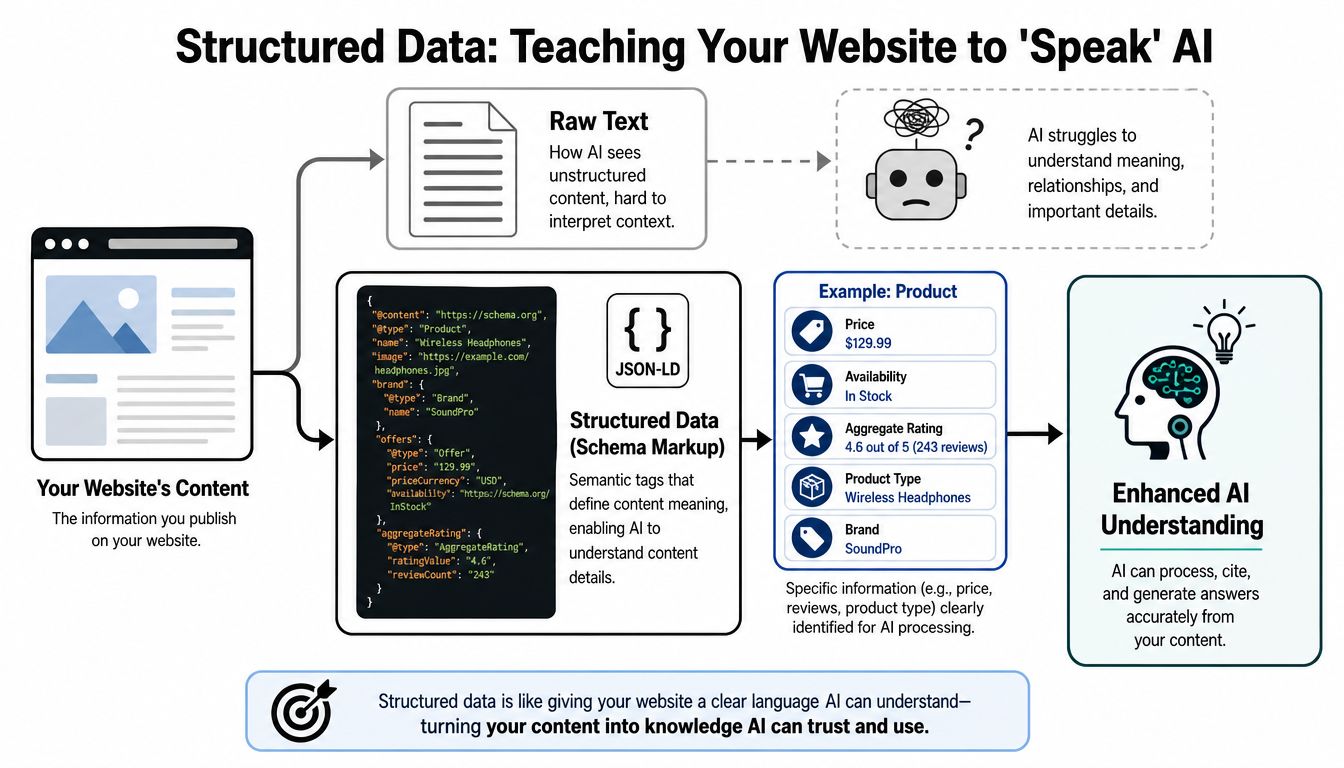
Most business owners don't need to become technical SEO engineers. They do need to understand one thing: AI systems read webpages more confidently when the page explains itself in a structured format.
That's what schema markup does. It gives your content labels.
Why JSON-LD matters
AEO shifts the focus away from old keyword tactics and toward JSON-LD schema markup, which helps AI extract precise answers. That includes FAQ sections and Organization or LocalBusiness schema that must match the visible page content, according to VPV's breakdown of AEO and schema.
If a service page says one thing in plain text but the structured data says another, you create ambiguity. Ambiguity lowers trust.
The simplest way to think about schema
Schema is a translator between your website and machine readers.
A human can infer that a page is about your company, your services, your expertise, and common questions. An AI system does better when you label those elements clearly.
A practical B2B setup often includes:
- Organization schema: Identifies who the company is.
- Article schema: Clarifies authorship, topic, and page type for educational content.
- FAQ schema: Makes direct question-and-answer content easier to interpret.
- Service-related markup: Helps define what the page offers and how it relates to the business.
Where teams usually make mistakes
The technical problem usually isn't “we have no schema.” It's “our schema is incomplete, outdated, or disconnected from the visible page.”
Use this quick audit table:
| Check | What good looks like |
|---|---|
| Organization details | Match the site's visible business information |
| FAQ content | Answers are useful, specific, and visible on the page |
| Article metadata | Author, topic, and page purpose are clear |
| Service pages | Page structure supports what the schema declares |
The implementation details matter, but the business takeaway is straightforward. Structured data makes your expertise easier to parse, easier to trust, and easier to cite. If you want the technical side handled properly, schema markup for AI is the discipline to focus on.
The Four Pillars of AI-Ready B2B Content
AI-era content isn't judged by the same standards that shaped blog-first SEO. The strongest framework is simpler and stricter.
According to MindStudio's analysis of AI search behavior, content now gets evaluated on four criteria beyond traditional SEO: directness, source credibility, structured data, and thoroughness. It also notes that deep topical authority in a narrow subject beats broad, thin coverage.

Pillar one and two
Directness means answering the actual question quickly.
A surprising number of B2B pages still open with brand language instead of the answer. That format was always inefficient. AI search just exposes the weakness faster.
What works:
- Lead with the answer: Put the core point high on the page.
- Use descriptive headings: Let users and machines scan the logic.
- Cut filler: If a sentence doesn't clarify, remove it.
Source credibility means the content sounds informed because it is informed.
That usually comes from named expertise, clear positioning, and factual discipline. Unsupported superlatives don't help. Specificity does.
Strong AI-ready content reads like a competent specialist wrote it for a serious buyer, not like a copywriter trying to stretch a keyword.
Pillar three and four
Structured data is the technical expression of clarity.
Without it, your page may still perform. With it, your page becomes much easier for machines to classify. This is especially important for service pages, educational articles, and FAQs.
Thoroughness is where most brands underinvest. One article on a big topic rarely builds authority. A connected set of pages usually does better because it covers the main question and its close variants, objections, definitions, and related decisions.
Here's a compact audit checklist:
- Directness: Does the page answer the headline question in the opening?
- Credibility: Does the page show expertise in a way a skeptical buyer would respect?
- Structure: Is the page organized for both readers and machine extraction?
- Scope: Does the page sit inside a broader topic cluster?
Why narrow beats broad
Many firms chase every adjacent keyword and end up sounding interchangeable. A tighter content footprint often performs better because it teaches both search engines and AI systems what your brand is known for.
That's the logic behind content clusters. They create depth without chaos.
A Practical Roadmap to AI Visibility
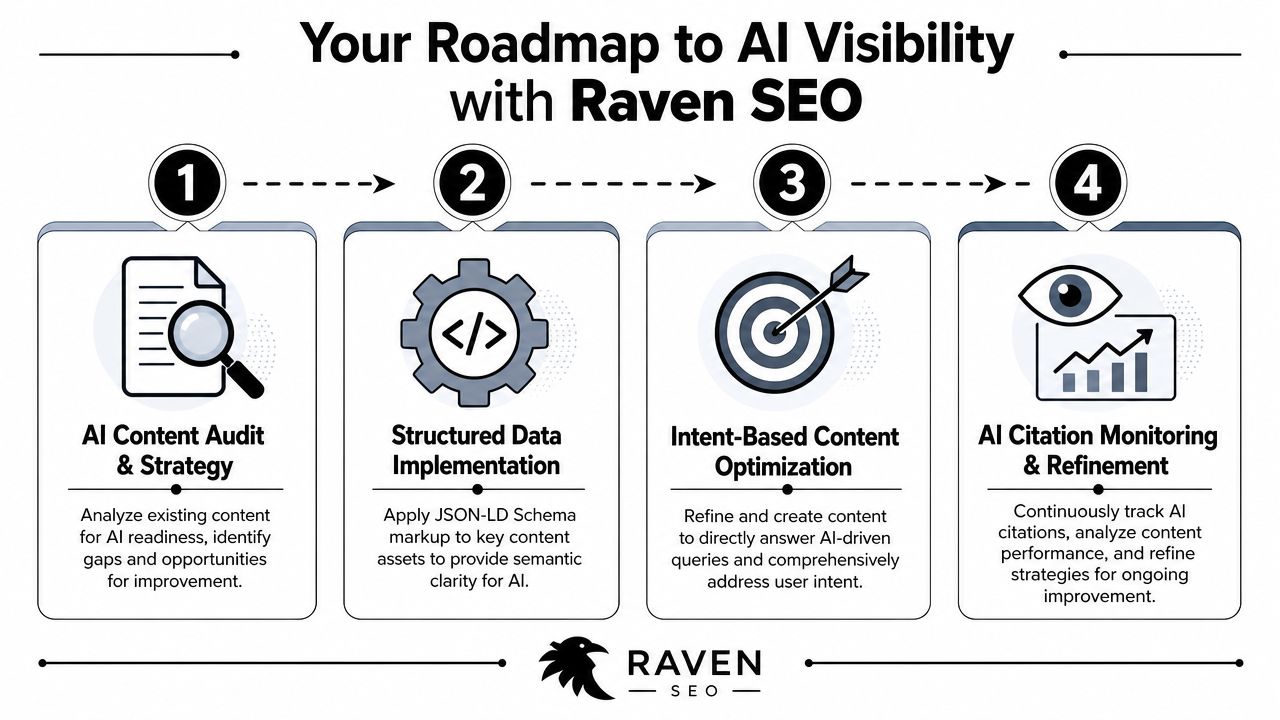
The shift to AI visibility isn't a one-time tweak. It's an operating model. Companies that approach it as a structured program usually make better decisions than companies that treat it like a publishing sprint.
Step one through step three
Start with an AI visibility audit.
Review your most important pages the way an answer engine would. Can the page answer a core commercial question directly? Is the company identity consistent? Are there obvious trust gaps, weak page structures, or missing schema?
Build an authority-led content strategy.
Many businesses overproduce and underperform without one. The right strategy narrows focus, identifies the commercial topics that matter most, and assigns each page a job. Some pages should educate. Some should compare. Some should prove credibility.
Implement technical clarity.
That includes structured data, clear internal linking, service page architecture, and metadata that accurately reflects the visible content. AI-ready web design matters here because the page has to be machine-readable as well as conversion-ready.
A short visual overview can help frame the process:
Step four and the measurement problem
Measure the right outcomes.
Content programs reach a point where they either mature or stall. According to Salesforce's B2B content marketing guide, B2B content marketing on average returns 2 to 3 times the initial investment. The same source notes that 40% of buyers prioritize content that explicitly drives a desired action, 39% struggle with resource constraints, and 33% find it difficult to measure effectiveness.
That's why vanity metrics aren't enough. Good evaluation connects content to commercial movement.
Track outcomes such as:
- Content-sourced qualified leads: Which assets bring in relevant opportunities.
- Pipeline influenced by content touchpoints: Where content supports serious buying motion.
- Content-influenced close rates: Whether informed prospects move faster or convert more cleanly.
What a mature program looks like
The strongest B2B content marketing services don't stop at writing.
They typically combine:
- Audit and strategy work
- AI-ready content production
- Schema and technical SEO implementation
- Ongoing measurement and refinement
- Website support built for AI discoverability
For brands evaluating modern delivery models, that often means pairing AI-ready service pages, content operations, and lightweight site infrastructure such as managed website systems or support models like Swyft Sites. The exact stack matters less than the operating discipline behind it.
FAQ About B2B Content and AI Visibility
Is traditional SEO dead
No. Traditional SEO still matters because your pages still need to be discoverable, crawlable, and relevant in conventional search.
What changed is the outcome you're optimizing for. Ranking is still useful, but it's no longer the only win condition. In many buying journeys, the stronger objective is becoming the page an AI system trusts enough to summarize or cite.
Do small B2B companies need structured data, or is that only for enterprise brands
Smaller companies arguably need it more because they usually have less margin for ambiguity.
A large brand may survive with uneven signals because it already has broad recognition. A smaller firm often depends on clarity. Schema helps reduce guesswork about who you are, what you do, and which content should be treated as trustworthy.
How should a company choose topics in an AI-first content strategy
Start with buyer questions that sit close to revenue. Focus on the questions a prospect asks before contacting sales, during vendor comparison, and right before internal approval.
That usually leads to stronger assets than broad awareness topics alone. Product explainers, comparison pages, implementation guidance, pricing context, use-case content, and objection-handling resources tend to be more valuable than generic trend pieces.
What does good B2B content look like when AI can generate content cheaply
It looks more original, not less.
AI can accelerate drafting, outlining, and repurposing. It can't create earned expertise on its own. The best content still depends on judgment, product knowledge, customer context, and clear editorial standards. Cheap output increases the value of credible input.
If your business wants a practical assessment of how visible it is in AI-driven search, Raven SEO can help. We provide no-obligation consultations focused on AI-ready websites, technical SEO, structured data, and sustainable growth, so you can see where your current content stands and what to fix first.