

Publishing more blog posts isn't a content strategy anymore. It's a publishing habit.
The old advice was simple: find a keyword, write an article, repeat. That approach already had limits in traditional search. In AI-assisted search, it breaks down faster. Large language models, AI Overviews, and modern search systems don't just look for a page that mentions a phrase. They look for a site that appears to understand a topic in depth, consistently, and in a structure machines can follow.
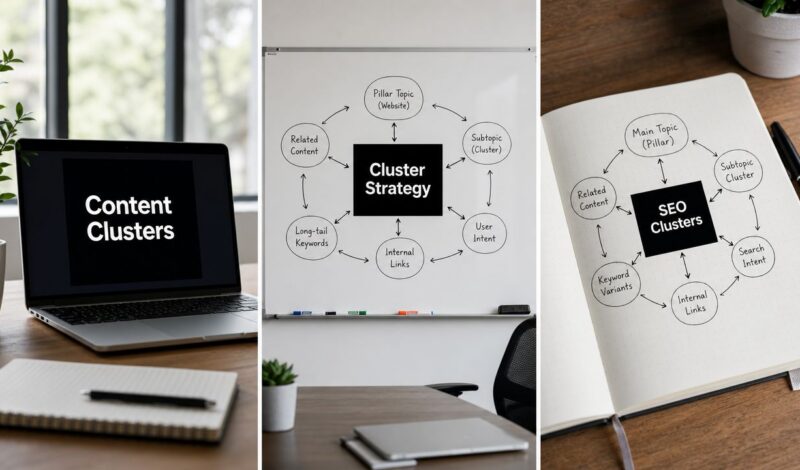
That's why learning how to create content clusters matters now. A cluster isn't just a neat editorial framework. It's a way to show both human readers and machine systems that your brand has a clear point of view, depth on the subject, and an organized content architecture that makes your best answers easy to find.
For a business owner, the shift is strategic. You are no longer trying to rank isolated pages. You are building a body of knowledge that can be surfaced, cited, and trusted across search and AI interfaces.
Beyond Blogging Why Clusters Are Essential for AEO
Publishing useful articles is no longer enough. Search visibility now depends on whether your site presents a topic as a connected body of knowledge that both people and AI systems can interpret quickly.
Much content advice still reflects an outdated model of search. It assumes a strong article can compete on its own. That was always an incomplete view. In AI-assisted search, it fails faster because retrieval systems are not just matching phrases. They are selecting sources that show clear scope, depth, and structure.
Disconnected articles create weak signals. A pricing post, an implementation guide, and a use-case article published months apart with no hierarchy force search engines and LLMs to infer which page represents your expertise. They often get an incomplete picture, or they skip your site entirely in favor of a source with clearer organization.
The shift from keyword pages to topic authority
A content cluster gives machines context. One pillar page covers the main topic. Supporting subtopic pages answer narrower questions, and internal links define the relationship between them. That structure helps search systems identify your canonical resource, understand supporting evidence, and connect related intent across the site.
AI visibility is increasingly a retrieval problem. If content is scattered, overlapping, or isolated, systems have a harder time finding the best answer and assigning confidence to it.
This is not just an SEO architecture issue. It is an information architecture issue too. If your content hierarchy is unclear, users hesitate and machines do the same. This information architecture guide explains the underlying principle well. Organized structures make content easier to interpret, not just easier to browse.
If you're still treating SEO and answer engine optimization as separate projects, Raven SEO's overview of AEO vs SEO in 2026 explains how the visibility model is changing.
Practical rule: If a reader and a machine cannot identify your definitive page on a topic within a few clicks, the cluster is not finished.
Why clusters matter for AI-driven discovery
AI systems reward explicit relationships between pages. They need to recognize which URL introduces the subject, which URLs expand it, and which page deserves to be cited first. Clusters make those relationships visible.
A strong cluster improves performance in several ways:
- Clarifies expertise: Your site reads like a deliberate knowledge base instead of a backlog of unrelated posts.
- Improves user flow: Visitors can move from broad education to specific answers without digging through archives or site search.
- Supports citation and summarization: Related documents reinforce the main page, which makes it easier for AI systems to extract and reference the right source.
- Reduces internal competition: Clear hierarchy lowers the odds that multiple pages will dilute the same intent.
There is a trade-off. Building clusters takes more planning upfront than publishing standalone blogs. But the return is better structure, clearer authority, and a site that is easier for both humans and AI systems to trust.
Planning Your Topical Authority Blueprint
Content clusters break long before publishing if the plan is weak.
Teams usually feel pressure to produce new articles, so they skip the slower work of defining scope, sorting existing assets, and deciding which page should own each intent. The result is familiar. Several posts target the same question, none becomes the clear reference page, and AI systems have no obvious URL to cite when they assemble an answer. Cluster planning is about coverage, but it is also about control.
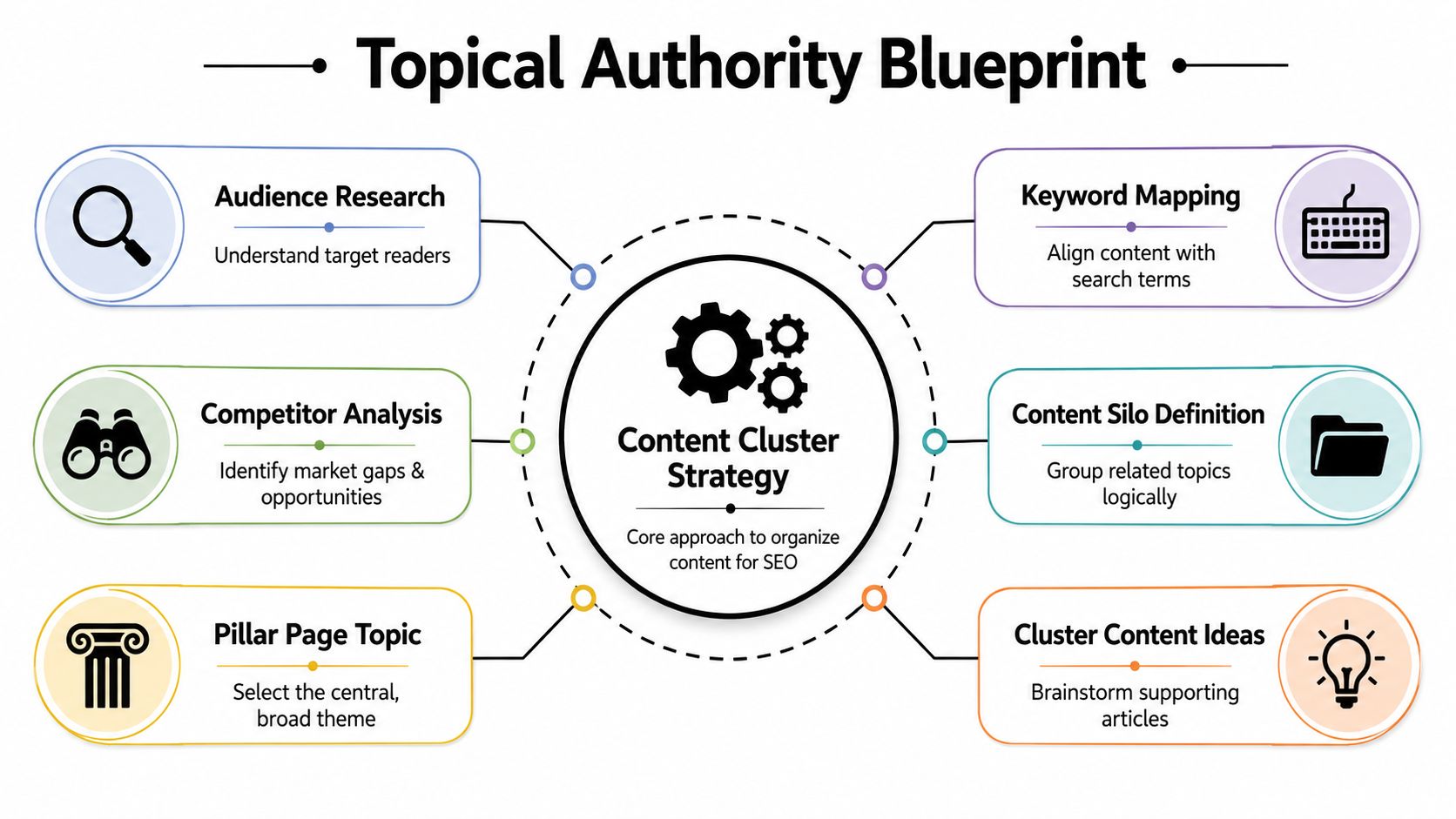
Start with an audit, not a blank page
A useful cluster plan starts with a content audit. Review what already exists, where pages overlap, which URLs still support your positioning, and which ones create noise. This step is less glamorous than drafting new pieces, but it prevents cannibalization and keeps you from building a second version of a topic you already covered poorly the first time.
For AI-oriented visibility, the audit needs an extra layer. Check whether your current pages answer distinct questions cleanly, use consistent language, and point users toward the next logical resource. LLMs and AI Overviews respond well to structure they can parse. If three similar posts each partially answer the same query, your site looks fragmented rather than authoritative.
A practical planning process usually includes:
- Set business goals for the topic, including what you want to rank for, be cited for, and convert from.
- Research search intent and group related queries into themes instead of treating every keyword as a separate article.
- Review existing pages and assign each one a role, keep, merge, rewrite, or remove.
- Identify gaps where buyer questions exist but no strong page does.
- Document ownership so every future page has a defined job in the cluster.
If you need a primer before grouping terms, Raven SEO's guide on how to do keyword research is a useful starting point.
Choose pillars that are broad enough to grow, but narrow enough to win
Topic selection is where many clusters go off track. Businesses often choose themes that sound important internally but are too broad to own in search or too disconnected from what they sell.
“Marketing” is too wide for a single business to cover with authority. “WordPress SEO for service businesses” is closer to a workable pillar because it has clear boundaries, commercial relevance, and several natural follow-up questions. That is the standard. A pillar should support a family of related pages without turning into a vague bucket for everything your team wants to publish.
A good filter is simple:
- Can this topic support several distinct questions with different intents?
- Does it map to a service, product category, or area of expertise you want associated with your brand?
- Can one page credibly introduce the subject without trying to answer every edge case?
- Will a human reader and an AI system both understand how the supporting pages relate to it?
In practice, I prefer a smaller number of pillars with tighter boundaries over an ambitious map of broad categories. Fewer clusters are easier to maintain, easier to interlink well, and more likely to produce a clear authority signal.
Score priorities before you publish
Cluster planning gets better when the selection criteria are visible. Otherwise, the roadmap gets shaped by whoever argues hardest for their preferred topic.
A simple scoring model works well. Rate each candidate topic for business relevance, audience demand, clarity of intent, and how well your company can speak on it from direct experience. Then review your existing assets against that score. Some pages belong under a pillar. Some deserve to become standalone resources. Some should be consolidated because they dilute the topic instead of strengthening it.
A lightweight planning table might look like this:
| Topic candidate | Best role | Why it qualifies |
|---|---|---|
| Broad service theme | Pillar | Supports multiple follow-up questions |
| Specific customer problem | Subtopic | Narrow intent, strong standalone answer |
| Repeated sales objection | Subtopic | Useful for both search and conversions |
| Legacy category page | Depends | May need rewrite or consolidation |
If your team struggles to map pages logically, an information architecture guide can help frame the structural side of the work. Cluster planning is as much about organizing knowledge as it is about choosing keywords.
A topic cluster should reflect how buyers learn, not just how marketers sort spreadsheets.
Architecting Your Central Pillar Page
A strong pillar page does a different job from a standard article. It gives buyers a clear model of the topic, gives your team a stable hub to build around, and gives search engines and AI systems an unambiguous reference page for the subject.
That last point matters more than it used to. Google can rank a messy post for a keyword. AI systems are less forgiving. They look for clean structure, clear scope, consistent terminology, and obvious relationships between the hub and its supporting pages. If your pillar page rambles, overlaps with subtopics, or hides key definitions, it becomes harder for both users and machines to interpret.
Place the visual near the top because this section is about structure and planning discipline.

What makes a pillar page different
The page should cover the topic broadly enough to orient a reader without trying to resolve every related question on one URL. That is the trap. Teams often confuse authority with length, then publish oversized pages that bury the useful paths a buyer needs.
A better pillar page feels like a well-organized knowledge hub. It defines the topic, frames the important subtopics, and creates clean routes into deeper pages. That structure helps a human visitor decide where to go next. It also helps AI systems identify which URL is the central source and which URLs supply supporting detail.
The strongest pillar pages usually include:
- A clear opening: State the problem, the audience, and what the page covers.
- Logical sectioning: Use descriptive H2s and H3s so readers and crawlers can follow the topic map.
- Brief treatment of subtopics: Introduce each major branch, then link to the deeper page.
- Contextual internal links: Use links where the reader naturally wants more detail.
- A closing next step: Move the visitor toward implementation, comparison, or conversion.
Publish the support pages first
Publishing the pillar last is usually the cleaner move.
If the hub goes live before the supporting pages exist, the result is often thin summaries, placeholder links, and weak internal pathways. That can still get indexed, but it rarely becomes the page your site can confidently point to as the definitive hub. For AEO, that gap is even more obvious. AI systems are more likely to trust a page that already sits inside a complete, well-linked topic set.
Build the spoke pages first. Then publish the pillar once it can point to real answers, not planned ones.
There is a trade-off. Launching the hub later can delay a visible flagship asset. In practice, it usually saves time because the pillar becomes easier to write once the detailed pages already exist. You can summarize with precision, use consistent language across the cluster, and avoid cannibalizing the subtopic URLs.
A practical blueprint for the page itself
The following video provides a visual overview of the process.
After that, focus on page mechanics. A pillar page should become one of the most useful assets on your site for that subject. It should orient a first-time visitor, support internal linking at scale, and hold up as a durable URL that you can expand over time without changing its core purpose.
Use this build pattern:
| Pillar element | What it should do |
|---|---|
| Intro | Frame the topic and establish relevance |
| Core sections | Cover the major dimensions of the subject |
| Supporting links | Route readers to specialized pages |
| Proof and clarity | Show practical understanding, not fluff |
| CTA | Give a logical business next step |
One practical standard helps here. Write the pillar for a buyer's understanding, not for a search engine. If your team needs help tightening readability and on-page structure, this guide on writing SEO-friendly blog posts is a useful reference.
Write the pillar so a buyer can understand the whole topic and a machine can identify the page as your hub.
Developing High-Value Cluster Content
Cluster pages do the detailed work. If the pillar sets the map, the supporting pages prove you know the territory.
Often, many brands drift into filler. They create supporting content that repeats the pillar, lightly rewrites competitor articles, or targets slight keyword variations that belong on the same page. That doesn't build authority. It creates noise.
Write one page per specific intent
Each cluster page should answer a distinct question or solve a narrow problem. If the pillar is "AI-ready SEO strategy," subtopics might include structured data, internal linking, entity clarity, content pruning, or AI citation monitoring. Each one deserves its own focused page if the intent is different enough.
That means your cluster articles should be:
- Specific: One page, one main job.
- Useful: Direct answers, examples, frameworks, and next actions.
- Non-overlapping: If two pages target the same search intent, consolidate them.
- Connected: Every spoke should reinforce the hub and the rest of the cluster.
For writing quality, process matters. Raven SEO's guide on how to write SEO-friendly blog posts is relevant if your team needs help turning outlines into focused, readable content.
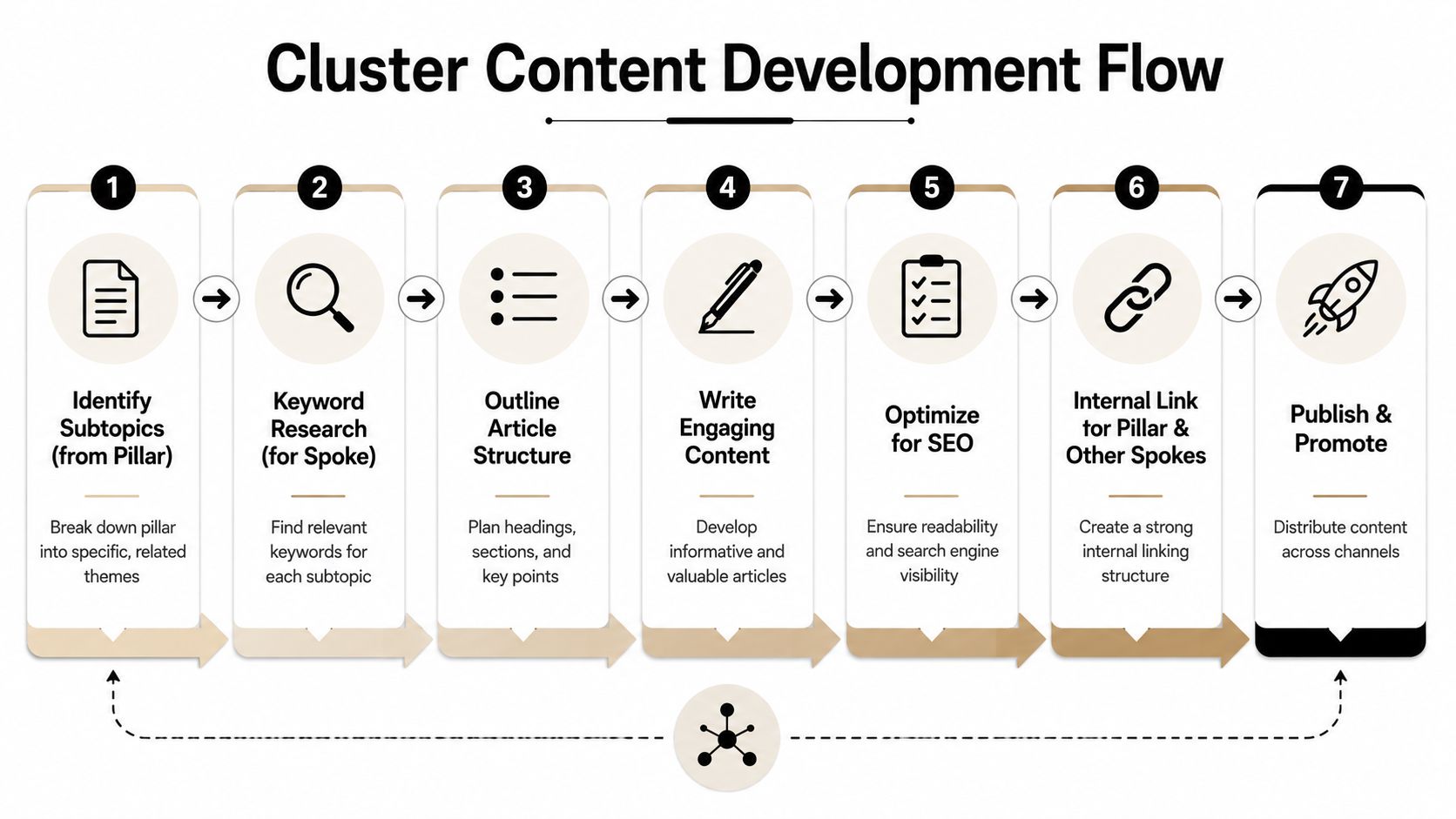
Keep the links mostly inside the cluster
This is one of the most useful heuristics in topic cluster work. To reinforce semantic relevance and reduce topical drift, a strong rule of thumb is that at least 80% of the internal links within a cluster post should point to other pages in that same cluster, according to this topic cluster implementation guide.
That doesn't mean every article becomes a closed loop. It means the majority of links should reinforce the topic neighborhood you're trying to build.
A clean linking pattern for a cluster page usually includes:
- One link up to the pillar
- Several links across to closely related supporting pages
- Very limited links out to unrelated sections of the site
A repeatable content workflow
The easiest way to scale cluster production is to standardize the workflow without making the content sound templated.
A practical rhythm looks like this:
- Map the subtopic to one clear intent.
- Outline the answer before drafting.
- Check overlap against existing pages.
- Write for completion, not just keyword placement.
- Add internal links to the pillar and relevant sibling pages.
- Review for duplication and weak sections after publishing.
The supporting page shouldn't exist because the keyword tool suggested it. It should exist because a reader following the pillar would naturally want that answer next.
The strongest clusters feel like a guided learning path. Every article helps on its own, but each one also makes the whole topic easier to trust.
Weaving the Web with Interlinks and Schema
A cluster becomes real when the structure is explicit. Without internal links, canonical signals, and a clean architecture, you don't have a cluster. You have a group of related URLs.
That's a problem for both search engines and AI systems. Machines infer authority partly from relationships. They need to see which page is central, which pages support it, and which older pages no longer deserve equal weight.

Internal links should express hierarchy
A lot of sites "do internal linking" but still miss the hierarchy. They add random links in body copy without deciding which URL is the hub, which pages are support, and which older pages should step aside.
For cluster architecture, the structure should be intentional:
- Pillar to spoke: The hub links to all major supporting pages.
- Spoke to pillar: Every support page reinforces the main resource.
- Spoke to spoke: Cross-links appear only when they clearly serve the reader.
- Legacy to canonical: Older overlapping pages should guide users toward the best maintained version.
If you want a practical internal linking primer for your team, Raven SEO's article on internal linking as a search and UX tool is one operational reference.
Clean up overlap before AI systems do it for you
Legacy content is where many cluster strategies go off course. Businesses often have years of articles that partially overlap, target the same terms, or answer the same question from slightly different angles. Leaving that mess in place weakens the cluster.
When building a new cluster on an existing site, it's critical to treat the work as an information architecture problem. Consolidating near-duplicate pages and using 301 redirects into the new cluster structure helps reduce keyword cannibalization and signal a single authoritative source to search engines, as explained in Orbit Media's content cluster strategy guide.
Use this decision framework:
| Existing page type | Best move |
|---|---|
| Strong page with clear intent | Update and map into the cluster |
| Thin page overlapping a stronger URL | Consolidate and redirect |
| Outdated page with little value | Prune or merge |
| Off-topic page | Keep outside the cluster or retire |
Schema helps machines read your expertise
Schema doesn't replace good structure, but it makes your structure more legible. It gives search systems extra context about what a page is, who published it, and how content entities relate across the site.
For AI visibility, schema helps in three practical ways:
- Clarifies page purpose: Article, FAQ, Organization, and other relevant types reduce ambiguity.
- Connects entities: Brand, author, service, and topical relationships become more machine-readable.
- Supports canonical understanding: Combined with internal linking, schema reinforces which URLs represent your main expertise.
Raven SEO appears here as one practical option among many agencies and implementation partners. The value in this kind of work isn't the markup alone. It's the combination of schema, content hierarchy, and pruning decisions that makes a site easier for machines to interpret.
A messy site can still have good content. It usually won't earn consistent trust signals until the structure gets cleaned up.
Measuring Success and Monitoring AI Citations
Content clusters were created to solve the limits of isolated keyword pages, but the strategy only works if you measure the cluster as a system. A complete implementation includes a long-term measurement plan to confirm whether the cluster is improving business goals, reflecting the shift from single-page targeting to measurable topic authority, as described in Mightybytes' content cluster workflow.
That point is more important in AI search than in classic SEO. Rankings still matter, but they're no longer the whole story. A cluster can increase visibility by improving brand recall, citation frequency, and answer inclusion across interfaces where the user never clicks.
Track the topic, not just the page
A weak measurement model looks at a few keyword positions and calls it done. A stronger one looks at whether the topic itself is gaining traction across the site.
Watch for signals like:
- Cluster-wide organic traffic: Are multiple pages in the same topic gaining visibility?
- Conversions from the topic set: Are those pages influencing leads, demos, or sales conversations?
- Query coverage: Are you appearing for more variations and follow-up questions?
- Engagement paths: Do users move from spoke pages to the pillar or service pages?
If you want a framework for tracking machine-surface presence, this guide to AI search monitoring is a useful reference point.
Monitor citations and answer inclusion
Here, future-proofing becomes real. You want to know whether AI systems are surfacing your brand, paraphrasing your ideas, or citing your pages as part of broader topic answers.
A practical monitoring stack can include:
- Manual prompt testing: Check how AI tools answer core industry questions.
- Brand mention tracking: Watch for recurring inclusion in conversational outputs.
- Cluster review cycles: Reassess whether your canonical pages are still the strongest answer set.
- Entity consistency checks: Make sure authorship, organization details, and topical alignment remain clear.
Raven SEO's AI Visibility Score is relevant here if you want a simpler way to assess whether your current digital footprint is readable and competitive in AI-driven environments.
The most useful mindset shift is this. Success isn't just winning a click. It's becoming the source systems trust when they generate the answer.
If you want help building clusters that work for both search engines and AI systems, Raven SEO offers a practical path forward. We help brands audit existing content, clean up site architecture, strengthen schema and internal linking, and turn fragmented articles into topic systems built for sustainable growth and AI discovery.