
Most advice about how to add to Google is outdated.
It still tells businesses to submit a sitemap, verify a profile, and wait for indexing. That advice isn't wrong. It's just incomplete. A page can be indexed and still be invisible where the market is heading.
A key shift is this. Google no longer acts only like a directory of blue links. It also acts like an answer engine. If your business isn't being understood, trusted, and cited inside AI-generated responses, you're missing the next layer of discovery. That's where Raven SEO sees the biggest strategic gap right now.
The New Meaning of How to Add to Google
A lot of businesses still think “add to Google” means one thing: get your site crawled and show up in search.
That was enough when search visibility depended mostly on rankings and snippets. It isn't enough now. As MindStudio's analysis of Google AI Mode for business research explains, Google's AI Mode is designed to synthesize answers with citations and support follow-up questions. That creates a new visibility layer that old indexing advice barely addresses.
If you're only focused on getting pages into Google's index, you're solving yesterday's problem.
Today's problem is harder. Your brand data has to be legible to systems that summarize, compare, and cite sources. That means Google needs more than pages. It needs confidence in who you are, what you do, and why your information deserves to be surfaced in an answer.
Indexing gets you included. Citation gets you chosen.
That distinction matters.
A page can rank for a query and still fail to become part of an AI-generated answer because the content is vague, the entity signals are weak, or the brand information is inconsistent across the web. AI systems don't reward ambiguity. They prefer clear facts, stable entities, and sources they can reconcile.
Getting into Google isn't the finish line anymore. Being citable inside Google's answer layer is the real competitive threshold.
If you want to understand how search results are being presented at scale, this guide to scraping Google results is useful because it shows how SERP layouts, result types, and extracted elements can be analyzed systematically. That kind of observation matters when you're trying to see where blue-link SEO stops and AI visibility starts.
What businesses should do first
Most companies don't need more generic blog posts. They need cleaner digital signals.
Start with basics that support both classic search and AI visibility:
- Verify your public business identity: Make sure your name, address, contact details, and category signals are consistent.
- Claim foundational Google presence: If you haven't handled this yet, fix that through a proper Google Business Profile setup guide from Raven SEO.
- Write for extraction, not just ranking: Use plain language, direct definitions, and factual statements AI can lift without guessing.
- Reduce contradiction across the web: If one directory says one thing and your site says another, you're training systems not to trust you.
Old SEO asked, “Can Google find this page?”
Modern search asks, “Can Google trust this brand enough to cite it?”
From SEO to AEO The AI Visibility Shift
SEO still matters. But it no longer covers the full job.
Traditional SEO helps a page get found. AEO, or AI Engine Optimization, helps a brand get understood, selected, and cited by AI systems. If SEO is like optimizing a book's title for a library catalog, AEO is like structuring the book so clearly that a researcher can quote it without hesitation.

Google still dominates the environment where this shift matters most. Statista's Google advertising revenue data shows Google's total revenue in 2023 was $305.63 billion, with ads making up the vast majority, and the same source notes Google held more than 84% of global desktop search traffic as of September 2023. That matters because the infrastructure shaping traditional search visibility is also shaping how brands are surfaced and cited in AI-driven search experiences.
The difference in plain English
SEO asks questions like:
| Focus | Traditional SEO | AEO |
|---|---|---|
| Primary goal | Rank pages | Earn citations and inclusion in AI answers |
| Main unit | Keyword-targeted page | Trusted brand entity plus sourceable content |
| Optimization style | Relevance and crawlability | Clarity, structure, verifiability |
| Success signal | Clicks and rankings | Mentions, citations, answer inclusion |
If you want a basic outside primer, this explainer on what is AEO is a decent starting point. The practical reality is more demanding than the definition. AEO isn't a content trick. It's an operating model.
For a deeper comparison from our side, Raven SEO breaks down the transition in this AEO vs SEO guide for 2026.
The three pillars that actually matter
Most businesses overcomplicate this. The structure is simple.
Citable brand authority
AI systems need to recognize your company as a stable entity. If your business appears differently across your website, directories, social profiles, and mentions, you weaken trust.
Machine-readable structure
AI doesn't want to infer everything from loose prose. It prefers markup, standardized attributes, explicit authorship, and pages with clear relationships between entities.
Verifiable content expertise
Thin rewrites don't hold up. Content needs identifiable authors, clear claims, and enough context that a system can understand what the page says without filling in gaps.
Practical rule: SEO gets you into the library. AEO gets your work quoted by the researcher inside it.
This is why businesses that treat AI search like a minor SEO update are falling behind. The shift isn't cosmetic. It changes what “visibility” means.
Building Citable Brand Authority for AI Systems
Authority used to be discussed like a link-building scorecard. That framing is too narrow now.
AI systems don't just look for popularity signals. They look for consistency, corroboration, and evidence that a business is a real entity with stable facts and credible expertise attached to it.

Search competition has always been tied to commercial value. According to Tenet's roundup of Google Ads statistics, more than 1.2 million businesses worldwide actively use Google Ads, U.S. search advertising spending was predicted to reach $137 billion in 2024, and the average Google Ads conversion rate was 6.96% in 2024. The takeaway isn't that paid search solves AI visibility. It's that search has always rewarded authority and conversion efficiency, not just presence. In AI Overviews and answer-driven search, that standard gets stricter.
What AI sees as authority
A language model doesn't trust your homepage because you say you're trusted.
It gains confidence when it sees the same business identity repeated across reliable places, when recognized people publish under your brand, and when your claims line up across sources. Many companies frequently falter here. Their site says one thing, their profile data says another, and their bios are vague enough to mean nothing.
The authority checklist that matters now
- Entity consistency: Use the same official business name, service naming, contact details, and brand description across your site and third-party profiles.
- Credible authorship: Attach real experts to important content. Include bios, areas of expertise, and clear relationships to the business.
- Topical discipline: Publish within your actual area of authority. Random content expansion weakens trust signals.
- Reference stability: Keep key facts consistent across service pages, profiles, and structured markup.
- Expert evidence: Show experience through case-led explanations, process detail, and direct knowledge instead of broad marketing copy.
For a sharper framework on quality and trust signals, see Raven SEO's take on E-E-A-T for AI visibility.
What to stop doing
A lot of brands still publish content that sounds polished but says almost nothing. AI systems are bad at trusting fluffy claims because there's nothing solid to extract.
Stop relying on:
- Empty superlatives: “Best,” “leading,” and “top-rated” without proof or context
- Anonymous content: No clear author, no expert ownership, no accountability
- Conflicting brand data: Different phone numbers, service lists, or business descriptions
- Generic location pages: Thin pages created only to rank, with no real substance
This video gives a useful visual perspective on how AI systems interpret digital identity and trust signals:
Authority for AI isn't theatrical. It's operational. Your brand has to become easy to verify.
Structuring Your Data for Machine Readability
Most businesses bury key facts inside paragraphs and expect machines to sort it out. That's lazy, and it costs visibility.
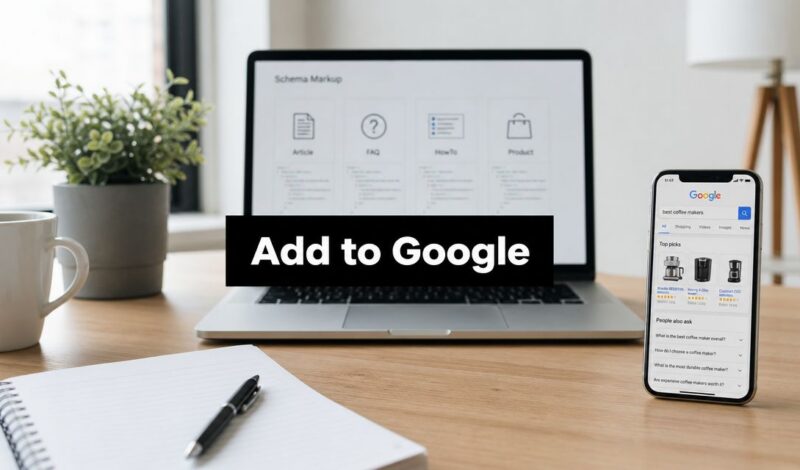
Schema markup fixes that problem. The concept is similar to labeling ingredients in a pantry. Without labels, a machine has to guess whether a number is a price, a model year, or a phone number. With labels, the machine knows exactly what it's reading.

Google's own product data model makes the case clearly. In Google Merchant Center's product data documentation, core fields such as description are required, and richer options like structured_description provide more normalized signals so Google can interpret intent, category, and attributes at scale. The principle applies directly to AEO. Structured data reduces ambiguity.
What schema does for AI systems
AI systems don't read the web the way humans do. They parse, infer, compare, and compress. The cleaner your structure, the less guesswork they need.
That changes how you should build pages.
Priority schema types for most brands
| Schema type | What it clarifies | Why it matters for AEO |
|---|---|---|
| Organization | Brand identity, official name, website, contact points | Helps systems connect your business across the web |
| WebSite | Site-level identity and search context | Reinforces your primary digital property |
| Article | Author, headline, publication context | Supports extractable expertise and source attribution |
| Service | What you offer and how it's defined | Makes service pages less ambiguous |
| Product | Item details, attributes, descriptions | Improves machine understanding for commerce pages |
Where businesses usually get this wrong
They install a schema plugin and assume the job is finished.
It's not. Auto-generated markup is often incomplete, generic, or disconnected from the actual business entity. If your schema says one thing and your visible content says another, you create confusion instead of clarity.
Schema isn't decoration. It's a translation layer between your website and the systems deciding whether your content is safe to cite.
A better implementation standard looks like this:
- Match visible and structured content: If the page says one service name, the markup shouldn't use another.
- Define entities explicitly: Identify the organization, author, service, or product without vague labels.
- Support articles with authorship data: Expert-led content should connect clearly to real people.
- Use service and product markup intentionally: Don't rely only on broad sitewide schema.
- Review markup after site changes: Redesigns often break structured data unnoticed.
If you want the technical foundation done properly, Raven SEO's resource on structured data implementation is the right place to start.
The businesses that win in AI search won't be the ones with the most content. They'll be the ones with the clearest data.
A Practical Roadmap to Achieve AI Visibility
Most companies don't need another vague checklist. They need a sequence.
At Raven SEO, the practical path to AI visibility starts with cleaning the entity, then improving structure, then producing content that machines can cite confidently. If you skip the order, you create noise faster than trust.

Google's own feed logic reinforces this approach. In Google's vehicle listings feed specification, fields like vin, price, condition, make, model, year, and mileage are required for certain listings, and Google notes that correct field usage improves accuracy and visibility. That's not just for automotive feeds. It's a direct lesson for AEO. Discovery systems reward complete entity specification.
Phase 1 builds the ground truth
Start by auditing what your brand currently looks like across the web.
Ask basic questions that many teams overlook:
- Is your business name identical everywhere?
- Do service descriptions stay consistent across pages and profiles?
- Are authors and experts clearly connected to your company?
- Do third-party mentions reinforce or blur your identity?
This isn't glamorous work. It's necessary work.
Phase 2 adds foundational schema
Once your entity is clean, implement the minimum viable structure.
That usually means:
- Organization markup on the core site
- WebSite markup to reinforce the primary domain
- Consistent contact and brand data aligned with visible content
- Article schema for editorial content with real authorship
Don't treat schema as a plugin setting. Treat it like business infrastructure.
Phase 3 changes how content is written
AI-citable content looks different from old-school SEO filler.
It should do these things well:
| Content trait | Weak version | Strong version |
|---|---|---|
| Definitions | Vague and broad | Clear, direct, easy to extract |
| Authority | Anonymous blog copy | Expert-owned and attributable |
| Structure | Long unfocused text | Tight sections, scannable facts |
| Entity clarity | Unclear references | Specific products, services, and owners |
A strong article doesn't ramble. It answers. It defines terms early, uses precise language, and avoids unsupported hype.
If an editor removed your brand name from the page, the content should still show unmistakable expertise. If it doesn't, it probably won't earn AI trust.
Phase 4 deepens coverage with specific markup
Here, many brands can separate themselves.
Add schema where it supports actual business meaning:
- Service pages: Define what you do with clear service entities
- Product pages: Mark up item-level details, descriptions, and attributes
- Author pages: Connect expertise to published articles
- FAQ content: Structure recurring questions where the answers are stable and useful
The model is simple. The more completely you describe the entity, the easier it is for AI systems to resolve it correctly.
Phase 5 monitors representation, not just rankings
Ranking reports alone won't tell you enough anymore.
You need to watch for:
- How your brand appears in AI summaries
- Whether your expertise is being attributed correctly
- Where misinformation or inconsistency keeps showing up
- Which content formats are easiest for AI systems to extract
For teams that want a process framework before diving into implementation, this six-step design process is a useful planning reference because AI visibility work depends on sequencing, not random execution. Raven SEO also supports this kind of reporting and audit workflow through its platform and consulting process when teams need visibility into search data, site performance, and implementation gaps.
The takeaway is blunt. You don't “add to Google” once. You build a digital entity Google can keep trusting.
Future-Proofing Your Brand in the Age of Answers
Search is moving from retrieval to synthesis.
That changes the job for every serious business. You still need your site indexed. You still need technical SEO. You still need strong pages. But that foundation now feeds a second system, one that summarizes, cites, compares, and answers on the user's behalf.
If your brand isn't structured for that system, you'll lose visibility even when you technically exist in search.
The businesses that adapt first will stop treating AI visibility like a side project. They'll tighten entity consistency, attach real expertise to content, implement schema with intent, and publish material that machines can quote without rewriting. That's the practical path from SEO to AEO.
Add to Google now means more than being present. It means being understandable. It means being verifiable. It means being citable.
If you want durable search visibility, build for citation, not just inclusion.
If you want a practical starting point, schedule a no-obligation AI visibility audit with Raven SEO. We'll review how your brand appears across search, where your entity signals break down, and what needs to change so your business is easier for Google and AI systems to trust, surface, and cite.