
Search Generative Experience is Google's AI-powered search feature that generates direct answers and summaries at the top of the results page. It became impossible to ignore once Google launched SGE in Search Labs in 2023, and independent analyses found generative elements appearing on 86.8% of 1,000 commercial queries in one study and on nearly 79% of searched keywords in another.
This is the essence of what is Search Generative Experience. It isn't a cosmetic update to Google. It's a redesign of what a search result is supposed to do.
For years, search worked like a directory. Google organized links, users compared sources, and brands fought for position. SGE changed that model by putting an AI-generated answer before the familiar list of pages. The result is a new visibility problem for businesses. Being present in search isn't enough if the AI summary pulls from other brands and leaves yours out.
The practical shift is bigger than most explainers admit. Traditional SEO asked, “How do I rank?” Generative search asks, “How do I get cited?” That difference affects content strategy, technical SEO, structured data, and brand authority all at once.
The New Search Landscape Beyond Ten Blue Links
The old search results page is fading. Not all at once, and not for every query, but the direction is clear. Google moved search from a link-first experience toward an answer-first experience when it introduced SGE in Search Labs in Google's 2023 Search Labs rollout.

Google's framing mattered. SGE wasn't just a chatbot layered on top of search. It was built to show AI-generated summaries, support conversational follow-ups, and create “vertical experiences” for shopping and other commercial intents. That's a major architectural change in how users move from question to answer.
Why this became a turning point
The strongest signal wasn't only the product launch. It was the observed coverage across commercial searches. In the same reporting summarized by Google's rollout context, one analysis of 1,000 commercial terms found a generative element on 86.8% of searches, while another reported that nearly 79% of searched keywords triggered SGE, split between 48% spontaneous results and 31% user-requested results. Those numbers explain why search strategists stopped treating SGE like a test feature and started treating it like a new search surface.
That changes the practical work of SEO.
A page can still rank and still lose the most visible part of the SERP. A brand can still own traditional positions and still fail to appear in the generated summary that users read first. That's why teams tracking the future of SEO with AI are shifting from pure rank monitoring to visibility analysis across AI surfaces.
What businesses need to understand first
SGE changed the sequence of user behavior:
- Before SGE: Users searched, scanned links, compared options, and clicked into pages.
- With SGE: Users often read a generated summary first, then decide whether any source is worth opening.
- For commercial research: Google can compress comparison behavior into a single interface.
Practical rule: If your content only works when a human reads the full page, it may be too slow for generative search.
That doesn't mean websites no longer matter. It means websites now serve two audiences at the same time. Humans still need clarity, persuasion, and trust. AI systems need extractable structure, explicit answers, and unambiguous attribution.
Businesses that understand this early aren't just protecting organic traffic. They're rebuilding their digital footprint for a search environment where the answer appears before the click.
Defining Search Generative Experience and AI Overviews
The simplest answer to what is Search Generative Experience is this: it's Google search acting more like a research assistant than a list of librarians' index cards.
Instead of giving you ten links and making you assemble the answer yourself, Google generates a summary from multiple sources, places that summary near the top of the page, and then offers supporting links for deeper reading. When Google rebranded the experience as AI Overviews, it made the direction even clearer.
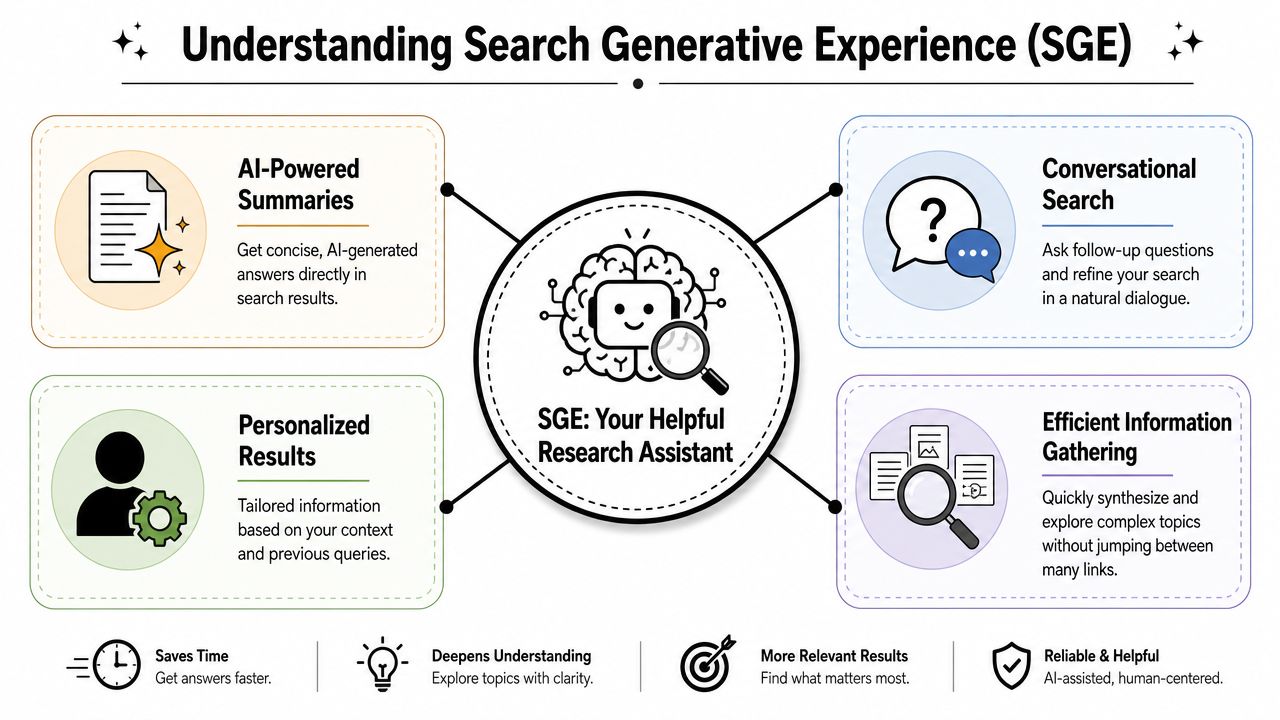
What AI Overviews actually do
AI Overviews began rolling out to U.S. users on May 14, 2024 and were designed to appear at or near the top of the search results page above conventional organic links, as described in this analysis of Google's AI Overviews rollout.
That placement is the whole game. If the generated answer appears before standard listings, then SEO is no longer only about earning position. It's about being one of the inputs Google chooses to synthesize.
TechTarget's explanation of SGE also notes that these answers synthesize information from multiple sources, including Google's Knowledge Graph and web content, rather than pulling from a single page. In practice, that means no single article “wins” the query in the old sense. Multiple assets can contribute, and some may be cited while others are ignored.
A useful way to think about it
Think of AI Overviews as a fast research assistant with two habits:
- It looks across several sources, not just one.
- It prefers content it can interpret quickly and safely.
That second point matters. If your page is vague, bloated, contradictory, or hard to parse, it becomes a weaker candidate for summarization. If your page is cleanly structured and precise, it's easier for a machine to extract.
That's also why brands need content workflows that avoid AI hallucinations. If your own material is sloppy, unsupported, or inconsistent, you make AI systems less likely to trust it and more likely to bypass it.
What works and what doesn't
Here's the practical distinction I use when reviewing sites for generative search readiness:
| Approach | What happens in AI search |
|---|---|
| Thin articles built around keywords | They may still be indexed, but they're weak candidates for citation |
| Pages with direct answers and clean structure | They're easier to extract, summarize, and attribute |
| Loose brand claims with no context | They create ambiguity |
| Topic-focused, entity-clear content | It gives systems a better chance to identify who said what |
Brands preparing for this shift are also rethinking how tools like Gemini affect search behavior. A useful starting point is understanding Google Gemini and the future of search strategy, because the line between search engine and AI assistant keeps getting thinner.
The Monumental Shift from Clicks to Citations
The biggest mistake in search right now is measuring success with the old scoreboard.
In a link-first SERP, the primary objective was simple. Rank higher. Win the click. Move the visit into a lead or sale. In an answer-first SERP, the path is different. Google's AI synthesizes information into a summary near the top of the page and then offers links for deeper reading, as explained in TechTarget's definition of SGE.

Why ranking isn't the whole goal anymore
If the answer is already on the page, many users won't need to click through multiple sites to get oriented. That means visibility now has two layers:
- SERP presence
- Attribution inside the generated answer
Those are related, but they aren't identical.
A brand might appear somewhere in the standard results and still lose the more important battle if the AI summary cites a competitor. For informational and mid-funnel commercial queries, that citation can shape user trust before a click ever happens.
Being cited in the answer is the new version of being shortlisted.
The new KPI for many search journeys
This doesn't mean clicks no longer matter. They do. But citations often come first now. A citation says your brand was considered credible enough, relevant enough, and structurally clear enough to help form the answer itself.
That has several business implications:
- Brand recall shifts earlier: Users may encounter your brand name before they ever visit your site.
- Trust can be pre-loaded: If Google's summary attributes your content, you begin with authority rather than needing to earn it from scratch.
- Traffic quality may change: Fewer casual clicks can sit alongside more informed visits.
What smart teams are changing
Teams that adapt well usually make three reporting changes:
- They stop treating ranking reports as the only signal.
- They review whether branded and non-branded queries surface AI summaries that include or omit their brand.
- They evaluate whether their content is citation-ready, not just keyword-optimized.
What doesn't work is pretending this is still the same contest with a new coat of paint. It isn't. The search result itself now performs part of the publisher's job: summarizing, framing, and narrowing options.
That's why the best search operators are moving from “How do we attract the click?” to “Why would the machine quote us?”
Building Brand Authority for AI Attribution
Authority in generative search isn't abstract. It shows up in how clearly your brand can be identified as a reliable source on a topic.
One of the least discussed parts of SGE and AI Overviews is how they change the meaning of ranking for branded and category queries. As noted in Coveo's discussion of generative search, many explainers stop at generic advice like schema, headings, and FAQs. They don't answer the harder question: what makes one brand earn attribution inside the answer while another brand stays visible but uncited?
Citation-worthy content has identifiable signals
AI systems need to resolve basic questions quickly:
- Who produced this content?
- What topic does this page thoroughly cover?
- Is the answer direct enough to extract?
- Does the page show real expertise, or just generic SEO formatting?
- Can the system confidently attribute a claim to a specific brand or author?
That's why E-E-A-T matters more in practice now. Not as a slogan, but as a content design principle. Experience, expertise, authoritativeness, and trustworthiness help machines and users reach the same conclusion: this source is usable.
A strong reference point here is E-E-A-T for AI visibility, especially if your brand publishes advice in regulated, high-trust, or comparison-heavy categories.
What tends to earn attribution
I look for five patterns when assessing whether a page is likely to be cited rather than indexed.
- Clear ownership: The page makes it obvious which company, expert, or editorial team created it.
- Topical discipline: The content stays focused instead of wandering across loosely related keywords.
- Direct answers: Important questions are answered early, in plain language, not buried under filler.
- Supportive structure: Headings, definitions, examples, and entity references make extraction easier.
- Consistency across the site: Brand claims, service details, and expertise signals don't contradict one another.
What usually fails
Pages miss citations for predictable reasons.
Some are written to satisfy a content calendar instead of a user need. Others are packed with generic introductions, padded subsections, or template FAQ blocks that add no unique value. Many local and service businesses also have a trust gap because their site says one thing, their profile pages say another, and their author signals are weak or missing.
Field observation: AI systems don't reward “SEO-shaped content” if it lacks identifiable expertise.
That's the distinction between visibility and attribution. Visibility means your page exists in the searchable web. Attribution means the system decided your brand helped answer the question.
If you want to earn that outcome, your site has to read like a source, not like an attempt to look like one.
A Practical Roadmap for AI-Ready Digital Assets
Most businesses don't need a reinvention. They need a cleanup, a structure plan, and a content model built for extraction.
That's the practical answer to what is Search Generative Experience from an operator's perspective. SGE rewards websites that are easier for machines to interpret, summarize, and trust. The work is less about chasing a trick and more about removing ambiguity across your digital assets.

Start with structure before scale
If a site is technically messy, publishing more content usually makes the problem worse. Fix the foundation first.
Clarify your core entities
Make sure your business name, services, experts, locations, and product or service categories are described consistently across the site. AI systems struggle when brand identity is fragmented.Tighten information architecture
Organize content into clear topic clusters. One page should answer one primary intent. If every service page targets multiple overlapping questions, attribution gets muddy.Use structured data where it adds meaning
Schema doesn't make weak content strong, but it helps machines understand context. Organizations, articles, services, products, FAQs, and authors are common places to begin. This guide to structured data for AI-ready SEO is the right starting point if your current implementation is partial or inconsistent.
Build pages that can be extracted
After the structure is sound, improve how pages communicate.
- Lead with the answer: Put the direct response near the top.
- Break complex ideas into blocks: Short sections, clear headings, and concise definitions help.
- Use explicit language: Don't force the model to infer basic meaning.
- Show who is speaking: Author pages, company about pages, and editorial ownership matter.
- Refresh important pages: Outdated pages create trust friction.
A lot of teams speed up this process with content analysis and workflow tools. If you're comparing platforms, this overview of top AI solutions for SEO is useful for evaluating where automation helps and where human review still matters most.
Technical hygiene still matters
Generative search didn't replace technical SEO. It raised the cost of neglecting it.
Here's the minimum standard I'd expect on an AI-ready site:
| Priority area | Practical requirement |
|---|---|
| Crawlability | Important pages can be discovered and rendered cleanly |
| Indexation control | Thin, duplicate, or low-value pages don't crowd your site footprint |
| Internal linking | Important topic pages are connected with descriptive anchors |
| Mobile usability | Content remains readable and structured on small screens |
| Page experience | Pages load cleanly and don't bury answers under intrusive elements |
Monitor the right things
Old reporting habits miss what matters in generative search. Add these reviews to your workflow:
- Brand presence checks: Search your core commercial and informational queries and record whether AI-generated results appear.
- Citation checks: Note whether your brand is referenced, linked, or omitted.
- Answer-gap analysis: Compare your page's coverage to the synthesized answer and identify what's missing.
- Entity consistency reviews: Confirm your experts, services, and brand claims are described the same way across key pages.
Working standard: If a machine can't quickly tell who you are, what you know, and which page owns the answer, you're not AI-ready yet.
This roadmap is practical because it matches how real sites improve. First clean the technical and structural layer. Then sharpen the content. Then monitor attribution, not just rank.
Thriving in the Age of Generative Search
Generative search isn't the end of SEO. It's the end of lazy SEO.
Search Generative Experience changed the reward system. Pages built only to attract clicks are weaker now that Google answers first and links second. Brands that thrive will be the ones that publish clear, attributable, technically structured content that machines can trust.
That creates an opening for businesses willing to do the unglamorous work well. Clean architecture. Strong entity signals. Better authorship. Better structured data. Better answers. Those aren't gimmicks. They're the foundation of citation-ready visibility.
The opportunity is simple. If search is moving from clicks to citations, then the winning strategy is to become the source AI systems want to reference. Businesses that want a focused plan can explore SEO for generative AI search as a next step toward building that kind of durable presence.
Frequently Asked Questions About Search Generative Experience
Is Search Generative Experience the same as AI Overviews
Mostly, yes. SGE was the experimental name Google used when it launched the feature in Search Labs. AI Overviews is the successor branding Google rolled out more broadly. The core idea stayed the same: Google generates a summary at or near the top of the results page and may include supporting sources.
Will AI Overviews kill website traffic
Not across the board, but they can change who clicks and why. Some users will get enough context directly in search and won't visit multiple sites. That raises the value of being cited in the generated answer. In many cases, the traffic that does reach your site may be more informed because the user already understands the topic.
Is traditional SEO obsolete now
No. Traditional SEO still provides the foundation. If your site can't be crawled, indexed, understood, and trusted, it won't perform well in either blue-link search or AI-generated results. What changed is the objective. Ranking is still useful, but it isn't the whole target anymore.
What's the first thing a business should do to prepare
Audit your most important pages for clarity, structure, and attribution. Check whether each page clearly answers a question, identifies the brand or expert behind it, and supports machine-readable understanding through clean formatting and structured data. If your content is vague or inconsistent, fix that before publishing more.
Raven SEO helps businesses build AI-ready websites, stronger technical SEO foundations, and structured digital assets that are easier for Google, AI Overviews, and conversational search engines to cite. If you want a practical review of your current AI visibility and a roadmap for sustainable growth, book a no-obligation consultation with Raven SEO.