
The most popular advice on this topic is also the most incomplete: add schema, validate it, and wait for better results.
That still matters. It just isn't enough.
Search has moved beyond a simple contest for blue-link clicks. Brands now need to be understood as entities, connected to topics, products, people, locations, and trusted references across the web. In practice, that means your visibility depends less on whether a page ranks in isolation and more on whether search systems and AI tools can confidently identify your brand and reuse its information.
That's why knowledge graph optimization has become a core search discipline. It's no longer a niche technical project for enterprise data teams. It's the operational work of making your business legible to machines.
For national brands, franchises, and multi-location companies, the hard part usually isn't adding markup. The hard part is keeping one canonical identity intact across websites, profiles, feeds, directories, and citations so AI systems don't split your brand into fragments.
The SEO Shift from Clicks to Citations
Traditional SEO taught teams to chase rankings, improve click-through rate, and measure success by sessions. That model still has value, but it no longer captures the whole search journey. Increasingly, people get answers without visiting ten pages. They ask a search engine, an AI assistant, or a conversational interface for a direct recommendation, summary, comparison, or explanation.
When that happens, the winning brand isn't always the one with the loudest page. It's the one the system can identify, trust, and cite.
Why rankings alone don't describe visibility anymore
A page can rank well and still fail to become part of the answer layer. That happens when the system sees content but doesn't fully understand the entity behind it. It knows the words on the page, but it's less certain about the organization, product, author, service area, or relationship between them.
A stronger modern search strategy asks different questions:
- Can a machine identify the brand clearly
- Can it connect the brand to relevant topics and services
- Can it verify the same identity across multiple sources
- Can it reuse the information safely in a generated answer
Those questions sit at the center of AI visibility.
Search performance now includes whether a system is willing to reference your brand, not just whether it indexes your page.
This is why old reporting frameworks can feel incomplete. A team may see stable rankings and still lose influence if competitors become more machine-readable, more consistent, and easier to cite in AI-generated responses.
The new success metric is trustable reuse
Generative search changes the optimization target. Instead of asking only, “How do we win the click?” brands also need to ask, “How do we become the source that gets referenced?”
That shift affects content strategy, technical SEO, local data management, brand governance, and digital PR. It also changes how national brands should think about consistency. If one division uses a slightly different company name, another publishes conflicting service descriptions, and third-party listings point to mixed profiles, the system gets a muddy signal.
That's where a lot of businesses fall behind. They're still optimizing pages one by one while search systems increasingly evaluate entities and relationships across the broader web.
For a deeper look at how this shift is changing the discipline itself, Raven SEO's guide to the future of SEO with AI is worth reading.
What Is Knowledge Graph Optimization
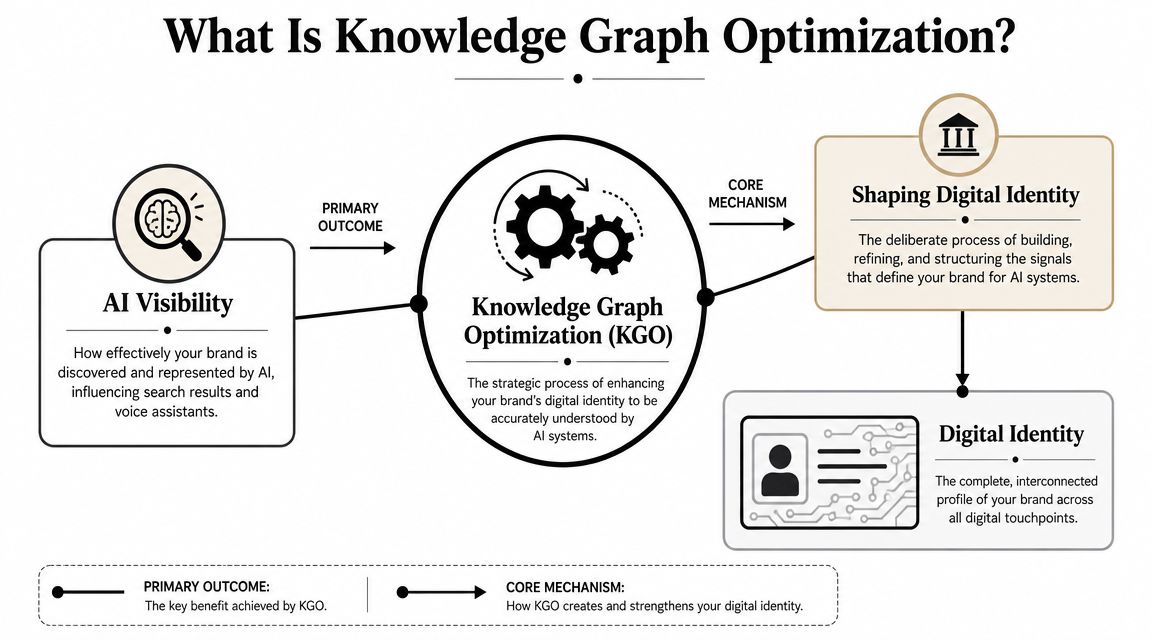
Knowledge graph optimization is the process of making your brand easier for machines to understand as a defined entity with attributes and relationships. If traditional SEO often treated pages as isolated assets, knowledge graph optimization treats your business as a connected digital identity.
A useful way to think about it is this: your website, profiles, listings, authors, products, and supporting references together form a digital resume for machines. The better organized that resume is, the easier it is for search systems to decide who you are, what you do, and when to surface you.
The turning point that changed search
A major historical turning point came with Google's introduction of the Knowledge Graph in 2012, which shifted search from matching strings to understanding entities and relationships, as explained in PingCAP's guide to knowledge graph optimization and structured entity understanding. That shift is why schema markup, validation, and continuous refinement now sit so close to practical SEO work.
This is not a short-term trend. It's the long arc of how modern search systems interpret the web.
If you've ever explained structured data to a non-technical stakeholder, the simplest version is this: it helps a machine read your business profile with less guesswork. Raven SEO's overview of what structured data means in SEO is a good primer if you want the implementation side in plain language.
What knowledge graph optimization includes in practice
Knowledge graph optimization usually involves several kinds of work happening together:
- Entity definition. Clarifying the official name, type, categories, ownership, services, products, and key relationships tied to the business.
- Structured data deployment. Using Schema.org and JSON-LD to describe those facts in machine-readable form.
- Relationship mapping. Connecting the brand to locations, authors, products, departments, social profiles, and external references.
- Validation and maintenance. Checking that markup, page content, and off-site references remain accurate over time.
A lot of teams stop after the second step. They publish schema and assume they're done. In reality, machines compare many signals. If the page markup says one thing and the wider web suggests another, confidence drops.
What works and what doesn't
What works is boring but effective. Clean entity naming. Stable profile links. disciplined schema use. Consistent page templates. Clear author and organization relationships. Repeatable governance.
What doesn't work is decorative schema layered onto a messy brand footprint. If the organization name varies by channel, location pages use different taxonomies, and social profiles point to outdated sites, the markup won't solve the underlying identity problem.
Practical rule: Treat schema as a translation layer, not a substitute for clean brand data.
That distinction matters. Knowledge graph optimization is not a trick for rich results. It's the operating model for machine-readable brand identity.
The Three Pillars of AI Visibility
AI visibility rests on three supports. Remove one, and the whole structure gets weaker. You can think of them as machine readability, trust signals, and factual stability.
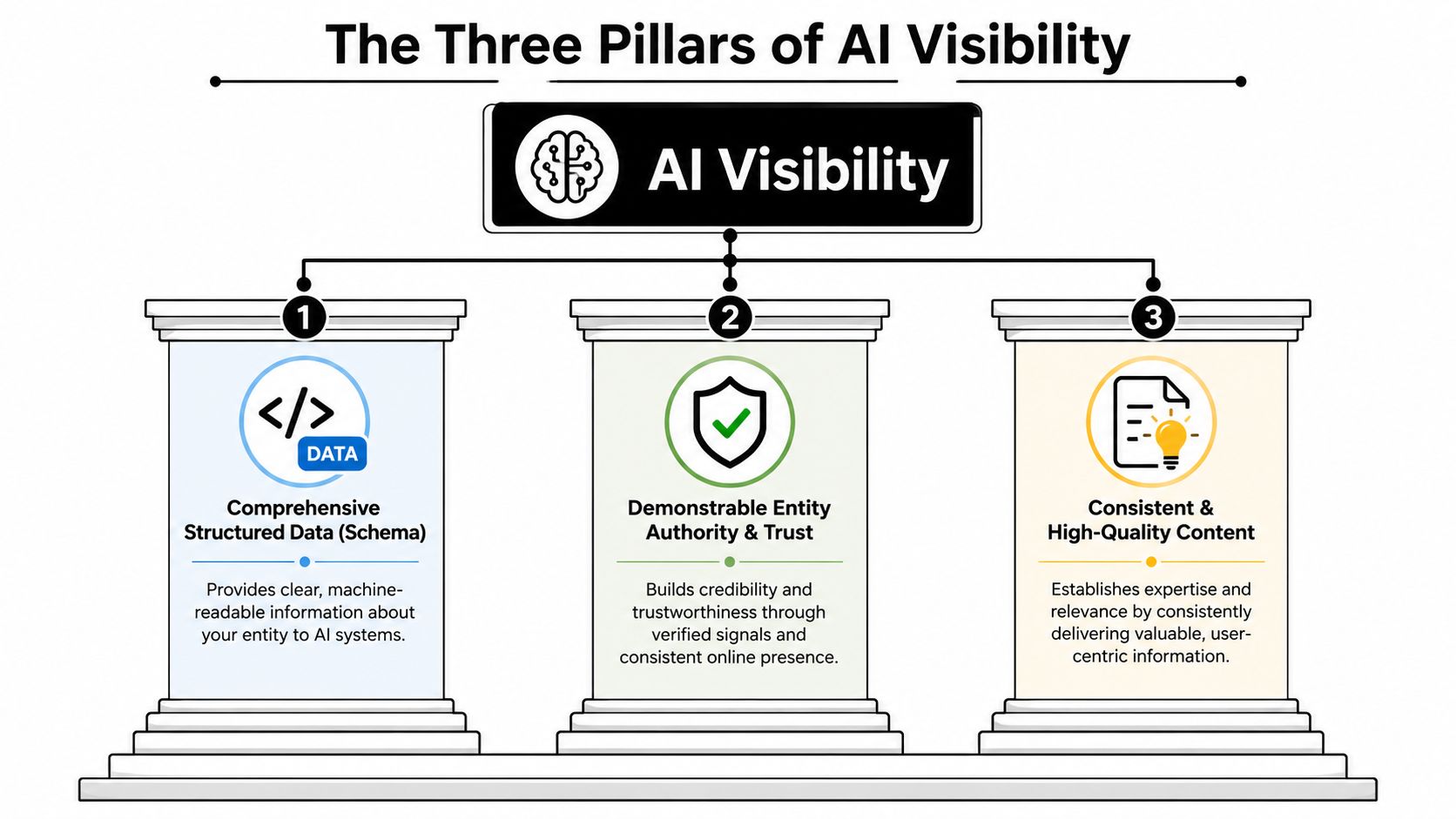
Comprehensive structured data
Machines need explicit cues. Structured data provides them.
When knowledge graphs model information as entities and relationships, systems can answer complex multi-hop questions through graph traversals instead of relying on more cumbersome multi-table joins, which is why connected data is so valuable for search and AI use cases, as outlined in Improvado's explanation of graph traversals and knowledge graph query efficiency. For marketers, the practical takeaway is simple: if your content is clearly structured, it's easier for a machine to follow the path from brand to product to category to use case.
That means your schema strategy should cover more than a homepage Organization node. Strong implementations usually connect:
- Organization data with official name, website, profile references, and brand details
- Location data for each market or branch where applicable
- Service and product entities tied to the right pages
- Author and article relationships for expertise-driven content
- FAQ, review, and media objects where appropriate
Demonstrable brand authority
Structured data tells systems what something is. Authority helps them decide whether to trust it.
This isn't just about backlinks in the old sense. It's about whether your brand appears as a credible, coherent source across its ecosystem. Reviews, citations, editorial mentions, author bios, expert content, and consistent branded references all contribute to that picture.
A practical way to judge authority is to ask whether an unfamiliar evaluator could verify your brand quickly across multiple surfaces. If the answer is yes, you're building useful trust signals. If every channel tells a slightly different story, authority weakens.
The machine-readable layer and the reputation layer have to agree. If they don't, your entity becomes harder to trust.
For teams building this capability more intentionally, Raven SEO's perspective on an AI visibility strategy is a useful framework.
Factual consistency across the web
The third pillar is often the weakest one because it spans departments. Marketing owns the website, local teams manage listings, social teams update bios, product teams change naming, and nobody keeps the canonical record aligned.
Here, brands lose clarity.
A system comparing your site, your profile pages, your business listings, your marketplace data, and your citations is looking for convergence. It wants to see the same organization represented the same way. Minor differences aren't always fatal, but repeated conflicts reduce confidence.
Here's a simple comparison:
| Pillar | What it does | Common failure |
|---|---|---|
| Structured data | Explains the entity | Markup exists but covers only a small part of the brand |
| Authority | Supports credibility | Strong content with weak off-site corroboration |
| Consistency | Stabilizes identity | Different names, categories, URLs, or location details across platforms |
Most weak AI visibility programs aren't failing because one page is poorly optimized. They're failing because the brand's digital identity is incomplete, unverified, or inconsistent.
Beyond Schema The Challenge of Entity Reconciliation
This is the part most guides skip.
They explain schema types, rich results, and validation tools, then stop before the harder operational issue: entity reconciliation. That's the work of making sure all references to your brand resolve to one stable identity instead of several competing versions.
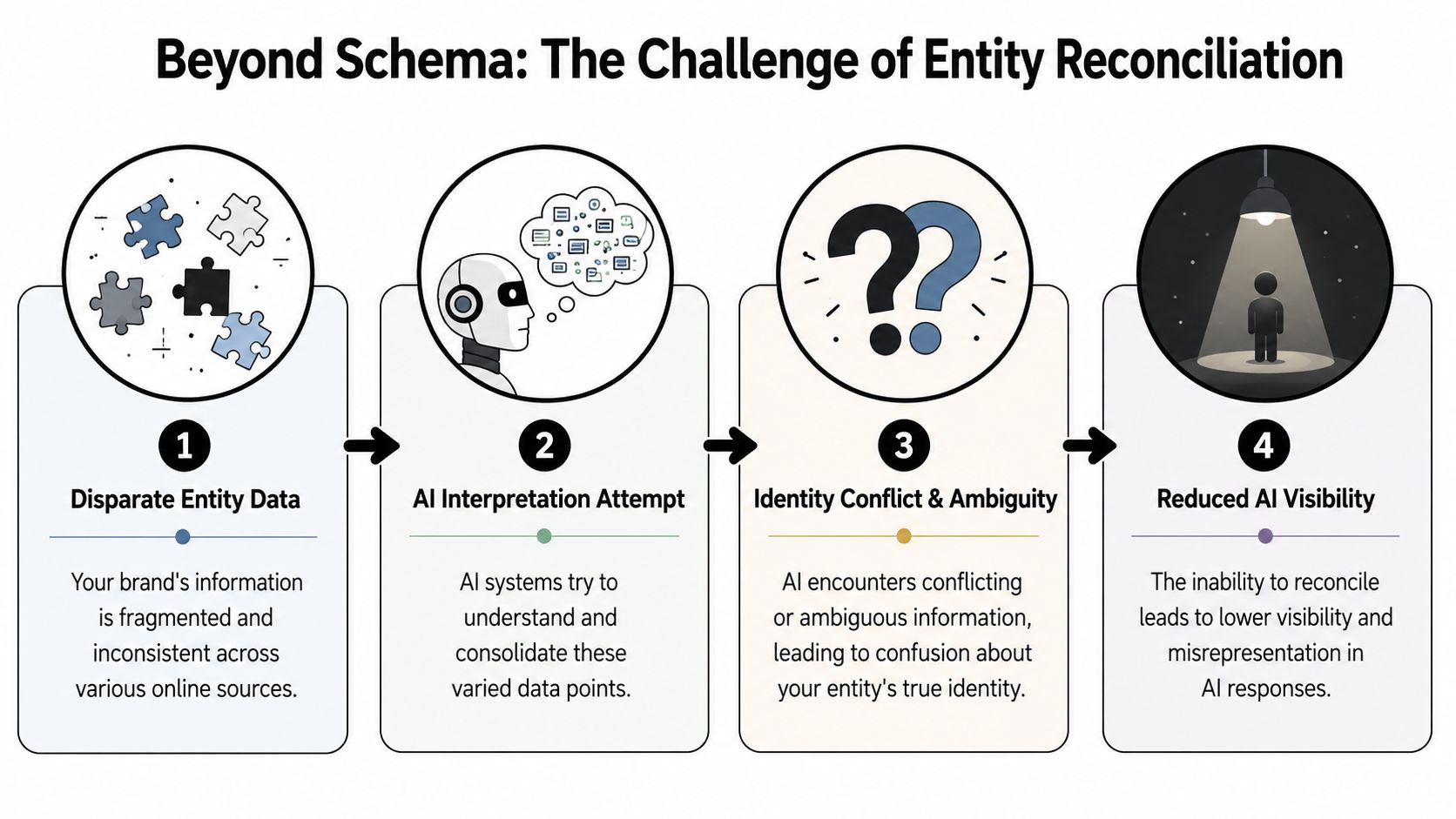
Why schema alone won't fix fragmentation
A major underserved angle in this field is entity reconciliation and canonical identity management. Public guidance tends to emphasize adding schema markup, but far fewer resources explain how to keep an organization's identity consistent across sources so search systems can merge those signals into one entity, which is critical for knowledge graph construction, as discussed in Quantexa's overview of entity reconciliation in knowledge graphs.
That's the actual problem for national and multi-location brands.
One team updates the legal brand name on the corporate site. Another keeps the older trading name on location pages. Franchisees edit profile descriptions. A product feed uses one category set. Business listings use another. Social accounts link to mixed destinations. Suddenly the same brand appears as several near-matches instead of one clean entity.
What fragmentation looks like in practice
You'll usually see entity fragmentation in forms like these:
- Name variation such as abbreviations, old brand versions, or inconsistent punctuation
- Address and phone drift across directories, location pages, and profiles
- Category mismatch between what the site says, what listings say, and what feeds say
- Broken relationship mapping where social profiles, GBP listings, and local pages don't clearly point back to one canonical source
- Conflicting sameAs targets that reference outdated or unofficial profiles
Here's a helpful explainer before the deeper point below:
Canonical identity is a governance problem
Entity reconciliation is not just a markup task. It's a governance task.
That means someone has to own the official version of key business facts and the systems that publish them. Without that control, every platform becomes a chance for drift. Multi-location businesses feel this more than most because local variation creeps in fast. One location manager updates hours on a profile. Another changes the business description. A third uses a different category. The website never catches up.
A strong canonical identity system usually includes:
- A master entity record with the official name, URL, categories, and profile references
- Location-level standards for how branches inherit and customize approved fields
- Publishing rules for websites, directories, social bios, and feeds
- Regular reconciliation reviews to catch mismatches before they spread
If your team wants a better grasp of how machines parse meaning from these signals, Raven SEO's guide to natural language processing basics adds useful context.
The key point is blunt: a fragmented brand can publish perfect schema and still remain hard for AI systems to trust.
A Practical Roadmap to Becoming an AI Source
Knowledge graph optimization works best when it becomes an operating discipline. Not a sprint. Not a one-time technical patch. A repeatable process.
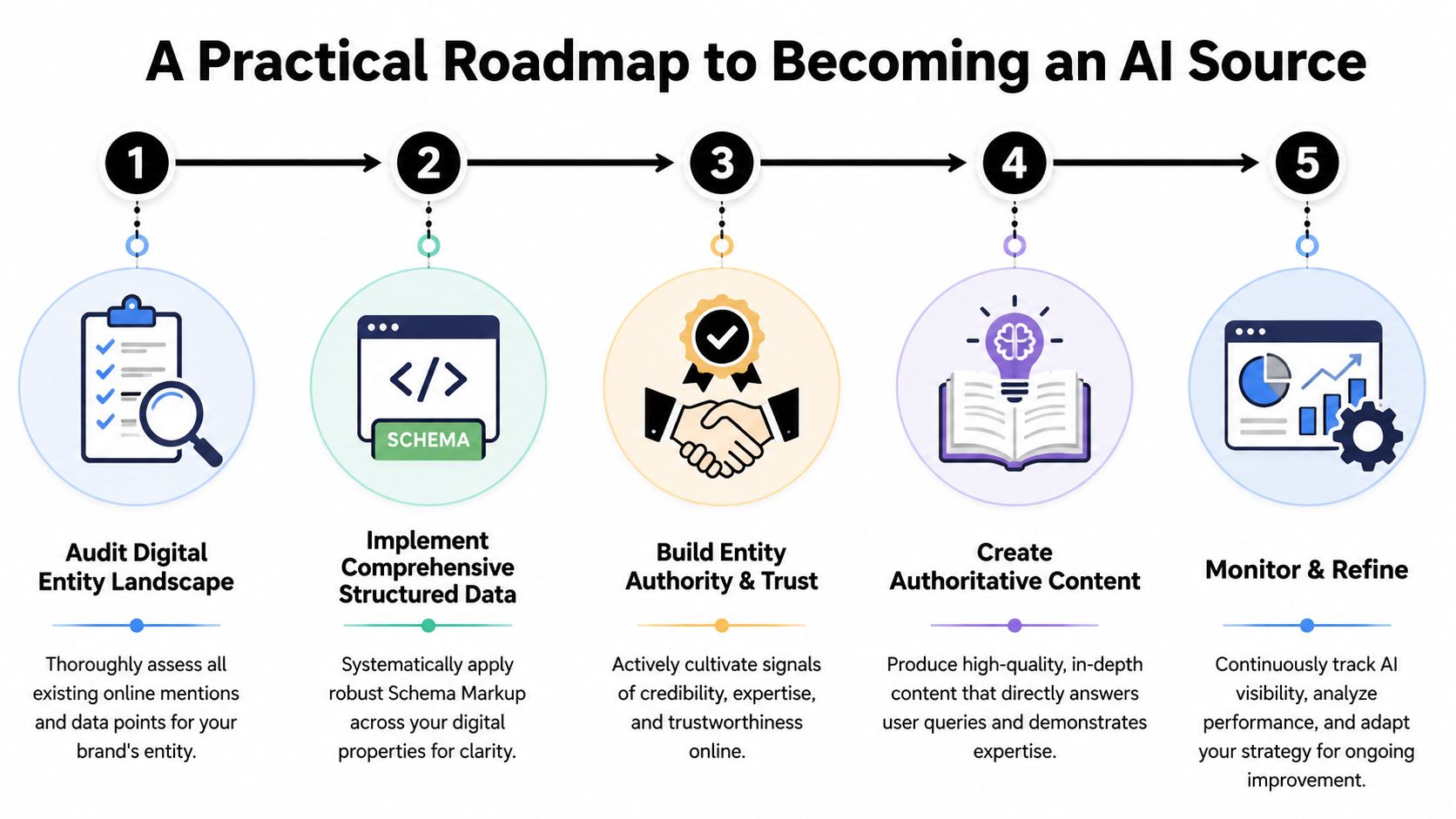
Contemporary guidance describes this work as a multi-step process: define goals, clean data, design an ontology, build the graph, optimize relationships, and continuously test. It also points to linking internal data with external knowledge bases such as Wikidata to improve semantic consistency and machine interpretability, which makes a brand more likely to be reused by AI systems, as explained in Meegle's guide to knowledge graph optimization workflows and external entity linking.
Step one: audit the full digital entity footprint
Start by inventorying every place your brand appears.
That includes the main site, subdomains, location pages, Google Business Profiles, social profiles, app marketplaces, review platforms, directory listings, press mentions, author pages, and product feeds. For larger organizations, include partner pages and franchise microsites too.
Your goal isn't to collect vanity mentions. It's to map the official and unofficial versions of your entity.
Look for:
- Core identity fields such as brand name, business description, categories, logos, and URLs
- Location records including addresses, phones, and service areas
- Profile relationships between corporate pages, social accounts, and local listings
- Entity conflicts where the same business appears under competing versions
This is usually where teams discover they don't have one digital identity. They have many.
Step two: build a schema system, not a schema patch
After the audit, define the entity model you want machines to understand. At this stage, ontology design becomes practical. You're deciding what entities matter and how they connect.
For many businesses, the core map includes organization, location, service, product, article, author, FAQ, and review relationships. The mistake is deploying these ad hoc. The better approach is to standardize templates by page type so schema stays coherent as the site grows.
A useful checkpoint is whether each important page answers three machine-facing questions:
| Question | Example |
|---|---|
| What is this page about | A service, product, person, location, or article |
| How does it relate to the brand | Offered by, authored by, located at, part of |
| Where is the corroboration | Internal links, profile references, consistent off-site mentions |
Step three: enforce canonical identity across channels
This is the most overlooked operational step.
Publish one canonical record for your organization and one approved framework for each location or sub-brand. Then align every channel to it. Don't let the website say one thing while directory vendors, local managers, and social teams say another.
Clean markup on a messy entity footprint still produces a messy result.
In practice, this means maintaining approved naming conventions, profile URLs, categories, and descriptive language. It also means removing or consolidating duplicate listings and outdated references.
Step four: strengthen authority with content and corroboration
AI systems don't only need facts. They need confidence.
That confidence grows when your brand publishes helpful, specific content and the wider web reflects the same identity. Strong service pages, expert articles, author transparency, media references, and trustworthy citations help create that reinforcement loop.
If your content operation needs structure, Raven SEO's resource on how to get content that supports discoverability offers a practical starting point.
Focus on content that does four things well:
- Defines expertise by answering category-level questions clearly
- Connects entities by tying services, products, people, and locations together logically
- Removes ambiguity with precise language and current facts
- Supports reuse through scannable formatting, summaries, and well-structured page elements
Step five: monitor, validate, and refine
Knowledge graph optimization is never finished.
Pages change. Locations move. Social accounts get renamed. Product lines expand. If there's no maintenance loop, identity drift returns. Teams that do this well create recurring checks for schema validity, canonical consistency, profile alignment, and citation cleanup.
What doesn't work is treating AI visibility as a black box. What does work is operational discipline: test, compare, fix, and repeat.
Future-Proofing Your Brand for Generative Search
The brands that win in generative search won't be those publishing more pages. They'll be the ones that present the clearest, most consistent, most machine-readable identity.
That requires three things working together: structured data that defines the entity, authority signals that support trust, and factual consistency that keeps the entity intact across the web. The overlooked piece is still reconciliation. If your brand appears in fragments, AI systems have less reason to consolidate and cite it confidently.
This is why knowledge graph optimization should sit inside the core search strategy, not on the edge of it. It's how businesses move from being crawlable to being understandable.
There's also a practical connection here to prompt design. Better prompts help users ask sharper questions, but those systems still need reliable source material to answer well. For that reason, ThirstySprout's prompt engineering insights are useful alongside entity optimization work. Prompt quality shapes retrieval, but digital identity shapes whether your brand can be retrieved and trusted in the first place.
The shift from clicks to citations isn't temporary. Search systems are moving toward synthesis, entity understanding, and answer generation. Brands that govern their identity now will be easier to find, easier to trust, and easier to reuse as this ecosystem matures.
If you want a practical starting point, Raven SEO offers a no-obligation consultation to review your current AI visibility, identify entity fragmentation, and map out an AI-ready strategy for sustainable search growth.