
Google AI Overviews now reach 2 billion monthly users, and roughly 60% of searches end without a click according to Semrush's AI SEO statistics. That one shift changes the job of SEO.
For years, search strategy centered on rankings, traffic, and landing pages. Those still matter, but they no longer tell the full story. In AI-driven search, your page doesn't always need to win the click to shape the answer. Your brand needs to become the source an AI system trusts enough to summarize, cite, and reuse.
That's where a modern AI SEO strategy starts. Not with publishing more content. Not with chasing every new prompt trend. It starts by making your business legible to machines and credible to people.
As Head of Search Innovation at an AI-focused agency, I've seen the same pattern repeatedly. Brands that treat AI search as a content formatting problem stay stuck. Brands that treat it as an entity-building problem start showing up where decision-making takes place.
The End of an Era for Traditional SEO
Traditional SEO was built for a simpler interface. A user typed a query, scanned ten blue links, and chose a page. Winning meant outranking competitors and earning the visit.
That model is fading. Search now acts more like a research assistant than a directory. Users ask complete questions, expect direct answers, and often make early judgments without ever entering a website. If your brand isn't present in that answer layer, your visibility shrinks even if your rankings look stable in a reporting dashboard.
Rankings still matter, but they're no longer the end goal
A strong position in search results still helps discovery. Technical SEO still supports crawling and relevance. Content still needs depth and precision. But the objective has changed.
The new goal is selection. Can an AI system identify your content as reliable? Can it pull a clean answer from your page? Can it connect your brand, expertise, products, and supporting evidence into a coherent entity?
Practical rule: If your website reads like a stack of isolated keyword pages, AI systems have less to work with. If it reads like a clear knowledge base tied to a real brand, citation becomes more likely.
This is why Answer Engine Optimization, or AEO, matters. It's not a replacement for SEO in the sense of deleting the old playbook. It's the next layer on top of it. You still need discoverability. You now also need answer eligibility.
Old habits that break in AI search
Several tactics from classic SEO lose force in generative environments:
- Thin variations of the same topic: Repeating near-identical pages creates noise, not clarity.
- Keyword-first copywriting: AI systems respond better to direct, well-structured answers than awkward phrase repetition.
- Authority by volume alone: Publishing more pages doesn't guarantee trust.
- Traffic as the only KPI: A brand can influence a buying decision before a click ever happens.
For brands trying to understand where search is headed, Raven SEO's perspective on the future of SEO with AI is a useful starting point. The practical implication is simple. If you keep optimizing only for clicks, you'll miss the layer where search is increasingly happening.
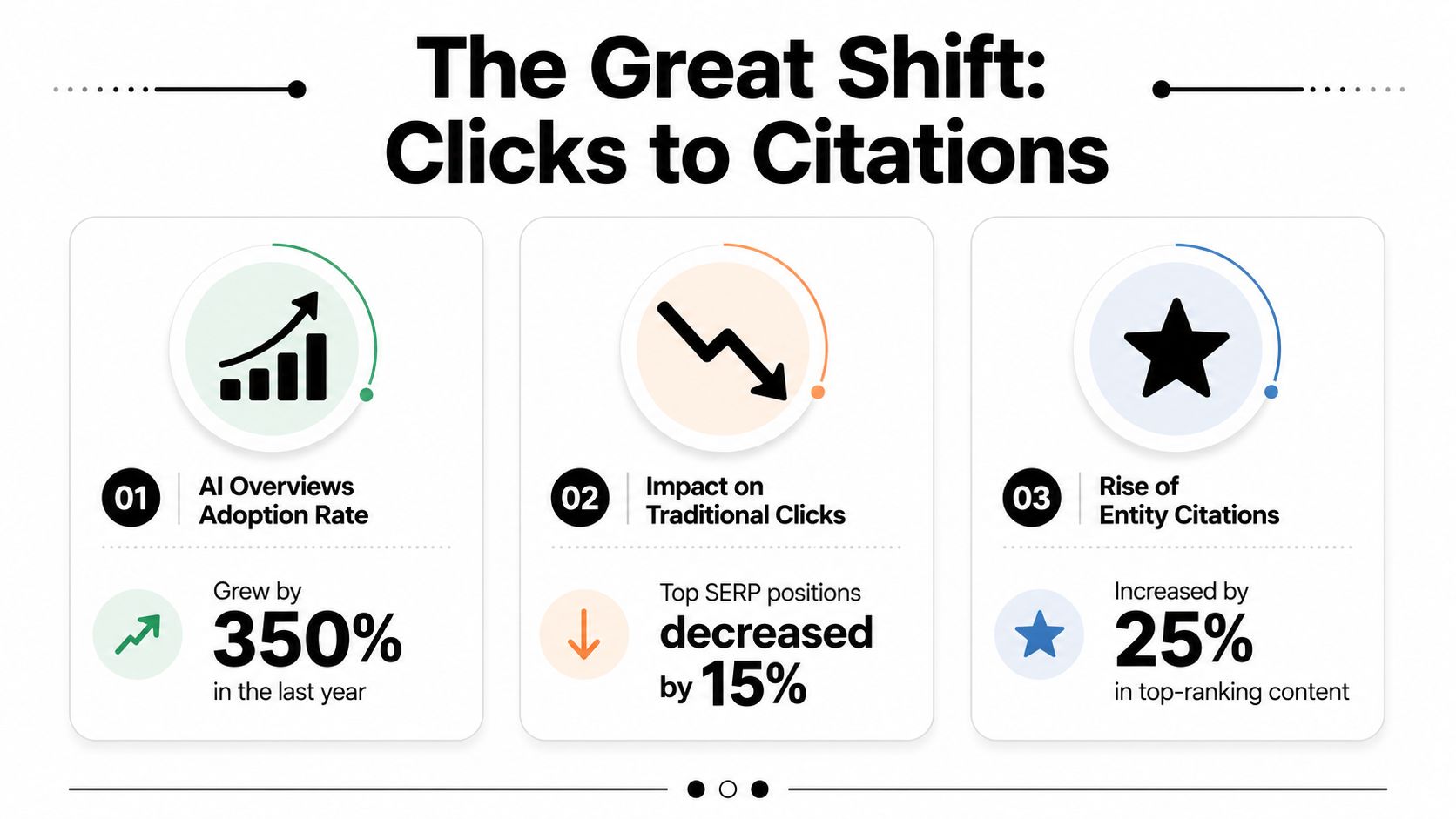
The Great Shift from Clicks to Citations
Zero-click behavior is no longer a side effect of search. It is becoming the product.
As noted earlier, AI features are training users to get enough of the answer on the results page itself. For brands that built their organic model around visits, that changes the objective. Visibility still matters, but visibility without inclusion in the generated answer has less commercial value than it did in classic search.
Why citations matter more than clicks
In traditional SEO, the win condition was straightforward. Earn a high ranking, attract the click, then do the conversion work on-site.
Generative search changes that sequence. The answer layer now does part of the filtering, framing, and recommendation before a user reaches your website. If your brand is cited there, you influence the decision early. If your brand is missing, you may lose the opportunity before the visit ever exists.
A useful business comparison is analyst coverage in financial markets. A company does not control the final report, but it can improve the odds of being referenced accurately by publishing clear data, consistent positioning, and evidence that holds up under scrutiny. AI search works in a similar way. You are preparing your brand to be retrieved, understood, and reused.
That shift matters because citation is not just a traffic event. It is a distribution event.
How AI systems decide what to use
Generative systems pull from sources they can parse with confidence. In practice, that usually means a few things working together:
- Direct answer formats: Pages that answer a defined question cleanly are easier to extract from.
- Stable entity signals: Brand names, products, authors, and categories need to appear consistently across the site.
- Context around the answer: Supporting explanations, definitions, and relationships help a model place the information correctly.
- Evidence and attribution: Clear authorship, examples, references, and specific claims improve trust.
An AI SEO strategy, therefore, cannot be reduced to prompt engineering or content generation. The essential task is to make your business machine-readable enough to qualify for citation and authoritative enough to keep appearing.
That is the market shift many teams underestimate. They are still optimizing pages as isolated ranking assets. AI systems evaluate a broader web of signals. They look for entity consistency, topical reinforcement, and language they can safely compress into an answer. The brands that win are restructuring their digital presence so the model can connect the dots.
For a clearer breakdown of that strategic change, Raven SEO's guide to AEO vs SEO in 2026 explains how answer-focused visibility changes the business trade-off. You are no longer competing only for page position. You are competing to become a source the model is willing to cite.
Building Your Brand as a Citable Entity
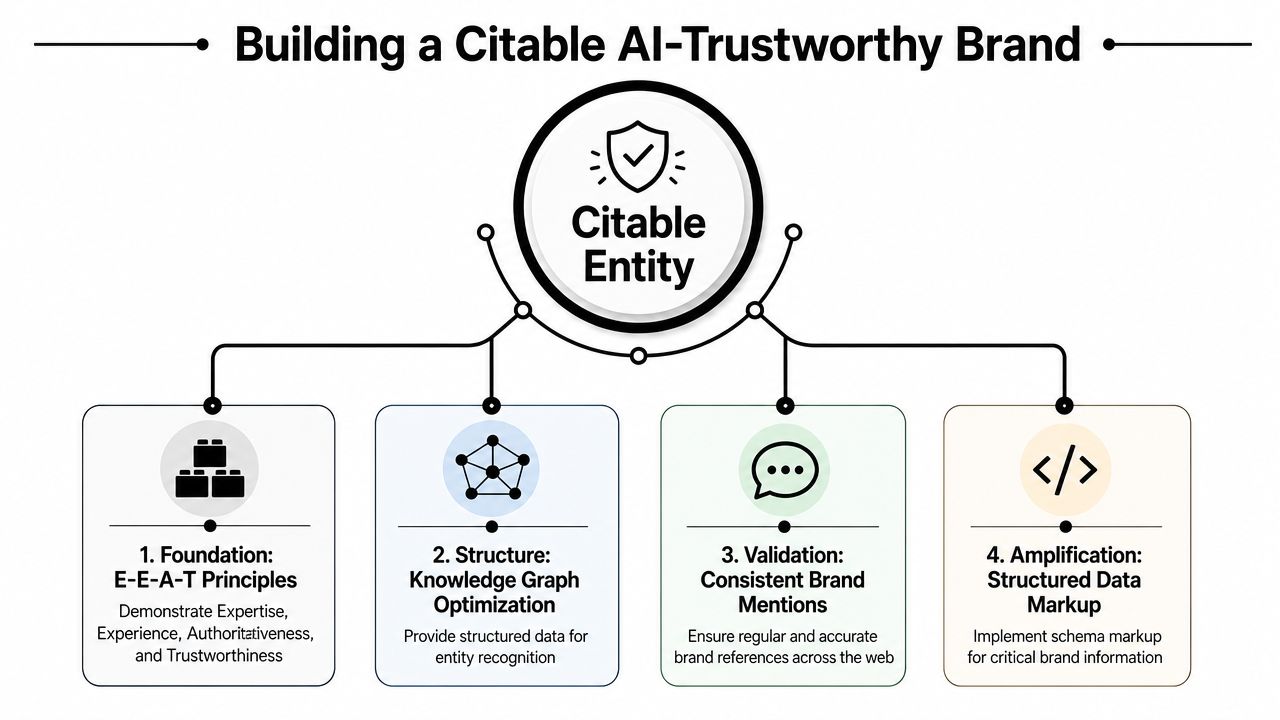
Most businesses talk about authority in vague terms. AI systems don't reward vague signals. They need enough evidence to connect your brand to a topic, enough clarity to understand what you offer, and enough consistency to trust the relationship.
That's why I frame modern authority as entity construction. You are not just publishing pages. You are teaching machines who you are, what you know, and why your information deserves to be reused.
Information gain is the dividing line
Basic content is easy for AI to summarize. That's exactly why basic content is losing strategic value.
Animalz argues that a key advantage now comes from information gain. Original research, customer data, expert interviews, and contrarian framing matter more because AI can already compress generic advice. Opportunity lies in answering the follow-up questions and practical implementation gaps that top-ranking pages still miss, as outlined in Animalz on information gain.
A useful way to think about it is this. If ten competitors publish “what is” content, an AI can blend those pages into one answer. If your brand publishes something only you can credibly say, the system has a reason to cite you.
What makes a brand citable
The strongest citable brands usually do several things at once:
- They publish first-hand knowledge: Internal data, operational insights, and lived expertise create differentiation.
- They identify real experts: Named authors, subject matter contributors, and visible credentials reduce ambiguity.
- They maintain consistency: The same company description, service language, and positioning appear across the site and broader web presence.
- They answer practical questions: Not just definitions, but implementation details, trade-offs, and limitations.
AI doesn't need your content to sound impressive. It needs your content to be specific enough to trust.
For businesses trying to operationalize those trust signals, Raven SEO's guide to E-E-A-T for AI is a practical reference. It helps translate abstract credibility principles into work a marketing team can execute.
A strong explainer on the broader shift is worth watching before you revise your content model:
What usually fails
I see three recurring mistakes:
Mass-producing interchangeable articles
This creates surface area, but not distinction.Hiding expertise behind brand-only copy
If no expert voice appears anywhere, authority feels thin.Publishing opinions without evidence
AI systems can summarize unsupported claims, but that doesn't make them durable.
A citable entity doesn't look like a content machine. It looks like a reliable source.
The Technical Blueprint for AI Visibility
If brand authority is the reputation layer, technical SEO is the blueprint layer. It tells crawlers how your digital property is organized and what each part means.
A house with no blueprint confuses builders. A website with weak structure confuses machines. Pages might exist, but relationships remain fuzzy. That ambiguity hurts AI visibility.

Structure tells AI what belongs together
Modern AI search systems still rely on classic technical foundations. Hierarchical architecture, topic clustering, and descriptive internal linking help models understand entity relationships. JSON-LD schema and @graph and @id patterns give crawlers explicit entity anchors for organizations, webpages, products, and FAQs. Structured data can also support retrieval-augmented generation workflows, as explained in iPullRank's technical SEO guidance for AI search.
That matters because most sites are still built like filing cabinets. One service page here. One blog article there. A scattered FAQ somewhere else. AI systems perform better when your site behaves more like a connected map.
The blueprint I recommend
A practical AI SEO strategy usually includes these technical moves:
- Build topic clusters: Create a clear parent page for a subject, then connect supporting articles, FAQs, and service pages beneath it.
- Use descriptive internal links: “Learn more about emergency HVAC repair pricing” tells a crawler more than “click here.”
- Implement entity-focused schema: Organization, WebPage, Product, FAQ, and related types help define what a page contains.
- Maintain stable identifiers:
@idpatterns help machines understand that the same entity appears across multiple pages.
Here's the important trade-off. Overcomplicated schema won't rescue weak content, and beautiful content won't fully compensate for poor structure. You need both.
What to fix first
If your team has limited bandwidth, start with the highest-value assets:
| Priority area | Why it matters |
|---|---|
| Core service pages | They define what your business does |
| About and author pages | They clarify who is behind the information |
| FAQs | They provide answer-ready content blocks |
| Product or category pages | They tie commercial intent to structured entities |
For teams that need implementation support, tools and services vary widely. Some brands rely on internal developers, some use schema plugins, and some work with agencies. Raven SEO's page on structured data gives a grounded view of how this work fits into broader AI-ready site architecture.
Optimizing Content for Generative Answers
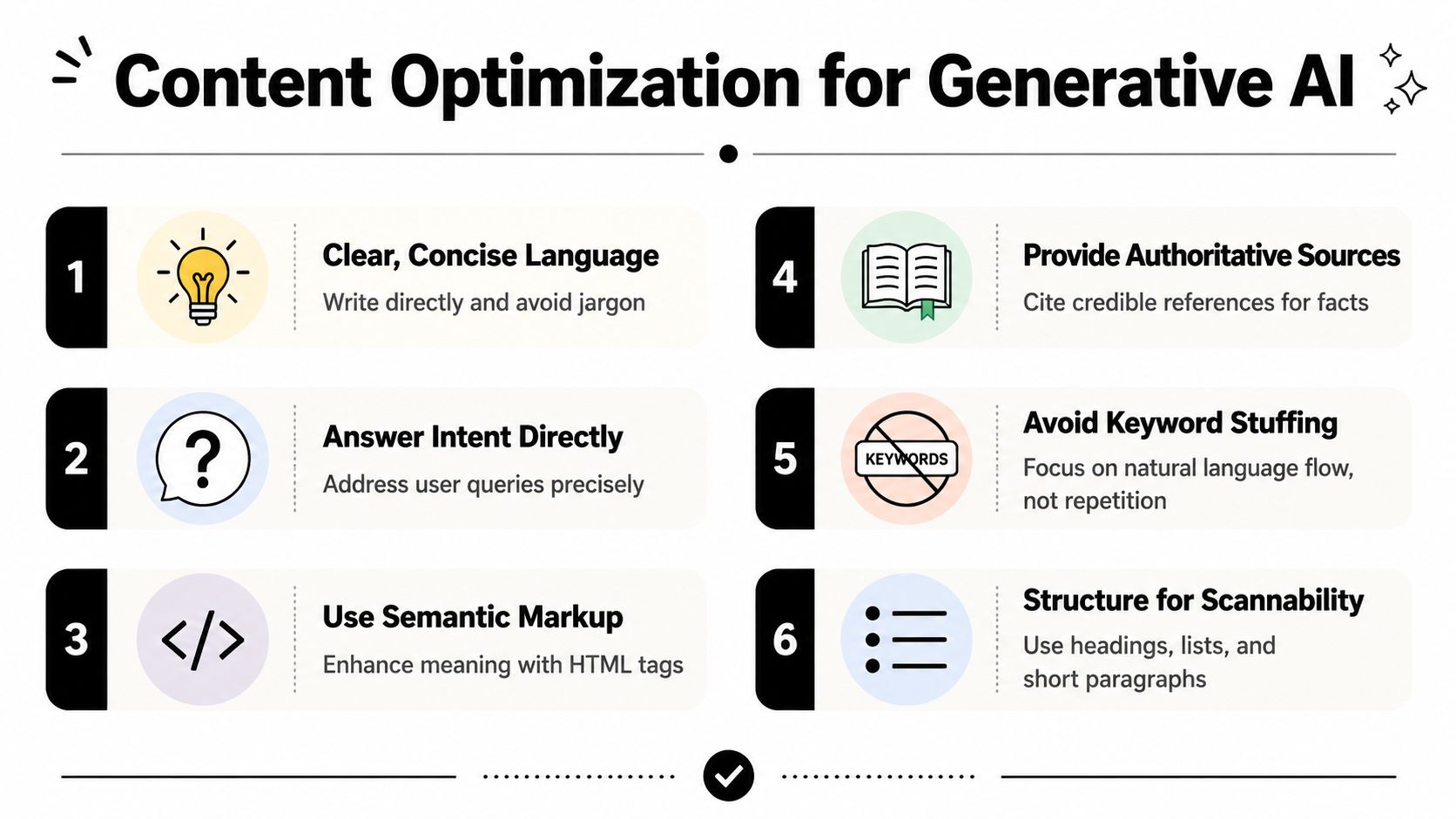
A lot of teams still write as if search engines are grading density and variation. They aren't. In AI search, content wins when it answers quickly, explains clearly, and removes ambiguity.
That changes the definition of quality. Quality is no longer just depth or word count. Quality is machine readability plus human usefulness.
SeoProfy reports that 86.07% of SEOs have already added AI to their strategy, and AI use helps companies publish 47% more content each month, according to SeoProfy's AI SEO statistics. That's exactly why publishing volume alone won't separate anyone. More teams can produce more pages. Fewer teams can produce pages that deserve to be cited.
Write for extraction, not just engagement
An AI system often needs a clean passage it can lift, summarize, or verify. That means your content should make extraction easy.
Use this checklist when revising key pages:
- Lead with the answer: Don't bury the definition or recommendation below a long introduction.
- Break ideas into sections: Tight headings help both users and machines move through the page.
- Use lists where appropriate: Steps, requirements, pros and cons, and comparisons become easier to parse.
- Keep paragraphs tight: Dense walls of text reduce clarity.
- Support factual claims carefully: If a claim requires evidence, provide it.
- Cut filler language: Decorative phrasing tends to weaken precision.
A strong generative-search page often reads like a good briefing memo. It is clear, direct, and easy to quote.
Formats that tend to perform better
Not every page needs the same shape. But some structures consistently help answer engines:
Question-and-answer blocks
These work well because they mirror user behavior. A direct question followed by a direct answer gives AI systems a neat content unit.
Comparison tables
Tables clarify differences between options, features, or approaches. They reduce interpretive work for the model and the reader.
Definition plus application
Start with a plain-language explanation, then move into when it matters, when it doesn't, and what to do next.
For teams building around Google's generative results specifically, Raven SEO's guide to a Google SGE content strategy is a useful extension of this approach.
What to stop doing
- Stop writing introductions that avoid the topic
- Stop treating every keyword as a separate article
- Stop optimizing headings for cleverness instead of clarity
- Stop publishing generic summaries of information already everywhere
Good content for AI search doesn't feel robotic. It feels unmistakably useful.
Measuring Success in the Age of AEO
The hardest part of AI SEO strategy isn't implementation. It's measurement.
Traditional SEO reporting was built around rankings, clicks, sessions, and conversions from organic search. Those metrics still matter, but they no longer capture the full effect of being present inside AI-generated answers. A brand can influence awareness, shortlist inclusion, and even buying confidence before analytics records a website visit.
Recent guidance has started emphasizing LLM referral traffic, citation counts, and conversion behavior from tools like ChatGPT or Perplexity. The challenge is that there still isn't a widely standardized reporting framework, which leaves many teams struggling to prove ROI, as discussed in WSI's guidance on AI-powered SEO measurement.
What to track now
You don't need perfect tooling to start building a useful reporting model. I'd begin with a working scorecard:
- Brand citations in AI answers: Track whether your company is named, linked, or referenced.
- LLM referral traffic: Separate traffic from conversational engines where your analytics stack allows.
- Conversion quality: Compare lead quality from AI-originating visits against other channels.
- Prompt visibility checks: Test priority commercial questions and document whether your brand appears.
- Message accuracy: Review whether AI systems describe your offer correctly.
This is also where newer frameworks such as implementing GxO with hostAI can help teams think beyond rank tracking and toward generative visibility as a measurable operating discipline.
The mindset shift
Old SEO asked, “How many visits did this page earn?”
AEO asks, “Did this brand shape the answer, and did that influence business outcomes?”
Those are different questions. Smart teams now track both.
The practical takeaway is to build reporting before standards settle. Teams that wait for a universal dashboard will spend too long blind to a channel that is already affecting buyer behavior.
Frequently Asked Questions about AI SEO
| Question | Answer |
|---|---|
| Is AI SEO replacing traditional SEO completely? | No. Traditional SEO still matters because pages still need to be crawled, indexed, and understood. What's changing is the objective. Strong rankings help, but brands now also need to be selected for summaries, citations, and conversational answers. |
| What does an AI SEO strategy usually focus on first? | The best starting point is clarity. That usually means tightening site architecture, improving core service and about pages, adding useful schema, and rewriting thin content so it answers real questions directly. |
| Does every business need original research to become citable? | No, but every business needs some form of unique value. Original research is one option. First-hand experience, expert commentary, practical process detail, and customer-informed insights can also create information gain. |
| Can AI-generated content help, or does it hurt? | It can help with speed and workflow support, but it doesn't create trust by itself. If teams publish unedited, generic AI text, quality usually drops. AI works best as an assistant for outlining, analysis, and drafting, with human experts shaping the final page. |
| What kinds of pages are most important for AI visibility? | Core commercial pages, detailed FAQs, product or service explainers, author pages, and well-structured educational content tend to matter most because they define your entity, your expertise, and your relevance to important queries. |
| How long does it take to see results from AI-focused optimization? | There isn't a universal timeline. Some changes improve clarity quickly, while authority and citation patterns often take longer to develop. The more fragmented your current site and brand signals are, the more foundational work is usually required first. |
If your team needs a practical way to assess how visible and citable your brand is in generative search, Raven SEO can help you audit the gaps. We work on AI-ready site structure, technical SEO, and machine-readable brand authority so businesses can compete for visibility inside AI Overviews and conversational search, not just in traditional rankings.