
Search is no longer primarily a click-distribution system. It is becoming an answer-distribution system.
For businesses, that changes the job of SEO. The target is no longer limited to ranking a page and waiting for the visit. The target is becoming a brand that AI systems can identify, trust, and cite inside the answer itself. That is the fundamental shift behind the future of SEO with AI. It is why the conversation is moving from Search Engine Optimization to AI Visibility, or Answer Engine Optimization.
Zero-click behavior has been building for years, and AI summaries are accelerating it. Users often trust the answer format itself, especially for early research, product comparisons, and local discovery. If your company is absent from that answer layer, you can lose influence before a prospect ever reaches your site. For a useful primer on how search behavior is changing, see our guide to Google Gemini and the future of search strategy.
I see the same pattern in client work. Traffic still matters, but it is no longer a complete measure of visibility or commercial impact. A brand can shape a buying decision by being quoted in an AI response, referenced in a recommendation set, or used as a source without getting the click. That is why smart teams are expanding their SEO programs now, not replacing them. They are adding the signals that help machines interpret authority with confidence.
A practical outside perspective on this shift appears in Flaex.ai on AI-powered SEO. The core idea is simple. Future-proof search strategy is less about chasing isolated rankings and more about building a trusted digital entity that answer engines are willing to cite.
The Search Landscape Is Changing Forever
Search has moved beyond the old model of ten links competing for attention. Google, chat-based assistants, and AI-powered search products now act more like a research assistant. They gather information, compress it, and present an answer upfront.
That changes buyer behavior fast. A user who once compared five pages may now read one AI-generated summary and make a decision from there. For brands, the front door to discovery isn't only the website anymore. It's the answer layer sitting above the website.
AI interfaces are changing what counts as visibility
Traditional SEO trained teams to think in rankings, clicks, and sessions. Those still matter, but they no longer tell the whole story. A brand can influence a buying decision without receiving the visit if it appears in the summary, the recommendation set, or the cited sources behind an answer.
The practical implication is simple. You don't just need pages that rank. You need content and site architecture that AI systems can interpret confidently.
Search used to reward the best match. AI search increasingly rewards the clearest, most trustworthy explanation.
This is why the future of SEO with AI is less about isolated keyword wins and more about total information quality. Your service pages, FAQ blocks, entity signals, author information, and structured data now work together as one credibility system.
For a useful outside perspective on how this affects optimization in practice, Flaex.ai on AI-powered SEO gives a solid overview of how AI changes both content creation and search strategy. If you're specifically trying to understand how Google's own AI direction affects planning, this breakdown of Google Gemini and the future of search strategy is worth reviewing.
This is a disruption, but it's also an opening
Most businesses are still operating with a pre-AI playbook. They publish pages built for keyword matching, not for extraction, summarization, and citation. That creates a real opening for companies willing to adapt earlier.
The brands that win next won't necessarily be the loudest publishers. They'll be the clearest. They'll define services precisely, answer common questions directly, support claims carefully, and make their digital footprint easy for machines to parse.
That's a significant reset. Search is no longer only about being found. It's about being selected.
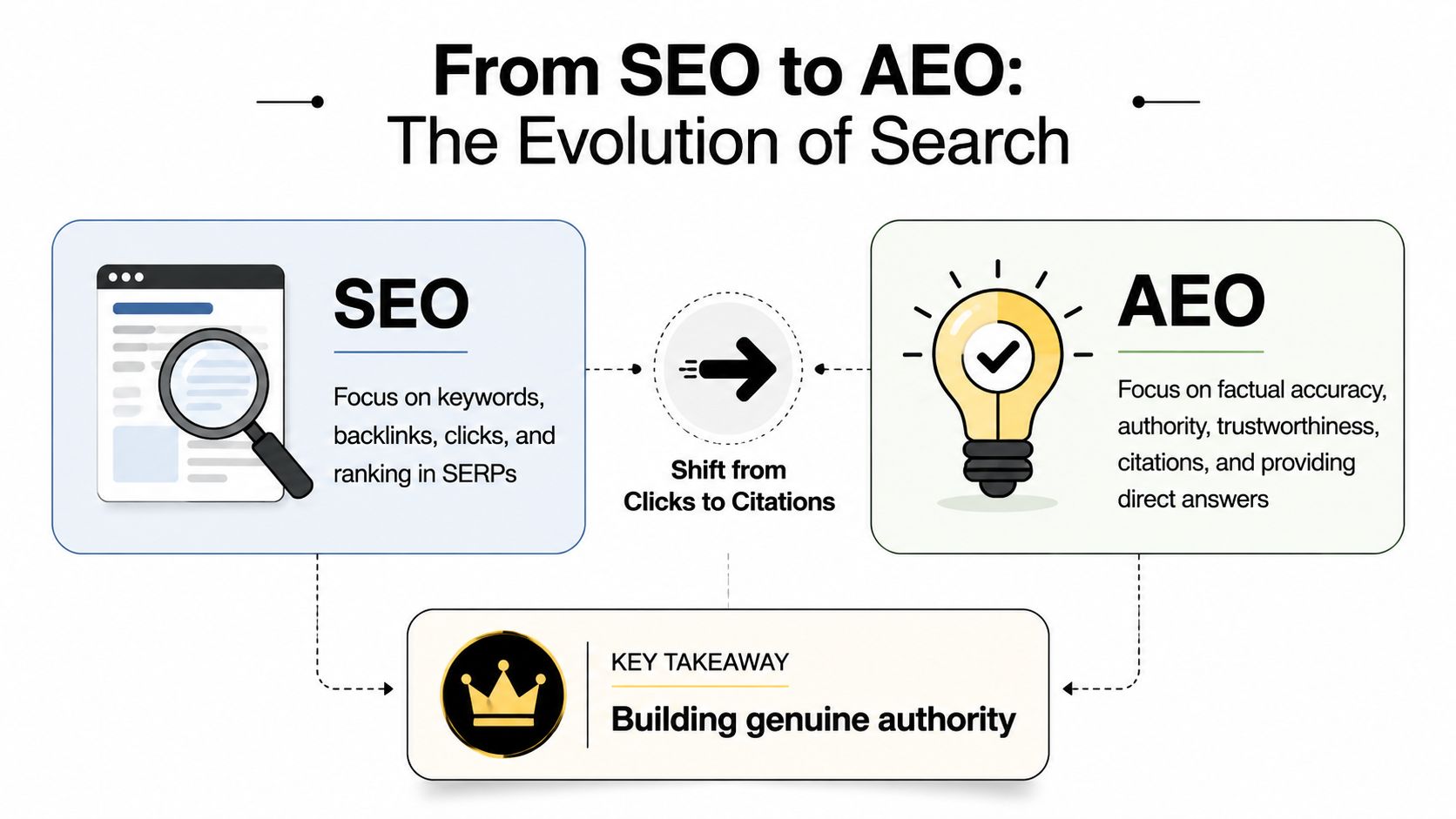
From SEO to AEO The Shift from Clicks to Citations
SEO is no longer the full objective. The next competitive advantage is AI visibility: being the brand an answer engine chooses to cite, summarize, and recommend.
SEO was built around page discovery. AEO, or Answer Engine Optimization, is built around source selection. That changes how content creates value. A high ranking can still drive visits, but a citation inside an AI answer can shape the buying decision before the click ever happens.
Under the old model, visibility came from placement. Under the newer model, visibility comes from being trusted enough to be reused.
Why citations matter more than raw clicks
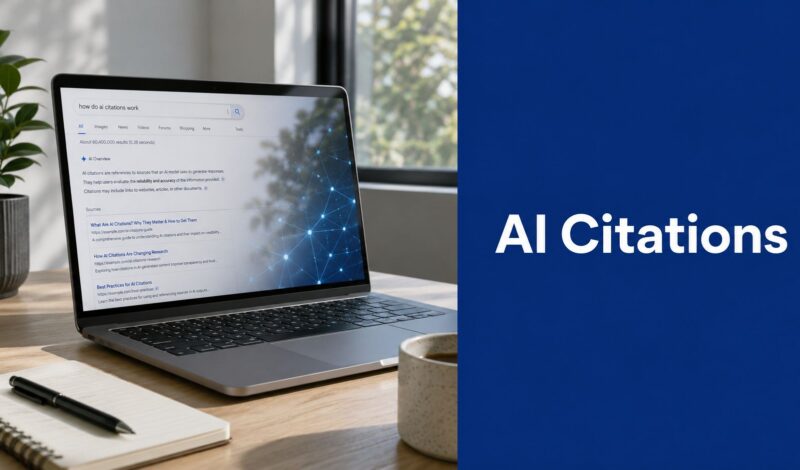
A citation in an AI Overview or conversational result carries an implied endorsement. The system is signaling that your content helped form the answer.
Users trust the answer format itself. In many cases, they do not compare ten blue links, especially for research, comparisons, definitions, and early buying questions. If your brand appears in the answer, you influence the decision earlier. If it does not, strong rankings may still leave you out of the moment that matters.
This is the true shift. Search visibility used to be measured mostly by traffic potential. AI visibility is measured by whether your brand is present in the answer layer.
What changes when you optimize for answers
AEO keeps the useful parts of SEO, then raises the standard for clarity and trust. The question is no longer only whether a page can rank. The question is whether a machine can extract a clean answer, attribute it to the right source, and feel confident reusing it.
That forces different editorial decisions:
- Write answer-first sections. Put the direct response near the top of a section instead of hiding it behind generic setup.
- Make claims easy to verify. Clear sourcing, named authors, and specific language reduce ambiguity.
- Structure pages for extraction. Strong headings, concise definitions, comparison tables, and Q&A blocks give AI systems reusable units.
- Strengthen entity consistency. Your brand name, services, expertise, and supporting signals need to align across your site and broader web presence.
I see the same mistake repeatedly in audits. Companies publish pages that are designed to sound relevant, but not to be quoted. In AI search, that gap is expensive.
Practical rule: If a paragraph cannot stand alone as a useful answer, it is less likely to appear in AI-generated search experiences.
The strongest pages now work like source documents. They still persuade, but they do it with precise language, clear scope, and facts that hold up when pulled out of context.
The metric shift is already underway
Traffic still matters. It just no longer captures the full value of search.
As noted earlier, more search experiences now end on the results page or inside an AI-generated response. That shifts attention toward brand mentions, citations, assisted conversions, and category association. A business can influence pipeline without winning the click, especially in markets where buyers use AI tools to shortlist vendors before visiting any website.
This creates a practical reporting problem for leadership teams. If the dashboard only tracks sessions and rankings, it will miss part of the return. Teams need a broader model. For a clearer breakdown of where classic SEO still applies and where answer optimization changes the goal, see this guide to AEO vs SEO in 2026.
The businesses that adapt first will treat visibility as a citation problem, not just a ranking problem. That is the shift from SEO to AEO.
How AI Search Finds and Trusts Your Brand
AI search doesn't "think" like a person, but it also doesn't operate like old keyword matching alone. It tries to determine what a page means, what entity it describes, and whether the information looks reliable enough to reuse.
That has major consequences for how pages should be built.

AI systems look for meaning, not just matching terms
Large language models and AI search systems increasingly evaluate pages through semantic meaning, topic coverage, and passage-level retrieval, not just exact keyword overlap. Technical SEO now needs content chunking, clear hierarchy, and structured Q&A blocks so useful sections can be retrieved and cited in AI answers (Lumar on technical SEO in the age of AI search).
In plain terms, the model isn't only scanning whether you used the phrase. It's trying to identify whether a section cleanly answers the question and whether that section belongs inside a credible topical context.
That means the unit of visibility is changing. It's no longer always the full page. It might be the paragraph, list, definition block, or short explanation nested inside the page.
Entity consistency is a trust signal
A brand becomes easier for AI systems to trust when its identity is consistent across the web. The company name, service descriptions, leadership details, industry focus, location signals, and supporting references should align.
When those details conflict, the system has to work harder to resolve who you are. When they align, your brand becomes easier to treat as a stable entity.
Use this mental model: AI is building a résumé for your business from everything it can access. Your site, profiles, citations, reviews, schema, authors, and mentions all contribute to that résumé.
A strong résumé usually includes:
- Clear business identity with one consistent naming convention
- Defined expertise shown through specialized content and subject ownership
- Transparent authorship so content isn't detached from real expertise
- Supporting corroboration from mentions, references, and external validation
- Technical clarity so key facts are machine-readable
If your website says one thing, your profiles say another, and your pages stay vague about who wrote them, AI won't fill in the gaps in your favor.
E-E-A-T becomes operational, not theoretical
Many businesses hear E-E-A-T and treat it like abstract Google guidance. In AI search, it becomes more concrete. Experience, expertise, authoritativeness, and trustworthiness are reflected in real page elements.
That includes bylines, author bios, cited sources, original analysis, service specificity, about-page clarity, customer support transparency, and the overall coherence of your site.
If you're tightening those trust signals, this guide on E-E-A-T for AI visibility is a practical place to start.
A Practical Roadmap for AI Visibility
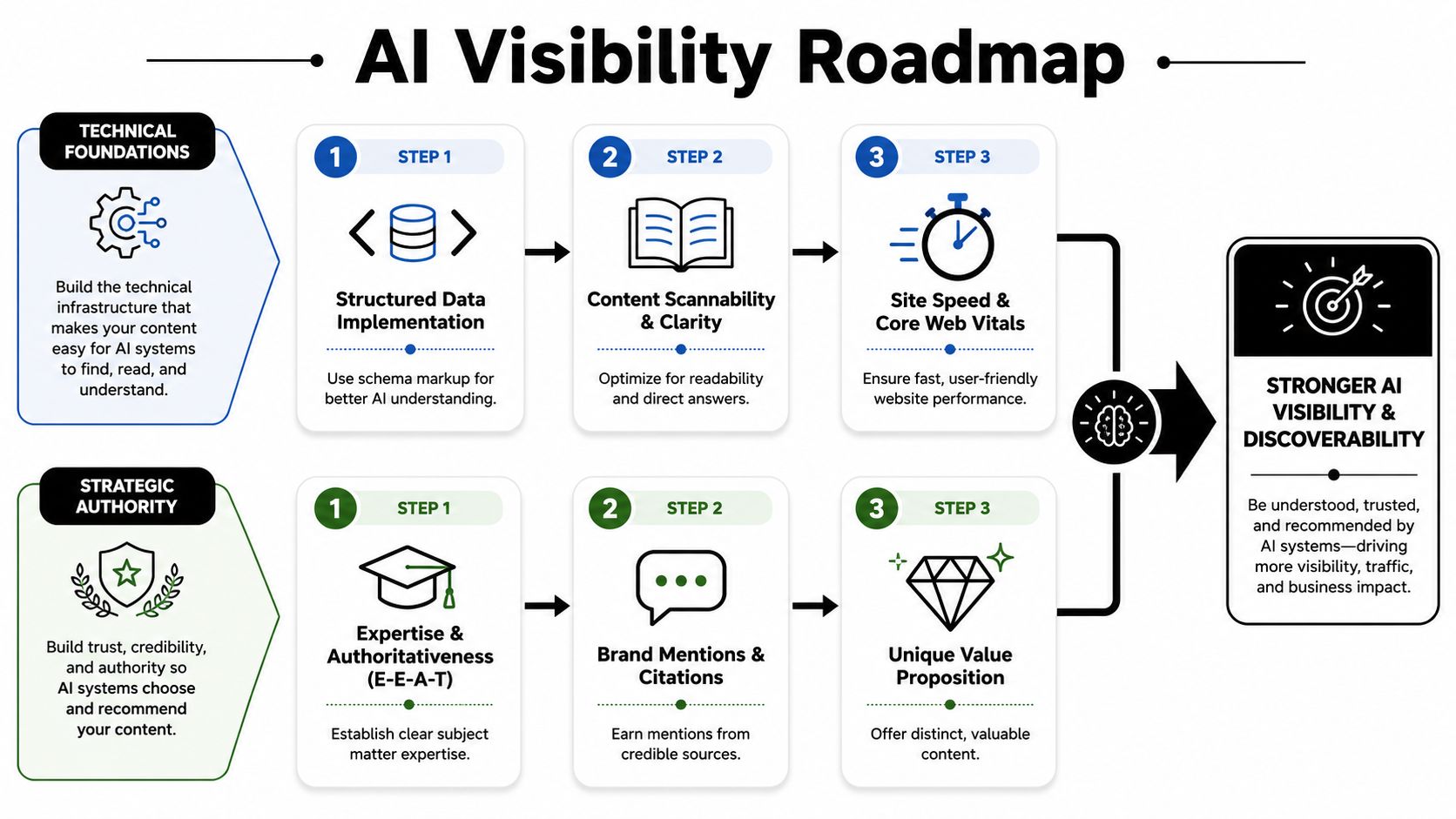
The companies that adapt well usually do two things at once. They improve the technical foundations that help machines interpret the site, and they build the kind of authority that makes the brand worth citing.
Both matter. One without the other creates a ceiling.
Recent market signals show why so many teams are reworking strategy now. The global AI-in-marketing market is projected to reach $217.33 billion by 2034, and search interest for “AI SEO” has risen by 1,900% over the past 5 years, which points to rapid adoption of AI across content, analytics, and search workflows (Digital Marketing Institute on AI marketing statistics).
Technical foundations
If AI can't parse the site cleanly, authority alone won't rescue performance.
Focus first on the infrastructure that reduces ambiguity.
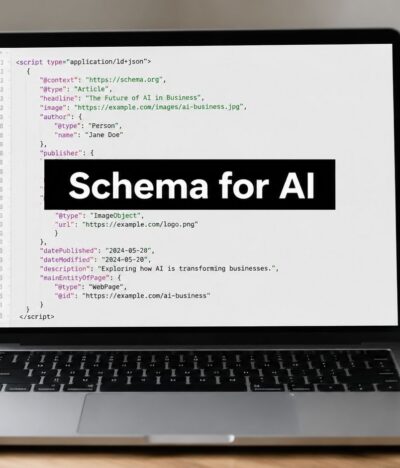
- Implement organization-level schema. Start with Organization or LocalBusiness where appropriate. Add the business name, website, core services, and other identity details consistently.
- Use page-level schema deliberately. FAQPage, Article, Product, Service, and Breadcrumb markup can help clarify page purpose when used accurately.
- Write headings that carry meaning. "Our Process" is weaker than "How Our Managed IT Support Onboarding Works."
- Break content into retrievable sections. Short blocks, descriptive subheads, and direct answers make passage-level retrieval easier.
- Build explicit Q&A blocks. These help both human readers and answer engines locate concise responses.
- Strengthen crawl clarity. Internal links should reinforce topic relationships instead of scattering authority randomly.
- Reduce friction. Slow, messy, or confusing pages undermine trust for users and search systems alike.
A lot of businesses underinvest here because schema and content architecture don't feel glamorous. But they often determine whether a model can identify and reuse your information accurately.
Strategic authority building
Technical clarity gets you parsed. Authority gets you chosen.
This part of the work is less mechanical and more strategic.
Build topic depth, not just page inventory
Publishing one page per keyword family doesn't create authority. It creates sprawl.
A stronger approach is to build a clear topic system. Create a core commercial page, then support it with buying guides, implementation FAQs, comparison content, definitions, and common-problem articles. Each asset should reinforce the others.
Create answer-ready content
Many articles still hide the useful insight beneath long intros and generic filler. That doesn't work well in AI search.
Aim for answer nuggets. These are concise passages that define a concept, explain a trade-off, or resolve a common question in plain language. They should be accurate enough to quote and specific enough to stand on their own.
The best AI-visible content often looks simple. That's because clarity is easier to extract than cleverness.
Earn corroboration beyond your website
AI visibility is rarely built from on-page work alone. Brands that get cited consistently usually have a wider footprint of supporting signals. That can include industry mentions, expert commentary, recurring branded search interest, founder visibility, and strong profile consistency.
That broader authority work often overlaps with content distribution. If your team is also trying to scale publishing across channels, workflows that automate social media content creation can help repurpose useful insights into formats that generate more brand familiarity and reference points over time.
A simple operating model for teams
For many businesses, the challenge isn't knowing what to do. It's sequencing the work.
A practical order looks like this:
- Audit core pages first. Fix the pages closest to revenue before expanding the content library.
- Define entity signals. Standardize brand descriptions, services, expertise statements, and author presentation.
- Add schema and restructure weak pages. Improve clarity before publishing more volume.
- Fill obvious topic gaps. Cover the questions buyers ask at each stage.
- Support with authority building. Strengthen mentions, references, and off-site consistency.
If your website itself needs restructuring to support that roadmap, this resource on a 6-step design process for modern websites is useful because design, content hierarchy, and AI readability now affect each other directly.
A helpful video overview can also sharpen the big picture before a team starts implementation:
Measuring Success in the Age of AI Search
The old SEO dashboard is still useful, but it no longer captures the full outcome. Rankings can improve while clicks flatten. Traffic can decline while brand influence inside AI results grows. That's why many teams misread what's happening.
If the future of SEO with AI is about visibility inside answers, measurement has to reflect that.
What to track now
The better question isn't "Did traffic go up?" It's "Did our brand become easier for AI systems to cite, summarize, and recommend?"
That shifts attention toward signals such as:
- Brand presence in AI answers across important commercial and informational prompts
- Citation frequency when AI tools summarize topics in your category
- Brand mention quality in summaries, comparisons, and product recommendations
- Knowledge consistency across brand descriptions and service explanations
- Lead quality from organic discovery rather than raw session volume alone
For teams trying to develop a modern reporting model, PeerPush's LLM SEO report is a useful read because it reflects how operators are starting to think beyond standard ranking reports.
Measuring Success Shifting from SEO KPIs to AEO Metrics
| Metric Focus | Traditional SEO KPI (Then) | AI Visibility Metric (Now) |
|---|---|---|
| Discovery | Keyword rankings | Presence in AI Overviews and conversational answers |
| Traffic | Organic sessions | Unclicked visibility and branded demand after AI exposure |
| Page performance | Click-through rate from SERPs | Whether pages supply extractable answer passages |
| Authority | Backlink totals | Brand mentions, citations, and trusted-entity recognition |
| Content success | Pageviews per article | Inclusion in summaries, comparisons, and answer blocks |
| User journey | Last-click organic attribution | Assisted influence across longer, AI-mediated research paths |
Old wins can hide new problems
A page can rank well and still fail in AI search if the answer is buried, the authorship is weak, or the page doesn't establish enough context for extraction.
The reverse is also true. A page might not generate the same click volume it once did, yet still shape demand because AI systems keep citing it or paraphrasing its information. That's why businesses need a broader AI visibility dashboard, not just a legacy SEO report.
If you're assessing where your brand stands today, an AI visibility score framework can help turn a vague concern into a more usable benchmark.
Conclusion Building a Future-Proof Digital Presence
The future of SEO with AI isn't about abandoning the fundamentals. It's about applying them to a new interface where recommendation, citation, and machine understanding matter as much as rank position.
That requires a different standard of execution. Businesses need cleaner information architecture, stronger schema, clearer service explanations, better authorship signals, and content that answers real questions without fluff. Those aren't gimmicks. They're the building blocks of a digital presence that both humans and AI systems can trust.

Brand authority is the durable advantage
A frequently missed point is that AI visibility is increasingly a brand-authority problem, not just a keyword problem. Major guidance now emphasizes that brands need to be cited in AI summaries, which shifts optimization from ranking pages to becoming a trusted entity in the AI's knowledge base. It also means brands need structured data, top-tier rankings, and answer-ready content to stay visible even when users never reach the site (Salesforce on the future of SEO).
That is the durable opportunity.
Plenty of tactical SEO work will still matter. Technical fixes still matter. Strong service pages still matter. But the businesses that hold visibility over time will be the ones that build a coherent, trustworthy, machine-readable brand footprint.
A future-proof search strategy doesn't chase every interface change. It creates a brand that any interface can understand.
The businesses that act earlier will have less to unwind later
Companies that wait usually accumulate more content debt. They publish more thin pages, create more duplication, and make the eventual cleanup harder. Companies that adapt now can shape their site around clarity and authority before the mess compounds.
That is why this transition is worth treating as a strategic project, not a side experiment. Better structure improves search visibility. Better authority improves conversion confidence. Better answers improve user experience regardless of channel.
Frequently Asked Questions about AI and SEO
Do keywords still matter in AI search
Yes. Keywords still help search engines and AI systems understand relevance. But they aren't enough on their own. The stronger approach is to use keywords inside pages that also provide clear structure, topic depth, entity consistency, and direct answers.
Is website traffic going to disappear
No. Websites still matter because buyers need places to validate, compare, and convert. What's changing is that some discovery and early evaluation now happen inside AI-generated answers before the click.
Does a small business need to care about AEO right now
Yes, especially if competitors are still relying on older SEO habits. Smaller firms can often move faster by cleaning up service pages, adding structured data, tightening brand consistency, and publishing useful answer-focused content.
What kind of content works best for AI visibility
Content that explains one thing clearly. Service explainers, pricing context, comparison pages, implementation FAQs, definition pages, and expert-authored guides tend to be more useful than generic blog posts written only to target broad keywords.
Can AI visibility be improved without publishing huge amounts of content
Yes. Most businesses need better content design before they need more content volume. Tightening page structure, clarifying claims, improving schema, and filling a few high-value topic gaps often does more than publishing a large batch of thin articles.
How can Raven SEO help with the transition from SEO to AI visibility
Raven SEO helps businesses evaluate how well their sites are prepared for AI discovery, answer extraction, and citation. That includes technical SEO, AI-ready web design, structured data planning, and a practical roadmap for building sustainable search visibility.
If your business wants a clearer picture of how visible it is in AI-powered search, Raven SEO can help you assess the gap between where your site is now and what answer engines need to trust and cite it. Start with a no-obligation consultation and get a practical view of your current AI visibility, technical readiness, and authority priorities.