
The days of simply ranking webpages for clicks are numbered. The new world of AI search engine optimization strategies is about becoming an authoritative source that AI Overviews and conversational assistants cite directly. It’s a fundamental change in focus—away from chasing blue links and toward earning direct mentions in the answers AI provides.
This educational guide makes it easy to understand how to adapt. Your new goal is to become the encyclopedia entry that AI assistants quote.
From Clicks to Citations: The New Goal of SEO
The ground is shifting under our feet. For years, the SEO game was about climbing the rankings to maximize clicks. Now, we're moving into an era of Answer Engine Optimization (AEO), where the ultimate prize is becoming a citable, trusted source for AI.
Think of it this way: traditional SEO was like creating a map so customers could find your store. AEO is about becoming the verified information source that the mapmaker—the AI—quotes directly to travelers before they even ask for directions. To thrive here, your brand’s digital voice must be clear, authoritative, and structured for machines to understand. If you're new to the technology driving this change, this essential guide to generative AI is a great starting point.

Why Citations Matter More Than Ever
AI summaries and conversational answers are rapidly reshaping how people find information. While the global SEO services market is projected to grow from $83.98 billion in 2026 to $148.86 billion by 2030, the strategies that lead to success are changing dramatically.
With reports showing that around 50% of Google searches already feature AI-generated summaries, the battle for visibility has moved. It's no longer just about getting a click; it's about being featured inside the AI Overview itself.
The new goal is not just to be found by search engines, but to be quoted by them. That is why an AI-ready SEO strategy is becoming a core digital asset for national brands, local service firms, and ecommerce businesses alike.
Practical AI search engine optimization now centers on three core pillars:
- Brand Authority: Proving you are a trustworthy expert in your field.
- Clear Topical Coverage: Creating content that is comprehensive and easy for both people and machines to understand.
- Structured Data: Using a specific code vocabulary that helps machines parse your information quickly and accurately.
To stay visible, companies need content with concise headings, precise language, and schema markup that clarifies exactly who you are and what you do. At Raven SEO, we specialize in building this foundation. You can learn more about making your website machine-readable in our guide to getting started with structured data.
Why Your Brand Must Be AI-Ready Now
If you think you can afford to wait and see how AI search plays out, think again. Sitting on the sidelines is no longer a strategy—it's a liability. Generative AI is already changing how your customers find information, and the brands that move now are building a lead that will soon be impossible to catch.
The shift isn't just theoretical; it's happening at a staggering pace. We're already seeing 15 million U.S. users turning to generative AI for answers, while nearly half of U.S. marketers have integrated AI tools into their workflows. This rapid adoption has created an entirely new discovery channel, with one report showing AI-driven search traffic has exploded by an incredible 527%.
Beyond Your Own Website
Here’s the catch: AI doesn’t play by the same rules as traditional search engines. These systems look for much more than just keywords on your website. They're hunting for content with deep semantic meaning, direct answers to complex questions, and—most importantly—signals of trust from all over the web.
Think about that for a moment. In key sectors like consumer goods and financial services, over 65% of sources fueling AI-generated answers come from third-party publishers, user-generated content, and affiliate sites. It's not just about what you say on your own domain anymore. A crucial part of getting AI-ready is understanding the current rules of engagement, as detailed in this resource from Humantext.pro on AI content penalties.
Building a Holistic Footprint
This data points to a new reality for brands: you have to build a holistic digital footprint. To be cited consistently by AI, you need a strong presence built on trusted mentions, glowing reviews, and earned media. These third-party signals have become the new currency for establishing the authority that AI models crave.
Think of your brand's authority as its digital reputation. AI systems act like fact-checkers, looking for consensus across multiple trusted sources before they recommend you.
So, where do you begin? Start by publishing genuinely authoritative content that answers real questions. Use schema markup to clearly define your brand as an entity for search engines. And make sure your site’s code is clean and easy for crawlers to understand. This entire approach directly supports building strong E-E-A-T (Experience, Expertise, Authoritativeness, and Trustworthiness), a concept we explore in our guide to improving E-E-A-T for AI search. The time for awareness has passed; it's time for action.
The Three Pillars of AI Search Optimization
Navigating the future of search doesn't have to be a guessing game. At Raven SEO, we've seen firsthand how the landscape is shifting, and we've developed a proven framework for success in the age of AI. It’s built on three logical and actionable pillars.
Think of these as the essential supports that elevate your brand from being merely present online to becoming a citable, trusted authority in the eyes of AI. This framework simplifies your AI search engine optimization strategies by honing in on what truly matters to today's machine learning models and large language models (LLMs).
Let’s break down each pillar.
The First Pillar: Brand Authority
Brand Authority is, quite simply, your digital reputation. It’s the sum of all the signals across the web that tell AI systems you are a trustworthy and credible expert in your field. This goes far beyond the content on your own website.
We're talking about mentions in industry publications, glowing customer reviews, discussions on forums, and links from other respected sites. Imagine an AI assistant trying to recommend a service. It will behave like a diligent researcher, looking for consensus across many different sources. If your brand is consistently mentioned as a leader, the AI gains confidence in citing you as a reliable answer.
The visual below illustrates why adopting this kind of AI-readiness is no longer optional.
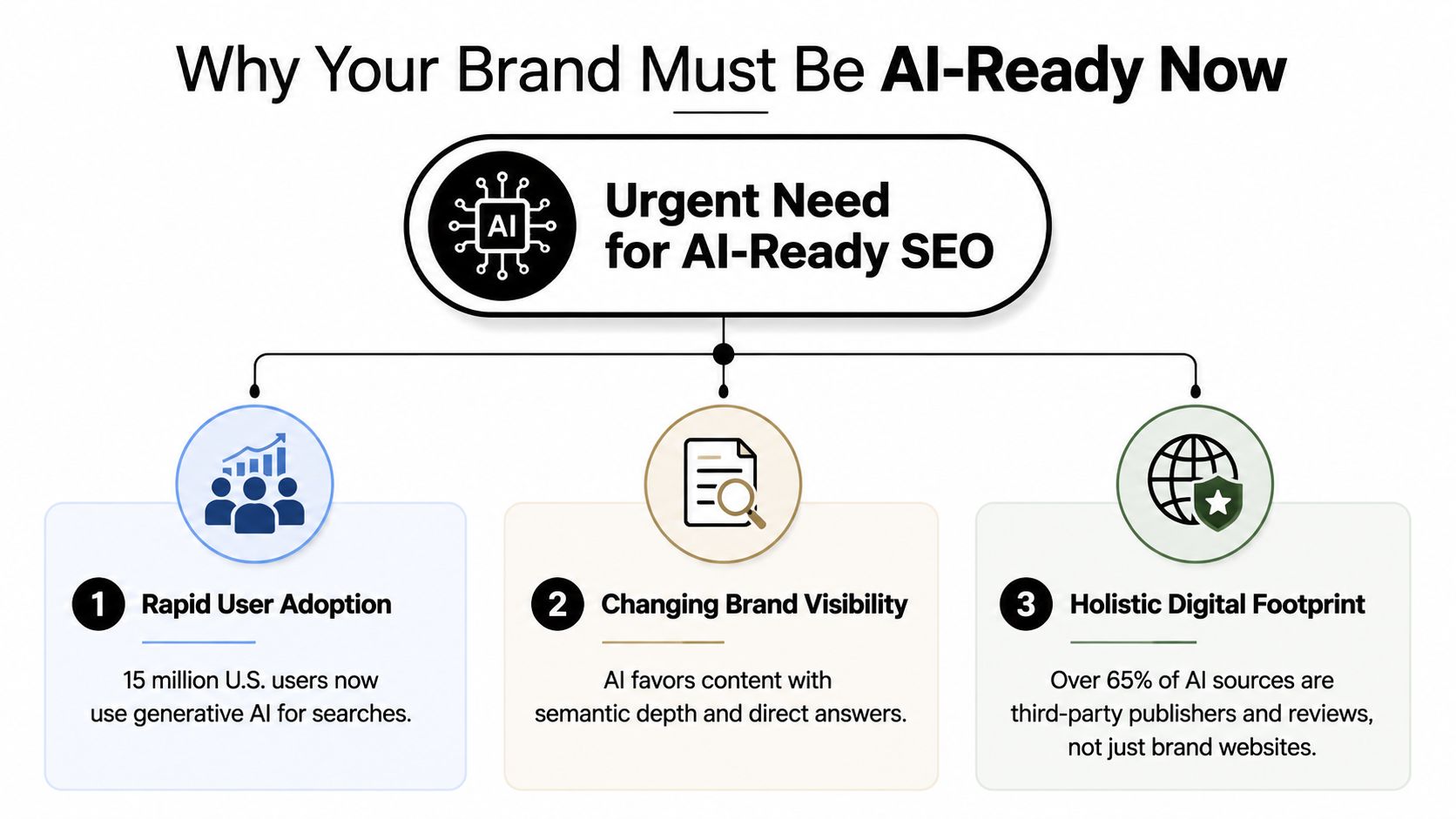
With AI now pulling over 65% of its information from third-party sources, building a sterling reputation everywhere you appear online is non-negotiable.
The Second Pillar: Structured Data
If Brand Authority is your reputation, Structured Data is the universal language that communicates your expertise directly to machines. It’s how you turn your website from a messy, disorganized library into a perfectly indexed digital file cabinet where every piece of information is clearly labeled.
By using a specific vocabulary known as Schema markup, you can explicitly tell AI systems:
- Who you are: Your official company name, location, and contact information.
- What you do: The specific products or services you offer, including features and pricing.
- Why you’re an expert: Your credentials, awards, customer reviews, and testimonials.
This clean, technical foundation makes it effortless for AI to understand, process, and ultimately trust the information on your site.
The Third Pillar: Content Verifiability
The final pillar holding everything up is Content Verifiability. This is the factual bedrock of all your information. For an AI to confidently cite you, it must be able to confirm that what you're saying is accurate, up-to-date, and supported by evidence.
Content Verifiability isn’t just about being truthful; it’s about making your truth easy to check. This means including clear sourcing, fresh publication dates, and specific data points that an AI can cross-reference against other trusted sources.
Together, these three pillars—Brand Authority, Structured Data, and Content Verifiability—form a powerful and logical framework. This is the new paradigm of search, moving from chasing clicks to earning citations.
The table below breaks down this fundamental shift in thinking.
Traditional SEO vs AI Visibility (AEO)
| Factor | Traditional SEO (Chasing Clicks) | AI Visibility (Earning Citations) |
|---|---|---|
| Primary Goal | Rank #1 in search results to win the click. | Become a cited source within AI answers. |
| Key Metric | Organic Traffic, Keyword Rankings | Brand Mentions, Answer Engine Citations |
| Content Focus | Long-form content targeting keywords. | Factual, verifiable, easily parsed content. |
| Technical Focus | On-page optimization, link building. | Structured Data (Schema), entity recognition. |
| Authority Signal | Backlinks from any high-DA site. | Topical authority, expert consensus, real-world reputation. |
By mastering this new approach, you prepare your business not just to compete, but to become a definitive voice in the new era of generative search. This is the core of the practical and effective strategy we champion at Raven SEO.
How to Build a Machine-Readable Footprint
This is where the rubber meets the road, moving your AI search engine optimization strategies from a high-level concept to on-the-ground execution. If you want AI to cite you as an authority, you first need to speak its language. The secret is making your brand, products, and services crystal clear to machines.
That language is structured data, specifically Schema markup. Think of it as creating a detailed, digital business card that translates your website's content into a clean, organized format that AI can instantly consume, trust, and reference. Without it, AI is left guessing. With it, you're handing the machine a perfectly legible fact sheet about your business.

Marking Up Your Digital Assets
Getting started with Schema doesn't need to be some monumental technical headache. The goal is simple: label your most important business assets so AI can understand them with complete confidence. For most businesses, that means focusing on three core pages first.
- Your 'About Us' Page: Use
OrganizationSchema to clearly define your official business name, logo, address, social profiles, and founding date. This tells AI systems, "This is exactly who we are." - Your Product Pages: Implement
ProductSchema. This allows you to detail each item’s name, price, availability, and even pull in customer reviews. It clarifies, "This is exactly what we sell." - Your Service Pages: Apply
ServiceSchema to outline what you do, the specific areas you cover, and how clients can hire you. This spells out, "This is exactly what we do."
By structuring this core information, you make it incredibly easy for an AI to grab accurate, reliable details for its answers instead of just making an educated guess.
Turning Ambiguity into Authority
Let’s look at a real-world example. A typical service page might say, "We offer fast and reliable plumbing repairs for homes and businesses." An AI has to infer the details from that sentence.
Schema markup removes all the guesswork. You can use the Service type to define the offering, areaServed to specify your location, and provider to link it all back to your official Organization entity. It's the difference between a vague description and a verifiable fact.
By translating your website content into structured data, you build a machine-readable footprint. This is the single most effective way to ensure AI systems can consume, trust, and cite your information accurately.
This is a central part of the AI-Ready services we offer at Raven SEO. We focus on building your digital foundation not just for today's search engines, but for the future of AI-powered discovery. Of course, adding this data is only effective if search engines can find it. You can learn more about how this works in our guide on how to create an XML sitemap, which ensures crawlers can efficiently access your newly structured content. Building this footprint is a methodical process, but it’s the most critical investment you can make in your brand’s future online.
How to Measure Your AI Visibility
So, how can you tell if your efforts in this new world of AI search engine optimization are actually paying off? If you're still obsessing over traditional keyword rankings, you're essentially navigating with an outdated map. The new terrain of AI-powered search demands a completely different set of tools for measuring what success looks like.
It's time to stop watching your site inch from position three to two. The key performance indicators (KPIs) that matter now are far more meaningful: think citation share, inclusion in answers, and the overall quality of your brand's presence within AI-generated responses. This isn't a small adjustment—it's a complete rethinking of how we define performance.
Moving Beyond Rankings
The most significant shift is how we measure performance. We're moving away from simple ranking positions and toward metrics like citation share and the quality of branded mentions. According to McKinsey, only 16% of brands are systematically tracking their AI search performance, even though their results can lag behind traditional SEO by 20% to 50%.
This gap represents a massive opportunity for businesses that get ahead of the curve. Investing early in AI visibility audits and building a strong entity-based strategy is no longer optional.
Businesses that cling to outdated SEO tactics risk becoming invisible in conversational search. Meanwhile, those that build an “AI-ready” digital footprint will earn recurring citations across LLMs and AI Overviews, securing their place in the new search landscape.
Your High-Level AI Readiness Checklist
How do you start tracking these new metrics? While a deep dive requires specialized tools, you can get a good sense of your starting point with a high-level audit. This checklist will help you assess your current AI readiness.
- Structured Data Implementation: Have you used Schema markup to clearly define your organization, products, and services? This is the most direct way to speak an AI’s language.
- Content Freshness and Verifiability: Is your most important content updated regularly? Does it feature clear publication dates and cite its sources, making it easy for an AI to verify the facts?
- Brand Signal Strength: Are you tracking your brand mentions across the web? This goes beyond your own site to include third-party reviews, news articles, and industry forums.
This initial check can quickly highlight critical gaps in your digital presence. For a more detailed analysis, you need a comprehensive, data-driven audit. We invite you to learn how Raven SEO can help you measure and improve your performance with our proprietary Raven SEO AI Visibility Score. We'll help you map out a clear path forward in this new landscape.
Your Practical Roadmap to Generative Search Success
Let's pull all these concepts together. Shifting your focus to AI-driven search doesn't mean you have to throw out everything that’s worked in traditional marketing. It's more of a strategic pivot—channeling your efforts down a clear, actionable path to become the kind of trusted, citable authority that AI models love to quote.
This is your roadmap to generative search success, built on three foundational pillars: Brand Authority, Structured Data, and Content Verifiability. Think of it as a sustainable approach designed for long-term growth as AI continues to reshape how people find information.
Your Path to AI Visibility
This journey starts by putting the core AI search engine optimization strategies we've discussed into practice. This isn't a one-and-done checklist, but an ongoing cycle of improvement that constantly reinforces your digital presence.
Build Your Brand Authority: You need to proactively manage your reputation all across the web. This means encouraging customer reviews, getting mentioned in industry publications, and showing up in relevant online discussions. Your authority is simply the sum of all the signals that prove you're a trustworthy expert in your field.
Structure Your Data for Machines: Go through your core pages—your homepage, product pages, and service pages—and implement Schema markup. This simple act of translation turns your content into a clean, machine-readable fact sheet that AI systems can understand and trust instantly.
Create Verifiable Content: Anchor everything you publish in facts, data, and hard evidence. Use clear sourcing, add fresh dates, and include specific details. AI models are built to prioritize information they can easily cross-reference, which makes your content much more "snippable" for use in generated answers.
This roadmap isn't a temporary fix; it's a strategic framework for future-proofing your brand's digital presence. Every step you take builds a more resilient and visible foundation for the new era of AI-powered discovery.
At Raven SEO, we act as your strategic partner on this journey. We don't just optimize for search engines; we build the digital infrastructure that makes your brand the definitive answer. For a deeper dive into optimizing for this new paradigm, we recommend reading our guide on how to adapt your SEO for generative AI search.
Ready to start building a dominant presence in the new era of search? Schedule your no-obligation consultation with Raven SEO today.
Frequently Asked Questions About AI SEO
As we've explored this fundamental shift from traditional search to AI-powered answers, a few key questions always come up. Let's tackle them head-on to clear up any confusion and give you a firm footing for what comes next.
What is the most important first step for AI SEO?
If you only do one thing, start with structured data. Implementing Schema markup on your core pages is the most powerful first step. It translates your key business information into a clear, machine-readable format, making it easy for AI systems to understand and trust you. This technical foundation is critical for becoming a citable authority in AI search.
How does AI change keyword research?
It shifts the focus from short-tail keywords to long-tail conversational queries. Instead of just targeting "plumbers in Miami," your AI search engine optimization strategy should address full questions like "how much does it cost to fix a leaking pipe in Miami?" Content needs to provide direct, factual answers to these complex questions to be featured in AI summaries.
Will AI search make my website's traffic disappear?
Not necessarily, but it will change its nature. While zero-click searches may increase as AI provides direct answers, the traffic that does come to your site will likely be more qualified and higher-intent. Users will visit your site for deeper information, to verify AI-generated answers, or to complete a transaction. The goal is to become the trusted source that AI and users turn to.
Do backlinks still matter for AI SEO?
Yes, but the context is more important than ever. High-quality backlinks from topically relevant and authoritative sources are powerful signals of trust for AI systems. They act as third-party endorsements that verify your expertise. A diverse and relevant link profile is a key component of building the brand authority that AI models look for when vetting sources.
Ready to secure your brand's future in the age of AI? Contact Raven SEO to schedule your no-obligation consultation and start building a dominant presence in the new era of discovery. Visit us at https://raven-seo.com.