
AI search has already changed what visibility looks like. AI Overviews now appear in 84% of Google search results, while independent websites have lost 60% of their Google traffic over the past two years, according to this industry report on SEO vs generative engine optimization. That's not a minor interface update. It's a structural shift in how people discover brands.
The old playbook focused on rankings, sessions, and click-through rate. That still matters, but it no longer tells the whole story. Today, a user can ask Google, ChatGPT, Perplexity, or another answer engine a complex question and get a synthesized answer without ever opening ten blue links. If your brand isn't part of the answer, your ranking report can look fine while your visibility declines.
That's where Generative AI search engine optimization comes in. Some call it AEO. Some call it GEO. The label matters less than the outcome. Your content needs to be understandable, extractable, trustworthy, and worth citing.
At Raven SEO, this shift changes the strategic question. It's no longer just “How do we rank?” It's “Why would an AI system choose to reference us?”
The End of Search as We Know It
Search hasn't disappeared. It has changed shape.
When AI-generated summaries sit above traditional listings, brands can't rely on legacy SEO habits alone. The model that worked for years, publish more pages, chase more keywords, win more clicks, now collides with a new reality. Users increasingly accept a synthesized answer as the search experience itself.
That's why the move from SEO to AI Engine Optimization, often grouped under AEO or GEO, matters so much. It isn't a replacement for technical SEO, content strategy, or authority building. It's a reordering of priorities. The page isn't valuable only because it ranks. The page is valuable because an AI system can read it, trust it, and cite it in context.
Why old reporting misses the real problem
A traffic drop usually gets blamed on rankings, competitors, or seasonality. In many cases now, the issue is simpler. The answer got consumed before the click ever happened.
Teams that monitor only clicks can miss what AI systems are doing with their content. That's one reason brands are starting to rethink how they collect and analyze web data, especially when dynamic pages, bot defenses, and rendering issues block visibility. For marketers doing technical research into crawler behavior, this guide on how to bypass anti bot protection is a useful reference for understanding the barriers automated systems encounter.
What changed: Search visibility is becoming citation visibility.
Traditional SEO still provides the foundation. In fact, a lot of AI discovery still depends on pages that already perform well in organic search. But the winner in this environment isn't always the page with the broadest keyword targeting. It's often the page with the clearest answer, the strongest context, and the most credible external signals.
If your team is still treating AI search as a side topic, start with a broader view of the future of SEO with AI. The shift is already underway.
The Shift from Clicks to Citations
Generative Engine Optimization changes the core success metric. As IMD explains in its overview of generative engine optimization, GEO redefines the success metric from ranking positions to whether AI systems cite, reference, and recommend content, challenging the traditional $80 billion SEO industry model.
That's the mental reset most businesses need.
Traditional SEO is like winning a billboard placement on a busy highway. You compete for position, hope the user notices, and try to earn the click before someone else does. AEO is closer to becoming a trusted source in an encyclopedia. Your value comes from being the reference the system pulls into the answer itself.
What answer engines are really doing
AI Overviews, ChatGPT, Perplexity, and similar systems don't behave like a standard list of links. They assemble responses. They compress multiple sources into a single output. Sometimes they cite clearly. Sometimes they paraphrase and point to a handful of sources. Either way, the user often gets what they need before visiting a website.
That changes the target.
Instead of asking only:
- Can we rank for this query?
- Can we improve click-through rate?
- Can we publish more pages?
You also need to ask:
- Can an AI system extract our answer cleanly?
- Does our page define entities and relationships clearly?
- Do other credible sources reinforce what we say?
SEO vs AEO A Paradigm Shift
| Aspect | Traditional SEO | AI Engine Optimization (AEO) |
|---|---|---|
| Primary goal | Earn clicks from search listings | Earn citations and references in AI answers |
| Core metric | Rankings, impressions, organic traffic | Citation frequency, answer inclusion, share of voice |
| Content style | Keyword-targeted pages | Answer-first, extractable, structured content |
| Authority signal | On-page relevance and backlinks | On-page clarity plus external validation and citation-worthiness |
| User journey | Search results to website visit | Question to synthesized answer, sometimes without a click |
| Technical priority | Crawlability, indexation, page quality | Crawlability, machine readability, structured entities |
| Winning asset | The page that ranks | The page the model trusts enough to cite |
A ranked page can still lose if the AI answer uses someone else as the source.
What this means in practice
AEO doesn't kill SEO. It raises the standard.
You still need strong pages, clean architecture, and solid technical health. But rankings are no longer the finish line. They're the entrance ticket to a new layer of competition where citation matters more than placement for many informational queries.
The brands gaining ground now are building content for both humans and machines. They answer full questions, reduce ambiguity, and make key facts easy to verify. They don't just chase attention. They earn selection.
Structuring Your Data for AI Discovery
Most businesses treat schema markup as a nice technical extra. In AI search, that's a mistake.
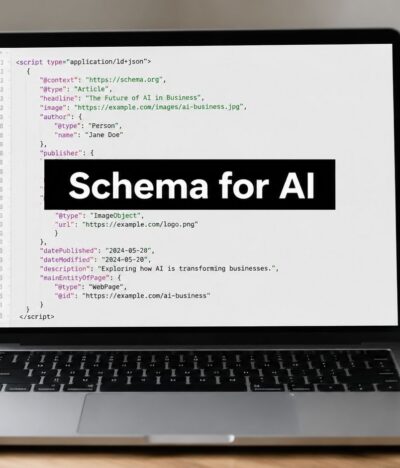
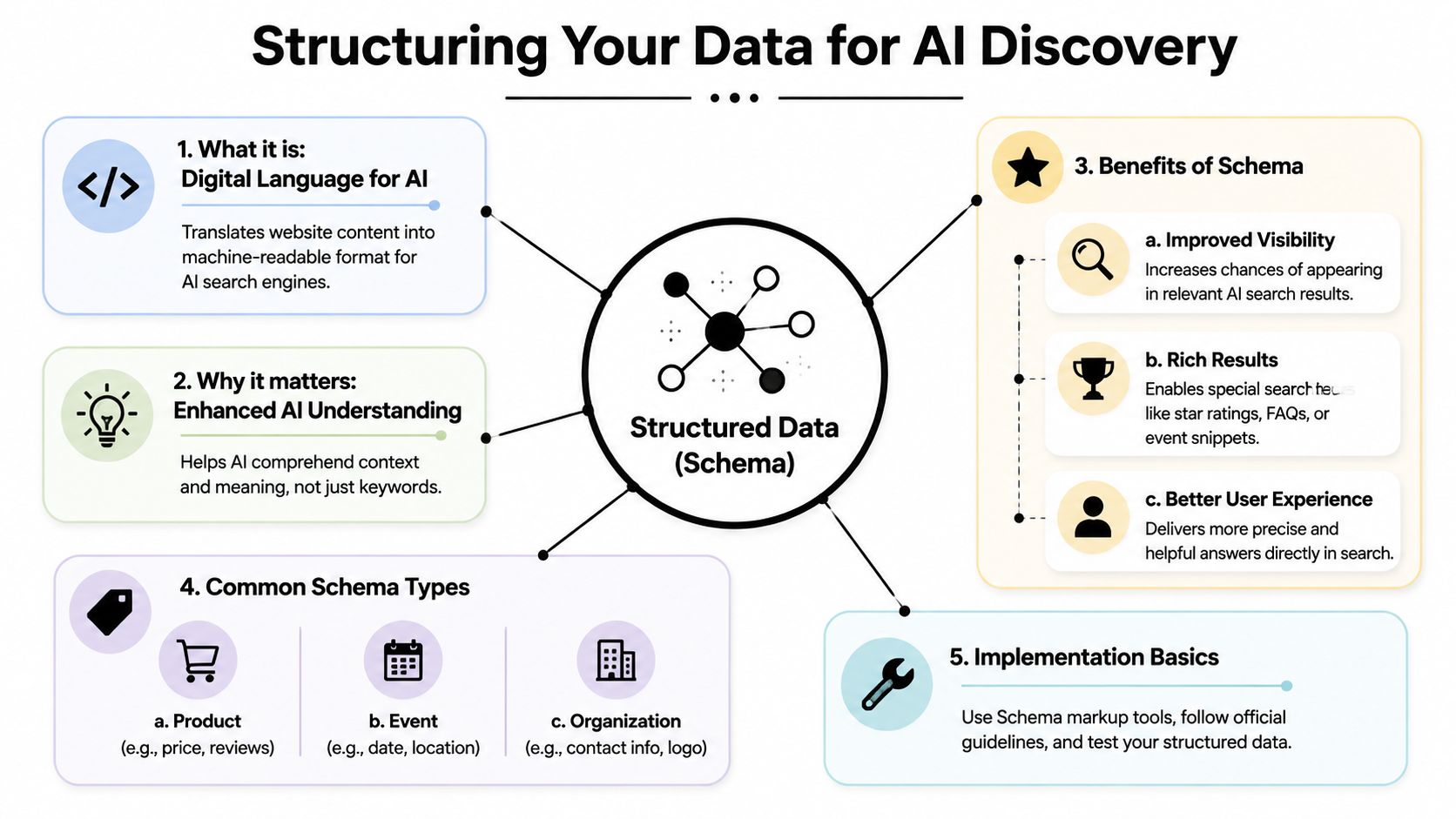
Structured data is how you turn your site from a collection of web pages into a system of clearly defined entities. Think of it as a digital resume your business publishes for machines. It tells AI systems who you are, what you offer, who created the content, how pages relate to each other, and where key facts belong.
Why JSON-LD matters more than most teams think
According to iPullRank's technical SEO guidance for AI search, prioritizing JSON-LD Schema markup with explicit @graph relationships and unique @id anchors is a critical technical requirement because it helps AI agents map entity relationships and assign unique identifiers, significantly increasing citation probability in LLM responses.
That sounds technical, but the strategy is straightforward.
When you define:
- Organization for your company
- Person for your authors or experts
- Product or Service for your offers
- Article for your educational content
- WebSite for the site-level entity
you reduce guesswork. AI systems don't have to infer everything from headings, paragraphs, and navigation labels. You give them a cleaner map.
What good schema actually does
Strong structured data helps AI systems understand relationships such as:
- Who published the page
- Which expert is associated with the content
- What service or product the page describes
- How one page connects to another
- Which facts should be interpreted as brand-level information
That's especially important on service pages, product collections, author pages, location pages, and deep educational content.
Practical rule: If a machine has to guess who wrote the page, what entity it describes, or how it connects to your business, you've already made citation harder.
Schema also works best when the visible page supports it. Markup can't save weak content. If the page is vague, generic, or overloaded with JavaScript that prevents easy parsing, AI systems still struggle.
What to fix first
Most sites don't need a massive structured data project on day one. They need the right entities on the right pages.
Start here:
- Homepage: Define the Organization and WebSite entities clearly.
- About page: Connect founders, executives, or specialists through Person schema.
- Service and product pages: Mark up the core offer with accurate descriptive fields.
- Articles and guides: Use Article markup tied back to your brand and authors.
- FAQ and support content: Format answers so the page works without schema dependency.
If your team also needs a plain-English primer before implementation, this explanation of what structured data means in SEO is a good starting point.
For content teams, there's a related operational benefit. Once your entities and page relationships are clear, prompt-writing and content design become more disciplined too. That makes resources like an AI prompt engineering guide useful, not for replacing strategy, but for helping teams create more precise, answer-oriented drafts.
Building AI-Perceived Brand Authority
Technical readiness gets you into consideration. Authority gets you chosen.
That's the part many generative AI search engine optimization guides miss. They spend pages on schema, headings, and answer formatting, then ignore the reality that AI systems often prefer third-party validation over brand-owned claims.

Why earned media carries more weight
Recent arXiv research on AI visibility and earned media bias found that generative AI systems exhibit a systematic, overwhelming bias toward third-party authoritative sources rather than content a brand creates itself. The practical consequence is hard to ignore. Standard publishing on your own site often won't be enough without parallel reputation engineering.
Here, AI-perceived authority holds significance.
AI systems look for corroboration. They don't just ask whether your page says you're credible. They look for whether trusted ecosystems treat you as credible. That can include industry publications, associations, expert roundups, trade press, podcasts, reviews, Reddit discussions, LinkedIn conversations, and reference-style pages that place your brand in a broader context.
What counts as a citable authority asset
Not every content asset builds authority equally. Product pages rarely do it on their own. Thin blog posts won't. Self-promotional thought leadership usually won't either.
The assets that tend to travel further are more defensible:
- Original research summaries: Especially when the methodology and source material are transparent.
- Expert-authored explainers: Articles tied to named specialists, not anonymous brand voice.
- Comparison content: Neutral, useful, and specific enough to be referenced.
- Glossaries and definitions: Clean, factual entries that answer one question well.
- Industry commentary in earned channels: Interviews, quotes, guest commentary, and referenced mentions.
What doesn't work
A lot of teams still overinvest in volume.
They publish dozens of keyword-targeted articles on their own site, use vague author bios, skip expert review, and expect AI systems to reward them for topical breadth. That model already underperforms in many categories because AI systems can find cleaner, more trusted summaries elsewhere.
If no one credible mentions your brand outside your website, AI systems have less reason to treat your site as a source worth lifting into an answer.
This is also where modern E-E-A-T work becomes more tangible. Expertise has to be visible. Experience has to be attributable. Trust has to exist beyond the domain itself. For a deeper look at that layer, review how E-E-A-T applies to AI search.
A short explainer on the broader mechanics can help frame the issue before execution:
The strategic trade-off
Authority building is slower than page publishing. It's also harder to outsource badly.
You can buy content production. You can't fake durable authority for long. That means businesses need a blended approach:
- maintain accurate, structured owned content
- build expert signals into authorship and review
- create material others want to cite
- invest in mentions and discussions outside the site
That's a strategic pivot, not a formatting tweak.
A Practical Roadmap to AI Visibility
Most companies don't need a complete rebuild. They need a sequence.
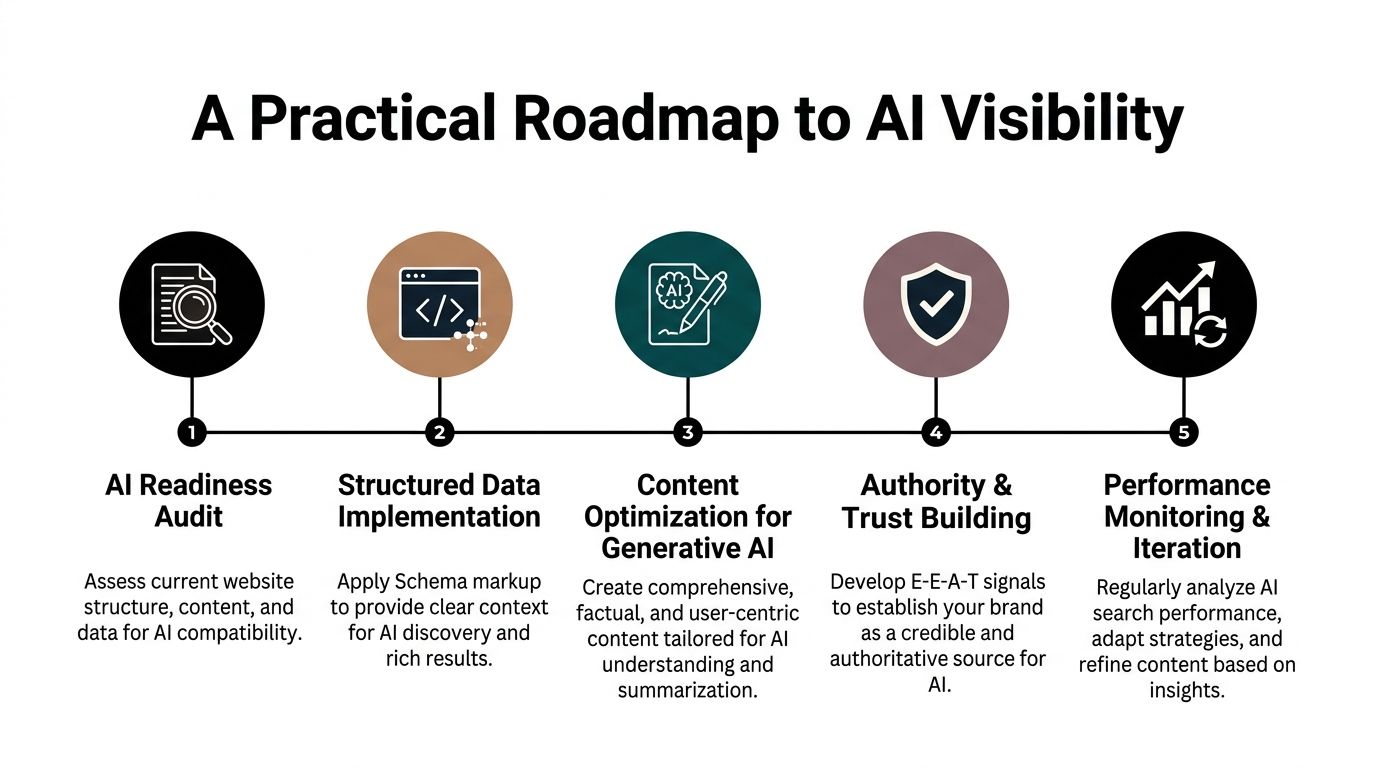
The fastest gains usually come from fixing the basics in the right order. According to Digital Agency Network's GEO statistics roundup, structural optimizations such as adding schema and formatting specific answers can improve AI citations within 30 to 60 days, while tactical content changes can yield visibility gains in 30 to 45 days. That's much faster than the timeline many teams associate with traditional SEO work.
Audit
Start by assessing how your brand appears in AI-generated answers today.
Check branded queries, high-intent informational searches, product or service comparison prompts, and category-defining questions. Look for whether your domain is cited, whether third-party sources dominate, and whether your owned pages answer the question directly.
Your audit should include:
- Content extractability: Can a model lift a concise answer from the page?
- Entity clarity: Is the business, author, product, or service explicitly defined?
- Rendering risk: Does critical content depend on client-side JavaScript?
- Authority gap: Are external sources discussing your brand accurately?
For organizations that want a formal starting point, an AI readiness assessment gives teams a framework to evaluate structure, visibility, and authority before making changes.
Structure
This phase is technical, but not abstract.
Apply JSON-LD where it matters. Tie authors to articles. Tie services to the organization. Make sitewide entity relationships coherent. Remove ambiguity from title tags, headings, page intros, and internal linking.
A few high-impact fixes often matter more than a large backlog:
- Clean entity definitions: Make sure the site consistently identifies the same brand, author, and offer.
- Answer-first formatting: Put the direct response near the top of the relevant page.
- Machine-readable architecture: Reduce reliance on layouts or components that hide core content from crawlers.
Create
Now create assets designed to be cited, not just indexed.
That usually means content that answers real questions in plain language, includes useful comparisons, and presents facts in a format AI systems can lift cleanly. Tables, ranked lists, FAQ blocks, concise definitions, and clearly segmented sections all help.
The strongest AEO content often has these traits:
- Specificity: It answers one question decisively.
- Verifiability: It includes attributable facts rather than vague claims.
- Neutral usefulness: It informs first and sells second.
- Named expertise: It shows who is responsible for the information.
This is the point where one toolset can support another. A business may use CMS schema plugins, editorial workflows, analytics dashboards, and AI testing prompts together. Some teams also use service partners to manage the audit and implementation process. Raven SEO is one option for brands that need support across AI-ready web design, technical SEO, and schema-focused execution.
Amplify
Publishing isn't distribution.
If you want stronger AI-perceived authority, the asset has to be seen, referenced, discussed, and reused outside your own site. That means PR, expert outreach, contributor placements, review generation, partnership mentions, and participation in communities where your category is actively discussed.
Try this checklist:
- Pitch original insights: Offer usable commentary to trade publications and journalists.
- Repurpose for external platforms: Turn one guide into LinkedIn posts, video explainers, and forum-ready summaries.
- Support brand mentions: Make sure partner pages, association profiles, and directories describe your business accurately.
- Refresh key assets: Update pages when the category changes so they remain citation-worthy.
The best AI visibility programs don't separate technical SEO, content, and digital PR. They operate as one system.
Get AI-Ready for Sustainable Growth
The brands that adapt early won't just protect traffic. They'll build a stronger position in the next version of search.
The pattern is clear. Sustainable AI visibility rests on three pillars. Structured data makes your content machine-readable. Brand authority gives AI systems a reason to trust you. Citable content gives them something useful to reference. Miss one, and the strategy weakens.
This transition is bigger than a new SERP feature. It changes how businesses earn digital attention. Some users will still click. Many won't. Your brand still needs to show up where decisions get shaped.
That applies far beyond software and publishing. Even practical industries are finding ways to operationalize AI across sales and customer workflows. For a niche example, this guide to AI in cleaning businesses shows how quickly AI adoption is moving into everyday service operations.
Businesses that treat generative AI search engine optimization as a side experiment will fall behind. Businesses that treat it as a visibility strategy will build an advantage that compounds across search, content, and reputation.
Frequently Asked Questions About AEO
Some of the confusion around AEO comes from terminology. Some comes from measurement. The rest comes from assuming traditional SEO has stopped mattering. It hasn't.
Here's the practical view.
| Question | Answer |
|---|---|
| Is AEO the same as GEO? | In most practical marketing discussions, yes. Teams use AEO, GEO, AI search optimization, and similar labels to describe the work of earning visibility inside AI-generated answers. |
| How do you measure success if users don't click? | Track whether your brand is cited, referenced, or consistently included in AI answers for priority queries. Also watch branded search behavior, assisted conversions, and visibility in answer engines alongside standard SEO metrics. |
| Is traditional SEO obsolete now? | No. Strong SEO still underpins AI visibility. Technical health, crawlability, page quality, and topical relevance remain essential. AEO extends SEO. It doesn't replace it. |
| What type of content is easiest for AI systems to cite? | Clear answers to real questions, comparison pages, definitions, FAQ content, expert explainers, and structured lists tend to be easier to extract than vague promotional copy. |
| Do small businesses have a real opportunity here? | Yes. A smaller brand can compete if it publishes clearer answers, demonstrates expertise, and earns credible third-party mentions in its category. |
| Where should a business start first? | Start with a visibility audit, then fix entity clarity, answer formatting, and expert attribution on your most important pages. After that, build external authority. |
A lot of teams also get stuck on the content side. They know they need better answers, but they don't know how to structure pages so they're useful for both readers and AI systems. This guide on how to get content that supports search growth is a practical place to start.
If your business needs a clearer path into AI search, Raven SEO can help you evaluate where your brand stands today and what to fix first. A no-obligation consultation can surface gaps in structured data, authority signals, and content citability so your next SEO investment supports sustainable growth in an AI-shaped search environment.