

When we talk about SEO for fintech companies, we're not just talking about ranking on Google. We're talking about a specialized game plan built to win visibility and, more importantly, trust in an industry that’s both incredibly competitive and heavily regulated. This isn't your standard SEO playbook. It's a strategy that weaves in compliance-aware content, high-authority link building, and rock-solid technical security to connect with high-value customers who won't settle for anything less than absolute confidence.
Why Generic SEO Fails in the Fintech Sector
In finance, trust isn't a "nice-to-have"—it's the currency your entire business runs on. Applying a generic SEO strategy to a fintech company is like trying to open a bank vault with a standard hotel keycard. It just doesn't have the right tools for the job. The fintech world is a unique beast, operating under intense competition, strict regulatory scrutiny, and the critical need for user trust before anyone even thinks about a transaction.

A one-size-fits-all approach is doomed from the start because it completely ignores the specific hurdles fintech firms have to clear. To really get why generic SEO misses the mark, you have to look at the key trends in the fintech industry. These trends paint a picture of a market that’s changing at lightning speed, leaving outdated, generic tactics in the dust.
The High Stakes of Financial Keywords
One of the biggest pain points is the eye-watering cost of acquiring customers through paid ads. It's no surprise the global SEO services market is expected to hit USD 127.3 billion by 2030, as companies hunt for more cost-effective ways to grow. For fintech, this is massive.
Think about it: financial keywords like 'payment gateway' can run you anywhere from £15 to £50 per click in Google Ads. That kind of spending is simply not sustainable. In sharp contrast, a smart SEO strategy builds a valuable, long-term asset—one that keeps generating qualified leads without that constant per-click drain on your budget.
Unique Industry Challenges
But it's not just about ad costs. Generic SEO is fundamentally unequipped to handle several other challenges that are unique to fintech:
- Regulatory Compliance: Your average content writer doesn't know the first thing about the precise legal language required by financial authorities. A single misstep here isn't just a typo; it can lead to serious penalties.
- Building E-E-A-T: Google holds financial topics to its highest standards for Experience, Expertise, Authoritativeness, and Trustworthiness (E-E-A-T). Generic, surface-level content will never build the kind of credibility needed to even get in the game, let alone rank.
- Complex User Journeys: A fintech customer doesn't just see an ad and sign up. Their journey involves deep research, comparing options, and seeking reassurance at every step. This requires a sophisticated content strategy that a generic approach simply can't deliver.
A specialized fintech SEO strategy is that custom-coded key. It’s built to navigate these complexities from day one, establishing a powerful, cost-effective way to attract and keep high-value customers by putting trust, authority, and compliance at the core of everything you do.
Sticking with a generic plan just opens the door to many common SEO mistakes to avoid, and in the high-stakes fintech arena, the consequences are far more severe.
The Four Pillars of a Winning Fintech SEO Strategy
When you’re building an SEO strategy in the fintech world, think of it like constructing a bank vault. You can’t just throw up some drywall and call it a day; you need a solid foundation built on four critical, interlocking pillars. When these elements work together, they create a powerful and sustainable engine for attracting high-value customers and building the kind of trust your brand can’t survive without.

This structure isn't just a "nice-to-have"—it's a non-negotiable for any fintech brand that wants to achieve and maintain long-term visibility. A holistic approach ensures that every single aspect of your digital presence, from server response times to the byline on a blog post, is actively contributing to your growth.
Let's break down each of these essential pillars.
Pillar 1: The Technical SEO Foundation
Think of technical SEO as the digital plumbing and wiring of your website. It’s the invisible framework that has to be absolutely flawless for everything else to work. In fintech, where security and reliability are everything, a rock-solid technical foundation isn't just important—it's table stakes.
A minor glitch that might be a small annoyance on a lifestyle blog could be an absolute deal-breaker on a financial platform. Key technical elements include:
- Ironclad Security: Implementing HTTPS is the bare minimum. This encrypts the connection between a user's browser and your server, signaling to both people and search engines that your site is secure.
- Site Speed and Performance: Financial decisions demand confidence. A slow, lagging website instantly erodes that confidence. Optimizing for speed is crucial for a smooth, trustworthy user experience.
- Structured Data (Schema Markup): This is specialized code that helps search engines understand the nitty-gritty details of your financial products, like loan interest rates or investment fund types. When implemented correctly, it can earn you enhanced search results (known as rich snippets) that significantly boost click-through rates. You can dive deeper with our complete schema markup guide to enhancing your website's search visibility.
Pillar 2: E-E-A-T-Driven Content Strategy
Content is where you prove your expertise and build a relationship with your audience. For fintech, this means sticking to Google's E-E-A-T (Experience, Expertise, Authoritativeness, Trustworthiness) guidelines like glue. You can't just churn out generic articles; your content has to be a beacon of credibility.
Organic search is a true powerhouse, driving 19.3% of the average website traffic for fintech firms. It's no surprise that companies prioritizing buyer-focused content rooted in E-E-A-T see visitors stay on their site five times longer, pushing blog conversion rates to an average of 3.14%. This data shows just how critical a content strategy is—one that educates, reassures, and guides users with genuine, verifiable expertise.
This involves:
- Showcasing authors with real, verifiable financial credentials.
- Publishing original, data-driven reports and white papers.
- Creating meticulously researched and fact-checked content that meets compliance standards.
In fintech, content doesn't just inform; it must provide a clear demonstration of your expertise and commitment to user security. Every article, guide, and calculator is an opportunity to reinforce that you are a trustworthy partner.
Pillar 3: Strategic Link Building and Authority
If your content is your proof of expertise, then backlinks from other respected websites are the third-party endorsements that validate it. For a fintech company, a strategic link-building campaign is all about quality over quantity. The goal is to earn mentions from authoritative financial news sites, industry publications, and respected business journals.
Think of it this way: a single link from Bloomberg or The Wall Street Journal is worth infinitely more than a hundred links from irrelevant blogs. These high-authority links act as powerful trust signals to search engines, giving your site's credibility and search rankings a significant boost. This pillar is about building relationships and creating content so valuable that it earns recognition naturally.
Pillar 4: Precise Audience and Intent Targeting
Finally, you need to make sure your message is reaching the right people at the right time. This pillar is all about deep keyword research and audience analysis to understand exactly what your potential customers are searching for at every stage of their financial journey. Are you targeting small businesses looking for payment processing, or individual investors researching robo-advisors?
The search habits and needs of these groups are completely different. An effective fintech SEO strategy maps content and keywords to specific user intent—from broad educational queries ("what is a high-yield savings account?") to highly specific, ready-to-convert searches ("best online business bank account no fees"). This ensures that when a potential customer has a problem, your brand shows up with the perfect solution.
Build Unbreakable Trust with E-E-A-T Content
In finance, trust isn't just a nice-to-have; it's the entire game. For any fintech firm, this is amplified a hundred times over online. A prospect won't connect their bank accounts or trust you with their company's cash flow just because you have a slick website. They need to feel an absolute sense of confidence in your credibility.
This is exactly where Google’s E-E-A-T framework becomes your most critical asset.
E-E-A-T stands for Experience, Expertise, Authoritativeness, and Trustworthiness. When it comes to "Your Money or Your Life" (YMYL) topics—and finance is the poster child for YMYL—Google's algorithms are incredibly strict. Your content has to do more than just rank for a keyword. It must prove, without a shadow of a doubt, that your information is accurate, reliable, and comes from a source that knows what it's talking about.
Think of it as a digital background check that's running 24/7.
Put a Face to the Expertise
The first step in building real E-E-A-T is showing who is behind the curtain. Anonymous articles or blog posts vaguely attributed to "The Marketing Team" just won't cut it in the financial world. They're a massive red flag.
Every single piece of content needs to be connected to a real person with credentials that can be verified.
This means building out detailed author profiles that proudly display:
- Real-world experience: How many years have they spent in the industry? What specific roles have they held?
- Credentials and qualifications: Flaunt those degrees, certifications like CFA or CFP, and any other professional wins.
- Industry recognition: Link out to their LinkedIn profile, other sites they've written for, or conferences where they've spoken.
When you put a credible human face on your content, you're sending a powerful signal of expertise and accountability to both your readers and Google. An article suddenly transforms from a generic web page into a piece of advice from a trusted professional.
To dig deeper, check out our complete guide on the power of E-E-A-T for crafting high-quality content.
Become an Authority, Not Just Another Voice
Beyond showcasing individual experts, your entire brand needs to establish itself as an authoritative voice in the fintech arena. You don't do this by just rehashing what everyone else is saying. You have to add something new and valuable to the conversation.
Two types of content are absolute powerhouses for achieving this.
1. Original Data and Industry Reports
Stop just quoting other people's statistics—create your own. Run a survey, analyze your own platform's anonymized data, or compile unique insights into a compelling report. When you publish original research, you instantly become a primary source. This makes your content a natural magnet for high-quality backlinks from journalists, analysts, and other major players in finance.
Publishing original data shifts your brand from being a consumer of information to a creator of it. This is how true digital authority is built and it's a core pillar of any serious SEO service for fintech companies.
2. Deep, Problem-Solving Guides
Your potential customers are trying to solve complex financial headaches. So, create the ultimate resource that walks them through it, step-by-step. A guide like "How to Choose the Right B2B Payment Gateway," complete with checklists, feature comparisons, and implementation pitfalls to avoid, offers immense, tangible value.
These cornerstone pieces show you have a deep, nuanced understanding of your customers' pain points and cement your site as the go-to place for answers.
Create Content That Actually Converts
Building authority is crucial, but let's be honest—the goal is to get customers. Your content needs to gently guide people toward making a decision. Certain formats are incredibly effective at bridging that gap between education and conversion.
These are a few high-impact formats you should consider:
- Competitor Comparison Pages: Think about a page titled "Stripe vs. Adyen" or "Plaid vs. Yodlee." This kind of content directly targets users who are at the very end of their buying journey. By offering a fair, detailed, and honest comparison, you capture this high-intent traffic and can subtly position your own solution as the best choice.
- Technical 'How-To' Guides: For any fintech with an API or a complex integration process, clear developer documentation isn't just a nice-to-have, it's a must. These guides not only help your existing customers but also attract new ones who are researching the technical side of a potential partnership.
By weaving these E-E-A-T principles and strategic content formats into your SEO plan, you do so much more than just rank for keywords. You build a foundation of trust so solid that it turns skeptical prospects into your most loyal customers.
Your Phased Roadmap to Fintech SEO Success
Think of SEO as a long-term investment in your company’s growth, not a quick hack for traffic. In the incredibly competitive fintech world, you need a disciplined, step-by-step approach that builds momentum over time. A clear roadmap transforms a complex process into manageable stages, making sure every move we make delivers real, sustainable results.
This isn’t about flipping a switch; it’s about building a powerful engine to attract qualified customers. We break it down into three distinct phases.
Phase 1: Foundation and Audit (Months 1-3)
The first 90 days are all about getting your house in order. Before we write a single blog post or reach out for a backlink, we have to ensure your website is technically sound. It’s a critical first step.
Trying to build a content strategy on a site with technical issues is like building a skyscraper on a shaky foundation—it’s just not going to work. Any underlying problems will undermine everything we do later.
Our initial focus is on deep discovery and diagnostics:
- Comprehensive Technical Audit: We go through your site with a fine-tooth comb, looking for anything that might hold you back. This means checking for slow page speeds, crawl errors, indexing problems, and mobile usability issues. We’ll run through all the essential technical checks for a new website to be absolutely certain we haven’t missed a thing.
- In-Depth Keyword Research: We look beyond the obvious, high-traffic keywords. Our goal is to find the specific, high-intent phrases and questions your ideal customers are actually typing into Google when they’re ready to make a decision.
- Competitor Analysis: We pinpoint who you’re really competing with in the search results (it’s not always your direct business rivals) and reverse-engineer what’s working for them. This tells us where the content gaps are and where we can find quick wins.
Think of this phase as the architectural survey before a major build. We find every crack in the foundation and draw up a detailed blueprint for a structure that can support massive growth.
Phase 2: The Content and Authority Engine (Months 4-9)
Once your website has a clean bill of technical health and we have a clear strategy, it’s time to execute. This phase is all about creating a steady stream of high-value, E-E-A-T-driven content and earning the kind of backlinks that tell Google you’re a credible authority. This is where we build the engine that drives your organic growth.
As you can see, E-E-A-T content evolves from simply having expert authors to producing comprehensive, data-backed guides that become industry touchstones.
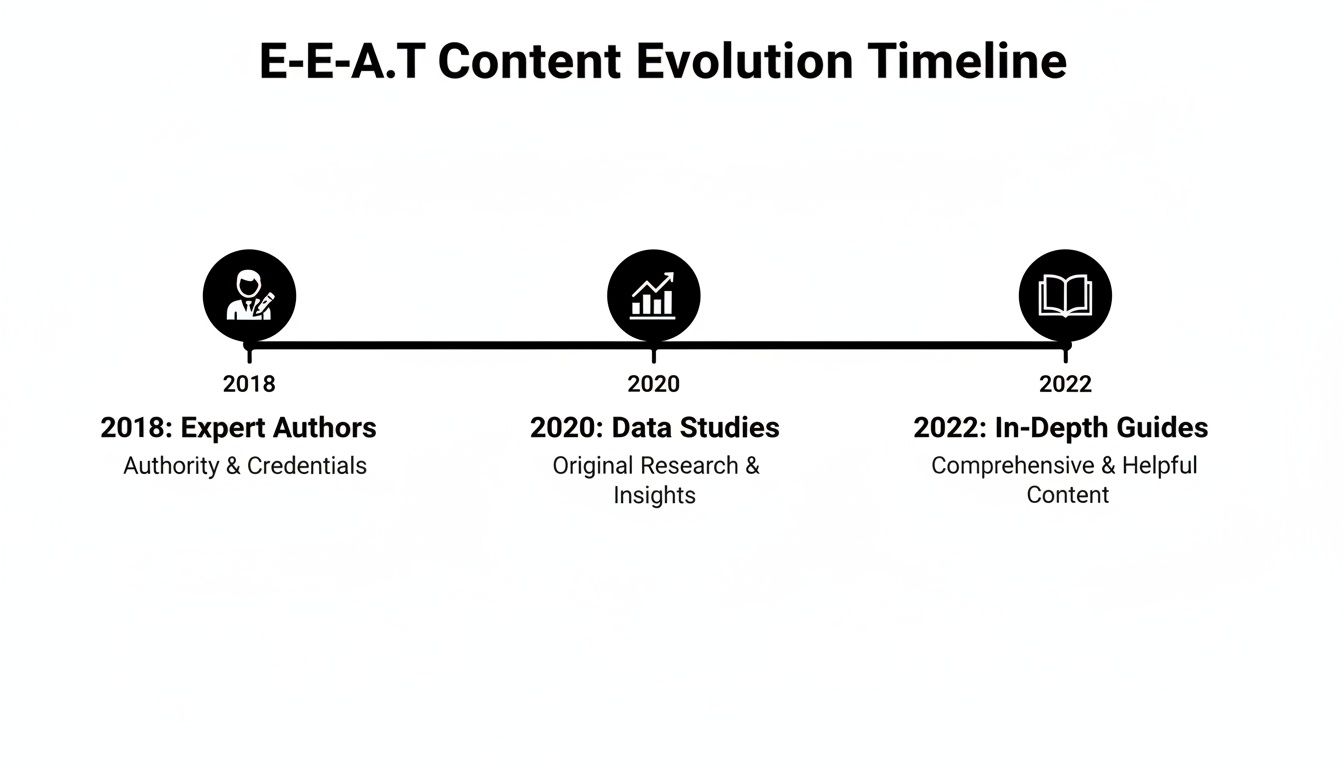
It’s this commitment to creating increasingly valuable and trustworthy content that truly separates successful fintech SEO from the rest.
During these six months, we focus on:
- Consistent Content Execution: We start rolling out the content plan from Phase 1. This means publishing in-depth articles, detailed comparison pages, and helpful resources that directly address the problems your audience is trying to solve.
- Strategic Link Acquisition: We kick off targeted outreach campaigns to earn links from reputable financial news sites, key industry publications, and respected business blogs. Every link acts as a powerful vote of confidence for your brand.
Phase 3: Optimization and Expansion (Month 10+)
By now, you’ll be seeing real, tangible results—better keyword rankings, more organic traffic, and a steady increase in leads. The final phase is a continuous cycle of analysis, refinement, and expansion. SEO isn't a "set it and forget it" tactic; it demands constant attention to keep the momentum going.
Here, the focus shifts to getting more value from the traffic you already have while capturing new market segments. Key initiatives include:
- Performance Analysis: We dig into the data to see what’s working. Which articles are driving the most traffic? Which pages are converting best? Where are people leaving your site?
- Conversion Rate Optimization (CRO): We use this data to form hypotheses and run A/B tests on your most important pages. We’ll tweak headlines, calls-to-action, and page layouts to turn more of your visitors into high-quality leads.
- Targeting New Verticals: With a strong foundation secure, we can start exploring new keyword groups and audience segments to expand your reach and market share even further.
Measuring the KPIs That Truly Matter in Fintech
In fintech, data isn't just important; it's everything. Yet, so many SEO campaigns get sidetracked by vanity metrics—things like total traffic or broad keyword rankings. These numbers might fluff up a report, but they don't tell you if your strategy is actually moving the needle on revenue.
Real success is all about connecting SEO activity directly to your bottom line. We need to move the conversation away from surface-level stats and toward the key performance indicators (KPIs) that genuinely drive business growth. That means tracking things that show tangible value, like qualified leads coming from organic search and a consistently lower customer acquisition cost.
Moving Beyond Vanity Metrics
A top-tier SEO service for a fintech firm has to focus on business outcomes, not just climbing the search engine ladder. Sure, ranking for "what is a Roth IRA" will pull in traffic, but it’s a world away from the value of ranking for "best robo-advisor for beginners." The difference is all about user intent.
The trick is to zero in on KPIs that reflect this kind of high-intent engagement. These are the metrics that build a rock-solid business case for putting more resources into your SEO efforts.
Here are the KPIs that really count:
- Organic Demo Requests and Sign-Ups: This is the big one. How many people who found you through a search engine actually requested a demo or signed up for a trial? This is the clearest possible sign of SEO success.
- Customer Acquisition Cost (CAC) from Search: What does it cost to land a new customer through organic search versus your paid channels? If your organic CAC is dropping, your SEO is delivering highly efficient growth.
- Rankings for High-Intent Keywords: You absolutely need to watch your position for terms like "best B2B payment processor" or "compare business savings accounts." These are the searches that capture people who are ready to make a decision.
The most impactful SEO strategies are those that can definitively prove their contribution to revenue. By focusing on conversion-centric KPIs, you transform SEO from a marketing expense into a predictable growth engine for your fintech company.
Tracking Share of Voice and Revenue Impact
It's not just about individual keywords; you also need to see the bigger picture of your visibility in the market. This is where tracking your Share of Voice (SOV) becomes a game-changer. SOV shows you how visible your brand is for your most important topics compared to the competition.
A rising SOV means you’re steadily claiming more market territory and cementing your brand as an authority. To get a clear view of these diverse fintech KPIs, you need the right tools. It's worth exploring the best AI search tracker tools that can give you deeper insights into your data.
The results from this kind of focused approach are hard to argue with. We've seen strategic SEO campaigns deliver 117% lead growth and cut the cost-per-lead in half for wealth management firms. We've also helped credit unions see 300% more applications at 69% lower costs. This just goes to show how powerful it is to tie SEO directly to bottom-line results, especially in a competitive field where organic traffic can slash customer acquisition costs.
In the end, every single KPI should loop back to financial outcomes. By meticulously tracking these metrics, you can draw a straight line from your SEO efforts to a positive return. To dig deeper into this, check out our guide on what is the return on investment (ROI) of SEO.
How to Choose the Right Fintech SEO Partner
Picking an SEO agency is a big deal. It’s not just about hiring another vendor; you’re looking for a strategic partner who genuinely gets the unique pressures and tricky compliance hurdles of the fintech world. Get this choice right, and you're on the path to sustainable, compliant growth. Get it wrong, and you're just burning cash on tactics that go nowhere.
A great partner feels like an extension of your own team—someone who's as invested in your success as you are.
Making the right call really boils down to asking the right questions. Any generic SEO agency can promise you more traffic. But a true fintech specialist will have real, battle-tested answers for the industry-specific challenges you face every single day. Your job is to dig deep and see if they truly know how to navigate this high-stakes environment.
Digging Deeper: What to Ask a Potential Agency
Before you even think about signing a contract, you need to put any potential agency to the test. Their answers to a few pointed questions will tell you everything you need to know about their real-world capabilities.
The table below outlines the critical questions you should be asking during your consultation calls. This isn't just a checklist; it's your blueprint for vetting whether an agency has the specialized knowledge your fintech company needs to win.
Key Questions to Ask a Potential Fintech SEO Agency
| Question Category | Specific Question to Ask | What a Good Answer Looks Like |
|---|---|---|
| Industry & Compliance Expertise | "Walk me through your process for creating E-E-A-T compliant content in a regulated industry like finance." | They should describe a multi-stage process involving subject matter experts (SMEs), rigorous fact-checking, and clear protocols for legal/compliance reviews. Bonus points if they mention author bios and clear sourcing. |
| Proven Track Record | "Can you share specific (even anonymized) case studies or examples of fintech clients you've helped?" | A solid agency will have results to share. Look for specific examples of challenges they solved—like ranking for "high-intent" keywords or improving conversion rates—not just vague traffic increases. |
| Technical & Security Acumen | "How do you approach technical SEO for a platform that handles sensitive user data?" | Their answer should go beyond the basics. They should talk about prioritizing site speed for trust, SSL/HTTPS implementation, secure architecture, and using structured data to build credibility with search engines. |
| Business-Focused Reporting | "Which KPIs do you prioritize for fintech, and how do you tie them back to our actual business goals?" | A great partner will focus on what matters: qualified leads, demo requests, and customer acquisition cost (CAC). If they only talk about rankings and traffic, they're missing the point. |
Getting clear, confident answers to these questions is a fantastic sign. It shows you're talking to a team that understands that fintech SEO is about much more than just keywords and links—it's about building trust, authority, and a real business asset.
Red Flags to Watch Out For
Just as important as knowing what to look for is knowing what to avoid. Some agencies are great at sales pitches but fall short on execution. Be on high alert for these warning signs.
The biggest red flag in SEO is a guarantee. If an agency promises you a #1 ranking on Google, run. No reputable expert can promise specific rankings because Google's algorithm is a complex, constantly shifting beast. A focus on guaranteed outcomes over a transparent, strategic process is a classic sign of trouble.
Here are a few other common red flags:
- Vague or Opaque Reporting: If their reports are a confusing mess of vanity metrics and you can't see a clear line between the work they did and the results, that’s a problem.
- A "Secret Sauce" Methodology: A trustworthy partner like Raven SEO will be open about their strategies. Hiding behind "proprietary methods" often means they're using outdated or even risky tactics that could get your site penalized down the road.
- Obsessed with Quantity Over Quality: If an agency brags about getting you 1,000s of backlinks but can't speak to their quality or relevance, their strategy is flawed. In fintech, one link from a trusted financial publication is worth more than a thousand from irrelevant blogs.
Ultimately, choosing the right partner comes down to finding a team that's committed to building a strong, secure, and sustainable foundation for your company's long-term growth.
Got Questions About Fintech SEO? We've Got Answers.
Here are some of the most common questions we hear from fintech leaders. Let’s clear up a few things so you can move forward with a solid plan.
How much does fintech SEO cost?
The cost of SEO services for fintech companies varies widely based on the company's size, goals, and the competitiveness of its niche. A smaller startup might invest a few thousand dollars per month, while a large, established player could have a budget well into the five figures. The key is to view it as an investment. A well-executed SEO strategy lowers your long-term customer acquisition cost and builds a valuable marketing asset that pays dividends for years, unlike paid ads that stop the moment you turn off the budget.
Is Content Marketing Really Necessary for B2B Fintech?
Yes. In fact, it's non-negotiable. The B2B fintech sales cycle can be long and complex, and it’s built almost entirely on demonstrating credibility and expertise. High-quality content is how you do that.
You're not just creating blog posts; you're solving real-world problems for your audience, whether that's a CFO looking to streamline payments or a developer searching for the right API. This is how you prove your E-E-A-T (Experience, Expertise, Authoritativeness, and Trustworthiness) and guide potential customers through their decision-making process.
For B2B fintech, your content is your digital handshake. It’s the first and most consistent way you prove your value long before a sales conversation ever happens. It's a critical component of any effective SEO services for fintech companies.
How Do You Handle SEO for Topics Under Heavy Regulation?
This is where a specialized fintech SEO agency is so crucial. We don't just "do SEO"; we operate with compliance baked into every step. It’s a completely different ballgame than standard content creation.
Our process is meticulous and designed to build authority while mitigating risk:
- Expert Vetting: Every piece of content is reviewed and approved by Subject Matter Experts (SMEs) with real, verifiable credentials in the financial space.
- Rock-Solid Sourcing: We only cite data and information from highly trusted financial institutions, academic sources, and top-tier publications.
- Visible Disclaimers: We make sure all legally required disclaimers are clear and easy to find, meeting all regulatory standards.
- Education Over Hype: The entire content strategy is built around providing factual, educational information, not making bold marketing claims that can’t be substantiated.
This approach isn’t just about playing it safe—it’s about building genuine trust with your audience and with search engines, which is the only way to win in fintech.
Ready to build a powerful, compliant, and results-driven SEO strategy? Raven SEO delivers specialized digital marketing services designed to help your fintech company get found online. Start the conversation with a no-obligation consultation today.