
A visitor lands on your site, has a real buying question, and hits a dead end. The page offers a form, a generic email address, or a phone number with business hours attached. They leave before anyone answers.
That gap is where modern marketing breaks.
Most businesses still treat digital marketing like a publishing system. They write pages, send emails, launch ads, and wait. Customers don't behave that way anymore. They expect immediate answers, context, and a smooth path to the next step. If they're on a pricing page, they want clarity now. If they're comparing vendors, they want specifics now. If they're confused, they want help without friction.
That's why what is conversational marketing has become a much more important question than it looked a few years ago. This isn't just about adding a chatbot to a website. It's about replacing delayed follow-up with active dialogue across chat, messaging, SMS, and human handoff. It changes how leads convert, how support gets delivered, and how brands collect first-party language from real customers.
There's another shift under that one. Search is changing from a click economy to an answer economy. AI Overviews, LLMs, and conversational search systems increasingly summarize brands instead of just listing them. The businesses that win won't just publish content. They'll build structured, credible signals from actual customer conversations.
That's also where the old debate around digital vs traditional marketing starts to feel incomplete. The issue isn't only channel choice anymore. It's whether your marketing stack can listen, respond, and turn customer language into assets that AI systems can understand.
Introduction The End of Waiting for an Answer
The old model asked customers to be patient. Fill out the form. Wait for a callback. Check your inbox later. Maybe someone from sales reaches out. Maybe they don't.
That model now feels slow because it is slow. Buyers move in moments of intent, not in tidy handoff stages built around internal team workflows. When a prospect has a question, the highest-converting answer is usually the one that arrives while that question is still active.
Conversational marketing is the discipline built around that reality. It gives people a way to interact with your brand in real time through live chat, chatbots, SMS, social messaging, and voice interfaces. It treats those exchanges as part of marketing itself, not as an afterthought owned by support.
The deeper shift is strategic. Customer conversations don't just help close business. They reveal the exact phrases, objections, and needs buyers express in their own words. That language is highly valuable in an AI-driven search environment, where structured relevance and topical clarity shape whether your brand gets surfaced or ignored.
Businesses used to optimize for the click. Increasingly, they need to optimize for the answer.
If your site still relies on static pages and delayed outreach, you're not just creating friction for users. You're losing the raw material that can teach AI systems what your brand solves, how customers describe the problem, and which entities your business should be associated with.
That's why conversational marketing has moved from a conversion tactic to a visibility strategy.
The Shift From Broadcast to Dialogue
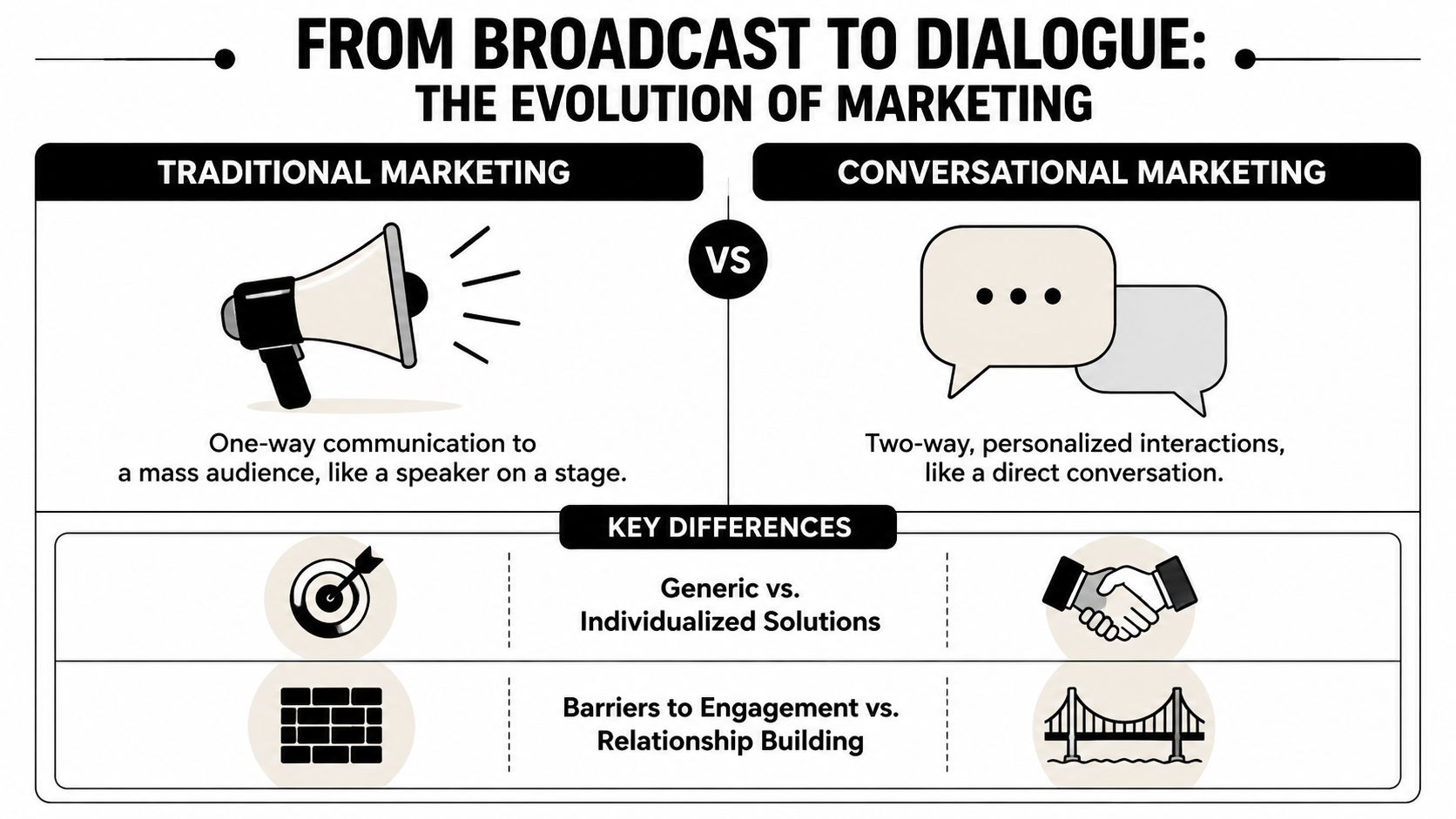
Traditional digital marketing is mostly a broadcast system. You publish a page. Send a campaign. Post an update. Launch an ad. The brand speaks first, and the customer chooses whether to respond.
Conversational marketing works differently. It starts a two-way exchange while intent is still active. Instead of asking a visitor to raise their hand and wait, it opens a direct path to questions, qualification, support, and next steps.
What conversational marketing actually means
The term conversational marketing emerged as a formal discipline in 2014, and the market has expanded sharply since then. Projections put the conversational marketing software market at $12.4 billion in 2023 and $49.8 billion by 2030, while 73% of consumers prefer messaging over phone calls for customer service, according to this conversational marketing market overview.
That growth makes sense because the format matches how people already communicate. Messaging feels easier than calling. It's faster than waiting on email. It lets customers ask one practical question without committing to a long process.
A simple way to think about it:
- Broadcast marketing reaches attention.
- Conversational marketing captures intent.
Monologue versus dialogue
A newsletter can create awareness. A paid social ad can create interest. A product page can build consideration. But none of those assets can answer a buyer's specific question unless someone or something is available to respond.
That's the divide.
Traditional channels often behave like a monologue. The business delivers a message to a segment. Conversational systems behave more like a dialogue. They can clarify, route, recommend, and escalate. Website chat, Facebook Messenger, WhatsApp, SMS, and voice assistants all fit into that model when they're connected to a wider customer journey.
Engage, understand, and recommend in real time.
That's the operating principle. It's also why content strategy now needs a distribution layer that doesn't stop at publishing. If your content attracts the right people but your site can't respond when they engage, you're creating avoidable leakage. The stronger approach is to connect traffic acquisition with real-time interaction, which is why content distribution strategy and conversational design increasingly belong in the same discussion.
What works and what fails
The companies getting this right usually do three things well:
- They trigger conversations with context. Pricing pages, service pages, and comparison pages deserve different prompts.
- They ask fewer questions. High-friction qualification kills momentum.
- They route quickly. If a buyer needs a person, the system shouldn't trap them in a loop.
What fails is equally consistent:
- Generic popups that interrupt without helping
- Bots posing as humans
- Dead-end automation with no useful next step
- Conversation tools disconnected from CRM, sales, or content systems
Conversational marketing isn't “chat on a website.” It's the shift from one-way delivery to responsive engagement.
The Business Case for Real-Time Engagement
The financial argument for conversational marketing is no longer theoretical. Teams adopt it because it changes customer behavior and improves operational flow at the same time.

According to conversational marketing performance data, 80% of companies report increased sales after deploying conversational marketing techniques, 82% report increased customer loyalty, and these tools can handle up to 80% of simple customer complaints. That combination matters because it ties growth and efficiency together instead of forcing a trade-off between them.
Why the numbers make practical sense
When customers can ask a question at the moment of hesitation, fewer of them abandon the process. When a system handles routine requests instantly, your team spends more time on exceptions, qualified leads, and complex service issues.
This doesn't mean every conversation should be automated. It means repetitive work should be automated so human attention is reserved for the moments that require judgment.
A good operating model usually looks like this:
- Low-complexity questions go to automation first
- High-intent sales questions move toward booking or a rep
- Sensitive or nuanced issues escalate to a person fast
- Every exchange feeds insight back into marketing and service teams
Loyalty is often the hidden win
A lot of teams buy conversational tools to improve lead capture, but retention and satisfaction often become the more durable benefit. Fast answers reduce frustration. Consistent handoff preserves context. Customers don't have to restate the problem every time they switch channels or talk to a new person.
That's one reason the ROI conversation needs more rigor than “we installed a chatbot.” Measurement should include sales movement, service deflection, customer experience, and retention signals. If a business only tracks form fills, it misses most of the business impact. That broader attribution issue is exactly why measuring return on marketing investment gets harder, not easier, when conversations span chat, SMS, and live follow-up.
Here's a practical look at the trade-offs:
| Business situation | What tends to work | What usually underperforms |
|---|---|---|
| High-volume FAQ traffic | Chatbot with clear fallback | Forcing every user to submit a form |
| High-intent pricing traffic | Live chat or instant booking flow | Generic “contact us” CTA |
| Service-heavy businesses | Blended bot and human workflow | Fully manual inbox monitoring |
| Complex buying journeys | Multi-step conversation history | Isolated channel-by-channel responses |
A short explainer can help if your team is weighing implementation options and stakeholder buy-in:
What decision-makers should watch
The strongest conversational programs don't try to prove value with one vanity metric. They watch the full path from engagement to outcome.
Operational reality: if your system answers simple requests fast and routes complex ones cleanly, both revenue teams and support teams benefit.
For most businesses, the practical question isn't whether real-time engagement matters. It's whether the current customer experience is leaking too much intent before anyone responds.
Beyond Chatbots The Technology Driving Modern Conversations
Many business owners hear “conversational marketing” and think “website bot.” That's too narrow. The actual system is a mix of language understanding, customer data, routing logic, and channel coordination.
The simple version of the tech stack
Natural language processing, or NLP, is what helps a system interpret what a person means. It turns “I need pricing,” “how much does this cost,” and “can someone quote me” into related intent.
Machine learning, or ML, is what helps the system improve decisions based on interaction patterns and first-party data. That can include behavior on the site, prior sessions, lifecycle stage, or channel history.
According to this overview of omnichannel conversational marketing systems, this orchestration can lead to 40% shorter sales cycles and 2x higher close rates when bots and humans hand off smoothly across channels. That's the part many teams underestimate. The value doesn't come from the bot alone. It comes from the continuity.
Why omnichannel matters
A customer might start on website chat, continue through SMS, and finish with a live rep. If those interactions don't share context, the system feels broken. If they do, the experience feels coherent.
A conversational stack should remember the customer even when the customer changes channel.
That continuity usually depends on a few core capabilities:
- Shared customer memory so prior interactions inform the next one
- Routing rules that know when to answer, when to qualify, and when to escalate
- Channel flexibility across web chat, SMS, social DMs, and voice
- Human fallback that preserves transcript history instead of starting over
This is also where businesses need to distinguish a basic chatbot from a broader AI workflow. If your team is comparing architectures, this AI agent comparison for scaling is a useful way to think about where simple scripted bots stop and more capable systems begin.
What to implement first
Many organizations should not begin by automating every interaction. They should instead start where friction is greatest and intent is most evident.
Good starting points include:
Pricing and service pages
Visitors here often need clarification, not more marketing copy.Appointment or demo workflows
If scheduling requires back-and-forth, conversation can remove lag.High-volume support questions
Repetitive requests are the best place to reduce load without harming experience.Lead qualification handoff
A fast, structured intake can help sales teams focus on fit instead of chasing every inquiry.
This matters for another reason. Once these conversations are flowing, they become part of your digital voice. They shape how your brand answers questions, which entities it gets associated with, and which recurring topics deserve structured treatment. That's why governance matters. Tools, prompts, and handoff logic should support the same brand language principles behind LLMs.txt and digital voice control.
The technology is mature enough to be practical. The challenge now is implementation discipline.
From Conversations to Citations The AI Visibility Roadmap
Most articles stop at the conversion story. That misses the larger opportunity.
Conversation logs are one of the best sources of first-party language a business can gather. They contain customer questions, recurring objections, decision criteria, urgency signals, and natural phrasing around products and services. That's useful for sales. It's also useful for AI Visibility, because modern search systems increasingly rely on structured understanding rather than keyword matching alone.

According to Raven SEO's internal analysis on conversational data and AI citations, current content often ignores a critical link: conversation data is a goldmine of semantic signals for AI, and real-time customer questions from chat logs can be used to build AI-ready FAQ schema and content clusters that increase the likelihood of being cited by AI Overviews and generative search engines.
Step one: extract recurring questions
Start with transcripts, chatbot logs, support threads, and sales chat summaries. Look for repeated questions and repeated phrasing.
Not “what do we want customers to ask?”
What are they already asking?
Useful patterns usually show up in areas like:
- Pricing confusion
- Service scope
- Eligibility or fit
- Comparisons
- Timeline expectations
- Trust and risk questions
The language matters. If users keep asking “do you work with small teams” or “how long does setup take,” those are not side questions. They are evidence of intent and uncertainty. They deserve a place in your content architecture.
Step two: turn raw language into structured assets
Conversational marketing starts feeding AI search readiness.
Take the recurring questions and convert them into:
- FAQ sections written in the same language customers use
- FAQ schema that labels question-and-answer relationships clearly
- Service page enhancements that address objections directly
- Topical content clusters built around real customer needs
- Entity-rich internal linking that reinforces relationships between services, use cases, and outcomes
A useful model is simple:
| Conversation signal | Content action | AI visibility benefit |
|---|---|---|
| Repeated customer question | Add FAQ content | Clear answer target for AI systems |
| Common objection | Expand service page copy | Better semantic coverage |
| Frequent comparison request | Build comparison content | Stronger contextual relevance |
| Recurring terminology | Standardize wording in schema and copy | Better entity consistency |
This is one reason implementation stories are useful when evaluating maturity. For example, Estimatty's journey to automated sales gives a grounded look at how conversation systems can move beyond simple support and into structured business operations.
Step three: make the data citeable
AI systems don't cite “good intentions.” They surface content that is clear, structured, and easy to interpret.
That means your roadmap should include:
Normalized question sets
Merge duplicates and align similar user phrasing.Schema deployment
Mark up FAQs, services, organizations, and relevant entities consistently.Clean internal linking
Connect answers to authoritative supporting pages.Transcript-informed updates
Refresh pages when new questions start appearing regularly.Governance for language consistency
Keep product names, service descriptions, and location or audience signals stable across the site.
The supporting technical layer matters as much as the writing layer. If you want AI systems to understand what your business is, what it offers, and what problems it solves, your site needs structured clarity. That's where structured data implementation becomes central, not optional.
What not to do
Some teams misuse conversational data by dumping raw transcript text onto a page or generating bloated FAQ sections with no editorial discipline. That creates noise.
Better practice looks like this:
- Remove personal or sensitive data
- Cluster similar questions
- Write concise, direct answers
- Map answers to the right page type
- Treat conversations as research, not as publish-ready copy
Customer conversations are not just support artifacts. They are training data for your content strategy.
That's the bigger point. In a search environment shaped by LLMs and AI Overviews, conversational marketing helps brands do two jobs at once. It improves live customer engagement, and it produces the semantic signals that support future citation.
Frequently Asked Questions About Conversational Marketing
FAQ Quick Guide
| Question | Answer |
|---|---|
| How hard is it to launch conversational marketing? | It depends on scope. A focused rollout on one high-intent page is manageable. A full multi-channel program takes more planning because routing, CRM sync, and handoff rules need to work together. |
| Can a business use conversational marketing without a large team? | Yes. Small teams often benefit the most when they automate repetitive questions and reserve human time for qualified leads or sensitive support. |
| Should every conversation start with a bot? | No. Some pages need live chat first, especially when stakes are high or the buyer is close to a decision. Use bots where speed and consistency matter more than nuance. |
| What industries benefit most? | Service businesses, healthcare practices, legal firms, ecommerce brands, SaaS, and multi-location businesses all benefit when customers need quick answers before taking the next step. |
Is conversational marketing just live chat with a new name
No. Live chat can be part of it, but conversational marketing is broader. It includes how conversations start, how they're qualified, how context is stored, how people move between channels, and what happens after the exchange.
A chat widget by itself is just a tool. A conversational strategy defines prompts, routing, fallback paths, ownership, and measurement.
What should a business prepare before launching
Three things matter most at the start:
- A clear use case such as lead qualification, appointment booking, or FAQ handling
- A response model that defines bot behavior, human escalation, and hours of coverage
- A content source of truth so answers stay accurate across pages, scripts, and messages
If those pieces are missing, the experience usually feels fragmented.
How do you handle after-hours conversations
The practical answer is a blended model. Let automation answer routine questions, collect context, and offer the right next step. For higher-value requests, create a clean handoff into scheduling, callback requests, or next-business-day follow-up with full conversation history attached.
The mistake is pretending a bot can resolve everything. After-hours coverage works when it reduces uncertainty and preserves momentum.
What's the difference between a helpful conversation and an annoying one
Helpful conversations appear at the right time, ask relevant questions, and lead somewhere useful. Annoying ones interrupt too early, ask for information the page should already answer, or trap the visitor in a script.
A simple test works well: if the prompt doesn't reduce friction, it probably adds friction.
If your business wants to improve both conversion performance and AI visibility, Raven SEO can help. We build AI-ready search strategies, structured data frameworks, and conversion-focused web experiences that turn customer language into stronger organic visibility. Start with a no-obligation consultation to audit how your current site supports real-time engagement, brand authority, and citation readiness.