

Search behavior has changed rapidly, exceeding prior expectations. A page can still rank, but that no longer guarantees it will be the source an AI system cites when someone asks a buying question. The old model rewarded position and clicks. The new model rewards clarity, authority, and machine-readable trust.
That's why the phrase ai visibility platform matters now. It isn't another vanity dashboard. It's the operating layer brands use to understand whether ChatGPT, Perplexity, Gemini, Claude, and Google's AI interfaces can find them, interpret them correctly, and cite them when it counts.
The End of Search As We Know It
Traditional SEO is still useful, but it's no longer the whole game. When search engines answer the question directly, fewer people need to click through to ten blue links. That changes how visibility works and how brands win attention.
Answer Engine Optimization, or AEO, is the shift from ranking pages to becoming a trusted source inside AI-generated answers. That means your content has to be crawlable, attributable, structured, and convincing enough to earn inclusion when an AI system composes a response.
Business owners don't need to become machine learning experts to adapt. They do need to accept that visibility now happens in two places at once:
- Search results pages where rankings still matter
- AI answer environments where citations, mentions, and source selection matter more
A lot of teams are still budgeting and reporting as if traffic from classic search will remain stable. It won't. The brands that move first are changing their reporting models now, not after a decline shows up in the quarterly dashboard.
Practical rule: If your brand appears in search but not in AI answers, you're visible to the browser and invisible to the decision.
Strategy gets more interesting as AI systems don't just retrieve pages. They synthesize. They compare. They compress. They choose a small set of sources and turn them into a direct answer. That favors companies with clean site architecture, strong entity signals, and pages that answer real questions without fluff.
If you want a broader view of where this is heading, Arlo's perspective on the future of AI marketing is useful because it frames AI visibility as part of a larger shift in how brands get discovered. For a direct comparison of old and new search strategy, Raven SEO's guide to AEO vs SEO in 2026 is a practical starting point.
Understanding the Shift from Clicks to Citations
By 2028, organic search traffic is expected to fall by 50% or more as users shift toward AI-powered answer engines, according to Gartner, as reported by Search Engine Land. That forecast matters because visibility now depends on whether your brand gets selected as a source, not just whether your page ranks.
Traditional SEO rewarded position and click-through. AI search rewards selection. The practical question has changed from “Did we win the click?” to “Did the model trust our page enough to cite it?”

That change affects how content should be built and maintained. A page can still rank well and get ignored by AI systems if the answer is buried, authorship is unclear, or the business behind the page is hard to verify across the web.
In practice, citation visibility depends on four things:
- Direct answer quality. Pages need concise, quotable responses near the top, followed by depth for users who want detail.
- Source transparency. Clear authorship, publish dates, editorial context, and company identity reduce ambiguity.
- Entity consistency. Your site, company profiles, reviews, and third-party mentions need to describe the same business in the same terms.
- Machine-readable structure. Schema, internal linking, and page hierarchy help models interpret what the page is about and when it should be cited.
This is also where many teams misread the trade-off. Ranking signals still matter, but AI systems often compress ten blue links into one answer and a short list of sources. That raises the bar. Your content has to be easy to extract from, easy to verify, and strong enough to survive comparison against competing sources.
Raven SEO's guide to E-E-A-T for AI visibility is useful here because it turns authority from a vague quality concept into something operational. Experience, expertise, authority, and trust affect whether your content looks safe and credible enough for an AI system to reference.
Citation also changes how buyers encounter your brand. If someone asks for the best payroll software for a 20-person firm or a reliable contractor checklist, they may never see a traditional results page first. They see a synthesized answer. If your company is absent from those citations, you lose discovery before the click even becomes possible.
Teams that want to improve this usually need more than better copy. They need cleaner page formatting, stronger attribution, tighter topic coverage, and evidence that other sources recognize the brand. Even visual assets can support that effort. For example, teams documenting product workflows or interface proof points often use ScreenshotEngine's powerful applications to generate consistent site captures for internal audits, content production, and reference libraries.
Video helps explain this shift in a more visual way:
What an AI Visibility Platform Actually Does
The term "AI visibility" often brings to mind a simple mention tracker. That's too narrow. A real ai visibility platform is a monitoring, diagnostic, and optimization system for how your brand appears in AI-generated answers.
One of the strongest signals of market maturity is that platforms are already being ranked against one another. According to this review of AI visibility optimization platforms, Profound holds an AEO Score of 92/100, tracks brand presence across more than 10 AI engines, and uses 400M+ anonymized prompt insights. The reason that matters isn't the leaderboard by itself. It's what the scoring model represents. Brands are moving from chasing SERP positions to tracking citation frequency in LLM outputs.
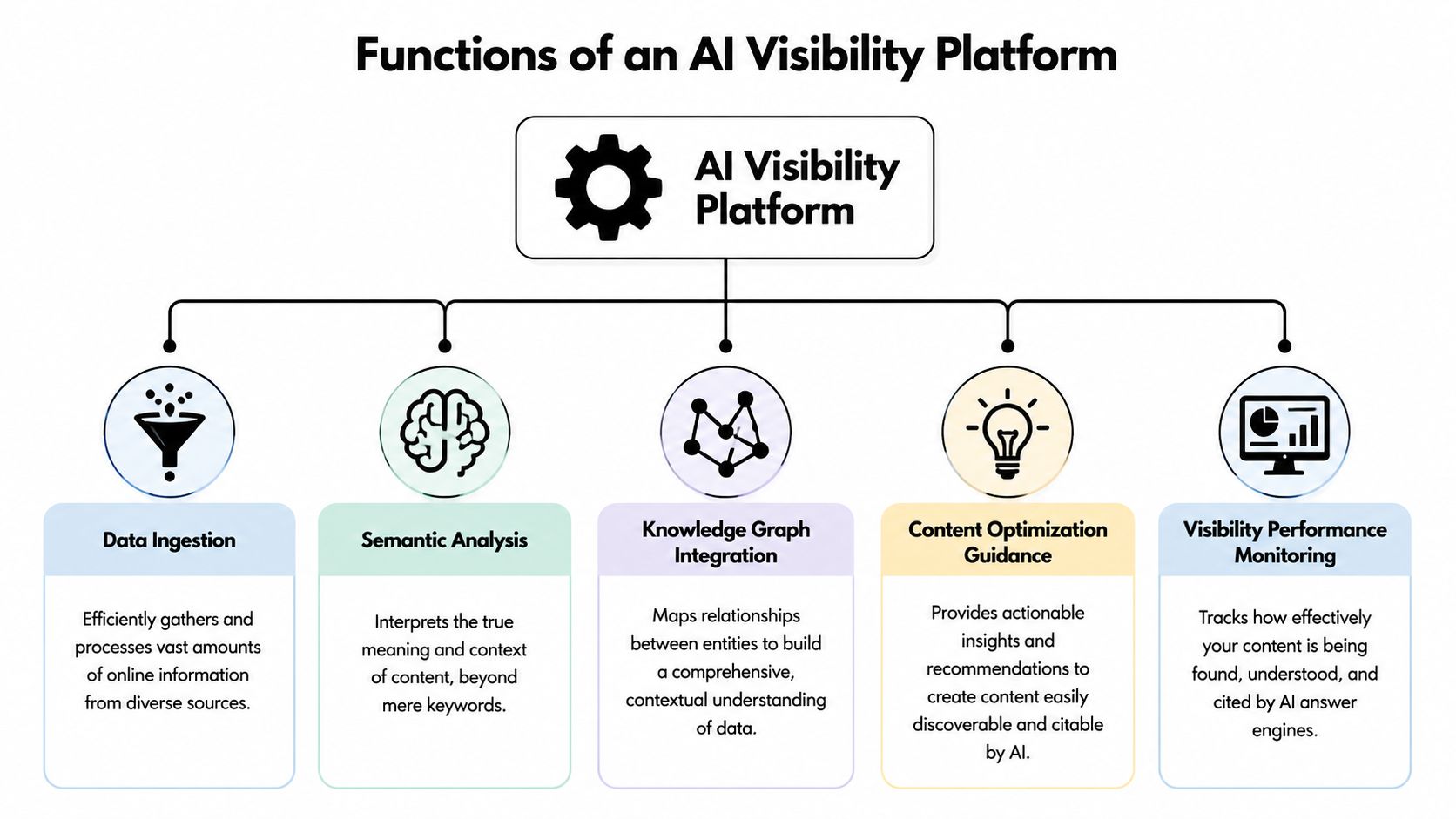
The five jobs these platforms handle
Track brand mentions across AI engines
Not every model answers the same way. A useful platform checks multiple environments so you can see whether visibility is broad or isolated.Measure citation share of voice
This shows how often your brand appears compared with competitors for commercial and informational prompts in your category.Identify cited pages and content patterns
You need to know which URLs are winning citations. That reveals whether service pages, comparison pages, FAQs, thought leadership, or support content are doing the heavy lifting.Flag factual errors and AI misstatements
A mention isn't valuable if the model gets your pricing, features, geography, or positioning wrong.Connect visibility to business reporting
The strongest platforms don't stop at mention counts. They help teams connect AI exposure to traffic quality, conversion paths, and content ROI.
What separates useful tools from noisy ones
The first trade-off is breadth versus depth. Some tools show basic monitoring but give little context. Others go deeper on attribution, content source analysis, snapshots, and governance. Enterprise teams usually need the second category because brand accuracy and compliance matter as much as visibility.
The second trade-off is screenshot evidence versus abstract reporting. If a platform says your brand appeared, you should be able to inspect the actual answer context. That's one reason visual capture matters. Teams that need to document how pages render and how answer environments appear can also borrow ideas from ScreenshotEngine's powerful applications, especially when they want repeatable visual records of page states and outputs.
The most useful dashboard doesn't tell you that AI exists. It tells you which page earned the citation, which competitor displaced you, and what changed.
For implementation work, structured data usually sits at the center of the fix list. Raven SEO's resource on structured data for AI discovery is worth reviewing if your pages are semantically thin or your service information is buried in generic copy.
A practical note on tools: some businesses don't need a heavyweight platform on day one. They need disciplined prompt testing, content review, and technical cleanup. The platform becomes more valuable as the number of products, locations, authors, or competitor sets increases.
Building the Technical Foundation for AI Visibility
Before an AI system can cite you, it has to access your pages, parse the content, and understand what the page is about. Most failures happen before content quality even enters the picture.
The technical layer is where many brands lose visibility. According to technical requirements for AI search visibility, 40 to 60 percent of AI bot traffic is blocked by misconfigured robots.txt files, LLMs like ChatGPT parse less than 10 percent of client-side rendered content, and proper Schema.org markup can boost entity recognition by 50 percent.

Start with crawl access
If important AI bots can't reach your content, you won't be cited no matter how strong the copy is.
Check three things first:
- Robots rules that may block AI user agents unintentionally
- Security layers that challenge or deny nontraditional crawlers
- Log patterns that reveal whether AI bots hit key pages at all
This isn't about opening the doors to every bot without control. It's about making intentional decisions. Allow the systems you want to be eligible for citation while managing abuse and server strain responsibly.
Field note: Teams often spend weeks rewriting copy when the real issue is that the model never got a clean view of the page.
If your team needs a practical review process, Raven SEO offers an audit workflow focused on AI agent crawlability. That kind of audit usually catches blockers faster than content revisions do.
Fix renderability before you polish copy
Many modern websites still rely heavily on client-side rendering. That may look fine to a human in a browser, but it creates a problem for AI parsing if the useful content arrives late or is hidden behind JavaScript execution.
For AI visibility, server-side rendering is often the safer choice because the page ships with the important content already present. This is especially important for:
- Service pages
- Product detail pages
- FAQ sections
- Author bios
- Review and comparison content
If your site depends on dynamic interfaces, don't assume the answer engines see what the user sees.
A similar issue shows up in other AI workflows too. Teams working with audio and transcripts run into the same machine-readability challenge. That's one reason resources like understanding OpenAI Whisper's capabilities are helpful. They remind marketers that AI performance depends heavily on how clearly data is presented to the model in the first place.
Use schema to remove ambiguity
Schema is where many websites become AI-ready. It turns vague page copy into explicit machine-readable statements about your business, services, people, products, articles, and FAQs.
A simple technical checklist looks like this:
| Priority | What to check | Why it matters |
|---|---|---|
| High | Organization schema | Helps define who the brand is |
| High | Article and author markup | Supports expertise and source clarity |
| High | Service or product schema | Clarifies offer type and page purpose |
| Medium | FAQ markup where appropriate | Makes answer-oriented content easier to interpret |
| Medium | sameAs references | Strengthens entity consistency across profiles |
The common mistake is adding schema as an SEO plugin afterthought. Good implementation reflects the actual business model, content type, and entity relationships on the site.
Creating Citable Content and Authoritative Signals
A crawlable site gives AI systems access to your pages. Citations go to the pages that are clear enough, specific enough, and trustworthy enough to quote.
Teams evaluating this work often use citation share-of-voice across major LLMs to see which pages earn mentions. Conductor outlines that connection between page structure, authority signals, and citation visibility in its overview of AI visibility platforms and citation share-of-voice.

What citable content looks like
Pages that earn citations usually do four things well.
Answer the question early
Put the core answer near the top of the page. If the useful sentence is buried under brand copy, pricing friction, or vague claims, the model often pulls from a cleaner source.Show clear authorship and subject credibility
Name the person behind the content. Add a short bio, relevant experience, and a visible connection to the topic. Anonymous content is harder to trust.Include specifics a model can reuse
Good source material contains definitions, steps, examples, constraints, and comparisons. General statements rarely win citations because they are easy to replace.Match the rest of your public footprint
Your website, company profiles, review sites, and social bios should describe the business the same way. Conflicting descriptions weaken entity confidence.
Build for retrieval, not just publishing
Many content programs still treat output as a volume problem. The better approach is to build pages that can be retrieved, extracted, and cited without losing meaning.
That requires visible relationships between your business, your offers, your experts, and the claims you make. If a company sells IT support for healthcare clinics, the site should connect those ideas directly. The homepage should define the company. Service pages should explain the offer. Author pages should show who knows the subject. Supporting articles should answer the operational questions buyers ask.
A practical content mix often looks like this:
| Content type | Best use |
|---|---|
| Service explainers | State what you do, who it is for, and where it fits |
| Comparison pages | Differentiate your offer from alternatives and substitutes |
| FAQ hubs | Capture direct question-and-answer phrasing |
| Author-led articles | Add expert interpretation, not just summary |
| Glossaries and definitions | Give models clean language for industry terms |
A simple test helps here. Pull one paragraph out of the page and read it on its own. If it still makes sense, states something useful, and reflects your expertise accurately, it is more likely to survive extraction.
Authority comes from corroboration
AI systems do not evaluate a page in isolation. They compare what your site says with what the wider web says about your brand and topic coverage.
That is why authority building still matters. The goal is not raw link volume. The goal is corroboration from relevant sources that reinforce who you are, what you do, and why you should be cited. Practical methods for earning those references are covered in Raven SEO's guide on how to build backlinks naturally.
This is also where many teams get the trade-off wrong. They publish dozens of AI-written posts to cover more keywords, then wonder why none of them get cited. Breadth helps only when each page adds distinct value. A smaller library with sharper authorship, better evidence, and tighter page purpose usually performs better in AI discovery than a bloated archive.
What usually fails
The same patterns show up again and again on sites that struggle to get cited:
- Thin pages rewritten by AI with no original expertise
- Generic list posts with no author, evidence, or point of view
- Service pages written like brochures instead of explanations
- Conflicting business descriptions across directories and profiles
- Topic clusters with no clear hierarchy or internal logic
An ai visibility platform can show where those gaps appear, but it cannot fix them for you. The work itself is editorial. Clarify the offer. Name the expert. Add proof. Tighten the page purpose. Connect each page to the broader entity behind the brand.
Raven SEO supports that process with entity consistency checks, structured data validation, and citation footprint analysis across major AI systems. Used well, those inputs help teams turn a technically sound site into a brand that gets cited.
Measuring Your Success and Starting Your Roadmap
Many companies still judge AI visibility by the old search dashboard. Rankings go up, traffic ticks up, and the report stops there. That misses the commercial question: are AI answer engines sending the right visitors, and do those visits turn into revenue?
As noted earlier, AI-referred traffic often behaves differently from standard organic traffic. Users arriving from an AI answer usually have more context and clearer intent. That shifts measurement away from raw visit counts and toward citation presence, assisted conversions, and sales influence.
The KPIs that matter now
Track AI visibility in layers, because one metric on its own can be misleading.
Citation frequency
How often your brand appears in AI answers for the prompts that matter to your business.Share of voice
How often your brand is cited compared with direct competitors in the same answer set.Source page contribution Which pages earn mentions, so you know where to improve and where to expand.
AI referral quality
What those visitors do after landing. Time on page, next-page path, form starts, and demo views matter more than vanity traffic.Conversion contribution
Whether AI-originated sessions assist or complete the actions your business cares about, such as calls, qualified leads, demos, or purchases.
Raven SEO's framework for measuring digital marketing success is useful here because it separates visibility metrics from business outcomes. That distinction matters. A brand can appear often in AI answers and still fail to win pipeline if the cited page is weak, mismatched to intent, or disconnected from conversion paths.
A practical starting order
Start with pages that already sit close to revenue. For most businesses, that means core service pages, high-intent product pages, comparison pages, and a few strong educational assets. Those are usually the fastest pages to improve because the commercial value is already there.
Then work in this order:
Audit crawlability and rendering
Confirm that AI systems and search crawlers can access the page, render key content, and follow important links.Clean up structured data
Add or fix schema that clarifies the page type, organization, author, product, service, and FAQ content where appropriate.Prioritize pages with citation potential Pick pages that answer specific questions clearly, contain original evidence, and map to prompts your buyers use.
Strengthen trust signals
Improve authorship, company details, editorial clarity, and internal links to related proof pages.Monitor prompts and competitor citations
Check how AI answers change over time, which competitors are being cited, and what source formats show up most often.Tie findings to conversion data
Compare citation gains against lead quality, assisted conversions, and closed revenue, not just sessions.
One practical trade-off shows up quickly. Teams often want to track every prompt, every model, and every page from day one. That creates reporting noise. A tighter prompt set tied to commercial intent gives clearer signals and makes it easier to decide what to fix next.
The fastest gains usually come from improving pages you already have, not publishing 50 new ones. Make the page easier to crawl, easier to interpret, and easier to trust.
Raven SEO helps brands improve AI visibility with technical audits, structured data planning, entity consistency work, and AI visibility analysis. If you want a practical starting point, request a no-obligation consultation with Raven SEO to review how your site is showing up across AI answer engines and where the biggest citation opportunities are.