
Meta Title: Master Your Amazon Marketing Strategy for Maryland Brands | Raven SEO
Meta Description: Learn a practical amazon marketing strategy for Maryland businesses with guidance on FBA vs FBM, listing optimization, PPC, and local funnel integration from Raven SEO.
Your storefront might do well in Annapolis on a Saturday, or your Dundalk workshop might already have loyal repeat buyers. But local demand has limits. Amazon gives Maryland businesses a way to move from neighborhood recognition to national reach without opening a second location.
That shift changes how you market. On Amazon, shelf space is earned through relevance, fulfillment, conversion, and ad efficiency. A solid amazon marketing strategy isn't just about listing products. It's about choosing the right logistics model, building a listing that answers buyer intent, buying traffic intelligently, and connecting marketplace activity to the rest of your marketing stack.
A Chesapeake Bay spice blend, a Baltimore-made pet accessory, or a sailing product from Anne Arundel County can all work on Amazon. The brands that win usually don't act like Amazon is a side project. They treat it like a channel with its own economics, its own customer behavior, and its own rules.
Your Maryland Business on a Global Stage
A lot of Maryland owners start in a familiar place. Sales come from referrals, seasonal foot traffic, local Facebook activity, craft fairs, or a solid wholesale relationship. Then growth stalls because the audience stays regional.
Amazon solves a different problem than your website or Main Street storefront. It puts your product in front of shoppers who are already in buying mode. That matters when you're trying to sell beyond Baltimore County, the Eastern Shore, or the DC commuter belt.
Local identity still matters
Maryland businesses often assume Amazon wipes out brand personality. It doesn't. In many categories, local identity helps if you use it well. "Chesapeake Bay-inspired," "Baltimore-made," or "designed for Mid-Atlantic boaters" can sharpen your positioning when the market is crowded with generic alternatives.
That doesn't mean every listing should lean hard on geography. It means your story should support the buying decision. If your product has roots in local expertise, say so in a way that reinforces trust and usefulness.
Your local angle works best when it answers a customer question. Why this product, from this brand, instead of the next search result?
Amazon works best when it's part of a system
Maryland brands get better results when Amazon supports the rest of their digital presence, not when it replaces it. Your website still matters. Your email list still matters. Your local search visibility still matters.
If you're building that broader foundation, Raven SEO's eCommerce marketing services show how Amazon can fit alongside owned channels instead of competing with them.
A practical amazon marketing strategy starts with one mindset shift. You're not just uploading products to a marketplace. You're building a sales channel that needs positioning, operations, and disciplined testing.
Choosing Your Fulfillment Path FBA vs FBM in Maryland
A lot of Maryland sellers make this decision too late. They launch on Amazon, get a few orders, then realize their fulfillment setup is draining margin or creating headaches in the warehouse.
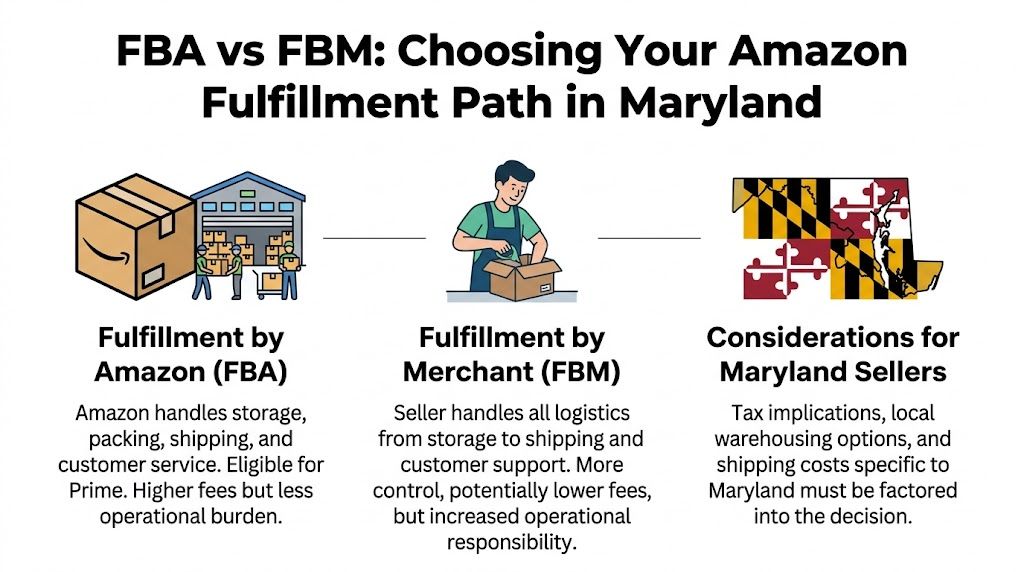
For a business in Annapolis, Baltimore, or anywhere else in Maryland, fulfillment affects more than shipping. It shapes your costs, your Buy Box competitiveness, your customer service workload, and how much operational control you keep as sales grow.
What FBA changes
With Fulfillment by Amazon, Amazon stores your inventory and handles pick, pack, shipping, returns, and a large share of the customer service process. The biggest upside is simple. Prime eligibility usually improves conversion rate because shoppers trust fast delivery and easy returns.
That advantage is real, but so is the cost. Storage fees, fulfillment fees, returns, and long-term storage charges can hit hard if your product is bulky, fragile, seasonal, or slow to move. Before choosing FBA, review the main fee categories in this breakdown of Fulfillment by Amazon costs.
FBA often works well for products with clear demand, healthy margin, and straightforward handling. A Baltimore supplement brand with small, fast-moving SKUs is a much better FBA candidate than a Maryland maker selling oversized gift sets or low-volume specialty bundles.
What FBM protects
With Fulfillment by Merchant, you ship orders yourself or through a warehouse you control. That usually gives you better oversight on packaging, bundling, inserts, and inventory flow.
FBM makes sense when your operation already ships efficiently from a Maryland facility, or when your products need extra handling Amazon is not set up to do well. I see this often with Chesapeake Bay lifestyle brands, marine accessories, handmade goods, and catalogs with a lot of SKU variation. If each order needs a careful pack-out or product-specific knowledge, FBM can protect both margin and customer experience.
It also gives you more flexibility during inventory swings.
A practical Maryland decision filter
The right choice usually comes down to product economics and operational reality, not preference.
| Fulfillment model | Best fit | Main risk |
|---|---|---|
| FBA | Lightweight, proven products that benefit from Prime shipping | Fee pressure and less control over inventory placement |
| FBM | Specialty items, lower-volume SKUs, or products needing custom handling | More work on shipping operations and service |
| Hybrid | Catalogs with a few winners and a long tail of niche products | More complexity across systems and reporting |
A hybrid model is often the best call for Maryland businesses. Send your proven sellers into FBA. Keep slower, more complex, or more fragile products under FBM. That setup gives you Prime coverage where it helps revenue and control where it protects profit.
If you need help deciding which ASINs belong in each bucket, this guide to optimizing Amazon listings for conversion and profitability pairs well with a fulfillment review because listing strength and fulfillment economics affect each other.
Practical rule: Choose FBA only when the conversion lift is likely to cover the extra fees. Choose FBM when control, flexibility, or margin matters more.
Maryland sales tax and nexus need attention early
Maryland business owners also need to think about tax exposure before inventory starts moving through Amazon's network. With FBA, Amazon can place your inventory in warehouses across multiple states, which can create additional filing and compliance work even if your business is based in Maryland.
That does not mean FBA is the wrong choice. It means your accountant should be part of the decision before you scale. A local seller in Annapolis may start with a simple setup, then face a messier reporting picture after Amazon redistributes stock behind the scenes.
Handle fulfillment as a finance decision as much as a logistics decision. That is how you avoid selling more and keeping less.
Optimizing Your Digital Shelf for Maximum Sales
Most weak Amazon performance traces back to one issue. The listing doesn't do enough selling. It may be indexed, but it doesn't answer objections, build trust, or make the buyer feel confident enough to click Add to Cart.

Write for intent, not keyword stuffing
Amazon's content environment has moved beyond crude repetition. You still need relevant search terms, but structure and meaning matter more than sellers think. Product titles, bullets, images, and enhanced content should explain what the product is, who it's for, and what problem it solves.
The strongest listings usually follow this pattern:
- Clear title: Lead with the core product identity and essential differentiators.
- Useful bullets: Focus on outcomes, fit, materials, use cases, and objections.
- Strong image set: Show scale, detail, packaging, and real-world use.
- Description or A+ modules: Reinforce the story and answer deeper questions.
A Maryland example is simple. A generic insulated mug listing says "double wall stainless steel tumbler." A stronger listing says who it's for and why it matters, such as commuters, boaters, or parents carrying drinks through long days. The product hasn't changed. The clarity has.
Premium A+ is no longer optional for serious brands
Amazon's AI systems evaluate listings with more context than many sellers realize. Semantic structure, problem-solving language, and organized content help products surface more effectively in AI-assisted shopping experiences.
According to this analysis of Amazon content strategy, basic A+ Content can increase sales by 8% or more, while Premium A+ achieves up to a 20% uplift through interactive elements, video, and structured data that help AI systems recommend products more accurately.
That doesn't mean every business should rush into expensive creative production. It does mean serious sellers should stop treating Premium A+ as decorative.
Use it to do work:
- Show product context: Demonstrate use in kitchens, workshops, gyms, boats, or offices.
- Explain differences: If you have multiple models, make comparison easy.
- Cross-sell logically: Link related products in a way that increases basket size.
- Reduce confusion: Anticipate common pre-purchase questions visually.
A listing should feel like a concise sales rep. If the buyer still has basic questions after scrolling, the listing is underbuilt.
Build pages that convert before you buy more traffic
Many owners want PPC fixes when the listing itself is weak. That's backwards. Ads amplify what's already on the page. If the product detail page is vague, traffic gets expensive.
A practical listing review should cover:
| Listing element | What to check |
|---|---|
| Main image | Is it clean, readable, and competitive in thumbnail view? |
| Title | Does it identify the product quickly without sounding robotic? |
| Bullets | Do they explain benefits, not just features? |
| A+ Content | Does it educate and differentiate, or just fill space? |
| Backend terms | Do they support discoverability without duplicating visible copy? |
If you need a framework for auditing titles, bullets, images, and conversion elements, Raven SEO's guide on optimizing Amazon listings is a useful reference point.
Driving Targeted Traffic with Amazon PPC
Amazon PPC is where many Maryland businesses burn money because they mistake activity for strategy. An auto campaign with broad targeting can generate clicks fast. It can also mask weak targeting, poor query control, and wasted spend.
Start simple, then segment hard
The first campaigns don't need to be fancy. They need to teach you what the market is telling you. For most sellers, that means launching with a clean structure across a few ad types:
- Sponsored Products: Best for direct product-level visibility and early sales data.
- Sponsored Brands: Useful when you have a stronger catalog and want to feature brand identity.
- Sponsored Display: Helpful for retargeting and audience-based visibility, especially once traffic exists.
The mistake is staying in a loose structure too long. Once search term data starts coming in, split campaigns by intent. Brand terms shouldn't live in the same bucket as generic category searches. Competitor ASIN targeting shouldn't be mixed with discovery campaigns.
New-to-Brand is the metric many sellers skip
A lot of Amazon reporting makes existing demand look like growth. That's dangerous. If your ads mostly capture people who already know your brand or were going to buy anyway, your budget may be preserving sales, not expanding them.
According to this Amazon Advertising reporting analysis, Amazon Marketing Cloud now provides granular visibility into New-to-Brand customer acquisition, helping sellers distinguish existing customer purchases from true NTB conversions and optimize spend for actual growth.
That changes how a smart account is managed. You can separate:
- Defensive spend protecting your own branded traffic
- Category spend capturing broader search demand
- Competitor conquesting aimed at switching behavior
- Retention-style spend that may look efficient but isn't expanding reach
If you don't separate existing demand from new customer acquisition, you'll overvalue the wrong campaigns.
Here's a practical walkthrough that pairs well with the strategy above:
What good PPC management looks like
For a Maryland seller, especially one with a limited budget, the goal isn't maximum impressions. It's controlled growth.
That usually means:
- Mine auto campaigns for search terms, then graduate winners into manual campaigns.
- Separate branded and non-branded traffic so you can see what's incremental.
- Use product targeting intentionally when competitor ASINs reveal a realistic opening.
- Cut waste quickly instead of hoping broad traffic will eventually "learn."
A local retailer running Amazon as a second channel often benefits from outside campaign oversight because the reporting logic gets dense fast. If you want support beyond basic setup, pay-per-click management services can help structure campaigns, queries, and budget controls in a more disciplined way.
Connecting Amazon to Your Local Maryland Funnel
Amazon shouldn't sit off to the side while your website, Google Business Profile, and social channels do their own thing. For many Maryland businesses, the strongest results come from connecting those assets into one buying path.
A customer might discover your brand through a Google search in Baltimore, check your Instagram, visit your website, and then choose Amazon because they trust the checkout and shipping experience there. That's not a leak in the funnel. That's how a lot of buyers behave.
Use local trust to support marketplace sales
Your local presence can do work that Amazon alone can't do. A detailed website, active Google Business Profile, and real community visibility make the brand more believable. That credibility can improve the odds that a shopper who sees you on Amazon converts.

Here are practical ways to connect the funnel:
- Website product pages: Add clear "Buy on Amazon" pathways for shoppers who prefer marketplace checkout.
- Google Business Profile updates: Mention product availability when Amazon is a real purchase option.
- Local social campaigns: Use Instagram or Facebook posts to push seasonal demand toward specific listings.
- Email flows: Send past customers to Amazon launches when early velocity matters.
Fix demographic mismatch before you scale ad spend
One of the more expensive mistakes in Amazon marketing strategy is targeting the buyer you assume you have, not the buyer who converts. Website analytics, customer service logs, retail feedback, and local sales patterns can reveal a very different customer profile than your initial ad setup suggests.
According to this case study analysis, some brands improve performance by correcting demographic mismatches, such as shifting spend to a 45 to 50-year-old segment converting at 15% instead of a 25 to 35-year-old segment converting at 5%.
That principle matters in Maryland because local businesses often start with a story about who they think the customer is. A downtown boutique may assume younger urban buyers dominate. The data may show suburban homeowners or older hobby buyers convert better.
Don't optimize creative for the audience you want. Optimize for the audience that's already proving it will buy.
Build one funnel, not three disconnected ones
The cleanest setup is one where each channel has a role:
| Channel | Main job |
|---|---|
| Website | Build brand trust and capture intent from search and direct visits |
| Google Business Profile | Reinforce local legitimacy and discovery |
| Social media | Create attention, education, and promotion around launches |
| Amazon | Convert ready buyers who value convenience and fast checkout |
If your current channels don't line up, revisit the structure of your customer journey. This guide on how to create a sales funnel gives a practical way to map those handoffs so your Amazon presence supports the rest of your marketing instead of fragmenting it.
Measuring, Scaling, and Winning the Long Game
A Baltimore maker can have a strong first month on Amazon and still be headed for trouble by month three. Early sales often come from existing customers, branded searches, or a short burst of launch traffic. The test is whether the account still performs after that first wave passes.
Track the numbers that explain profit, not just activity. For a Maryland seller, that usually means conversion rate by ASIN, ad cost by campaign type, contribution margin after Amazon fees, and inventory health. If a product gets clicks but does not convert, the problem is usually the listing, price, review profile, or offer structure. More traffic will only make that inefficiency more expensive.
If you want better reporting, this roundup of Amazon Analytics Tools is a practical starting point for comparing platforms built for search term tracking, profitability analysis, and catalog-level performance.
Customer value also changes by fulfillment setup and buyer expectations. Products that fit Amazon's convenience model often earn stronger repeat demand because the buying process is easy and familiar. I see this with Maryland brands that sell replenishable goods, giftable items, and household staples. A Chesapeake Bay-inspired seasoning blend or a pantry product from Annapolis can justify more aggressive scaling than a slow-moving specialty item, but only if margins stay healthy after storage, shipping, and ad spend.
Scale in stages.
Increase spend and inventory on products that already convert well, stay in stock, and have enough margin to absorb testing. Add adjacent products only when they support the original winner instead of splitting reviews and budget across too many SKUs. If a hero product is working, build around it with bundles, size variations, or complementary items before expanding into a separate category.
Clean attribution matters here, especially for businesses that sell on Amazon, through their own site, and through local retail or in-person events. A shop in Annapolis might see Amazon sales rise after a local social push or a weekend festival, then assume PPC drove the lift. It is easy to misread channel influence if reporting is scattered. This guide to measuring return on marketing investment is useful for deciding what deserves the next dollar.
The long game is simple. Protect margin, keep inventory stable, and scale the products that have already earned the right to grow.
Frequently Asked Questions for Maryland Sellers
Do I need an LLC in Maryland before selling on Amazon?
Not always, but you should have your business structure, tax registration, and banking setup cleaned up before launch. Amazon rewards operational consistency. Sloppy backend setup creates avoidable account and bookkeeping issues.
Should a Maryland seller start with one product or a full catalog?
Start with the product most likely to win. That usually means the item with the clearest demand, simplest fulfillment, and strongest margin. Expanding too early usually spreads reviews, ad spend, and inventory too thin.
How do I protect a niche product once competitors copy it?
Refresh the listing, improve the images, and actively encourage detailed reviews from real buyers. According to this competition analysis, sellers who encourage detailed customer reviews and continuously update listings based on feedback can sustain 20% to 30% higher sales velocity than static listings.
Can I use Amazon even if most of my business is still local?
Yes. For many Maryland brands, Amazon works best as a supplemental channel. It helps you reach national buyers while your website, local search, and in-person reputation continue to support the brand.
If you want a clearer path for your Amazon channel, Raven SEO helps businesses align product visibility, conversion-focused content, and channel strategy so Amazon fits into a revenue plan instead of becoming another disconnected marketing task.