


Cross-channel marketing attribution is the process of figuring out which marketing touchpoints get credit when a customer makes a purchase. It’s an educational approach to understanding how your social media ads, blog posts, email newsletters, and search campaigns work together to drive sales, rather than giving all the credit to the final click.
Why Is Cross-Channel Attribution So Difficult?
Trying to pinpoint which marketing effort sealed the deal can feel like solving a complex puzzle. The biggest challenge for marketers is that the customer journey is messy, unpredictable, and rarely follows a straight line.
Today’s buyers don’t just see an ad and immediately buy. They bounce between their laptops and phones, jump from social media to a Google search, and read a few blog posts before they even think about converting. This complexity creates a major problem. We need to know what’s working to justify our budgets and improve our campaigns, but the path from awareness to purchase is more like a tangled web than a clear road.
The Problem with Giving All the Glory to the Final Scorer
Think of your marketing strategy like a winning soccer team. The striker who scores the final goal gets all the applause, but what about the midfielder who made the perfect pass? Or the defender who started the whole play from the back?
Giving 100% of the credit to the final touchpoint—a model known as last-click attribution—is like ignoring all the critical assists that made the goal possible. It’s a dangerously simplistic view that leads to poor decisions and wasted ad spend.
For example, a typical customer journey might look like this:
- They first discover your brand through an engaging Instagram Reel.
- A week later, they search a related topic on Google and read one of your helpful blog posts.
- They sign up for your email newsletter to get a discount code.
- Finally, they click a retargeting ad on Facebook and make a purchase.
In a last-click world, that Facebook ad gets all the credit. This model wrongly suggests that the Instagram Reel and the SEO-driven blog post were worthless. This could lead you to cut funding for the very channels that are essential for building awareness and trust. By looking at all the interactions, you get a much clearer, more educational picture of what actually drives growth, as seen in these insightful integrated marketing campaign examples.
Closing the Attribution Gap
Despite global digital marketing spend being projected to race past $830 billion by 2025, a surprising number of businesses are still flying blind. In fact, nearly 70% of retailers say they struggle to connect their digital campaigns to actual sales, creating what experts call an ‘attribution gap.’
This gap is a massive blind spot where marketing dollars disappear without anyone knowing their true impact.
Cross-channel marketing attribution is your strategic playbook. It provides the clarity needed to invest in channels that genuinely drive growth, improve customer journeys, and maximize your marketing return on investment.
Ultimately, effective cross-channel marketing attribution moves you from guessing to knowing. It allows you to build a smarter, more resilient, and more profitable marketing machine.

Exploring Key Marketing Attribution Models
Think of attribution models as different lenses for viewing your customer’s journey. Each one tells a slightly different story about what led to a conversion, highlighting certain touchpoints while downplaying others. To get a real handle on cross-channel marketing attribution, you need to know how these various “lenses” work.
Here, we’ll break down the most common models in an easy-to-read way, without confusing jargon. We’ll move from the simplest snapshots to a more complete, panoramic view. You’ll see how each model assigns credit, its honest pros and cons, and when it makes sense to use it for your business.
First-Click Attribution: The Origin Story
The First-Click Attribution model is as straightforward as it gets: it gives 100% of the credit for a sale to the very first marketing touchpoint a customer ever interacted with. It’s all about answering the question, “How did this person first discover us?”
Imagine a customer who finds your brand by clicking on a blog post that ranked well in Google. Over the next month, they see a few of your social media ads and get an email promo before finally buying something. With first-click, that initial organic search visit gets all the credit.
This model is great for businesses laser-focused on top-of-funnel marketing and brand awareness. It shows you which channels are best at introducing new people to your brand. Its major blind spot, however, is that it completely ignores every interaction that happened after that first hello, giving you a seriously incomplete picture.
Last-Click Attribution: The Final Push
On the opposite end of the spectrum is Last-Click Attribution, which is probably the most common and easiest model to set up. This approach gives 100% of the credit to the final touchpoint the customer engaged with right before converting. It’s focused on what sealed the deal.
For instance, if a customer clicks a Google Shopping ad and immediately buys a product, that ad gets full credit. While simple and widely used, last-click attribution has a huge flaw. It overlooks all the hard work that came before—like the social media content, email newsletters, and organic visits that built trust. To truly see the whole journey, it’s essential to understand what revenue attribution is and how it works, as this concept is the foundation of these models.
Key Takeaway: Last-click is useful for identifying your heavy-hitting, bottom-of-funnel channels, but it often overvalues direct-response marketing while completely undervaluing your brand-building efforts.
Linear Attribution: The Democratic Approach
The Linear Attribution model takes a more balanced view by distributing credit equally across every single touchpoint in the customer’s journey. If a customer interacted with four different channels before buying—say, a LinkedIn ad, a webinar, an email, and a direct visit—each one would get 25% of the credit.
This multi-touch model finally acknowledges that every interaction has some value in moving a customer forward. It provides a much more holistic view than the all-or-nothing models like first-click or last-click.
But its fairness is also its weakness. The linear model assumes every touchpoint is equally important, which is almost never true. An initial blog post that sparked interest and a final retargeting ad that clinched the purchase are likely more influential than a passive social media impression, yet they all receive the same weight.
A Practical Comparison of Marketing Attribution Models
To make sense of these different “lenses,” it helps to see them side-by-side. Each model offers a unique perspective on your marketing performance, and the right choice depends on your business goals and customer journey. This easy-to-read table breaks down the core models to help you decide which one fits your needs.
| Attribution Model | How It Works | Pros | Cons | Best For |
|---|---|---|---|---|
| First-Click | 100% credit to the first touchpoint. | Simple to implement; highlights top-of-funnel success. | Ignores all mid and bottom-funnel touchpoints. | Businesses focused on lead generation and brand awareness. |
| Last-Click | 100% credit to the last touchpoint. | Easy to measure; identifies conversion-driving channels. | Undervalues brand-building and nurturing efforts. | Short sales cycles and direct-response campaigns. |
| Linear | Credit is split equally among all touchpoints. | Provides a balanced, multi-touch view; values every step. | Assumes all touchpoints are equally important, which is rarely true. | Marketers who want a holistic view of the entire customer journey. |
| Time-Decay | More credit is given to touchpoints closer to the conversion. | Acknowledges that recent interactions are often more influential. | Can undervalue crucial early-stage, awareness-building channels. | Longer sales cycles where relationship nurturing is key (e.g., B2B). |
| U-Shaped | 40% credit to the first touch, 40% to the last, and 20% split among the middle touches. | Values both the “first impression” and the “final push.” | Can be more complex to set up; middle touches are still devalued. | Businesses that value both lead generation and conversion channels. |
Ultimately, there’s no single “perfect” model. The best approach is often to compare insights from a few different models to get a well-rounded understanding of how your marketing channels work together to drive growth.
Time-Decay Attribution: The Recency Bias
The Time-Decay Attribution model also gives credit to multiple touchpoints, but it doesn’t distribute it equally. Instead, it gives more weight to the interactions that happened closer to the final conversion. The first touchpoint gets the least credit, and the last one gets the most.
This model runs on the logical assumption that the marketing efforts made just before a purchase were likely more influential in closing the sale.
- Example Scenario:
- Day 1: Customer sees a Facebook Ad (receives minimal credit).
- Day 7: Customer reads a blog post from an organic search (receives some credit).
- Day 12: Customer clicks an email link (receives significant credit).
- Day 14: Customer clicks a Google Ad and converts (receives the most credit).
This approach is especially helpful for businesses with longer sales cycles, like B2B companies or those selling high-ticket items, where nurturing the relationship over time is critical. If you’re running performance campaigns, you should review these Google Ads best practices to maximize ROI to make sure those final touchpoints are as effective as possible.
U-Shaped Attribution: The Bookend Method
The U-Shaped (or Position-Based) Attribution model tries to find a happy medium by giving the most credit to the two moments that arguably matter most: the beginning and the end. In this model, the first touchpoint and the last touchpoint each get a big chunk of the credit (usually 40% each).
The remaining 20% is then split evenly among all the touchpoints that happened in the middle. This model smartly recognizes the importance of both the channel that introduced the customer and the one that sealed the deal.
It’s a fantastic hybrid model that offers a more nuanced view than single-touch or linear models. It’s particularly useful for marketers who want to know which channels are good at both starting the conversation and closing the sale.
How to Choose the Right Attribution Model
Moving from theory to practice is where a cross channel marketing attribution strategy truly comes to life. With a handful of different models available, picking the right one can feel a bit paralyzing.
Here’s the secret: stop hunting for the “perfect” model. Instead, focus on finding the one that best answers your most urgent business questions. The right attribution model is like a well-fitted glove—it should match the unique shape of your business goals, sales cycle, and marketing complexity, giving you insights that lead to smarter decisions, not just more data to stare at.
Start With Your Primary Business Goal
Before you get tangled up in technical details, ask yourself a simple question: What’s the main thing I need to learn from my attribution data right now? Your answer will instantly help you narrow the field.
Different goals demand different lenses. Are you trying to figure out how new customers discover you, or are you trying to understand what finally convinces a hesitant buyer to click “purchase”? Aligning your model with your core objective is the first and most critical step.
- For Brand Awareness: If your main goal is to find out which channels are your best brand ambassadors, a First-Click model is a solid place to start. It shines a bright light on all your top-of-funnel efforts.
- For Sales Conversion: If you just need to know which channels are your closers, the Last-Click model will give you a clear (though limited) answer. It’s fantastic for identifying your strongest bottom-of-funnel players.
- For a Holistic View: If you’re ready to see the whole picture and give credit to every channel that played a part, you’ll need a multi-touch model like Linear or Time-Decay.
Consider Your Sales Cycle Length
How long does it take for a potential customer to go from curious to converted? This is a huge factor. A short, simple sales cycle has completely different attribution needs than a long, complex one.
An ecommerce shop selling trendy t-shirts might have a sales cycle that lasts just a few hours. A customer sees an Instagram ad, clicks, and buys. In that scenario, a Last-Click model might provide enough useful information.
But now think about a B2B software company with a six-month sales cycle involving demos and contract negotiations. That customer might interact with a dozen touchpoints over several months—webinars, blog posts, sales calls, and a long email nurture sequence. For them, a Time-Decay or Position-Based (U-Shaped) model is far more effective because it values both the initial discovery and the critical nurturing steps along the way.
This decision tree gives you a great visual for how to think about it.
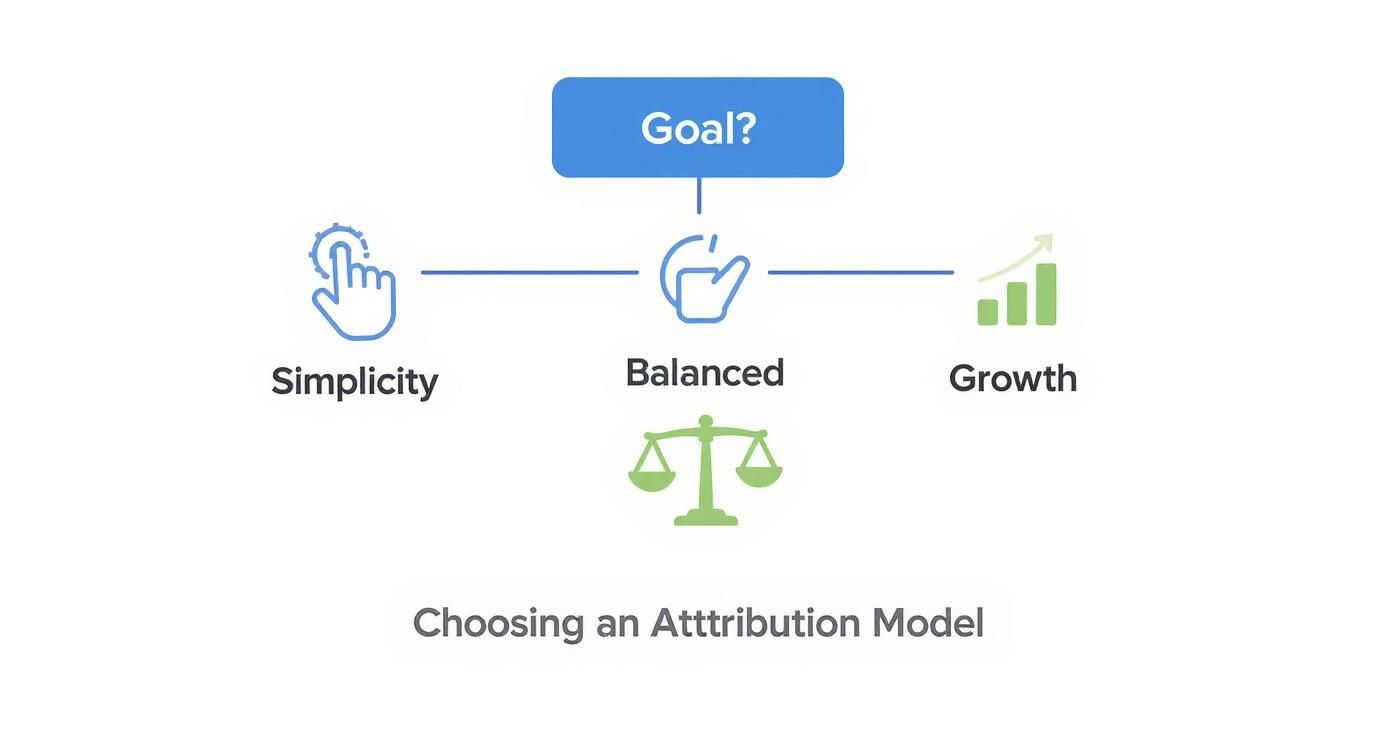
As the flowchart shows, your path begins by deciding if your priority is simplicity, getting a balanced view, or pushing for aggressive growth.
Analyze Your Marketing Mix Complexity
Finally, be honest about how many marketing channels you’re juggling. A business that relies on just paid search and email has very different needs than one managing a complex mix of SEO, social media, content marketing, and affiliates.
If your marketing is spread across a half-dozen or more platforms, a single-touch model is guaranteed to leave you with massive blind spots. You’ll be misattributing value and likely cutting budgets for channels that are playing a vital support role.
This is exactly what multi-touch models like Linear, Time-Decay, or U-Shaped were built for. They help you see how your channels work together. You might discover that your organic blog content is a powerful “assist” channel, teeing up new leads who later convert after joining your email list.
Ultimately, choosing the right model is an iterative process. Start with the one that makes the most sense for your current goals. As your business grows and your marketing gets more sophisticated, you can—and should—evolve your approach to get even deeper and more accurate insights.
Implementing Your Attribution Model and Tools

Picking an attribution model is a huge step, but it’s really just the starting line. Now comes the part of bringing that model to life by building the technical foundation that will power your insights. This process is about connecting the dots to create a complete, accurate picture of every customer interaction.
Effective cross-channel marketing attribution depends on one thing above all else: clean, unified data. Without it, even the most sophisticated model is useless. Your goal is to tear down the walls between your different marketing platforms and create a single source of truth for your customer journey data.
Think of it like putting together a puzzle. Each piece—a website visit from your analytics, a lead from your CRM, a click from your ad platforms—is valuable on its own. But it’s only when you snap them all together that you can finally see the big picture. That means integrating data from your ad platforms (like Google Ads and Meta), your website analytics, and your Customer Relationship Management (CRM) system.
Choosing the Right Tools for the Job
Once you have a plan for organizing your data, you need the right tools to make it happen. The market is full of options, from free platforms perfect for starting out to specialized software built for complex analysis.
For many small and medium-sized businesses, the best place to start is with the powerful features already in Google Analytics 4 (GA4). It gives you several attribution models you can switch between, which lets you compare how different lenses change your understanding of channel performance. We have a deep dive to help you get started with understanding key reports for data-driven insights in Google Analytics 4.
As your needs grow, you might explore other tools:
- Third-Party Attribution Software: Platforms like HubSpot, Ruler Analytics, or Triple Whale are built from the ground up for attribution. They often make it much easier to integrate different marketing channels and CRM systems, giving you a more seamless view.
- Customer Data Platforms (CDPs): Tools like Segment are designed to collect and unify customer data from all over the place. They create a central hub that can then feed clean, organized data into your analytics or attribution tools.
The best tool is the one that fits your budget, technical comfort level, and business goals. Don’t chase the most complex solution if a simpler tool like Google Analytics already gives you the insights you need.
Mastering the Technical Essentials
No matter which tools you choose, two technical pieces are non-negotiable for accurate tracking: UTM parameters and tracking pixels. These are the unsung heroes of attribution, making sure every click and interaction gets properly recorded.
UTM (Urchin Tracking Module) parameters are simple tags you add to the end of your URLs. They tell your analytics platform exactly where a visitor came from. Think of them as digital breadcrumbs that trace a user’s path back to the source.
A well-built UTM link has a few key parts:
utm_source: This identifies the platform that sent the traffic (e.g.,google,facebook,newsletter).utm_medium: This specifies the type of marketing (e.g.,cpc,social,email).utm_campaign: This names the specific campaign you’re running (e.g.,summer_sale_2024).
Consistent and disciplined use of UTMs is absolutely essential. Without them, a huge chunk of your traffic will get miscategorized, making accurate attribution nearly impossible.
Tracking pixels, on the other hand, are little snippets of code you place on your website. The most common ones are the Meta Pixel (from Facebook) and the Google Ads tag. These pixels track what users do on your site, like viewing a page or making a purchase.
When someone who has clicked one of your ads takes an action on your site, the pixel “fires” and sends that data back to the ad platform. This connection is what allows you to measure conversions and tie them back to specific ads. Getting both UTMs and pixels set up correctly ensures you capture the full story of user interactions.
Turning Attribution Data Into Actionable Insights

Getting a cross channel marketing attribution model up and running is a huge win, but the real value isn’t in the data itself—it’s in what you do with it. Data sitting in a dashboard is just noise; the goal is to turn those numbers into smarter, more profitable decisions that grow your business.
This is where the magic happens. You stop just reporting on metrics and start using that newfound clarity to strategically fine-tune your campaigns. It’s all about turning observations into actions that boost performance and drive revenue.
From Reports to Revenue
Think of your attribution reports as a treasure map pointing to optimization opportunities. The first move is to look at your key performance indicators (KPIs) through the new, more accurate lens your model provides. Two of the most important metrics to re-evaluate are Cost Per Acquisition (CPA) and Return on Ad Spend (ROAS).
A last-click model might have told you a certain channel has a terrible CPA. But with a multi-touch model, you might discover that same channel is a killer “assist” player, constantly introducing new customers who convert later.
This insight changes everything. Instead of slashing the budget for what looked like an underperformer, you now have the data to justify keeping it, knowing it plays a vital role at the top of the funnel. You can dig deeper into which metrics matter most by reviewing our educational guide on how to measure digital marketing success.
Identifying Your True Growth Levers
With a clear, multi-touch view, you can finally see which channels are your workhorses and which are your unsung heroes. This allows you to allocate your budget with real confidence, doubling down on what actually works.
Here’s a practical example:
An e-commerce store notices its podcast sponsorships have a dismal last-click ROAS. But its new position-based attribution model shows that these same podcast ads are consistently the first touchpoint for their highest-value customers.
- The old insight (Last-Click): “Podcast ads are a waste of money.”
- The new insight (Position-Based): “Podcast ads are our best tool for acquiring premium customers.”
This one shift in perspective empowers the marketing team to not only keep the sponsorships but to actively seek out similar podcasts, knowing they’re tapping into a valuable audience.
Attribution data gives you the power to defend your budget with evidence, not just intuition. It helps you shift conversations from “I think this channel is working” to “I know this channel contributes X% of the value in our customer journeys.”
Optimizing the Entire Customer Journey
Actionable insights aren’t just about shuffling budget between channels; they also shine a light on ways to improve the customer journey itself. By analyzing the common paths your customers take, you can spot patterns and identify points of friction or opportunity.
- Are certain channels better at introducing vs. closing? You might find that your SEO-driven blog posts are amazing for initial discovery, while your email marketing is what finally seals the deal. This insight allows you to tailor the messaging on each channel to its specific role.
- How long is the typical journey? If you see that your average sales cycle is 30 days, you can adjust your retargeting campaigns and email sequences to match that timeline, ensuring you stay top-of-mind without burning out your audience.
The modern customer journey is a winding road, which is why cross-channel attribution has become so essential. To make the most of your data, leveraging real-time data analytics can be a game-changer. By translating insights into immediate strategic adjustments, you build a marketing engine that’s always learning and getting better.
A Few Lingering Questions on Cross-Channel Attribution
As you begin to implement cross-channel marketing attribution, some practical questions are bound to come up. It’s one thing to understand the theory, but another to put it into practice. This final section tackles some of the most common hurdles we see businesses run into.
Think of this as an easy-to-read guide to clear up any last-minute confusion and help you move forward with confidence.
What Is the Biggest Challenge in Getting This Set Up?
Without a doubt, the biggest headache is data integration. Most businesses have plenty of data, but it’s stored in different systems that don’t connect. Your Facebook Ads platform, your CRM, Google Analytics, and your email software rarely talk to each other right out of the box.
The real struggle is pulling all that siloed customer data together into one unified view of the customer journey. Getting this right demands clean data and the right tools to stitch everything together. If you don’t build that solid foundation first, any attribution model you choose will be working with incomplete data, giving you inaccurate insights.
How Often Should I Revisit My Attribution Model?
Your attribution model is not a “set it and forget it” tool. At a minimum, it’s good practice to review and potentially tweak your model quarterly or biannually. You need to make sure it still reflects the reality of your business and how your customers are behaving.
More importantly, you should always reassess your model after a major shift in your marketing strategy. Launching a big new channel, like a podcast or an affiliate program, is a perfect trigger. So is making a significant change in how you allocate your budget. Customer behavior evolves, marketing channels change, and your attribution approach has to adapt to stay useful.
Can a Small Business Actually Use a Data-Driven Model?
Yes, but with a big caveat: it all comes down to data volume. Data-driven (or algorithmic) models need a ton of data to feed their machine learning algorithms so they can spot meaningful patterns.
Platforms like Google Analytics offer these advanced models, but a small business with low website traffic or just a handful of conversions each month simply won’t have a big enough dataset for the algorithm to produce anything reliable. In those cases, you’re far better off starting with a simpler, more educational multi-touch model like Linear or Time-Decay. They are more practical and will give you more insightful results.
Ready to stop guessing and start making decisions with real data behind them? The experts at Raven SEO can help you implement a cross-channel marketing attribution strategy that delivers genuine clarity and drives growth. Start with a no-obligation consultation to build a practical roadmap for your business. Visit us at raven-seo.com to learn more.