
A lot of Maryland business owners start fb advertising services the same way. They boost a post, target a wide area, let it run for a week, then wonder why the phone didn’t ring enough to justify the spend.
That usually happens to a contractor in Dundalk trying to stay visible against bigger regional players, a law office near Towson competing with firms that blanket the corridor, or a boutique in Annapolis getting clicks from people who were never likely to buy. The problem usually isn’t Facebook itself. The problem is treating a local market like a national one.
Facebook still gives local businesses unusual reach and targeting power. Meta platforms had 3.07 billion monthly active users in 2025, and Facebook generated an estimated $118.96 billion in ad revenue in 2023, which says a lot about how much business still flows through the platform’s ad system, according to DataAlly’s Facebook advertising statistics roundup. For Maryland companies, that scale only matters if the campaign is built around local intent, neighborhood relevance, and clean tracking.
Why Maryland Businesses Need a Hyper-Local Ad Strategy
The Baltimore-Washington corridor is crowded. A roofer in Essex isn’t just competing with other roofers in Essex. They’re competing with companies willing to target Baltimore County, Harford County, and parts of Anne Arundel from one ad account with one generic message.
That broad approach wastes money.
Generic targeting burns budget fast
A local business usually doesn’t need more impressions. It needs the right impressions from people close enough, motivated enough, and relevant enough to act. If you run the same ad to Canton, Columbia, and Bethesda without changing the message, you flatten the differences that drive response.
A med spa near Federal Hill should sound different from a family dental office in Catonsville. A home remodeler selling higher-ticket work in Severna Park should not use the same audience setup as a pizza shop in Hampden.
Practical rule: If your service area is specific, your ad geography, copy, and offer should be specific too.
Maryland buyers respond to local proof
People here know their area. They know the difference between Fells Point and Roland Park, between Ellicott City and Glen Burnie, between downtown Annapolis and the surrounding suburbs. Ads that feel local get more attention because they feel more credible.
That’s also why local paid social works best when it supports broader demand generation. If you want a useful companion read on broader lead flow, CallZent’s strategies for explosive business growth gives a practical look at how businesses turn attention into pipeline.
A strong local ad campaign also works better when your search presence is clean. If someone clicks an ad, searches your business name, and finds a weak Google profile or inconsistent location signals, performance drops. That’s why smart advertisers tie paid social to the same fundamentals covered in these local SEO best practices.
What hyper-local actually looks like
Hyper-local fb advertising services usually come down to three choices:
- Tighter geography: Serve ads only where your customers come from.
- Local creative: Use references, photos, and offers that match the area.
- Real business intent: Optimize for leads, calls, purchases, or booked appointments. Not vanity clicks.
That’s the difference between “running Facebook ads” and building a local acquisition system.
Setting Up Your Ad Account and Budget for Maryland
Most ad problems start before the first campaign launches. Weak account structure, messy billing access, missing tracking, and unrealistic budget expectations will cripple results before the creative even has a chance.
Build the account the right way
Use Meta Business Suite and keep ownership centralized. Don’t run everything through a personal profile or let a former employee control the page, pixel, or billing. If a business grows, changes agencies, or adds locations, that loose setup becomes a headache.
If you need to connect the page and ad assets correctly, this walkthrough on how to add manager access to a Facebook page is worth reviewing before launch.
Here’s the setup flow most Maryland businesses should follow:
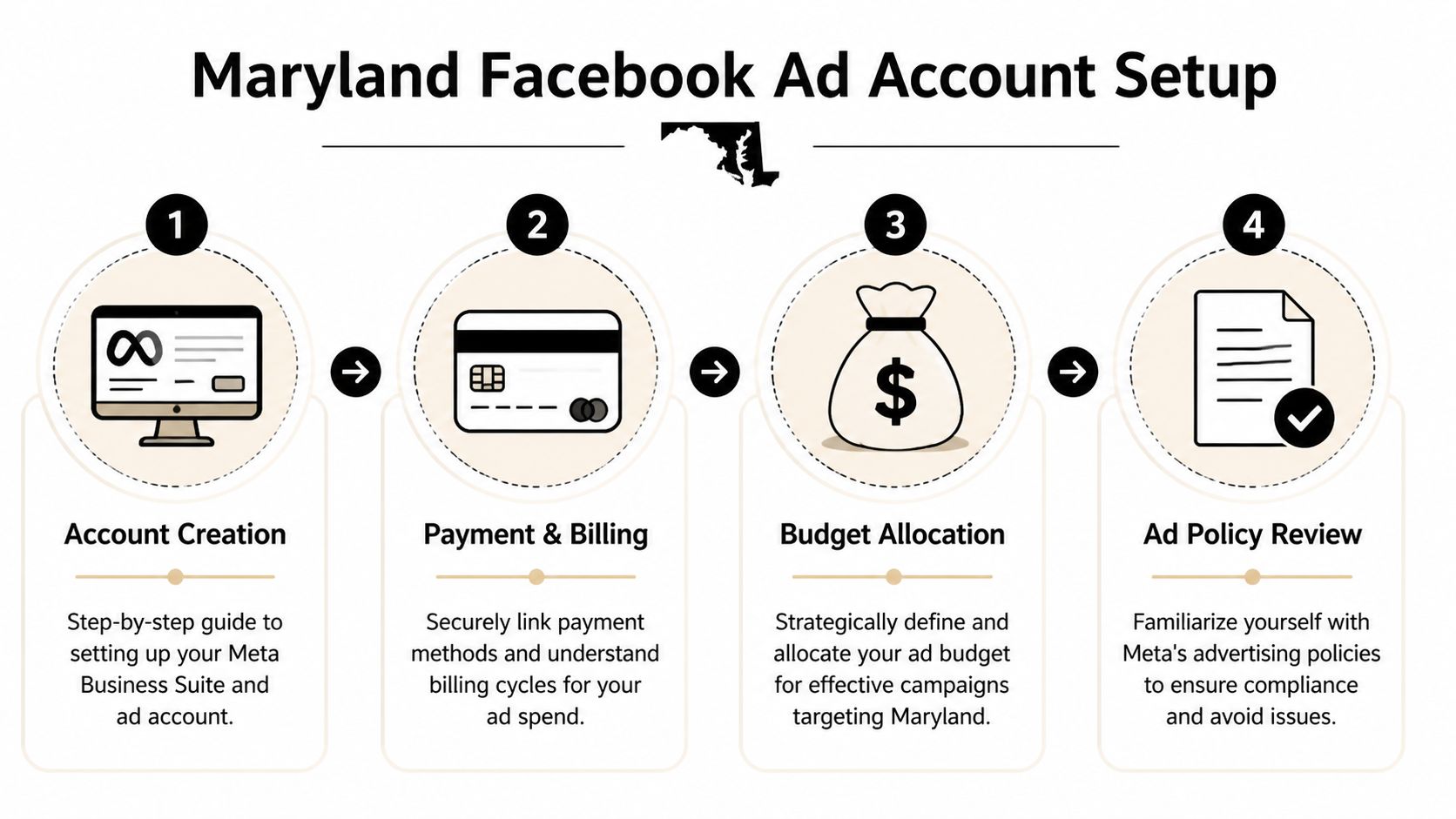
Tracking is not optional
If you can’t trust the data, you can’t make good decisions. That’s why Meta Pixel alone is no longer enough for serious fb advertising services.
Implementing Conversions API alongside the Meta Pixel can lead to a 22% average conversion rate lift and recover 15% to 20% of signal loss from privacy restrictions, according to Amra and Elma’s Facebook ads statistics roundup. In plain terms, hybrid tracking gives Meta a better read on what happened after the click.
Businesses often think their ads failed when the bigger issue is measurement loss. Bad tracking makes decent campaigns look weak.
For a local business, that means calls, form submissions, booked consultations, and purchases can get undercounted if the setup is sloppy.
Budget for learning, not fantasy
A small Maryland business doesn’t need a giant ad budget to start, but it does need enough spend to gather useful signal. Going too low often creates false negatives. The campaign never exits the messy early phase, and the owner assumes Facebook ads don’t work.
A better way to think about budget:
| Budget decision | What it means in practice |
|---|---|
| Daily budget | Better when you want stable pacing and ongoing lead flow |
| Lifetime budget | Better when you have a fixed promo window or event |
| Testing budget | Reserved for audience, offer, and creative variation |
| Scaling budget | Added only after a clear winner appears |
Where Maryland businesses usually go wrong
- They launch without conversion tracking: Then judge results by comments or likes.
- They spread spend across too many campaigns: The account never gathers enough data in one place.
- They chase the cheapest clicks: Cheap traffic often means weak intent.
- They skip policy review: Ads get rejected, delayed, or limited.
A cleaner account setup doesn’t guarantee results. It does make results possible.
Designing Campaigns That Resonate with Marylanders
A campaign should match the business model. That sounds obvious, but many local advertisers still run traffic campaigns when they need leads, or engagement campaigns when they need sales.

Keep the campaign structure simple
Meta’s structure is easier to manage when you treat it like this:
- Campaign: The business goal.
- Ad set: The audience, placements, budget, and optimization choices.
- Ad: The actual message, image or video, headline, and CTA.
That hierarchy matters because it forces discipline. If the business goal is lead generation for a Towson personal injury firm, the campaign should optimize for leads. If the business goal is online purchases for a Baltimore apparel brand, the campaign should optimize for sales.
Pick the objective based on business intent
Many local campaigns falter at this juncture. A lot of owners choose Traffic because they assume more website visitors will naturally turn into more business. Often they don’t.
Choosing a Leads objective over Traffic is usually the stronger move for service businesses. Lead generation campaigns on Facebook average a 2.53% CTR, which is 61% higher than traffic campaigns, according to Focus Digital’s Facebook CTR benchmark data.
That matters for businesses like:
- Law firms in Annapolis: Use Lead forms for consultation requests.
- HVAC companies in Baltimore County: Use instant forms or call-focused landing pages.
- Med spas in Columbia: Use lead campaigns for appointment inquiries.
- B2B providers near the I-95 corridor: Use forms to qualify prospects before a sales call.
An eCommerce store is different. If the sale happens on-site, a Sales objective tied to clean conversion tracking usually makes more sense than a lead campaign.
Creative should look and sound local
Maryland audiences can spot generic creative instantly. Stock-photo-heavy ads with vague claims rarely hold attention. Better ads use recognizable settings, actual team photos, real service visuals, or product shots that feel grounded.
A few examples:
- A Canton fitness studio should use real class footage, not anonymous gym stock imagery.
- A Fed Hill restaurant should feature the dining experience, not a generic plate on a white background.
- A contractor serving Anne Arundel County should show actual project types common to the area.
The best local ads don’t try to look polished first. They try to look believable first.
Use copy that solves one problem clearly
Most local ad copy gets too broad. It lists everything the company does, then asks for action. That creates weak relevance.
A stronger approach is to build each ad around one angle:
| Business type | Weak message | Better local message |
|---|---|---|
| Roofing company | We do all roofing services | Storm damage inspection for homes in your service area |
| Law firm | Experienced legal help | Fast case review for a specific legal issue |
| Boutique | Shop our new arrivals | New seasonal styles for local shoppers who want curbside pickup |
| Dentist | Full family dentistry | New patient offer tied to a specific treatment need |
That focus makes the click more qualified. It also makes the landing page easier to align with the ad.
Mastering Hyper-Local Targeting in Maryland
A bakery in Canton does not need the same Facebook audience setup as a family law firm serving Roland Park and Towson. Yet I still see Maryland campaigns built with a 20-mile radius, a pile of interests, and no clear service-area boundaries. That is how local budgets get drained.
Different neighborhoods need different targeting logic
Hyper-local targeting starts with how people buy in each part of Maryland.
In Hampden, a coffee shop can stay tight. A short radius, mobile-first placements, and offers built around repeat visits usually make sense because convenience drives the click. In Fells Point, a retailer may need a different mix. Tourist foot traffic matters, but so do locals who browse on Instagram, visit later, and come back after seeing a retargeting ad.
Service businesses need a wider lens, but still with discipline. A remodeling firm working in Bethesda or Anne Arundel County should target the neighborhoods that fit the project size, home value, and travel range the team can profitably serve. A law office in Roland Park may pull leads from a broader geography, but the copy and landing page still need to speak to a specific local client, not the entire state.
That is the point. Geography is only useful when it matches buying behavior.
Benchmarks shift by business model
Lead cost expectations should reflect the category you are in, not what another local owner says they paid.
WordStream's industry summary shows that Facebook cost per lead varies widely by vertical, with legal far more expensive than categories like real estate and retail in many cases, as reported in WordStream's Facebook ads benchmarks by industry. If you run a Maryland law practice, comparing your CPL to a realtor in Howard County will lead you to the wrong conclusion fast.
The better question is simpler. Are you getting qualified leads at a cost your sales process can turn into profit?
Cheap clicks from the wrong ZIP codes create nice-looking reports and bad revenue.
Use layered audiences instead of one broad guess
A solid Maryland account usually has a few audience types working together, not one oversized cold audience doing all the lifting.
- Core local audience: City, ZIP code, or radius targeting based on true service areas.
- Custom audience: Website visitors, past leads, customer lists, video viewers, and page engagers.
- Lookalike audience: Built from actual customers or qualified leads once the account has enough clean data.
- Exclusions: Existing customers, recent converters, and neighborhoods you do not serve profitably.
This setup gives Meta room to optimize while protecting your budget from obvious waste. It also makes testing cleaner. If one ad set is built around Federal Hill prospects and another focuses on homeowners in Severna Park, performance differences are easier to interpret and act on.
If your site already has neighborhood pages, local case studies, or service-area content, use those assets in the funnel. They improve message match after the click and support trust before someone calls. For businesses building that foundation, this guide on how hyper-local content supports targeting and trust is worth reviewing.
Where local targeting usually breaks down
The pattern is pretty consistent across Baltimore-area accounts.
First, the map is too wide. Ads reach people outside the true service area, including users who may click but will never book.
Second, the audience logic is soft. Layering random interests onto a local campaign often lowers relevance instead of improving it, especially for businesses where location and intent matter more than hobbies.
Third, the message is too general for the area being targeted. A homeowner in Locust Point and a shopper in Towson may both live in Maryland, but they do not respond to the same offer, timing, or proof points.
The hook is often the actual problem. If the audience is local but the ad still reads like a generic national campaign, results flatten out.
Hyper-local targeting works best when the radius, the neighborhood, and the promise in the ad all line up. That level of restraint is what separates a Maryland campaign that spends money from one that produces calls, appointments, and store visits.
Tracking Performance and Integrating with Local SEO
A Canton salon owner can look at Meta Ads Manager in the morning, see cheap clicks, and assume the campaign is working. By Friday, the front desk says the calls were weak, no one mentioned the offer correctly, and the booked appointments came from Google searches, not the ad itself. That is a normal local reporting problem. Facebook created the demand, but the business only counted the last step.
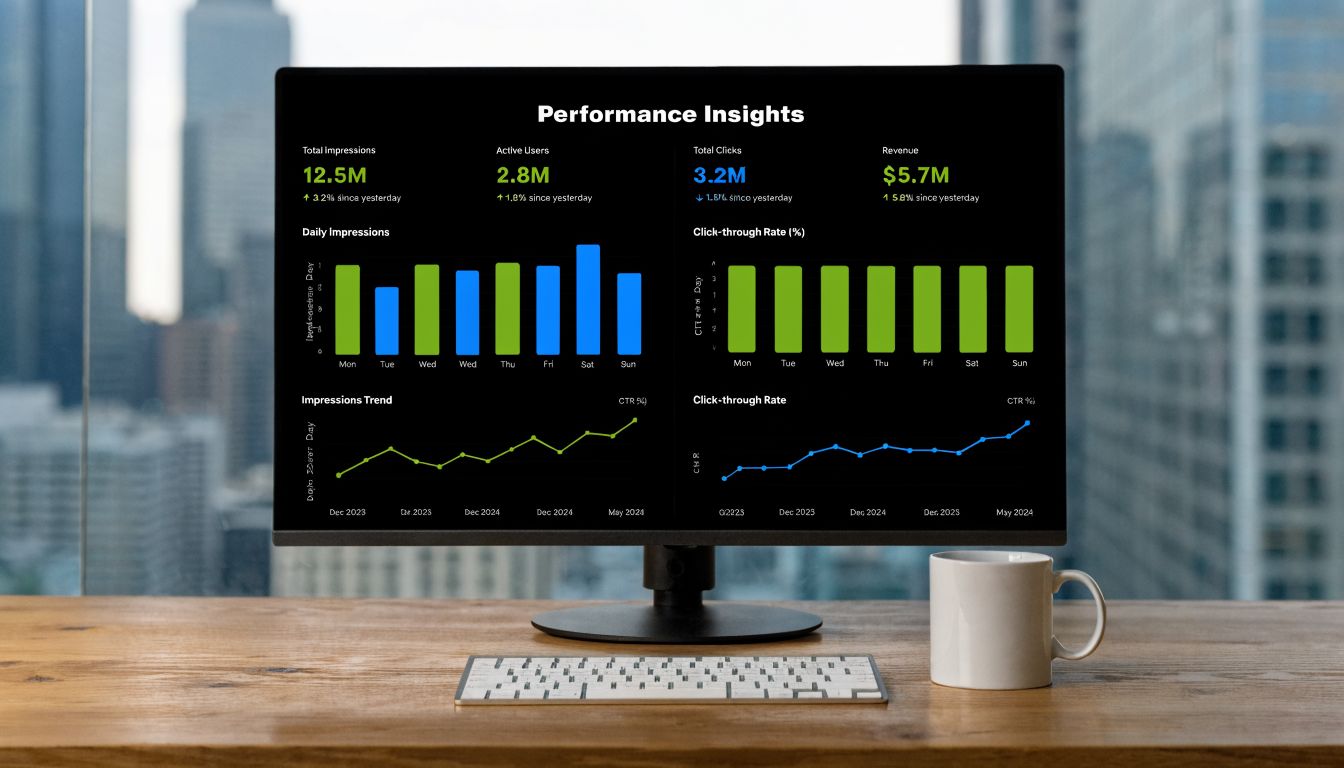
Watch the metrics that connect to revenue
Local campaigns need a shorter scoreboard.
Start with cost per lead, booked call, purchase, or direction request. Then check click-through rate to see whether the message earned attention from the right people. For ecommerce, return on ad spend still matters. For service businesses in Baltimore, lead quality usually matters more than raw lead volume, so match Meta results against what your staff hears on the phone and what turns into jobs.
Benchmarks can give you context, but they do not run your account. A Hampden HVAC company and a Fells Point boutique will not share the same click costs, sales cycle, or close rate. Use benchmarks as a loose reference point, then judge performance by your own margins, close rate, and service area reality.
Track what happens after the click
At this stage, many Maryland businesses lose the plot.
A prospect might see your ad, ignore it, search your brand that night, check your reviews, visit your Google Business Profile, and call two days later. If you only credit the final branded search, Facebook looks weaker than it really was. If you only trust Meta's reported conversions, search looks weaker than it really was.
That is why local reporting should include ad platform data, CRM outcomes, Google Business Profile activity, and branded search trends in the same review. If you want a better framework for measuring assisted conversions across channels, this cross-channel marketing attribution guide is a useful reference.
Paid social can improve local SEO performance
Facebook ads do not raise rankings by themselves. They can, however, increase the branded searches, review activity, repeat visits, and location-page traffic that often show up around stronger local visibility.
The connection is practical. Run a neighborhood-specific ad for Federal Hill or Locust Point, send traffic to the matching service page, and make sure the same offer appears on your Google Business Profile posts or landing page. That message consistency improves trust and makes branded search behavior easier to read. National guides usually stop at ad metrics. Local businesses need to measure what happens across Meta, Google search, and GBP together.
Test angles before you polish minor details
Small edits rarely rescue a weak offer. Message angle does.
For the same Maryland remodeling company, these angles lead to very different responses:
| Angle | Message focus |
|---|---|
| Stress reduction | Make the renovation process easier to manage |
| Home value | Improve resale appeal and long-term equity |
| Family function | Create more usable space for daily life |
| Design pride | Upgrade how the home looks and feels |
AdEspresso explains the concept well in its write-up on Facebook ad angles. I see the same pattern in local accounts. A kitchen remodel ad built around "less chaos during construction" can outperform a polished before-and-after creative set if the audience is made up of busy families in Roland Park or Towson.
If results are flat, test the promise first.
For owners deciding whether they have the time and reporting discipline to do this in-house, Sensoriium's guide for scaling paid social efforts lays out the trade-offs clearly.
Your Next Steps for Facebook Advertising Growth
Local Facebook ads work best when they’re built around geography, intent, and measurement. That means tighter targeting, cleaner tracking, stronger offers, and creative that feels native to the communities you serve.
Maryland businesses that do this well don’t treat fb advertising services like a side experiment. They treat them like a controllable acquisition channel. They know which neighborhoods matter, which campaign objectives fit the business, and which numbers deserve attention.
If you’re still deciding whether to keep managing campaigns in-house or bring in outside help, Sensoriium has a useful guide for scaling paid social efforts that lays out the trade-offs clearly.
For businesses that want a broader system around paid social, local visibility, and conversion support, it also helps to review what a full social media marketing strategy for small businesses should include beyond just ad setup.
The businesses that win on Facebook usually aren’t louder. They’re more precise.
Frequently Asked Questions about FB Advertising Services
How much should a Maryland business spend to get started
Start with a budget you can sustain long enough to learn from. The exact amount depends on your industry, service area, and sales model, so don’t copy another business blindly.
A better question is whether the budget is large enough to support testing. You need room to compare audiences, offers, and creative without shutting the campaign off too early. If the spend is too tight, the data usually stays noisy.
Do I need a website to run Facebook ads
No, but a website usually gives you more control.
Lead forms inside Facebook can work well for service businesses that want consultation requests or quote inquiries. That said, a website gives you stronger tracking, better follow-up options, and a place to support the ad with proof like reviews, FAQs, and service details.
For eCommerce, a website is usually the better path because the product page, cart experience, and checkout all affect performance.
What’s the difference between boosting a post and running a real campaign
Boosting is the simplified version. It can be useful for extra visibility, but it has far less strategic control.
A proper campaign in Ads Manager lets you choose the right objective, build custom audiences, run retargeting, test multiple creatives, and optimize for actual business outcomes. If the goal is leads or sales, that’s the better setup.
How long does it take to know if a campaign is working
You need enough time to gather signal, but not so much time that you let a weak campaign drift.
In practice, you’re looking for early indicators first. Is the click-through rate healthy? Are leads coming in? Is the cost per result within a reasonable range for your industry? Then you look at lead quality, call outcomes, and sales feedback.
Don’t make major decisions off a few hours of data. Don’t let a poor setup run unchecked for weeks either.
Should I target all of Maryland or just my immediate area
Only target the area you can serve profitably and well.
A local restaurant, salon, gym, or med spa should stay tight. A law office, home service company, or regional B2B provider may need a broader footprint, but even then, the targeting should reflect actual service patterns rather than hopeful expansion.
What’s the biggest mistake small businesses make with Facebook ads
Most small businesses either go too broad or track too loosely.
They target a large area, use generic copy, and then judge performance by surface-level engagement. The better approach is simple. Match the geography to your real market, match the objective to the result you want, and track outcomes you can tie back to revenue.
If you want a practical plan instead of more guesswork, Raven SEO can help you build a Facebook and local search strategy that fits your market, your budget, and your actual growth goals. For Maryland businesses that need clearer targeting, better tracking, and campaigns tied to real business outcomes, Raven SEO offers the no-nonsense support most owners wish they had before spending their first ad dollar.