

Handling hyper-local content isn’t about casting a wide net over a city; it’s about using a magnifying glass. It means you stop talking to “Baltimore” and start speaking directly to the people in Federal Hill, Canton, or Fells Point. This educational approach is how you build immediate trust and show up for the customers right around the corner.
What Hyper-Local Content Means for Maryland Businesses
If you run a business in Maryland, you know Baltimore isn’t a single market. It’s a patchwork of fiercely unique neighborhoods. A customer in Roland Park has entirely different reference points than someone working in the Inner Harbor, and that’s the whole game.
A hyper-local strategy is about making your digital presence reflect that on-the-ground reality. You’re trading the wide-angle lens for a microscope, zeroing in on the specific streets, landmarks, and community quirks your customers see every day. The goal is to feel less like a faceless company and more like the familiar, trusted neighbor down the block.
To put this into perspective, let’s break down the core components of what a hyper-local content strategy actually involves in this easy-to-read guide.
Core Components of a Hyper-Local Content Strategy
This table outlines the essential pieces, moving from abstract concept to a concrete example for a local Baltimore business.
| Component | Description | Example for a Baltimore Plumber |
|---|---|---|
| Micro-Audience Definition | Identifying and targeting customers in specific, small geographic areas (e.g., neighborhoods, zip codes) rather than an entire city. | Instead of targeting “Baltimore,” focus on homeowners in the Federal Hill (21230) or Hampden (21211) neighborhoods. |
| Geo-Targeted Content | Creating content that speaks directly to the needs, landmarks, and language of that micro-audience. | Write a blog post titled, “Fixing Leaky Pipes in Historic Federal Hill Rowhomes: A Plumber’s Guide.” |
| Local Search Intent | Answering the specific questions and “near me” queries that customers in that area are searching for. | Create a service page optimized for “emergency plumber Canton Baltimore” to capture high-intent, urgent searches. |
Seeing it laid out like this makes it clear: this isn’t just about dropping a neighborhood name into your content. It’s a fundamental shift in how you approach your entire digital marketing plan.
The Power of Neighborhood-Specific SEO
Drilling down to this granular level isn’t just a “nice-to-have” tactic; it drives real business results. When your ideal customers search for services, they almost always include their neighborhood or use “near me” queries. Having content dedicated to their exact location dramatically increases your odds of showing up for these high-intent searches.
In fact, getting hyper-local right can boost your conversion rates by 3-5 times compared to a generic, city-wide strategy. For a digital marketing agency like Raven SEO, this means we don’t just target ‘Baltimore SEO.’ We create content for ‘SEO services in Canton, Baltimore,’ which attracts local business owners who are ready to meet and filters out unqualified leads from miles away. This precision leads to higher click-through rates and lower bounce rates because the content feels instantly relevant.
By speaking the language of a specific neighborhood, you build an instant connection. You’re no longer just another option; you’re the local expert who truly gets the community.
Building Your Foundation
To pull this off, you have to think like a local. What are the unique problems for homeowners in Federal Hill’s historic rowhomes? What are the go-to lunch spots for professionals in Harbor East? Answering these kinds of questions is where it all starts.
A fantastic example of this in practice is a resource like this detailed Nassau County NY living guide, which perfectly demonstrates how to create content that serves a very specific geographic community. Building this foundational knowledge is non-negotiable for creating authentic content that actually works. If you’re just starting, our guide on local SEO best practices is a great place to begin.
Ready to move from theory to practice? This is how you start winning in local search. To really nail hyper-local content, you need a playbook that goes way beyond just name-dropping a neighborhood. It’s about building specific content assets, each engineered to capture a different kind of local search.
This isn’t about slapping together cookie-cutter pages. It’s about proving you’re part of the community you serve by embedding true local flavor—from interactive maps that show your service area to testimonials from clients who live right down the street. Forget the generic templates. Let’s build content that feels like it was made exclusively for your customers in Roland Park, Federal Hill, or Canton.
The Three Pillars of Hyper-Local Content
To build a truly powerful hyper-local presence, you’ll want to focus your energy on three core types of content. Each one plays a unique role in attracting and converting customers in the neighborhoods you serve.
- Dedicated Location Pages: If you have a physical storefront, this is non-negotiable. Think of this page as the digital front door for that specific location, giving local customers every essential detail they need.
- Service-in-Neighborhood Pages: This is the absolute powerhouse for service-area businesses (SABs). These pages are built to target high-intent searches like “emergency roof repair in Roland Park,” combining a specific service with a specific neighborhood.
- Community-Focused Blog Posts: This is where you earn trust and establish yourself as the local authority. These posts tackle local pain points, answer community questions, and show off your expertise in a way that truly connects with residents (e.g., “A Homeowner’s Guide to Federal Hill’s Historic District Regulations”).
By developing these three assets, you create a comprehensive net that catches users at every stage of their local search journey.
Building the Ultimate Service-in-Neighborhood Page
Let’s get tactical. Imagine you’re a roofer in Baltimore, and you want to win more business in the historic Roland Park neighborhood. A generic “Roofing Services” page just isn’t going to cut it. You need a dedicated page for “Roof Repair Roland Park” that speaks directly to those homeowners.
Here’s an example of an interactive map you could embed on a neighborhood page. It gives people immediate visual context and confirms you know the area.
This map instantly orients the user, showing them they’ve found a provider who understands their precise location.
To turn this page into a real conversion machine, you have to infuse it with unique, local details. Don’t just say you work in the area—prove it.
Your page should include:
- Neighborhood-Specific Language: Talk about common issues you see there, like the challenges of working with slate roofs on historic Roland Park homes. This shows you have hands-on experience.
- Local Testimonials: Feature a quote from a happy client right there in the neighborhood. A review from “Sarah P. in Roland Park” is infinitely more powerful than a generic one.
- Photos of Local Work: Add a gallery showcasing projects you’ve completed within that community. Visual proof builds an incredible amount of trust.
- References to Local Landmarks: Mentioning nearby spots like the Roland Park Water Tower or Stony Run Trail adds a layer of authenticity that generic content can never match.
This approach transforms a simple service page into a high-value local resource. It signals to both users and Google that you are the go-to expert for that community.
Using Video to Tell a Local Story
Text and images are the foundation, but video can forge a connection that nothing else can. When you’re creating compelling hyper-local content, incorporating small business video marketing tips helps you craft stories that genuinely resonate with the people in your target neighborhoods.
A short video testimonial from a client standing in front of their Federal Hill home is more convincing than pages of text. It provides social proof and a human element that builds instant credibility.
You could even create a short video tour of a project you just wrapped up in a specific neighborhood, pointing out the unique challenges you solved. This does more than just showcase your work; it reinforces your deep understanding of the local architecture and community standards. It’s all about showing, not just telling.
Creating Community-Centric Blog Content
Your blog is your opportunity to move beyond the hard sell and become a true community resource. This type of content is perfect for grabbing those informational search queries and building long-term brand loyalty.
Think about the questions and concerns that are specific to the residents you serve.
- A landscaper could write “Best Native Maryland Plants for Canton’s Container Gardens.“
- A real estate agent might create “Navigating School Zones in the Towson Area.“
- An IT company could publish “Improving Wi-Fi in Fells Point’s Historic Brick Rowhomes.“
These topics are hyper-specific and incredibly useful to your target audience. They position your brand as a helpful expert, not just another service provider. By consistently producing content that addresses the unique lifestyle and challenges of each neighborhood, you build a loyal following and a powerful SEO moat that competitors will have a tough time crossing. Here at Raven SEO, we find this strategy is absolutely key to helping our Maryland-based clients dominate their local search results.
Optimizing Your Content for Local Search Engines
Creating brilliant, hyper-local content is half the battle. The other half? Making sure search engines like Google can actually find, understand, and rank it. This is where the technical side of your strategy comes into play.
Think of it as giving Google a crystal-clear map to your business’s front door for every single neighborhood you serve. Proper on-page optimization is how you send precise signals about your location, your services, and your relevance to a specific community. Without this technical foundation, even the most compelling neighborhood page can get lost in the digital noise.
Speaking Google’s Language with Local Schema Markup
One of the most powerful tools in your local SEO toolkit is schema markup. This is essentially a special vocabulary you add to your website’s code to help search engines understand the context of your content. It’s like adding descriptive labels to your information so Google can easily categorize it.
For any hyper-local strategy, the LocalBusiness schema is non-negotiable. It lets you spell out critical details like:
- Business Name, Address, and Phone (NAP): The absolute bedrock of local SEO.
- Service Area: You can define the specific neighborhoods or zip codes you cover, like “21231” for Fells Point.
- Opening Hours: Critical for customers looking for immediate service.
- Reviews and Ratings: This builds trust by pulling your star ratings directly into the search results.
Implementing this markup clearly tells Google, “This business is located here and serves these specific surrounding areas.” It takes all the guesswork out of the equation and gives you a serious leg up in “near me” searches.
By correctly implementing local schema, you’re not just hoping Google figures out your service area—you’re explicitly telling it. This can dramatically improve your chances of appearing in the coveted local map pack.
The Overlooked Power of Geo-Tagging Media
Every single photo and video you upload is another chance to reinforce your local relevance. Geo-tagging is the simple process of adding geographic coordinates (latitude and longitude) to the metadata of your media files.
When you snap a picture of a finished roofing project in Canton, geo-tagging that image before uploading it adds another layer of tangible proof that you operate there. This data gives search engines verifiable, physical evidence of your local footprint, which strengthens the authority of your neighborhood-specific pages.
Building Authority with Strategic Internal Linking
Your website’s structure matters. A lot. You can’t just publish a dozen neighborhood pages and hope for the best; you need to connect them logically using internal links. This helps both users and search engines navigate your site and understand how your pages relate to one another.
Picture this: you have a main “Roofing Services” page. From that page, you should link out to your specific neighborhood pages like “Roof Repair Federal Hill” and “New Roof Installation Canton.” Just as important, those neighborhood pages should link back up to your main service page.
This creates a topic cluster, or silo, with your main service page as the central pillar, supported by all your hyper-specific neighborhood pages. This structure signals to Google that you have deep authority on the topic of roofing throughout the Baltimore area. And to really amplify those local signals, a well-optimized Google Business Profile is key.
Avoiding the Duplicate Content Trap for Multi-Location Businesses
If your business has multiple physical locations or serves many distinct neighborhoods, the fear of getting hit with a duplicate content penalty is real. It’s a valid concern—if you just copy and paste the same service description onto every page and swap out the neighborhood name, you’re asking for trouble.
The solution is to provide unique value on every single page. Each location or neighborhood page must offer distinct, genuinely useful information.
- Location-Specific Details: Add the address, hours, and an embedded map for that specific branch.
- Unique Local Content: Talk about nearby landmarks, showcase projects you’ve completed in that area, and feature testimonials from local clients.
- Targeted Keywords: Optimize each page for keywords specific to that neighborhood (e.g., “IT support Towson” vs. “IT support Columbia”).
By ensuring each page is a genuinely unique resource, you show Google you’re providing tailored information, not just spamming keywords. At Raven SEO, we specialize in helping Maryland businesses build out these unique local assets to ensure they dominate search results in every community they serve.
Take Your Hyper-Local Content Beyond Your Website
A killer hyper-local content strategy can’t just live on your website. If you really want to own the local search results, you have to push that same neighborhood-specific focus out to the external platforms where your customers are already looking. Doing this creates a consistent, authoritative presence that Google absolutely loves.
Think of your website as the central hub. Platforms like your Google Business Profile (GBP) and local business directories are the spokes connecting you directly to the community. When you treat these channels with the same level of detail as your on-page content, you create a powerful feedback loop that cements your local relevance and drives real-world results.
Master Your Google Business Profile for Hyper-Local Wins
Your Google Business Profile is, without a doubt, your most valuable local SEO asset. It’s often the very first thing a potential customer sees from your brand, popping up right in Google Search and on the Map. Just filling it out and forgetting it is a massive mistake; you need to manage it like a dynamic, hyper-local marketing machine.
This means going way beyond the basic info and using its features to connect directly with the neighborhoods you’re targeting.
- Neighborhood-Specific Posts: Use Google Posts to show off projects you just finished in a specific area. A quick post like, “Just wrapped up a beautiful kitchen remodel in Canton!” with a few photos shows you’re active and working in the communities you claim to serve.
- Local Q&A Engagement: Don’t wait for people to ask questions—get ahead of them. Use the Q&A feature to ask and answer common questions relevant to specific neighborhoods, like, “Do you offer emergency plumbing services in the 21230 zip code?” This tackles local concerns before a customer even has to type them out.
- Review Responses with Local Keywords: When a happy customer from Federal Hill leaves you a glowing review, thank them by name and be sure to mention their neighborhood. A simple reply like, “Thanks so much, Sarah! We’re thrilled you love your new roof in Federal Hill,” reinforces your local connection for everyone else who reads it.
The Make-or-Break Role of Consistent Local Citations
Beyond Google, your business info is scattered across a ton of online directories—think Yelp, Angi, and even niche industry sites. Every single one of these listings is a local citation, and making sure they are all perfectly consistent is non-negotiable for local search visibility.
A citation is just any online mention of your business’s Name, Address, and Phone number (NAP). When your NAP information is identical everywhere, it sends massive trust signals to Google, confirming you’re a legitimate, established local business.
Inconsistent NAP information is a huge red flag for search engines. A tiny variation in your business name or a wrong zip code can create confusion, kill trust, and tank your local rankings.
Think of it this way: if ten different people give Google ten slightly different addresses for your shop, Google gets nervous and won’t confidently send customers your way. But if all ten give the exact same information, Google trusts that it’s correct. Nailing this consistency is a foundational step in any serious hyper-local plan. At Raven SEO, one of the very first things we do for a new client is a deep-dive citation audit. You can get a better feel for the whole process by checking out our overview of local citation building services.
This obsession with off-site detail isn’t just busywork; it’s a strategic necessity. It’s shocking how much money is left on the table when brands fail to connect at this granular level. Research shows that poor local visibility costs brands a staggering $54.1 billion annually, while top performers see their revenue grow 2-3 times faster. In today’s economy, focusing your marketing efforts on specific Baltimore neighborhoods like Charles Village or Roland Park is just smart business—it maximizes your ROI, a core principle we live by at Raven SEO. This is more critical than ever as consumers increasingly ignore national noise in favor of trusted voices from their own community. You can discover more insights about why hyperlocal strategies are a goldmine for agencies on exverus.com.
By mastering both your Google Business Profile and your wider citation network, you build an undeniable digital footprint in the neighborhoods that actually matter to your bottom line.
Scaling Your Strategy and Measuring Real Results
Targeting a single neighborhood is a great start. But to truly dominate your local market, you have to scale that initial success across your entire service area. This is where things get tricky.
Moving from a single campaign to a full-blown strategy introduces some real operational headaches. How do you possibly handle hyper-local content for ten, twenty, or even fifty different communities without the quality tanking?
The answer is building efficient, repeatable workflows. It’s all about creating smart templates and using the right tools to do the heavy lifting. This frees up your team to focus on what really matters—adding that authentic, human touch that makes local content connect.
Creating a Scalable Content Production Workflow
To scale effectively, you need a system. Start by building a master template for your “service-in-neighborhood” pages. This template should have standardized sections that are easy to customize for each new area you target.
Think of it as a blueprint with placeholders for:
- Neighborhood-Specific Intro: A unique opening paragraph that mentions local landmarks or common pain points in that area.
- Local Testimonials: A spot reserved for a glowing review from a client in that specific community.
- Project Photo Gallery: A section to show off work you’ve actually completed in that neighborhood.
- Embedded Local Map: A map centered on the neighborhood for immediate visual context.
- Unique Local FAQ: A list of 2-3 questions specific to homeowners or businesses in that community.
With this structure in place, you can use AI assistants to generate initial drafts for each section, which dramatically speeds up production. But the final step is always human. A team member has to go in, inject local nuance, verify details, and make sure the tone is right. That’s how a generic draft becomes an authentic local resource.
Redefining Your Metrics for Success
When you’re doing hyper-local content, standard metrics like overall website traffic just don’t cut it. Success isn’t about getting more visitors; it’s about getting the right visitors from the specific areas you want to serve. You need to shift your focus to more granular, location-based Key Performance Indicators (KPIs).
Measuring hyper-local ROI means looking beyond broad analytics. You have to connect your content efforts directly to tangible actions from customers in your target neighborhoods.
This process flow shows how to monitor your local reach across your most important digital assets—your website, Google Business Profile, and citations.
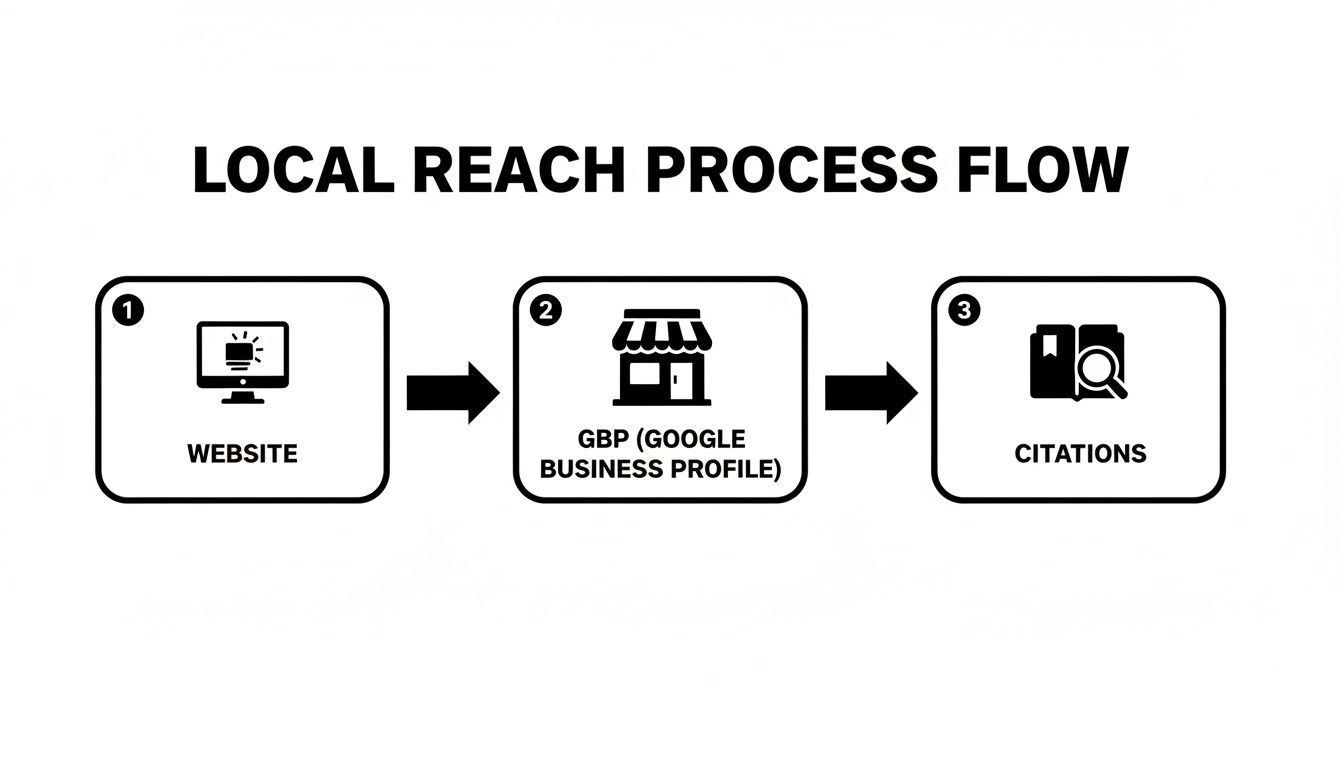
The key thing to see here is how these elements work together. Strong performance on your website drives better GMB signals, which get reinforced by consistent citations across the web.
Tracking the KPIs That Actually Matter
It’s time to stop looking at your main dashboard and start digging deeper into your analytics. These are the metrics that will give you a clear framework for proving the ROI of your hyper-local strategy.
1. Neighborhood Keyword Rankings:
Use an SEO tool to track your rankings for terms like “plumber Federal Hill” or “landscaping services Towson.” Are you climbing the ladder for these specific, high-intent phrases? A steady rise is a direct sign that your strategy is paying off.
2. Conversions from Location Pages:
Get into your Google Analytics, set up conversion goals, and segment your reports to see how many leads (form fills, calls, you name it) are coming directly from your individual neighborhood pages. This data tells you exactly which areas are your top performers.
3. Google Business Profile Actions:
Keep a close eye on your GBP Insights. Track the growth in clicks for phone calls, website visits, and direction requests. A noticeable jump in these actions after launching new hyper-local content is a clear win.
This level of local detail is only becoming more critical. By 2026, voice search will be a major player, with 76% of voice queries carrying local intent and powering over $2 billion in commerce. Voice assistants prioritize neighborhood-specific content for queries like “best lawyer near Mount Vernon,” demanding that businesses—like those we serve in Baltimore—optimize with precise proximity signals.
The data already shows that 58% of consumers use voice search for local info, asking conversational questions that your hyper-local pages are perfectly designed to answer.
By tracking these specific metrics, you can clearly show the value of your work and make data-driven decisions to fine-tune and expand your strategy. For a deeper dive, check out our guide on how to measure digital marketing success.
Common Questions About Hyper-Local SEO
Jumping into a hyper-local strategy can feel like a big shift, and it’s totally normal for a few questions to pop up. When you decide to really lean into hyper-local content, you’re investing in a more precise, community-focused game plan. Let’s tackle some of the most common hurdles and questions we hear from businesses all the time.
Our goal here is to give you clear, straightforward answers that will help you move forward with confidence.
How do you create unique content for multiple locations?
This is a really common and valid concern about duplicate content. The short answer is no—creating multiple pages won’t hurt your SEO, but only if you do it the right way.
Simply copying and pasting your service description and swapping out the neighborhood name is a recipe for disaster. That’s what search engines penalize. The key is to make sure every single neighborhood page is genuinely unique and valuable on its own.
While the core service you offer doesn’t change, you have to customize the surrounding content to provide distinct local flavor.
- Talk about local landmarks or well-known streets to prove you know the area.
- Feature testimonials from clients who actually live in that specific neighborhood.
- Discuss unique challenges that are relevant to that community, like “navigating historic home plumbing in Fells Point” versus “installing high-efficiency HVAC in new Columbia townhomes.”
This unique content tells Google that each page serves a different local audience, neatly sidestepping any duplicate content penalties. You can dig deeper into what makes local pages rank in our guide on local search ranking factors.
Is This Strategy Only for Businesses with a Physical Location?
Absolutely not. In fact, hyper-local content is an absolute game-changer for service-area businesses (SABs) like plumbers, landscapers, mobile detailers, and IT consultants. Even if you don’t have a storefront customers can walk into, you can—and should—create dedicated pages for every neighborhood you serve.
These pages are built to capture those high-intent “near me” searches from potential customers right where they are. For example, a page perfectly optimized for “Landscaping Services in Towson” can rank for searches made by homeowners in that Maryland suburb, driving highly qualified leads right to your phone.
You don’t need a physical address in a neighborhood to be the most relevant digital result for a customer searching there. Your content’s relevance is what earns you that top spot.
How many neighborhoods should a small business target at once?
It’s tempting to go broad and try to hit every single neighborhood in your service area right out of the gate, but that approach almost always backfires. The best way to do it is to start small and focused.
We always recommend starting with 3-5 of your most important service areas. These are the neighborhoods where you already have a solid customer base or see the biggest opportunity for growth. By zeroing in your efforts, you can create genuinely high-quality, in-depth content for these core areas first. Once you start seeing real results—like better rankings and more leads from those pages—you can use them as a template to scale your efforts outward. Trying to tackle 20 neighborhoods at once just leads to thin, cookie-cutter content that doesn’t rank for anything.
At Raven SEO, we specialize in crafting hyper-local strategies that put your business on the map in the neighborhoods that matter most. If you’re ready to stop competing for the whole city and start winning over your ideal local customers, let’s talk. Visit us at https://raven-seo.com to schedule your no-obligation consultation today.