
What exactly are local search ranking factors?
Think of them as the specific signals Google’s algorithm uses to decide which local businesses appear for “near me” searches. To rank high, you need to master three core pillars: Proximity (how close you are to the searcher), Relevance (how well your business matches their search), and Prominence (how well-known and reputable your business is).
Getting these three right is the secret to appearing in the valuable local pack and on Google Maps, which is how you drive more foot traffic and phone calls. This educational guide will walk you through each step.
Why Local Search Factors Matter
Local SEO is a digital race to capture the attention of customers in your neighborhood. When someone in Baltimore searches for “best crab cakes near me,” Google instantly analyzes hundreds of local signals to provide the most helpful results.
Mastering these factors ensures your restaurant appears at the top of that list—not your competitor down the street. It’s that simple.
The following diagram from Whitespark illustrates this hierarchy, showing how the three core pillars form the foundation of local search visibility.
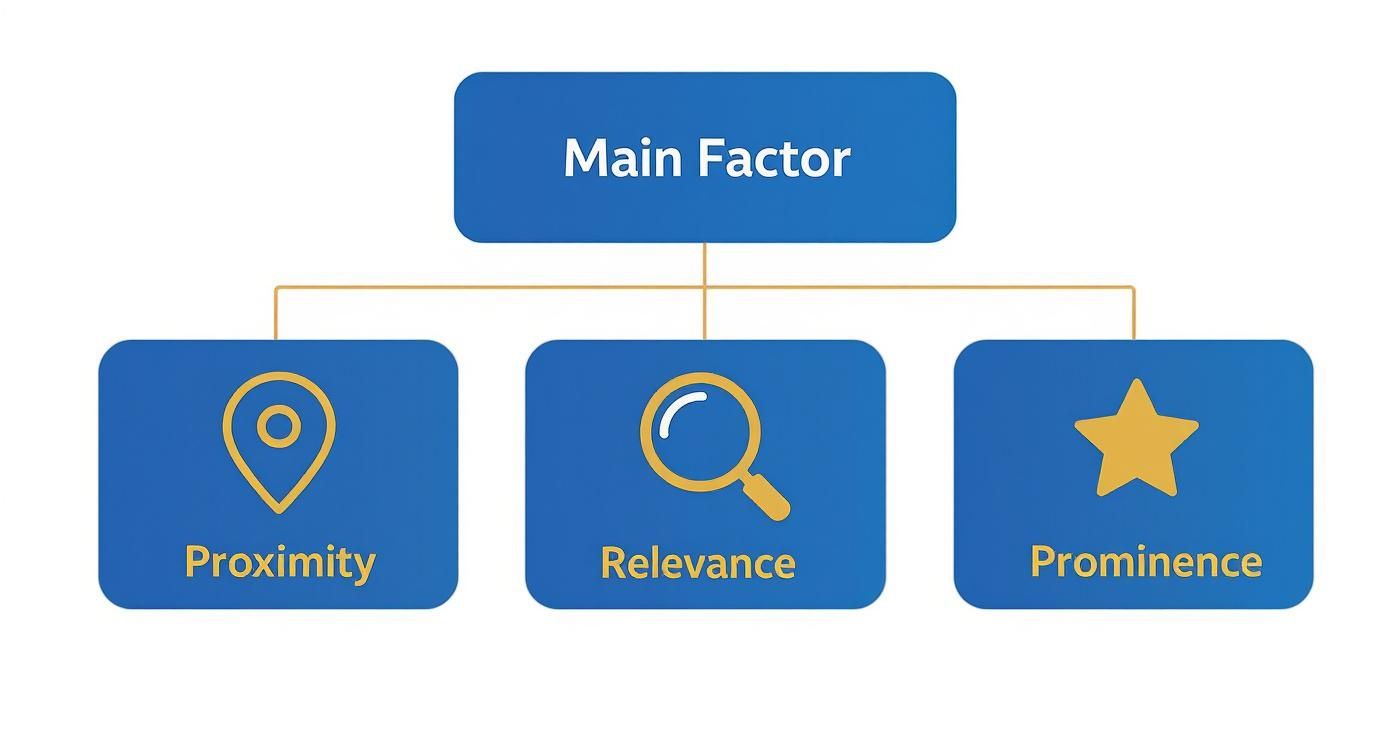
Here’s a quick look at what those pillars mean for your business in an easy-to-read format.
The Three Pillars of Local Search Ranking Factors
| Pillar | What It Means | Primary Focus Area |
|---|---|---|
| Relevance | How well your business profile and website match a searcher’s query. Google needs to understand what you do and what you sell. | Optimizing your Google Business Profile categories, services, and on-page content with local keywords. |
| Proximity | The physical distance between the searcher’s location and your business address. This is the one factor you can’t really change. | Verifying your business address and ensuring your service areas are accurately defined in your Google Business Profile. |
| Prominence | How well-known your business is, both online and offline. It’s a measure of your authority and reputation. | Earning positive reviews, building local citations, and acquiring high-quality backlinks from other local websites. |
As you can see, these three elements work together to determine whether Google trusts your business enough to show it to potential customers.
Throughout this guide, we will break down each of these factors and more, giving you practical, actionable steps to improve your performance. You can also explore the best local SEO tools that can help you track and manage these signals more effectively.
Let’s begin.
Optimize Your Google Business Profile
Your Google Business Profile (GBP) is your digital storefront. It is the single most important local search ranking factor you have direct control over. Think of it as the hub where Google gets the official story on who you are, what you do, and why a local customer should choose you over a competitor.
A complete, active, and accurate profile is a massive trust signal to Google. It shows you’re a legitimate, operating business.
The first step—and it’s a critical one—is to choose the correct primary business category. This single choice has a huge impact on the searches you appear in. For example, a law firm in Baltimore specializing in personal injury cases should choose the specific category “Personal Injury Attorney” instead of the generic “Law Firm” for much better results.
Fill Every Field Available
Completeness is not optional; it’s essential. The primary category is the top signal, but simply filling out 100% of the available fields in your GBP gives you an immediate visibility boost.
Don’t just set it and forget it. You should consistently upload high-quality, recent photos. Use Google Posts to share updates, promotions, or news. Actively monitor and answer questions in the Q&A section. Every piece of information you add reinforces your relevance for local searches.
To learn more about the details, check out our guide on making Your Google Business Profile a local SEO powerhouse.
Improve Proximity Signals
Proximity in local search is like having a well-placed storefront sign—it tells Google and nearby customers exactly where you are. Google measures the distance from your business to a searcher’s location to decide which listing to show first. If you run a Service Area Business (SAB), you can map out your exact coverage area within your Google Business Profile.
Distance still carries significant influence—55.2% of your ranking can come down to how close you are. Since 46% of searches carry local intent, optimizing your proximity signals is non-negotiable. Learn more about proximity findings
Key Tactics:
- Set clear service boundaries in GBP using zip codes or a radius.
- Encourage customers from different areas to mention their location in reviews.
- Publish dedicated location pages like “Plumbing Services in Towson MD” to solidify your local reach.
Service Area Business Setup
Go to your GBP dashboard and click on the “Service Area” settings. Here, you can input the zip codes or mileage radius that cover your service zone, then save your changes.
- Sign in to your Google Business Profile.
- Enter your target zip codes or define a service radius.
- Save your updates and complete any verification prompts.
Expert Insight: Drawing precise service areas helps Google target your listing to the right neighborhood queries, making it an important local search ranking factor.
Additionally, our article on how Google Maps embraces AI and visuals can help you evolve your local reach.
Build Prominence with Reviews and Citations
Beyond your own website and GBP profile, Google pays close attention to your reputation across the web. This pillar of local search is built on two powerful elements: customer reviews and business citations.
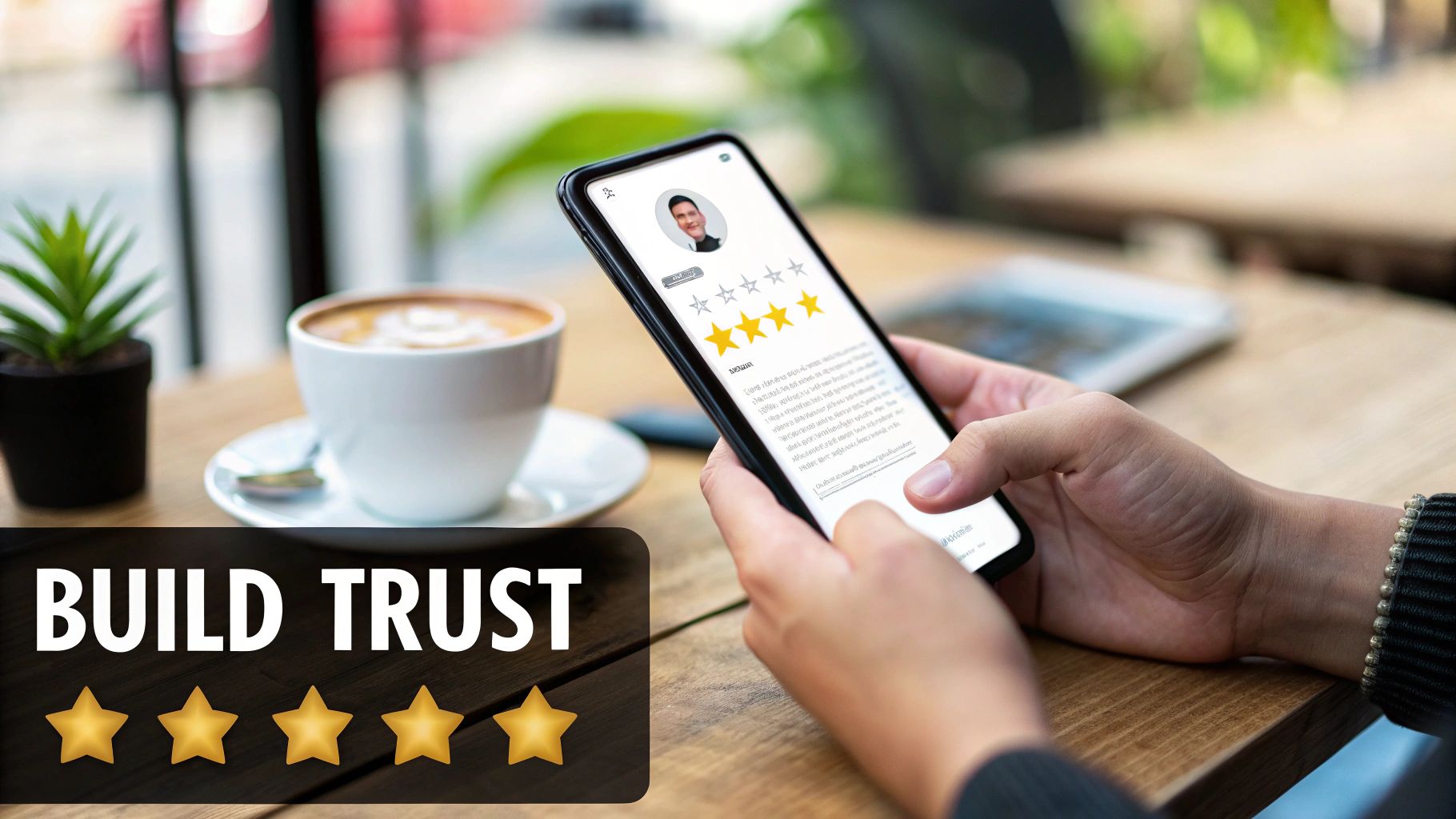
A steady flow of positive, recent reviews is a huge signal to Google that customers trust you. In fact, reviews are one of the most important factors for ranking in the Local Pack. Encouraging your happy customers to share their experiences on Google, Yelp, or industry-specific sites is essential.
Why Reviews and Citations Matter
Reviews provide the social proof that convinces new customers to choose you. Citations, on the other hand, build a consistent digital footprint. A citation is any online mention of your business’s Name, Address, and Phone number (NAP), typically in online business directories.
Google uses this information to verify that your business is legitimate and located where you say it is.
An inconsistent NAP across different directories is a major red flag for search engines. It creates confusion and erodes trust, which can directly harm your visibility in local search results.
This example from Google Maps shows what a potential customer sees. The star rating and review count are front and center, heavily influencing their decision to click, call, or choose a competitor.
When you actively manage both your reviews and your citations, you send strong signals to Google that you are an established, credible local authority. To better understand how these external signals fit into the bigger SEO picture, it’s helpful to learn about the different types of links and how they contribute to your site’s authority.
Weave Local SEO Into Your Website’s DNA
Think of your website as the home base for your digital presence. It is the ultimate destination for customers and the primary source of truth for Google. While your Google Business Profile is the flashy digital storefront, the on-page SEO signals from your website tie everything together, cementing your local authority.
This means you cannot just put your address on the homepage and be done. You must strategically weave your location and services into the very fabric of your website.
A Maryland plumber, for example, should create dedicated pages for local searches, like “Emergency Plumbing in Annapolis” or “Drain Cleaning Services in Columbia,” instead of a generic “services” page. These geo-targeted pages are highly effective for attracting customers who are nearby and ready to hire.
Weave Local Keywords into Your Content
Integrating local keywords must feel natural. The key is to place them where they matter most to both your customers and Google’s crawlers.
Your main targets should be:
- Title Tags and Meta Descriptions: This is your first impression in search results. Make them count with compelling, locally-focused language.
- H1 and H2 Headings: These headlines tell users and search engines what the page is about. Be direct and clear.
- Body Content: Include mentions of your city, county, or specific service areas throughout your text where it makes sense.
When you get this right, you create a powerful feedback loop between your website and your GBP. Each reinforces the other, building a rock-solid foundation that’s the cornerstone of any winning local SEO strategy.
To get a deeper understanding of these foundational elements, check out our in-depth guide on what is on-page optimization.
Google doesn’t just care about what you say on your profile; it also watches what your customers do.
These behavioral signals are powerful clues that tell Google whether searchers are engaging with your business. For instance, when many people search for “best crab cakes in Fells Point” and click on your listing, request directions, or call you, it sends a clear positive message to Google.
This isn’t just about relevance; it’s about popularity and trust.
Why User Actions Matter
A high click-through rate (CTR) on your profile means your listing is catching people’s attention. Clicks to your website, requests for directions, and phone calls are even stronger votes of confidence, showing that a real person is taking the next step to become a customer.
Your job is to make those actions irresistible.
- Craft compelling headlines and posts on GBP. Think of them as tiny digital billboards that are impossible to ignore.
- Keep users on your website longer. Engaging local content, like a blog post on “Summer Festivals in Baltimore,” signals that your site is valuable. A low bounce rate tells Google your content delivered on its promise.
Every time a user interacts with your business over a competitor’s, you’re building proof that you’re the superior local choice.
If you’re struggling to keep visitors engaged, our guide on how to improve bounce rate is packed with practical strategies.
Common Questions About Local Search Ranking Factors
Business owners often ask smart questions about what it takes to improve their local presence. Getting these details right is key to a strategy that works.
Here are straightforward answers to a few of the questions we hear most often.
How Long Until I See Local SEO Results?
Patience is key. You can typically expect to see initial movement within 3 to 6 months. This timeline depends on how competitive your market is and how consistent you are with your efforts.
While optimizing your Google Business Profile might show some results in a few weeks, building your website’s authority and earning trust with Google is a long-term game.
Do I Need a Public Address to Rank Locally?
No, you do not have to display your address publicly. This is a common question from Service Area Businesses (SABs), like plumbers or mobile detailers, who work at their customers’ locations.
You can hide your physical address in your Google Business Profile and simply define the areas you serve. However, you still need to verify a real, physical address with Google (even if it stays private) because proximity remains one of the most significant local search ranking factors.
Ready to master the local search ranking factors that drive real growth for your business? The experts at Raven SEO create practical roadmaps to increase your visibility, traffic, and conversions. Start your journey with a no-obligation consultation today!