

You've probably done what business owners were told to do for years. You published service pages, wrote blog posts, chased keywords, and waited for rankings to turn into leads.
Now search feels unstable.
Google shows AI-generated answers. Buyers get quick summaries without clicking. Pages that used to earn steady traffic don't feel as dependable. If that sounds familiar, your problem isn't that content stopped mattering. Your problem is that the rules for visibility changed.
A modern content marketing consultation shouldn't start with a generic content calendar. It should start with one question: is your brand structured, credible, and clear enough to be cited by AI systems?
That's the shift. The brands that win next won't just rank. They'll be understood.
The Search Landscape Is Fundamentally Changing
A lot of business owners still think search works like it did a few years ago. You optimize a page, build authority, move up the rankings, and collect clicks. That model still matters, but it's no longer the full game.
Search is moving from blue links to direct answers. In practical terms, that means your content now has to do more than attract a visit. It has to give search engines and AI systems enough confidence to use your brand as a source.
Why old SEO expectations are breaking down
Traditional SEO trained companies to focus heavily on positions, pages, and traffic curves. That approach created results for a long time. But AI Overviews and conversational search tools are changing what “visibility” means.
If someone asks a question and an AI system answers it immediately, your brand can influence that decision without earning a click. That's good news if you're cited. It's a problem if your competitors are easier for machines to interpret than you are.
Practical rule: Stop treating visibility as a ranking-only problem. Start treating it as a trust and interpretation problem.
The stakes are high because content isn't shrinking as a business channel. It's growing fast. The content marketing industry is projected to reach approximately $1.95 trillion by 2032, and 83% of marketers cite it as the most effective method for demand generation, surpassing organic SEO, according to content marketing industry projections.
What a business owner should do now
You don't need to panic. You do need to adapt.
Start with these priorities:
- Review your core pages: Your homepage, service pages, and About page should explain what you do in plain language, not brand jargon.
- Tighten topical relevance: Each page should answer one major question clearly instead of trying to cover everything.
- Document your expertise: Certifications, years of experience, service scope, named experts, and business details all help create a more credible digital footprint.
- Study AI search behavior: If you haven't yet, read this breakdown of the future of SEO with AI to understand where search is heading.
A standard content audit asks whether your pages rank. A smarter content marketing consultation asks whether your pages can be parsed, trusted, and cited.
That's a much tougher standard. It's also the right one.
From SEO to AEO The Shift from Clicks to Citations
SEO and AEO aren't enemies. But they are not the same job.
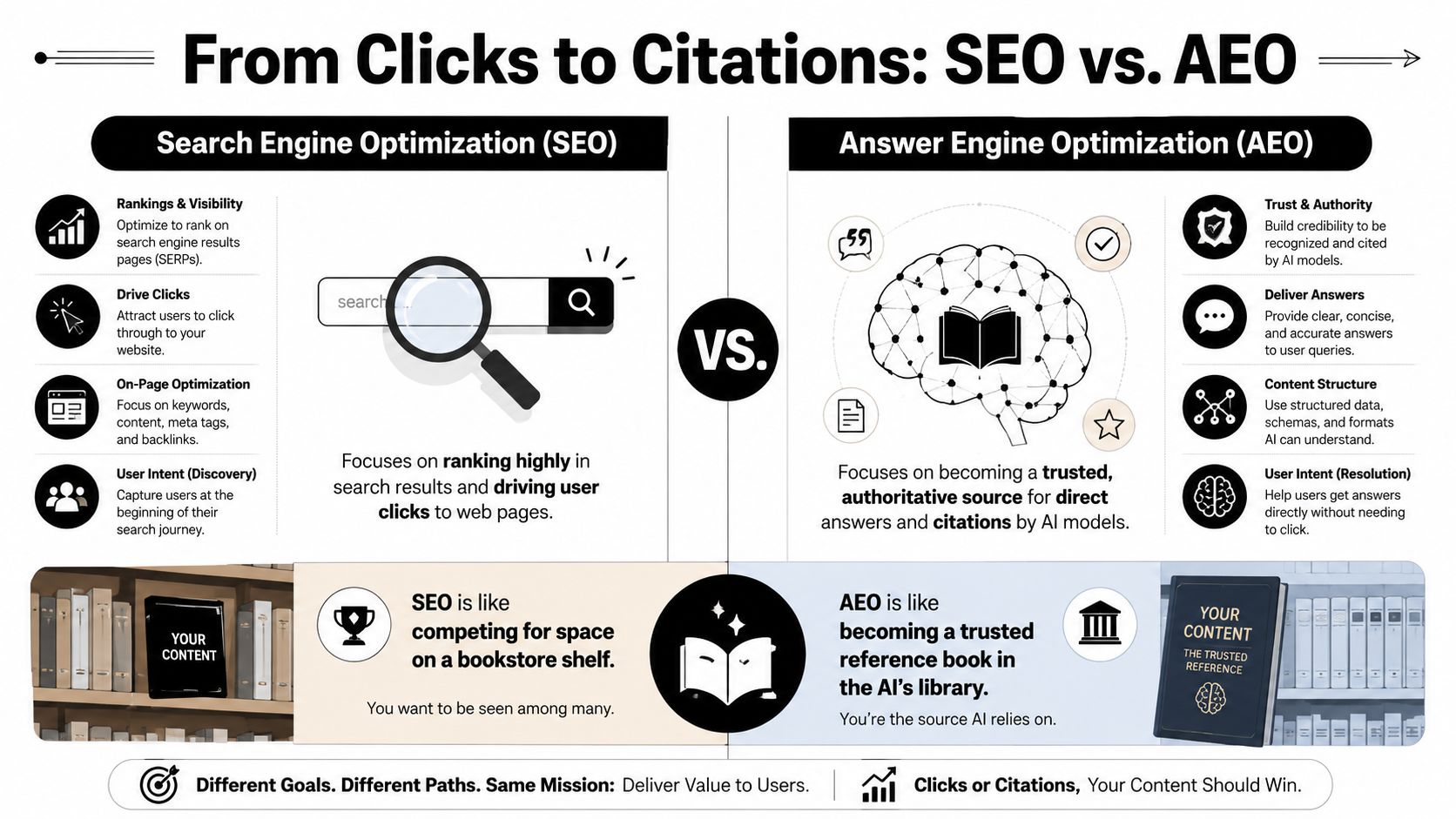
SEO is about helping a page appear prominently in search results. AEO, or answer engine optimization, is about helping your content become the source an AI system pulls from when it generates an answer. If SEO is competing for space on a bookstore shelf, AEO is becoming a trusted reference book in the AI's library.
Early in this shift, visual comparisons help clarify what changed.
The real difference between the two
Here's the simplest comparison:
| Approach | Primary goal | Core focus | Success signal |
|---|---|---|---|
| SEO | Rank pages | Keywords, links, page optimization | Clicks and rankings |
| AEO | Earn citations in answers | Structure, clarity, authority, entities | Mentions, citations, answer inclusion |
That distinction matters because the mechanics are shifting. Data indicates that 71% of AI Overview keywords have a difficulty score below 30, and brands require 3X fewer backlinks to rank in answer engines compared to traditional SEO, highlighting a different ranking model, as discussed in this AI Overview analysis video.
For business owners, that creates an opening. You may not need to outmuscle larger competitors on every classic SEO metric if you can become easier for AI systems to trust and reuse.
What to prioritize in AEO
AEO rewards disciplined content design more than brute-force publishing.
Focus on these areas:
- Entity clarity: Make it obvious who your company is, what it offers, who leads it, and what topics it owns.
- Answer formatting: Write sections that can stand alone as clean, direct answers.
- Factual consistency: Keep your service descriptions, brand details, and expertise signals aligned across the web.
- Machine-readable signals: Use structured data and page architecture that remove ambiguity.
If you want a second perspective on how this discipline is evolving, this guide to AI-powered search optimization is a useful companion read.
Later, compare your current search strategy against a more direct breakdown of AEO vs SEO in 2026. Most companies find they're still over-invested in ranking tactics and underprepared for citation-based discovery.
There's also a practical walkthrough worth watching before you redesign your content process:
A content marketing consultation built for 2026 should explain this shift plainly. If your consultant still talks only about blogs, backlinks, and metadata, they're behind.
Building AI-Ready Brand Authority
AI search doesn't trust brands because they say they're experts. It trusts brands that look consistently documented across their digital footprint.
That's a major change in mindset. Many companies still treat authority as a soft branding concept. In AI search, authority is increasingly operational. If machines can't connect your business, people, services, and expertise into a reliable entity, your content becomes harder to cite.
Your digital reputation has to be visible
Think of brand authority as your machine-readable reputation.
A strong authority profile usually includes:
- Clear business identity: Company name, service categories, leadership, and contact details should stay consistent.
- Detailed About information: Generic About pages don't help much. Real credentials, service philosophy, location context, experience, and specialist roles do.
- Topic ownership: You need repeated, credible coverage of the subjects you want to be known for.
- External validation: Mentions, references, profiles, interviews, and third-party citations strengthen your footprint.
AI systems don't reward vague expertise. They reward well-documented expertise.
This is why thin websites struggle. A site with ten pages of generic copy gives an AI system very little to trust. A site with clear service definitions, named experts, helpful explanations, policy pages, and strong topic clustering gives it far more context.
What authority looks like in practice
For most service businesses, the fix isn't flashy. It's disciplined.
A practical authority cleanup looks like this:
- Rewrite your About page so it explains who leads the company, what experience they bring, and what problems the business solves.
- Create expert-led service pages instead of broad, catch-all pages stuffed with keyword variants.
- Standardize your brand facts across your website, profiles, directories, and partner mentions.
- Publish commentary with a point of view rather than generic educational filler.
This also affects content style. If every article sounds like it was written by an anonymous intern, your expertise gets diluted. Businesses entering crowded categories need a stronger narrative angle. That matters even more in consulting and technical services, where many firms struggle to connect content with client acquisition, as discussed in this content marketing consultant perspective.
For a deeper look at how search systems interpret expertise and credibility, review the principles behind E-E-A-T for AI. The core idea is simple. Your authority has to be visible, consistent, and specific enough for machines to verify.
A content marketing consultation worth paying for should diagnose authority gaps, not just editorial gaps.
The Technical Backbone of Structured Data and Schema
Most companies describe their business for humans only. AI systems need more than that. They need explicit signals.
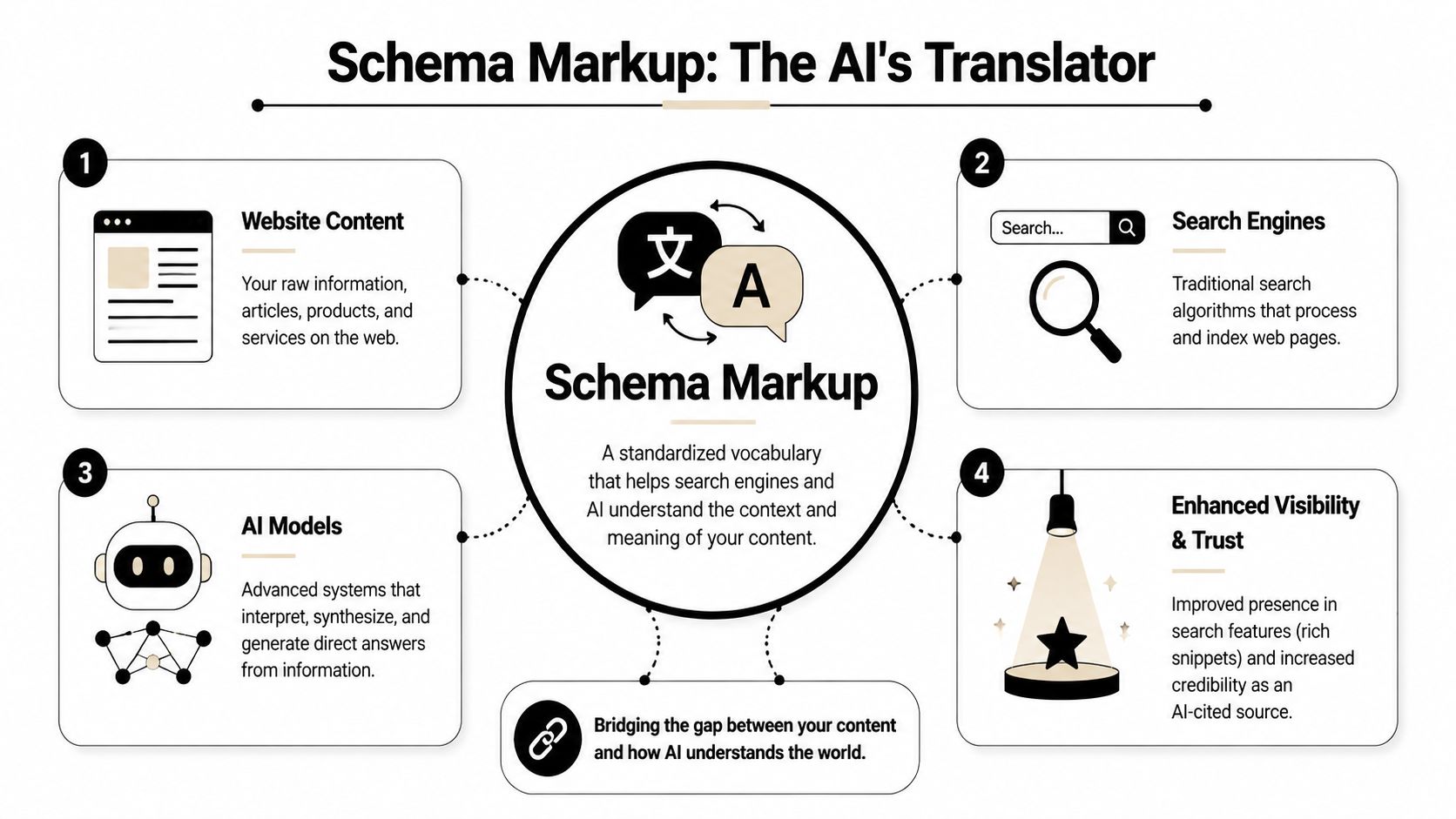
That's where Schema markup matters. Think of it as a translator. Your website already contains facts about your company, services, people, and content. Schema turns those facts into a format machines can interpret with much less guesswork.
What schema actually tells AI
When properly implemented, schema can help define:
- Organization details: Your business name, website, logo, contact information, and social profiles.
- Person entities: Founders, authors, physicians, attorneys, consultants, or executives connected to your brand.
- Services or products: What you sell, how it's categorized, and how it relates to customer needs.
- Article and FAQ content: Which sections answer questions, who wrote the piece, and what the page is about.
Without this layer, search engines infer meaning from plain text. Sometimes they get it right. Sometimes they don't. If your market is competitive, ambiguity costs you.
Where businesses usually get this wrong
The common mistakes are predictable:
| Mistake | Why it hurts |
|---|---|
| Using no schema at all | Machines must guess what your content represents |
| Adding partial markup only | Key business and author details stay disconnected |
| Marking up pages inaccurately | Trust drops when structured data and page content conflict |
| Treating schema as a one-time task | Your site changes, but the machine-readable layer stays outdated |
Structured data isn't decoration. It's a clarity system.
You don't need to become a developer to act on this. You do need to know what should be marked up and why. For many businesses, the starting point is an audit of these page types:
- Homepage
- About page
- Primary service pages
- Expert bios
- Articles and FAQs
If you want a practical primer on implementation and use cases, this guide to schema markup and search visibility is a solid place to start.
A strong content marketing consultation should identify missing schema, mismatched entity signals, and pages where machine-readability is weak. If your content is good but your structure is poor, AI systems may never use it confidently.
How to Get Your Content Cited by AI
AEO content doesn't win because it's longer. It wins because it's easier to extract, verify, and reuse.
That requires a different writing discipline. Research demonstrates that Google's AI models analyze text blocks within the first 160 characters to extract answers and prioritize content structured into self-contained chunks with clear headings, according to this analysis of answer engine optimization and AI search behavior.
Write for extraction, not just for reading
Most business content hides the answer under long introductions. That's a mistake.
Use this checklist:
- Lead with the answer: The first sentence under a heading should directly answer the implied question.
- Keep sections self-contained: Each H2 or H3 section should make sense on its own if extracted from the page.
- Use explicit headings: “How Long Does Recovery Take” works better than “What to Expect.”
- Separate facts from opinion: State facts plainly. Put interpretation after.
- Trim filler: AI systems don't need your warm-up paragraph.
Here's the difference.
Weak opening: “Choosing the right payroll software can feel overwhelming because there are many options on the market today.”
Better opening: “The best payroll software for small businesses depends on employee count, tax complexity, and integration needs.”
The second version gives a machine something useful immediately.
Format pages so answers survive extraction
Many content teams often fail. They write pages that read well top to bottom but break apart poorly when an AI model lifts one passage.
Use these formatting habits:
- One question per block. Don't answer three different questions in one paragraph.
- Use short paragraphs. Dense text reduces extractable clarity.
- Add concise FAQ sections. FAQs create clean answer units when they're written well.
- Keep terminology consistent. If your service has three different names across the page, you create ambiguity.
If your team is trying to scale this process without turning the site into AI sludge, study how to build AI content workflows that preserve editorial quality.
A useful internal editing test is simple. Pull any subsection from a page and ask, “Would this still make sense quoted on its own?” If the answer is no, rewrite it.
Content marketing consultation should include this level of page-level editing logic. Otherwise, you're publishing for humans alone while AI becomes the first reader.
Your Practical Roadmap The AI Visibility Audit
Most content marketing consultations are too broad. They produce a list of ideas, a few keyword themes, and a publishing recommendation. That's not enough anymore.
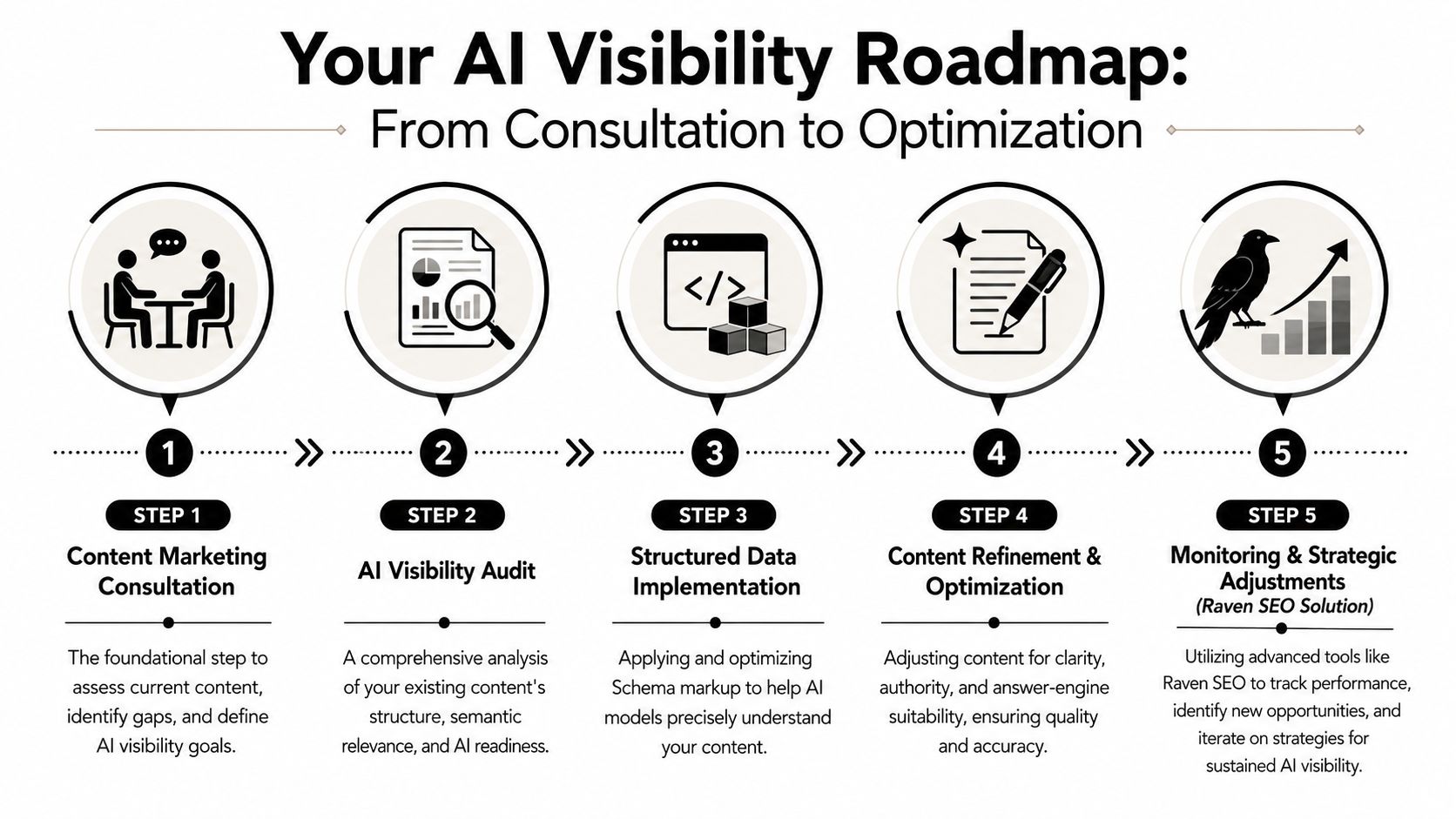
What businesses need now is an AI Visibility Audit. That's a more useful starting point because it measures whether your current site can be understood, trusted, and cited in generative search environments.
What an AI Visibility Audit should include
A serious audit reviews four layers at once:
- Authority layer: Does the brand present clear expertise, ownership, and trust signals?
- Structure layer: Are schema, page hierarchy, and entity relationships implemented correctly?
- Content layer: Do key pages answer questions directly and in extractable formats?
- Gap layer: Which topics, proof points, and page types are missing entirely?
This process matters because strategy beats improvisation. In 2026, 73% of B2B marketers maintain a documented content marketing strategy, and these organizations generate 3x more leads per dollar spent than those without, according to this dataset on documented content strategy and lead efficiency.
A roadmap provides an advantage. Random publishing doesn't.
The output should be prioritized, not theoretical
A good audit doesn't hand you a giant spreadsheet and disappear. It gives you an order of operations.
That usually looks like:
| Priority | Typical action | Why it comes first |
|---|---|---|
| High | Fix business entity clarity | AI systems need a reliable core identity |
| High | Implement or clean up schema | Machines need structured context |
| Medium | Rewrite top commercial pages | These pages influence high-intent visibility |
| Medium | Expand authority signals | Expert bios, About content, and references build trust |
| Ongoing | Build answer-first content | This supports citation growth over time |
The right roadmap doesn't ask you to publish more first. It asks you to become clearer first.
If you're evaluating your own readiness, a formal AI readiness assessment helps frame the right questions. Not every site needs a full rebuild. Many need cleaner entities, stronger page architecture, and much better content formatting.
That's why I see content marketing consultation as the front door to AI search strategy. It's not a blog planning exercise. It's a future-readiness diagnostic.
Begin Your Future in Generative Search
The shift is simple, even if the work isn't. Search visibility is no longer just about ranking a page. It's about earning enough trust, clarity, and structure for AI systems to cite your brand.
That changes what content marketing consultation should deliver. You need a strategy that strengthens authority, implements structured data correctly, and rewrites key pages so answers can be extracted cleanly.
The brands that adapt fastest will be easier to trust
This transition favors businesses with real expertise. That's the opportunity.
AI systems need reliable sources. If your company explains what it does clearly, documents who stands behind the work, and structures its information well, you're in a stronger position than brands still publishing generic SEO copy.
The industry is moving fast. In 2026, 97% of content marketers plan to use AI to support their efforts, up from 83% in 2024, according to content marketing AI adoption data. That doesn't mean every brand will use AI well. It does mean your competitors won't wait.
What to do next
If you're serious about future-proofing your visibility, start with an audit, not another blog post.
Use this sequence:
- Assess your current footprint
- Identify authority and schema gaps
- Rewrite your most important pages
- Build a content system that produces citable answers
- Monitor how AI surfaces your brand over time
If you want an example of how these reviews are being framed in the market, this overview of an AI Visibility Audit is useful context.
The mistake is waiting for search to “settle down.” It won't. Generative search will keep changing, and brands that build clarity now will have an advantage later.
A content marketing consultation done right gives you a practical roadmap. That's the next move.
If you want a no-obligation next step, schedule a consultation with Raven SEO. We help businesses assess AI visibility, strengthen structured data, and build content systems designed for sustainable search growth.