
Most advice about web design for SEO is outdated.
It still treats your website like a brochure for human visitors and a page for Google to crawl. That model is too small now. Search has shifted from lists of links to generated answers, summaries, and citations. Your site isn't just competing for a click. It's competing to become the source an AI system trusts enough to reference.
That changes what “good design” means. A beautiful site that hides key information in sliders, overlays, or JavaScript-heavy components can look polished to a person and still fail as a machine-readable asset. If an AI system can't reliably parse your services, expertise, location relevance, authorship, FAQs, and proof points, your brand becomes harder to cite.
The businesses that win next won't just publish more content. They'll build websites that function like structured knowledge systems.
Beyond the Ten Blue Links
Ranking still matters. It's just no longer the whole game.
Traditional SEO taught business owners to focus on position, traffic, and clicks. That logic worked when search results were mostly ten blue links. Today, users increasingly get synthesized answers before they ever decide which site to visit. Your website now has to do two jobs at once. It must persuade people and feed machines clean, trustworthy information.
Mobile search already gave us a preview of this shift. Design choices have always affected discoverability. 62% of top-ranking websites on Google are optimized for mobile devices, and 40% of users abandon a search result if the previous site wasn't mobile-friendly, according to VWO's web design statistics roundup. The lesson is simple. Search visibility has never been separate from design quality.
Why old SEO advice falls short
The common playbook says to publish keyword-targeted pages, improve on-page copy, and wait for rankings. That's incomplete now.
AI-driven search systems don't just retrieve pages. They interpret, compress, compare, and cite. That means your site architecture, content hierarchy, metadata, and page design influence whether your brand becomes part of the answer.
Practical rule: If a machine can't confidently identify what your business does, who it serves, and why it's credible, your website is underbuilt for modern search.
A smart place to understand that shift is this overview of Search Generative Experience. It helps frame why the future of search is moving from raw retrieval to answer synthesis.
What business owners should take from this
You don't need to become an engineer. You do need to stop treating design as cosmetic.
Your homepage, service pages, FAQ sections, author information, and supporting proof all need to be arranged so both people and machines can read them without guessing. That's the new baseline. Good design no longer means “looks premium.” It means “communicates clearly to humans and systems.”
The New Battlefield From SEO to AEO
Traditional SEO is like fighting for the best shelf space in a grocery store. You want your product visible when a buyer scans the aisle.
AEO and GEO are different. Now the chef is choosing ingredients for the customer before the customer even walks the aisle. If your brand isn't clearly understood, the AI chef won't pick you.

SEO gets you found. AEO gets you used.
That's the practical distinction.
Search Engine Optimization focuses on ranking pages. Answer Engine Optimization focuses on making your content easy to extract into direct answers. Generative Engine Optimization extends that further by helping AI systems use your content inside conversational and synthesized outputs.
According to Lumar's guidance on AI search visibility, in 2026, AEO and GEO are essential for visibility, requiring content to be highly structured, fact-based, and semantically rich, with clear answer-first formatting that directly addresses user questions.
That requirement changes web design decisions in a very practical way.
What AI systems reward
AI-friendly websites tend to share a few traits:
- Clear answer blocks: Important questions get direct responses near the top of a section.
- Predictable headings: H2 and H3 structure creates retrievable content chunks.
- Strong semantic cues: The page makes it obvious what the topic, entity, and purpose are.
- Visible proof: Reviews, policies, authorship, and service details aren't buried behind interaction-heavy elements.
Here's the business implication. A page can rank reasonably well and still fail in AI search if the answer is buried inside vague copy, hidden tabs, or bloated layouts.
Why this shift is bigger than rankings
Traffic was always a proxy for authority. Citations are becoming a new one.
If an AI system references your brand while answering a high-intent question, you gain trust earlier in the decision process. That exposure can happen even when the user never sees a standard ranking list. The brand that becomes quotable often beats the brand that merely appears.
For a deeper comparison of the old and new models, this breakdown of AEO vs SEO in 2026 is worth reviewing.
Good SEO used to mean being one of the options. Good AEO means being the explanation.
That's the battlefield now. You're not only trying to win placement. You're trying to become the reference.
Building Your AI-Citable Brand Database with Structured Data
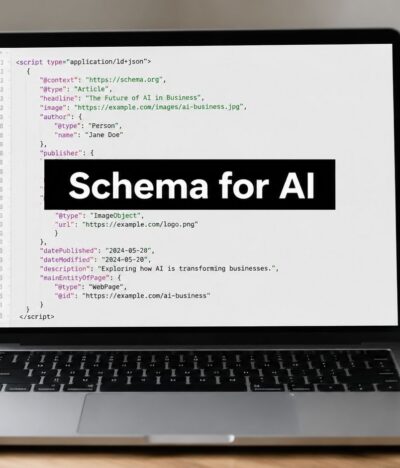
Most business owners hear “Schema” and assume it's a technical side quest. It isn't. It's one of the clearest ways to tell machines exactly who you are.
Think of your website as a warehouse. Without labels, a robotic picker sees clutter. With labels on every shelf, bin, and product, it can find the right item instantly. Structured data does that for your digital presence.

What structured data actually does
According to Arrow Design's explanation of Schema and structured data SEO, Schema is the technical practice of embedding an invisible metadata layer into a website's HTML using Schema.org vocabulary to eliminate semantic ambiguity for search algorithms. It explicitly defines entities and prevents pages from being interpreted as “alphabet soup” by crawlers.
That's the right way to think about it. Structured data isn't decoration. It's a machine-readable brand database built directly into your site.
The minimum information your site should label clearly
If you want AI systems to cite you reliably, stop making them infer basic business facts. Define them.
A strong implementation usually labels things like:
- Business identity: Your company name, type, and core description.
- Products or services: What you sell, what you do, and how those offers differ.
- Location relevance: Where you operate or serve.
- Expertise signals: Author, reviewer, organization, credentials, or area of specialization.
- Knowledge assets: FAQs, articles, service explainers, reviews, and other structured content.
At this stage, web design for SEO stops being visual and becomes operational. The structure of your templates should support this data layer from the start.
Why design and Schema must work together
A lot of teams bolt Schema on after launch. That's sloppy.
If your design templates don't have consistent places for product details, service summaries, review content, FAQ copy, author information, and company details, your structured data becomes patchy. Machines see inconsistency. That weakens confidence.
Use structured data implementation guidance as a planning tool, not just a cleanup task.
| Website element | Human benefit | Machine benefit |
|---|---|---|
| Service summary near top of page | Faster understanding | Clear entity and topic recognition |
| FAQ section in clean HTML | Better usability | Easier extraction into answer formats |
| Author or company info block | More trust | Stronger attribution signals |
| Consistent template structure | Better experience | Repeatable metadata mapping |
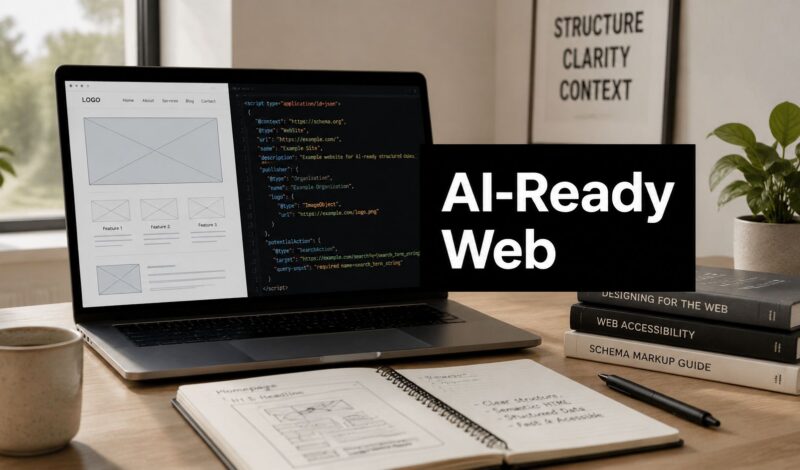
Structured data is the native language of AI-ready websites. If you don't speak it, you force the system to guess.
The payoff
When your site clearly defines what your brand is, what it offers, and where its authority comes from, AI systems have a stronger foundation for retrieval and citation. That matters for rich results today and machine-assisted discovery going forward.
This isn't a plugin checkbox. It's digital infrastructure.
Designing for AI Visibility Not Just User Experience
A sleek website can still be invisible to AI.
That's the mistake I see most often. Teams assume that if a site feels modern, it must be search-friendly. Not true. Some of the most popular design patterns in WordPress, Shopify, and custom builds make critical information harder for machines to parse.

The design choices that quietly break AI-readiness
The market is behind. Most guides still talk about Schema like it exists in isolation. It doesn't. Design can corrupt the delivery of structured content.
The underserved issue is design-driven Schema implementation. Emerging data cited in Forge Apollo's guide to SEO-friendly web design notes that 68% of AI Overviews fail to parse content hidden behind complex JavaScript overlays or non-standard navigation patterns. That's a direct warning for brands using flashy interfaces without considering machine readability.
Common offenders include:
- Accordion overload: Useful content exists, but it's hidden by default and poorly rendered.
- Image sliders for key messaging: Humans skim them. Machines often get weak context.
- Mega menus with unusual markup: Navigation becomes harder to interpret.
- Sticky headers and dynamic overlays: They can interfere with rendering and content hierarchy.
- Template-heavy pages with thin visible copy: The layout dominates while the substance gets diluted.
Build pages in chunks, not blobs
AI systems don't want your page as one long sales monologue. They want retrievable chunks.
That means every important page should be structured with clear sections, direct language, and obvious topic boundaries. Use descriptive H2s and H3s. Answer the question first. Support it second. Keep critical business details in normal HTML text, not inside graphics or interaction-heavy modules.
A practical page structure often looks like this:
- Direct opening answer: State what the service, product, or page is about immediately.
- Supporting detail block: Explain features, use cases, or differentiators in plain language.
- Trust section: Add reviews, credentials, policies, or expertise cues in visible text.
- FAQ layer: Include common questions with concise answers.
- Structured metadata support: Match visible content to valid Schema markup.
If your best information is hidden for the sake of aesthetics, AI systems will reward the plainer competitor.
The technical workflow that actually works
There's no mystery here. The process is disciplined.
According to The Brand Brew's technical workflow for structured data, implementation requires a four-step sequence: identify high-value content types, generate valid JSON-LD code, insert the code, and validate it using Google's Rich Results Test.
Use that process in the same order every time:
- Start with high-value page types: Service pages, product pages, FAQs, articles, and business identity pages usually come first.
- Generate JSON-LD carefully: Tools can help, but they still need human review.
- Insert code in the correct place: Keep implementation clean and consistent across templates.
- Validate before publishing: If markup doesn't match the visible page, fix the page or fix the code.
For teams redesigning a site, a documented 6-step design process helps prevent technical SEO issues from appearing late in the build.
A useful walkthrough sits below.
What non-technical owners should insist on
You don't need to write JSON-LD by hand. You do need to ask better questions.
Use this checklist with your designer or developer:
- Ask where critical business facts live: If they're inside images or sliders, that's a problem.
- Ask how headings are structured: H2 and H3 hierarchy should reflect real topics.
- Ask whether FAQ content is visible in HTML: Hidden content often underperforms.
- Ask how Schema is validated: “We installed a plugin” isn't an answer.
- Ask whether image Alt Text includes relevant keywords where appropriate: This supports accessibility and reinforces topical clarity.
Good UX still matters. But good UX alone no longer wins. Your site has to be readable by people, crawlers, and answer engines at the same time.
Measuring What Matters in the Age of AI
If you're still judging success only by rank position, you're reading the wrong dashboard.
Keyword rankings and organic sessions still have value, but they don't fully capture what's happening when AI systems summarize results, cite sources, and answer users directly. A business can gain influence in search without seeing that influence reflected cleanly in old reporting models.

The metrics that deserve executive attention
The smarter question isn't “Where do we rank?” It's “Where do we appear in AI-mediated decision moments?”
That means tracking things like:
- Visibility Scores: Monitor how often your brand appears across major AI platforms.
- Citation frequency: Watch whether your pages get referenced in generated answers.
- Comparative share of voice: Measure whether competitors show up more often in the same query space.
- Format performance: Identify which content types are being used and which are ignored.
According to Profound's AEO guide for marketers, brands should run a living process of AI visibility optimization that includes tracking Visibility Scores, conducting monthly competitive analysis, and testing different content formats.
What to stop obsessing over
Stop treating position tracking as the whole truth. It isn't.
A page can rank well and still fail to become part of AI answers. Another page can have modest traffic but become highly influential because machines repeatedly use it as a trusted source. Those are very different outcomes, and old SEO reporting often blends them together.
Operational shift: Move from position-based reporting to influence-based reporting.
A simple reporting framework
A non-technical business owner doesn't need a giant analytics stack. You need a clean decision framework.
| Metric category | What it tells you | Business use |
|---|---|---|
| Search rankings | Baseline discoverability | Confirms classic SEO health |
| AI visibility | Presence in answer engines | Shows future-facing authority |
| Citation patterns | Whether AI trusts your pages | Reveals content usefulness |
| Competitor comparison | Who owns the category narrative | Guides content and design priorities |
For teams trying to modernize reporting, these AI visibility analytics tools for search optimization offer a useful starting point.
What usually improves results
The wins rarely come from publishing more generic content. They usually come from refining structure.
That means improving page chunking, making service pages more explicit, fixing template inconsistency, tightening structured data, and testing formats like comparison pages, FAQ blocks, and concise answer sections. If a format consistently fails to get cited, retire it. If one keeps showing up, scale it.
That's how mature teams should measure web design for SEO now. Not as a one-time redesign, but as an ongoing visibility system.
Your Roadmap to Sustainable Generative Search Authority
The future of search belongs to brands that are easy to understand.
That doesn't mean louder branding, more blog posts, or fancier visuals. It means clean site architecture, structured business information, answer-first content, and design patterns that machines can parse without friction. The companies that build those systems will earn more trust from both users and AI intermediaries.
If you want to strengthen that foundation, it helps to study adjacent authority signals too. This practical resource on how to improve your website's SEO gives useful context for how authority compounds across your broader digital footprint.
The core move is straightforward:
- Design pages for retrieval, not just appearance
- Use structured data to label your brand clearly
- Write in answer-ready chunks
- Measure citations and AI visibility, not just rankings
Businesses that act on this now will be easier to surface, easier to trust, and easier for answer engines to cite. Businesses that don't will keep wondering why polished websites produce uneven search performance.
Frequently Asked Questions About AI Visibility
Is traditional SEO still worth doing
Yes. It's still the base layer.
Technical SEO, crawlability, page structure, internal linking, speed, and high-quality content still matter. The difference is that they're no longer enough on their own. You also need pages that AI systems can extract, interpret, and cite.
Can a small business implement this without a dedicated engineer
Yes, if the site is built with discipline.
A small business can make major gains by using cleaner templates, visible FAQs, consistent heading structure, valid structured data, and simpler page layouts. You don't need an enterprise stack to be machine-readable. You need fewer design mistakes.
What part of web design affects AI visibility the most
Clarity beats cleverness.
The biggest issues usually come from hidden content, weak semantic structure, inconsistent templates, and missing structured data. If your site buries core service details inside design flourishes, AI systems have less to work with.
Do images still matter for SEO and AI visibility
Yes, but they need supporting context.
Images should reinforce page meaning, not carry the whole message by themselves. Use relevant file naming, visible surrounding text, and Alt Text with a relevant keyword when it accurately describes the image. That improves accessibility and supports topical clarity.
How fast should we expect results
Some technical fixes can help quickly, especially when they improve crawlability, page clarity, and metadata consistency. Broader authority gains take longer because AI visibility depends on repeated trust signals across your site and content library.
What should we fix first on an existing website
Start with the pages closest to revenue.
Prioritize your homepage, key service pages, core product pages, FAQ content, and business identity information. Clean up those templates first. Then expand structured data and answer-focused formatting across the rest of the site.
If your website still treats SEO as a rankings-only problem, it's already behind. Raven SEO helps brands build AI-ready websites that support structured data, stronger machine readability, and sustainable search authority. If you want a practical audit of how your current site performs for AI visibility, start with a no-obligation consultation.