

The age-old obsession with clicks is officially over. We're now living in the era of AI citations, where being the cited authority in an AI-generated answer is the new top spot on the SERP.
This isn't a subtle shift; it's a complete reinvention of what it means to be visible online. It demands a new playbook, moving from traditional SEO to Answer Engine Optimization (AEO), where the primary goal is to be deeply understood and trusted by artificial intelligence.
Why AI Citations Are the New Clicks
For years, SEO success was a straightforward numbers game: clicks, traffic, and your rank on a list of blue links. But with AI Overviews and conversational search becoming the norm, success now hinges on citations.
When a user asks an AI assistant a question, you don't just want to be a hyperlinked source at the bottom—you want your brand, your data, and your expertise named directly in the generated answer. This is the ultimate signal of digital trust and authority.
Powering this massive change is a technical process called Entity Disambiguation. It's the critical mechanism that allows an AI to tell the difference between entities with similar or identical names. Without it, an AI is lost. Is "Apple" the tech giant or the fruit? Is a search for "Paris" about the city in France or a person's name?
For your business, this process is what ensures an AI knows exactly who you are, what you offer, and why you’re a credible source of information.

From Ambiguity to Authority
Entity Disambiguation has quickly moved from a complex computer science problem to a core commercial priority. If you want your brand to show up in LLM-generated answers, you first have to make it crystal clear who you are.
The data backs this up. Recent studies show that 70% of AI citations rely on the AI first being able to disambiguate the entities mentioned in the source text. What’s more, entities that are clearly identified and tied to a unique knowledge base ID have a 3x higher probability of being cited in generative search results compared to those with ambiguous mentions.
At Raven SEO, our entire focus is helping businesses navigate this new AI-first world. We specialize in structuring your brand’s digital footprint so that it’s unmistakable to AI systems. This is no longer just about being found; it's about being recognized, understood, and ultimately, cited as the authority.
Wondering how well AI systems understand your brand right now? Get a clear picture of where you stand by learning how to calculate your AI Visibility Score.
What Is Entity Disambiguation Really?
Let’s talk about a huge, often invisible, problem for brands online: ambiguity. When someone mentions "Jaguar," is the AI thinking about the luxury car, the big cat, or the NFL team? This confusion forces search engines and AI to guess, and when they guess wrong, your brand gets lost in the noise.
Think of Entity Disambiguation as creating a unique digital passport for your brand. This passport holds all your official, verified details—your legal name, where you operate, and exactly what you do—all in a format that machines can read and trust instantly.
Without this digital passport, you're just another "Jaguar" in a sea of them, hoping the machine gets it right.

Entity Disambiguation is the technical process of resolving that confusion. It works by connecting every mention of your brand across the web back to a single, authoritative source of truth, much like how a passport number is unique to one person. This is how you turn ambiguous text into structured, citable knowledge.
From Ambiguous Text to a Clear Entity
Your website and marketing materials are filled with text that makes perfect sense to a human reader but is wide open to interpretation for a machine. Entity Disambiguation adds a layer of technical clarity that removes all doubt. For a deeper dive into the mechanics, our guide on knowledge graph optimization is a great next step.
Here are a few common ways ambiguity can undermine a brand's visibility:
- Multiple Meanings: A query for "Apple" could pull up results for the tech company, the fruit, or the record label.
- Shared Names: "Paris" might refer to the capital of France, Paris, Texas, or a person's name like Paris Hilton.
- Brand Variations: Is it "Nike Inc.," "Nike," or "Nike Global"? Disambiguation connects them all to the one official entity.
By explicitly defining who you are and linking all mentions back to a central identity, you are essentially telling search engines and AI: "When you see this name, this is what it means. There is no other interpretation."
This is what separates brands that get consistently cited by AI from those that are ignored or misrepresented. The table below shows the stark difference between an ambiguous term and a clearly defined entity from a machine's perspective.
Ambiguous vs. Disambiguated Entities
| Ambiguous Term | Potential AI Misinterpretations | Disambiguated Entity (Goal) |
|---|---|---|
| "Delta" | The airline, a river delta, a variant | Delta Air Lines, Inc. (Airline) |
| "Amazon" | The e-commerce giant, the rainforest | Amazon.com, Inc. (Company) |
| "Raven" | The bird, a character name, a poem | Raven SEO (The Digital Agency You Are Reading About Now) |
As you can see, the risk of misinterpretation is high, but the reward for clarity is even higher.
Ultimately, Entity Disambiguation isn't just a technical SEO task—it’s fundamental brand management for the age of AI. It ensures that when an AI or search engine looks for an expert, your brand's digital passport is stamped, verified, and ready for the spotlight.
How Disambiguation Fuels AI Visibility
At its core, artificial intelligence—whether it's a Large Language Model (LLM) or one of Google’s AI Overviews—runs on a single, non-negotiable principle: confidence. An AI simply will not cite information it can’t fully understand or verify. This is exactly where Entity Disambiguation becomes the secret weapon for your brand’s visibility in this new era of search.
Without clear, consistent signals, your brand is at risk of being ignored, misunderstood, or worse, completely replaced by a competitor in an AI-generated answer. If an AI can’t be 100% sure that your business is your business—and not some other company with a similar name—it’s going to play it safe and feature the option it understands best. And that might not be you.
Clarity is the ultimate currency for machines. When you make your brand’s information easy for AI to digest, you’re building a foundation of trust that pays dividends in visibility and authority.
Making Your Brand AI-Ready
The process of Entity Disambiguation is what connects all your brand's scattered digital mentions back to a single, authoritative profile that an AI can trust. By ensuring every mention is tied to this central, verified identity, you’re removing all the guesswork for these powerful systems. This goes way beyond old-school SEO; it’s now a fundamental requirement for even showing up in AI-driven conversations. You can dive deeper into the nuts and bolts of this in our guide on structuring data for modern search.
And the impact of turning messy, unstructured text into clean, machine-readable knowledge is measurable. Named Entity Disambiguation (NED) isn't just a theoretical concept; its real-world applications show just how vital it is for cutting through digital noise. In fact, one study found that brands and concepts linked to unique identifiers (like those on Wikidata or DBpedia) are 4.5 times more likely to be included in LLM-generated responses. That’s not a small difference.
From Data Points to Digital Authority
Think of your website, your social profiles, and every article that mentions you as a collection of scattered data points. Entity Disambiguation is the process of organizing those points into a coherent, authoritative profile that tells a clear story. This structured clarity allows an AI to do more than just find your name; it helps the system truly understand who you are, what you do, and why your information is credible enough to cite.
Here’s how that translates into real-world wins:
- Prevents Misrepresentation: It stops an AI from confusing your brand with another, protecting your hard-earned reputation.
- Boosts Citation Probability: A clearly defined brand is seen as a reliable source, dramatically increasing the odds of being featured in AI answers.
- Builds Topical Authority: It helps AI systems confidently associate your brand with specific areas of expertise, cementing your status as a leader in your field.
Ultimately, brands that invest in clear Entity Disambiguation aren’t just optimizing for today’s search engines. They are positioning themselves as indispensable sources of truth for the AI systems that are actively shaping how the world finds information.
Building Your Authoritative Digital Footprint
Alright, it's time to roll up our sleeves. Knowing what Entity Disambiguation is and why it matters is one thing; actually taking control of your brand’s AI identity is another. The goal is to build a digital footprint so clear and authoritative that there's simply no room for AI to get it wrong.
This whole process starts with one critical task: creating a single, powerful “source of truth” on your own website. From there, we broadcast that consistent story across the web. This isn't just a good idea—it's the foundational step for successful Entity Disambiguation. Without it, search engines and AI models are left guessing, trying to piece together your identity from a messy trail of conflicting clues. That's a recipe for confusion and poor visibility.
Creating Your Central Source of Truth
So, where do you build this definitive brand hub? Your “About Us” page is the perfect place to start. But this can't be just another page with a fluffy narrative. It needs to be a structured, data-rich asset built for both people and machines.
Think of this page as your brand’s official birth certificate for the digital world. It needs to state, in no uncertain terms:
- Your official, legal business name.
- Your primary business address and phone number (NAP).
- A clear description of what your business does, who it serves, and its unique value.
- Links to your most important, official online profiles (e.g., LinkedIn, Wikidata).
By gathering all this core information in one spot, you create the ultimate reference point that AI can use to confirm who you are. It’s your first step in telling the entire digital ecosystem, “This is us. This is our official story.”
This visual shows just how that foundational clarity translates directly into better AI visibility.
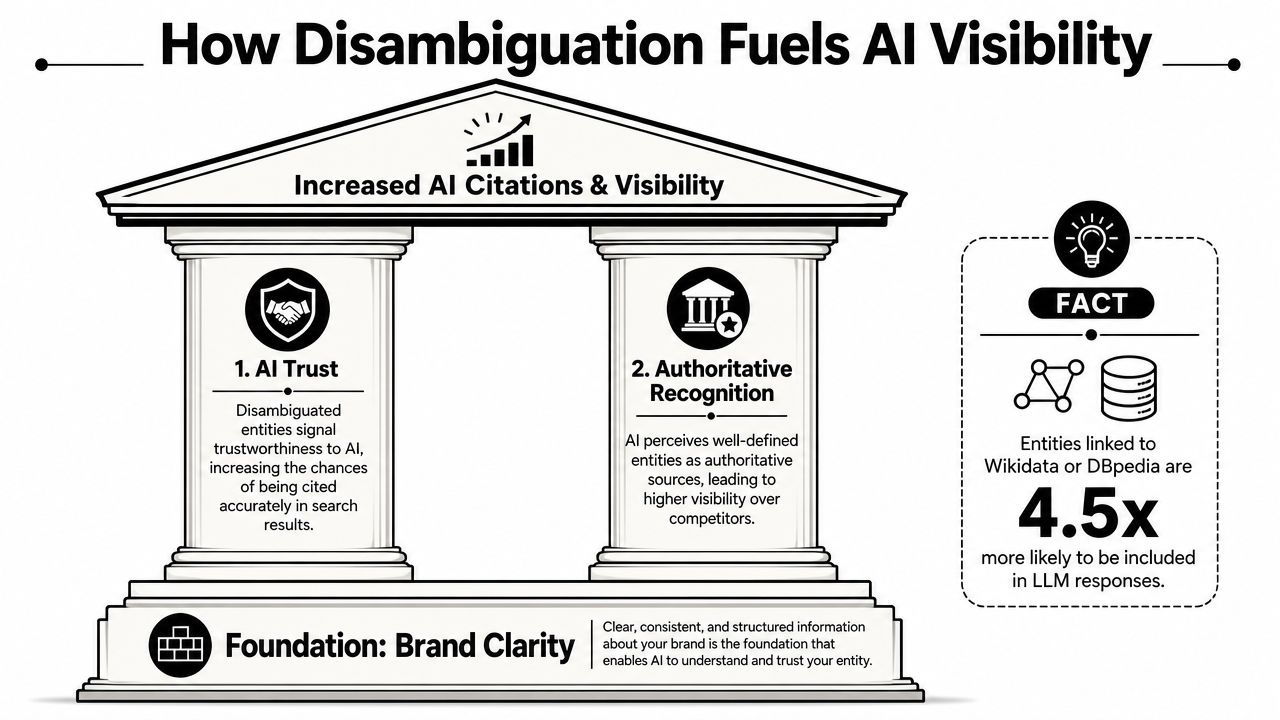
As the diagram makes clear, brand clarity is what builds the trust and authority needed for AI to confidently cite you in its answers.
Expanding Your Footprint with Consistency
Once your central source of truth is locked in, the next phase is all about replication. You need to ensure the information on your "About Us" page is mirrored exactly across the rest of the web.
Inconsistency is the archenemy of disambiguation. Even a tiny variation in your business name or address on different platforms can introduce ambiguity and chip away at the trust AI has in your entity.
You'll want to focus your efforts on a few key platforms first:
- Google Business Profile: This is your digital storefront in local search and the most visible representation of your entity for many businesses. Every detail here must be a perfect match for your website’s source of truth.
- Major Data Aggregators: Services like Data Axle and Neustar Localeze are the wholesalers of business data. They feed information to hundreds of other online directories, so getting it right with them has a massive ripple effect.
- Key Industry Directories: Being listed correctly on high-authority sites relevant to your niche reinforces your topical expertise and credibility.
Building this web of consistent citations acts as a powerful form of third-party verification, a topic we explore in more detail in our dedicated guide. This network of corroborating information strengthens your entity’s authority in the eyes of search engines and AI alike.
Finally, the most direct way to define your entity is by speaking the search engine's native language: Schema.org markup. By adding Organization schema to your site, you’re not just suggesting your identity—you are explicitly declaring it. This structured data wraps your core information in a format machines can read instantly, making the job of Entity Disambiguation significantly easier for AI.
Optimizing Your Content for LLM Citation
So, you’ve established a clear and consistent digital presence. What’s next? The real magic happens when you start structuring your content—from your core service pages to your blog posts—so that large language models (LLMs) can use it as a citable source. This is about more than just writing for your human audience; it’s about writing for machine comprehension, too.
The objective is simple: present your information in such clear, factual statements that an AI can parse, verify, and reference it with absolute confidence. Every piece of content you publish should be another brick in the wall, reinforcing your entity’s expertise and authority.
Structuring Content for AI Comprehension
To make your content truly AI-ready, it needs to be direct, unambiguous, and factually dense. An AI doesn’t infer context or read between the lines like a person does; it looks for definitive, verifiable statements. While many of the top AI content generation tools can assist with output, the core structure must be deliberate.
You can start auditing your own pages by asking a few surprisingly powerful questions:
- Does this page clearly state who we are and what we do in simple, declarative terms?
- Are our core products or services described with factual, non-promotional language?
- Is our brand name consistently linked back to our main "About Us" or home page?
That last point is especially important. Every time you use your disambiguated brand name as an internal link to your central hub, you're reinforcing that crucial connection for AI crawlers.
The precision with which an AI can interpret your content is directly tied to the clarity you provide. An AI will always favor a source it can understand without ambiguity over one that requires interpretation.
This isn't just theory. Entity Disambiguation is a core pillar of modern natural language processing. Research from Johns Hopkins University has shown that advanced systems can achieve up to 95% accuracy on complex data, a level of precision that allows LLMs to correctly interpret who you are. OpenAI’s own work in this area involves training models on over 150,000 entity types. This is the science that allows a conversational search engine to cite your brand accurately instead of hallucinating an answer.
From Content to Citable Facts
The best way to become a citable authority is to think like the AI that's trying to learn from you. Your job is to provide it with clean, well-structured information. Our team at Raven SEO helps clients future-proof their digital assets for generative search by focusing on these core principles, and we can show you how to apply these techniques with our expertise in NLP content analysis.
Here are some practical steps you can take to optimize your content today:
Lead with a Factual Summary: Start key pages with a concise, factual summary of the page's contents. Think of it as the abstract from an academic paper.
Use Definitional Language: Don't be shy about being direct. Use phrases like "[Your Brand] is a company that…" or "[Your Product] is a tool designed to…" This leaves zero room for misinterpretation.
Break Down Complex Ideas: Use bullet points and numbered lists. This structures information in a way that is incredibly easy for both humans and machines to parse and process.
By implementing these content strategies, you're doing more than just improving readability. You're feeding LLMs the clear, organized data they need to trust and cite your brand as an authority.
Getting AI-Ready with the Raven SEO Roadmap
The path from traditional SEO to what’s required for AI and Answer Engines is now much clearer. We’ve covered the power of Entity Disambiguation and the concrete steps needed to build a digital footprint that AI models will actually trust. This whole process is about turning your brand from just another name online into a citable, recognized authority.
It all works together. A central source of truth on your website, consistent brand information scattered across the web, and content that’s properly structured for machines to understand—these aren’t separate chores. They are interconnected pieces of a single, powerful strategy designed to secure your visibility for years to come. For some broader insights into how artificial intelligence is changing the digital world, you can explore our franchise articles for a wider perspective.
Your Practical Next Step
This isn't just theory. At Raven SEO, we've refined this exact process to get measurable results for our clients. It starts with a no-obligation consultation where we audit your brand’s current AI readiness and give you a clear, actionable plan.
Turning this knowledge into action is the most important step you can take. Partnering with experts ensures your business doesn't just adapt but thrives in the age of AI.
This is your chance to stop guessing and start building a real, defensible digital authority. Secure your consultation today and take the first definitive step toward mastering your brand's future.
Frequently Asked Questions About Entity Disambiguation
So, we've walked through the essentials of building a brand identity that AI systems can actually understand, trust, and even cite. But what does this mean in practical terms? Here are some of the most common questions we hear from business owners trying to get a handle on Entity Disambiguation and its role in their growth.
How Does Entity Disambiguation Relate to SEO?
Think of it as the next evolution of SEO. Traditional SEO focuses on ranking web pages for keywords. Entity Disambiguation focuses on establishing your brand as a recognized 'thing' (or entity) that AI systems can understand and trust. Instead of just aiming for a blue link, the goal is to become the authoritative source cited directly in an AI-generated answer. This builds deeper authority and can capture traffic that never even sees a traditional search results page.
How Long Does It Take to See Results from Entity Disambiguation?
Building a clear, authoritative digital identity isn't an overnight fix. It's a foundational strategy. Initial improvements can be seen within a few months as you clean up your core business data and implement Schema markup. However, the real, lasting benefits—like consistent AI citations and stronger topical authority—build over time as search engines and AI systems repeatedly encounter your consistent, verified information across the web.
Do I Need to Be a Big Brand for This to Matter?
Absolutely not. In fact, Entity Disambiguation is even more critical for small and medium-sized businesses. Larger brands often have a massive digital footprint that helps AI figure out who they are through sheer volume. Smaller businesses don't have that luxury. By being deliberate and precise with your entity signals—your name, address, services, and expertise—you can cut through the noise and compete on clarity and authority, even without a global marketing budget.
As you start building this authoritative digital footprint, it helps to understand how your site is seen by the crawlers that power search. Learning about the various SEO bot software tools can give you valuable insight into how machines interpret information online, helping you structure your data more effectively from the get-go.
Ready to turn your brand into an AI-cited authority? Raven SEO specializes in building the digital footprint that secures sustainable growth. Book a no-obligation consultation and let's create your practical roadmap to AI readiness.