

The most important search result may soon be the one that never sends a click.
That sounds backward until you look at how answer engines work. A growing share of search behavior now ends inside AI-generated responses, summaries, and conversational interfaces. In that environment, the winning brand isn't always the one that ranks first on a blue-link page. It's the one the model trusts enough to cite.
That shift changes the role of NLP content analysis. It's no longer just a research method for sorting reviews or tagging content. It has become a practical way to understand how machines interpret meaning, identify entities, group themes, and decide which passages are clear enough to reuse in an answer. If your site isn't easy for systems to parse, validate, and connect to known entities, visibility becomes fragile.
The opportunity is bigger than rankings. Brands that adapt can shape the answer itself.
Beyond Rankings The New Goal Is AI Citation
For years, SEO teams optimized for position, click-through rate, and landing page traffic. Those still matter. But they no longer describe the whole game.
AI Overviews and conversational search change the economics of visibility. A user asks a question, the system synthesizes an answer, and only a small set of sources influences that output. If your content becomes one of those sources, your brand gains something stronger than a visit. It gains embedded authority.
Why citation matters more than a raw ranking
A traditional search result gives users options. An AI-generated answer compresses those options into a recommendation layer. That means authority is being re-evaluated at the passage level, not just the page level.
Three practical consequences follow:
- Your content must stand alone in small pieces. A model may use a paragraph, list, or definition, not your entire article.
- Clarity beats cleverness. Dense brand language and vague claims are harder to trust and harder to extract.
- Verification becomes part of visibility. If a system can connect your claims to recognizable entities, structure, and supporting context, your odds improve.
Practical rule: In the AI search era, the best-performing page isn't always the one that attracts the most clicks. It's often the one that supplies the cleanest answer.
This is why agencies are rethinking search strategy around AI consumption patterns, not just crawler behavior. If you want an outside perspective on how firms are approaching this transition, Surnex published a useful piece on AI Overviews strategy for agencies.
A modern visibility plan also has to account for how your content is interpreted beyond classic SERPs. That's where a structured assessment of your AI visibility strategy becomes useful. The key question is simple: can a machine identify what your brand knows, why it's credible, and which passages deserve reuse?
The real shift is from discoverability to answer eligibility
Search used to reward pages that were easy to find. AI systems reward pages that are easy to reuse.
That's a stricter standard. It asks whether your page contains a direct answer, whether the answer is semantically coherent, whether the source appears authoritative, and whether the machine can separate fact from filler. Brands that still optimize around keyword placement alone are preparing for a market that is already changing underneath them.
Decoding Language How AI Reads Your Content
Most business teams hear “NLP” and picture something abstract. In practice, it's closer to a very fast librarian combined with a meticulous research assistant. It reads huge volumes of text, breaks language into parts, groups similar ideas, and tags important details.
That process matters because AI systems don't experience your page the way a human does. They convert it into tokens, patterns, entities, and relationships. If you understand that workflow, your content gets easier to design for retrieval and citation.
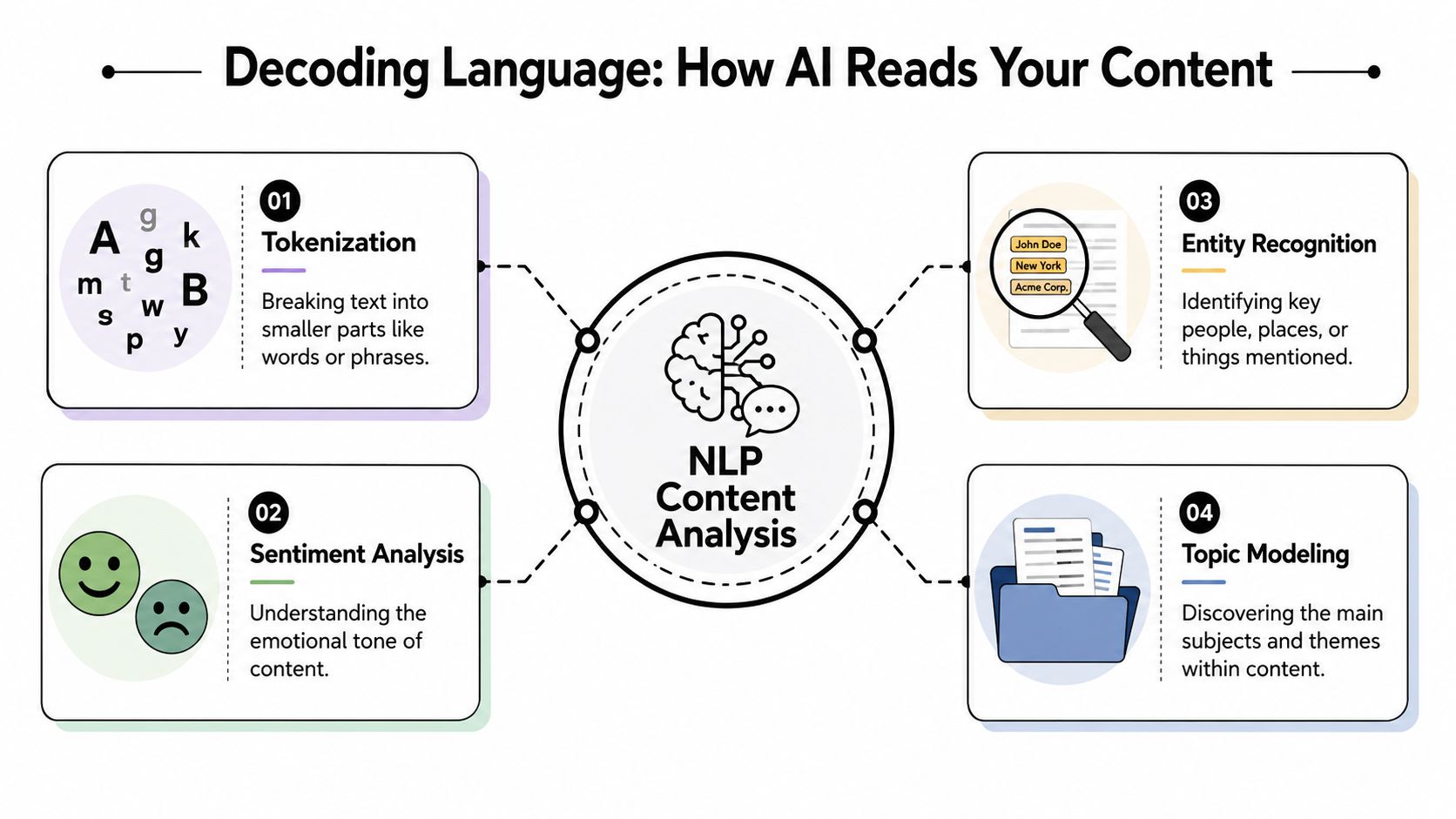
The four reading moves that matter most
Start with the basics.
- Tokenization breaks text into smaller units such as words or phrases. This is the machine's first pass. It turns a paragraph into components it can analyze.
- Sentiment analysis estimates tone. In customer feedback, that helps separate praise from friction.
- Entity recognition highlights the specific people, products, organizations, and places mentioned in the text.
- Topic modeling identifies recurring themes across a large set of documents.
These aren't fringe techniques. In large-scale text analysis, topic modeling and sentiment analysis are the dominant methods. A review of social media studies found that 58% used topic modeling and 55% used sentiment analysis, which supports the idea that this combination has become standard in AI-driven content analysis pipelines, as noted in this social media NLP review.
A simple business example
Take a retailer with thousands of product reviews.
Topic modeling helps sort comments into practical buckets like shipping, quality, sizing, and support. Sentiment analysis tells the team whether each bucket trends positive or negative. Entity recognition identifies product lines, model names, and competing brands. Once all of that is structured, the business can spot recurring issues without reading every line manually.
That same logic applies to your own website. An AI system reads your articles and tries to answer questions such as:
| AI reading task | What it's looking for |
|---|---|
| Theme detection | What is this page mainly about? |
| Entity extraction | Which brands, products, people, or places appear here? |
| Tone assessment | Is this explanatory, promotional, uncertain, or critical? |
| Passage utility | Is there a concise answer worth quoting? |
If your copy jumps between ideas, hides the main answer, or uses inconsistent names for the same concept, the system has to work harder. That usually doesn't help.
Good NLP-oriented content feels obvious in retrospect. The topic is stable, the entities are explicit, and each section does one job.
For teams that want to operationalize this with real workflows, especially with scripts for classification and semantic clustering, Outrank's guide to expert Python tips for SEO is worth a look.
A stronger foundation starts with the underlying concepts. If your team needs a cleaner framework first, this guide to natural language processing basics is the right place to align marketing and technical stakeholders.
From SEO Clicks to AEO Authority
The shift from SEO to AEO isn't a branding exercise. It reflects a different way machines evaluate content.
Traditional SEO was built around matching queries to pages. AEO, or AI Engine Optimization, is built around matching questions to trustworthy answer units. The difference sounds subtle, but it changes what gets rewarded.
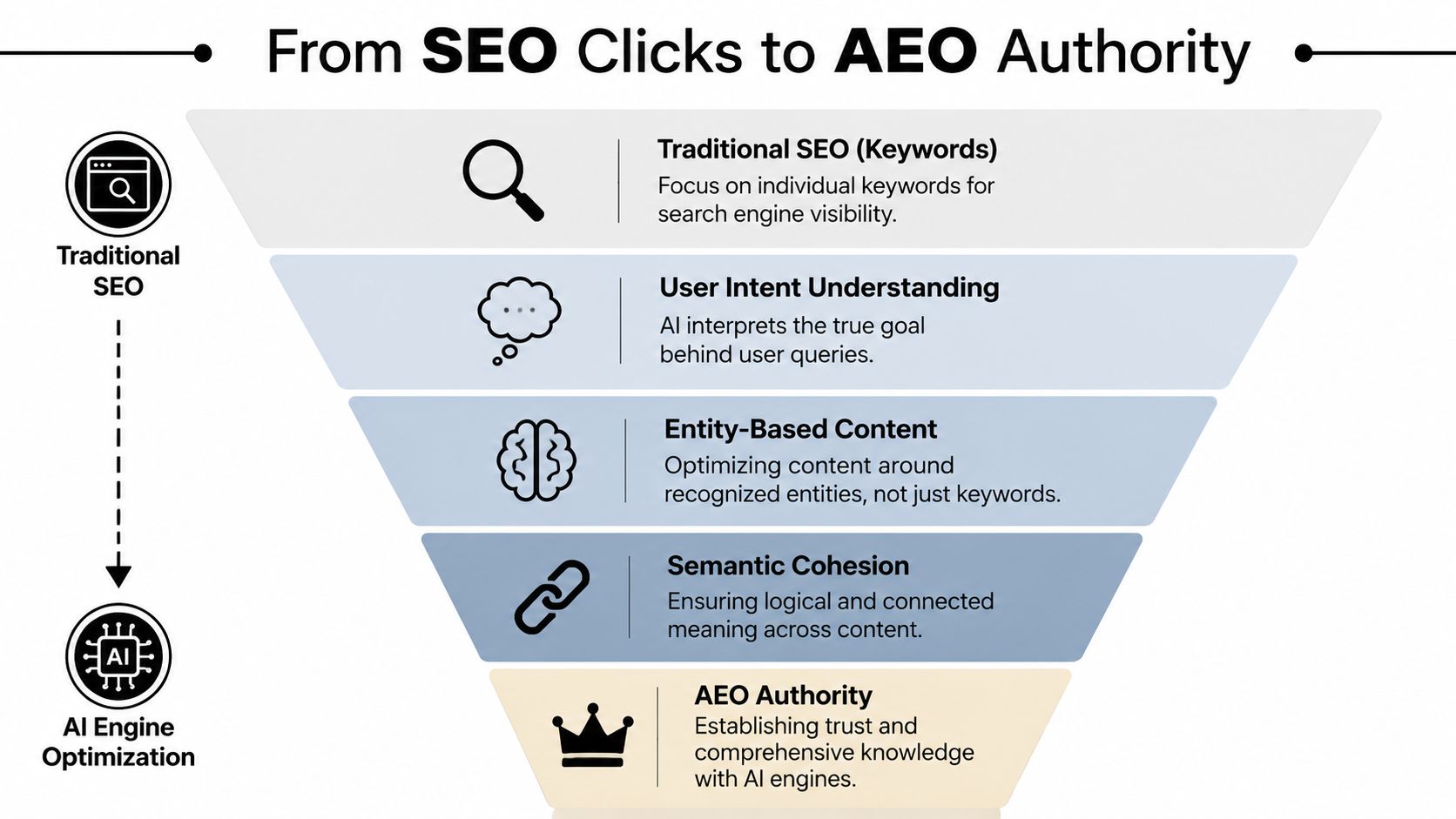
The old stack and the new stack
Here's the cleanest way to think about it.
| Traditional SEO | AEO |
|---|---|
| Optimize pages for keyword relevance | Optimize passages for answer relevance |
| Earn visibility through rankings | Earn visibility through citations |
| Focus on crawlability and link signals | Focus on entities, structure, and semantic clarity |
| Measure clicks and sessions | Measure mention quality and citation presence |
This doesn't mean classic SEO disappears. It means it becomes the floor, not the ceiling.
Why businesses are moving now
The operational shift is already underway. As of 2026, over 70% of large enterprises in North America and Europe use some form of NLP-driven content analysis for marketing, customer experience, or risk monitoring, according to Analysis Group's NLP overview. That matters because AI visibility increasingly depends on the same infrastructure: classification, extraction, labeling, and semantic organization.
When teams adopt that mindset, they stop asking, “How do we rank this page?” and start asking better questions:
- What exact question does this page answer?
- Which entities should a machine associate with our brand?
- Is the answer explicit enough to reuse without interpretation?
- Does the page support trust with clear definitions, examples, and structure?
What works and what fails
What tends to work:
- Entity-focused writing. Name the product, company, category, and relevant people clearly.
- Structured answers. Put the direct answer near the top of the relevant section.
- Semantic consistency. Use stable terminology across related pages.
What tends to fail:
- Keyword stuffing. It signals old optimization habits and weakens readability.
- Thin category pages. They rarely contain enough substance to deserve citation.
- Unverifiable claims. If the language is vague, the system has less reason to trust it.
For a deeper comparison of these models, this overview of AEO vs SEO in 2026 helps frame the strategic differences more clearly.
AI systems don't reward the loudest page. They favor the page that resolves ambiguity.
Structuring Content for AI Comprehension
Strong ideas aren't enough. The presentation layer matters because AI systems need content that's both readable and extractable.
The practical goal is to build pages as collections of answer units. An answer unit is a self-contained block of content that addresses one question clearly, with enough context to stand on its own. Think of it as the smallest passage on your site that could be quoted without requiring the reader to decode the rest of the article.
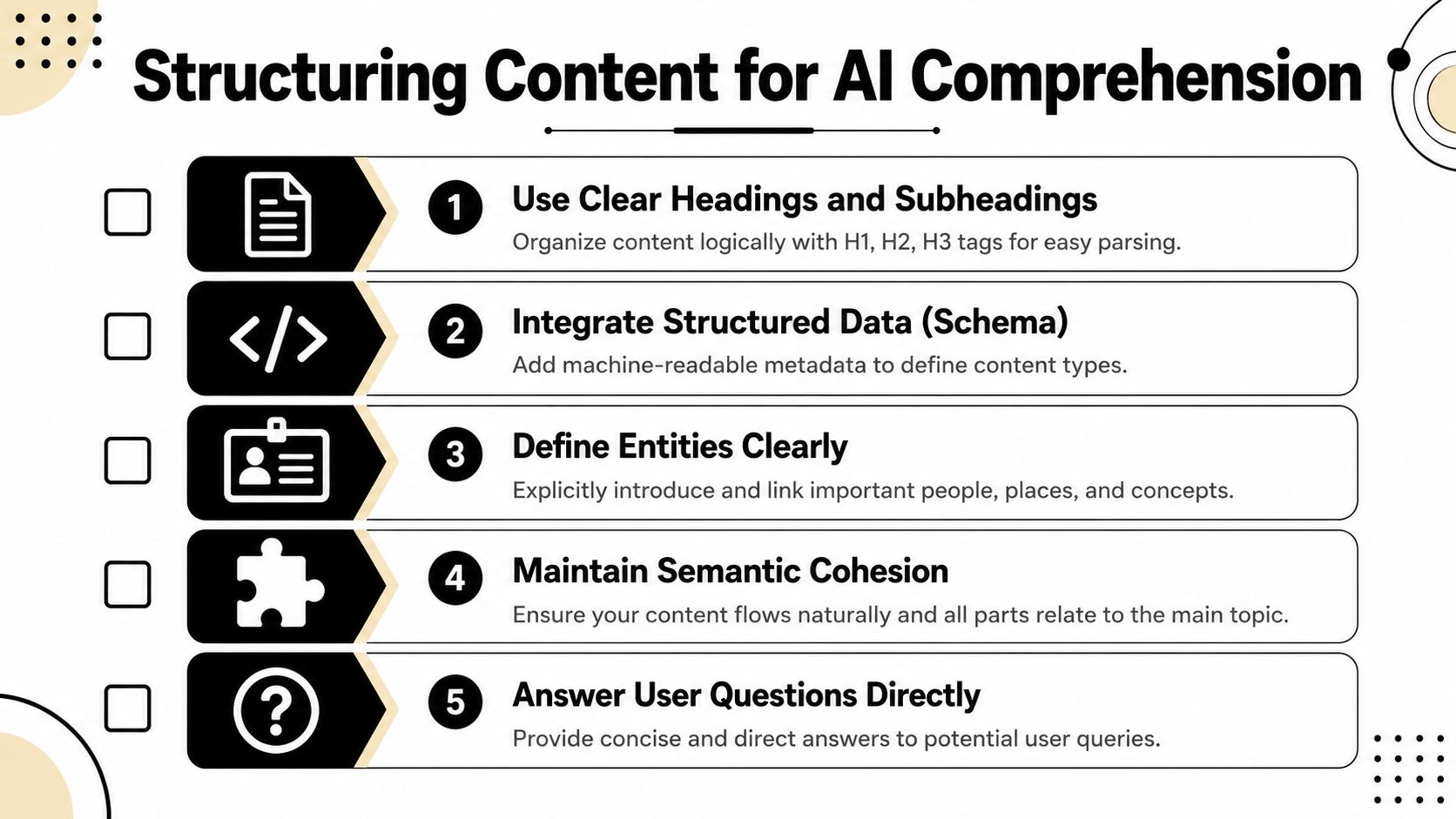
Build pages around answer units
A useful answer unit usually includes four elements:
- A direct question or implied query
- A plain-language answer in the first lines
- Supporting detail that adds precision
- Terms and entities that anchor meaning
Here's what that looks like in practice:
- Weak version: A long introduction about industry change before the answer appears.
- Better version: A short paragraph that answers the question immediately, followed by specifics.
That structure helps both humans and machines. It reduces interpretation overhead.
Field note: If a paragraph can't survive copy-and-paste into an AI answer without losing meaning, it probably needs tighter structure.
Use headings as retrieval cues
Headings aren't just formatting. They tell machines where one concept ends and another begins.
Use them to create a clean hierarchy:
- Descriptive H2s: State the topic plainly.
- Focused H3s: Narrow to one sub-question or decision point.
- Parallel phrasing: Keep related sections consistent so patterns are easier to parse.
Avoid vague headers such as “What this means” or “Key considerations” when a sharper label would do more work.
A content team that manages many pages will also benefit from thinking in systems, not one-off articles. MeshBase has a useful overview of understanding AI content management systems that connects structure, workflow, and machine readability.
Favor auditable language over soft marketing copy
Research into evidence-anchored LLMs shows that systems grounded in verifiable text spans from source documents achieve high accuracy, and their explanations link back to exact source content, as described in this evidence-anchored LLM study. That has a direct implication for content teams: AI systems are more comfortable with language they can trace.
That means you should prefer:
- Definitive claims with support
- Specific terminology
- Clear attributions to observable facts
- Tight phrasing that reduces ambiguity
It also means you should cut:
- Inflated adjectives
- Unclear pronouns
- Long intro paragraphs
- Claims that sound impressive but say little
This walkthrough is worth watching if your team needs a visual sense of how AI-friendly content is structured in practice.
A practical checklist for editorial teams
Use this before publishing:
- Question fit: Does each section answer a distinct query?
- Passage quality: Can a paragraph stand alone without surrounding context?
- Entity clarity: Are important names, products, and concepts explicit?
- Evidence support: Are factual claims written in a way a machine can audit?
- Hierarchy: Do headings reflect the actual structure of the topic?
If your site is expanding into clusters, this guide on how to create content clusters is useful because it forces the same discipline at the architecture level, not just the paragraph level.
Building Authority with Structured Data and Entities
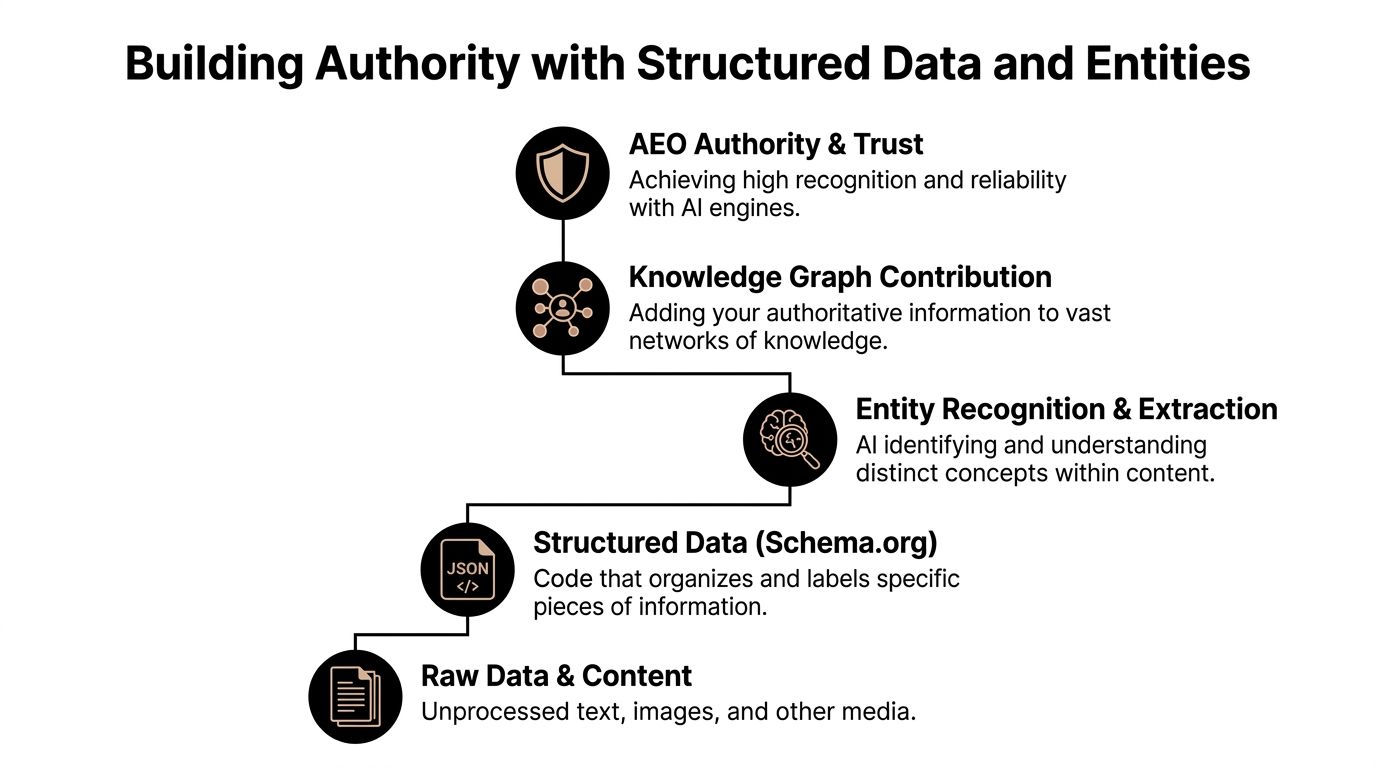
Great copy helps humans trust you. Structured data helps machines verify you.
Many brands face a common challenge. They publish solid articles, but they never give machines a reliable identity layer. Schema, entity consistency, and internal content relationships are what turn a helpful page into a source that systems can classify with confidence.
Treat schema as a digital resume
A simple way to explain structured data to clients is this: it acts like a digital resume for every page.
It tells machines what the page is, who published it, what organization is behind it, what the main topic is, and how that page relates to other known concepts. JSON-LD with Schema.org markup is the standard implementation, widely used because it separates structured signals from the visible page copy.
At the page level, that often means identifying things such as:
- Article type
- Organization identity
- Author details
- Product or service references
- FAQ or how-to structure where appropriate
The point isn't to dump code onto a page and hope for magic. The point is to reduce ambiguity.
Why entities matter more than keywords
Keywords describe strings. Entities describe things.
That distinction matters because modern AI systems try to understand whether “Apple” means a company or a fruit, whether “Mercury” refers to a planet or a product line, and whether a person mentioned on one page is the same person referenced elsewhere on your site. Entity consistency helps resolve those questions.
NLP models for named entity recognition can achieve 80% to 90% precision in identifying entities such as people, organizations, and products, and content rich in verifiable entities paired with semantic markup is more likely to surface as a candidate passage in LLM-driven overviews and conversational search, based on this overview of NER and semantic markup.
That leads to a practical rule for site architecture.
Name the same thing the same way everywhere that matters. Don't call a service by one label on your homepage, a shorter label on your product page, and a marketing nickname in your blog.
A compact implementation model
For teams, starting with an exhaustive knowledge graph is not necessary. Consistency is what they need.
A sensible rollout looks like this:
| Layer | What to implement |
|---|---|
| Site identity | Organization, website, brand naming, core profiles |
| Page type | Article, service, product, FAQ, local business where relevant |
| Entity layer | People, products, services, locations, categories |
| Relationship layer | Internal links that clarify parent-child and topic relationships |
Then audit for alignment.
- Check naming consistency. Brand, product, and service names should match across title tags, headings, body copy, and schema.
- Review orphan concepts. If an important entity appears once and nowhere else, it's harder to validate.
- Map topic relationships. Supporting pages should reinforce the authority of your core pages, not compete with them.
What usually goes wrong
In real audits, the most common failures aren't technical edge cases. They're operational.
- Schema is incomplete. Teams add basic markup once and never revisit it.
- Entities are inconsistent. Different writers use different naming conventions.
- Pages overlap semantically. Several URLs target the same concept with slightly different wording.
- Authority signals are disconnected. The company page, author bios, and service pages don't reinforce one another.
That's why entity strategy belongs with content strategy, not in a separate technical bucket. If you want a framework for organizing pages around machine-recognizable topics, this guide to entity-based SEO is a useful next step.
A strong AEO footprint doesn't come from schema alone. It comes from schema layered onto clear editorial structure and stable entity language across the site.
Your Practical Roadmap for AI Visibility
The teams that adapt fastest usually don't start by publishing more. They start by making existing content easier for AI systems to trust.
That's the practical use of NLP content analysis in a visibility strategy. It helps you see your site the way retrieval and synthesis systems do: as a set of topics, entities, relationships, and passages competing for inclusion in an answer.
A four-part plan that works
Start with an audit.
Review your current pages with a semantic lens
Look for mixed intent, fuzzy headings, weak answer blocks, and inconsistent terminology. Prioritize pages that already have authority or cover high-value topics.Rewrite for answer extraction
Tighten introductions. Move direct answers higher. Break large sections into clean subtopics. Remove language that sounds polished but carries little factual weight.Layer in structured signals
Add or refine schema. Standardize entity naming. Make sure service pages, bios, organization details, and related articles reinforce each other.Measure citation readiness, not just traffic
Track whether your brand appears in AI-generated answers, whether your pages contain reusable passages, and whether your most important topics are covered with enough depth and consistency.
Why this matters now
Transformer-based models such as BERT achieve F1 scores of 85% to 92% on text classification, outperforming older methods, which means AI systems are increasingly rewarding semantic coherence over raw keyword density, as shown in this transformer benchmark overview. For marketers, that means the optimization target has changed. Concept clusters, entity relationships, and structural clarity now do more work than repetitive phrase matching.
The brands that win won't be the ones chasing every interface change. They'll be the ones building content that stays legible across interfaces.
Your website is no longer just a destination. It's a knowledge source competing to be quoted.
If your team wants a practical starting point, the right move is an honest audit of where your brand stands today, which pages are closest to citation-ready, and where your structure still leaves too much ambiguity.
Raven SEO helps brands become AI-ready with technical SEO, structured data strategy, content architecture, and practical audits built for AI visibility. If you want a no-obligation review of how your site performs in the shift from rankings to citations, start with Raven SEO.