
The future of search engine optimization will not be won by chasing clicks alone. It will be won by becoming a source AI systems trust enough to cite.
Search visibility now happens in two layers at once. One layer still rewards rankings, page quality, and technical SEO. The other decides which brands appear inside AI summaries, AI Overviews, and conversational results before a user ever reaches a website. If your team still treats traffic as the only proof of success, it will miss the part of search that increasingly shapes consideration.
This shift changes how teams allocate time and budget. Rank tracking still matters, but it no longer deserves the entire measurement model. More effort now has to move into content structuring, entity clarity, source attribution, and brand authority work that improves your odds of being referenced in machine-generated answers. Google's own shift toward generative responses is part of that change, and Google's Search Generative Experience is a useful reference point for understanding how the answer layer developed.
The practical mindset change is simple. Stop treating every query as a click opportunity and start treating more queries as citation opportunities. The goal is no longer just to rank, win the visit, and convert later. The goal is to be understood, selected, cited, and remembered, then earn the click when the buyer needs validation, detail, or action.
Traditional SEO still matters. It now sits inside a broader visibility system where AI intermediates discovery. Brands that adapt will build pages and data models that machines can interpret with confidence, while still giving humans a reason to trust what they find.
The End of Search As We Know It
Practical rule: If your content can be indexed but not easily summarized, compared, or cited, it is losing ground, even when it still ranks.
Search has shifted from link retrieval to answer mediation. Users still search. What changed is where decisions get made. More of the evaluation now happens inside AI-generated summaries, overviews, and conversational responses before a visitor ever reaches your site.

Clicks are no longer the only measure of winning
The old model treated a click as the proof of visibility. That model is breaking down. As noted earlier, zero-click behavior has risen and top organic listings capture less attention as AI-generated answers occupy more of the results page. If your dashboard still treats organic sessions as the full measure of search performance, it is missing the influence layer that now shapes shortlist creation.
That has a direct strategic implication. The question is no longer just, "How do we win the click?" It is, "How do we become a source the model selects, cites, and reuses?" That is the mindset shift many teams still have not operationalized.
Search behavior is moving toward answer mediation
Understanding Search Generative Experience and how it changed search visibility is critical because it shows how the interface now compresses discovery, comparison, and recommendation into a single answer layer. In practice, users often form their first impression of a brand from a machine-composed summary, not from a landing page.
I see the same mistake repeatedly in enterprise content programs. Teams publish pages that are broad enough to rank, but too vague to quote. AI systems prefer material they can extract cleanly, attribute with confidence, and reconcile with other trusted sources. Pages built only for keyword coverage tend to underperform in that environment.
Tools can help teams close that gap. Editorial systems built around entity clarity, source support, and structured drafting make it easier to produce content that machines can interpret and cite consistently. Narrareach's powerful AI features are a useful example of that shift toward citation-ready publishing.
What this means for business leaders
The future of search engine optimization is a move from traffic capture to visibility architecture. The objective is broader than ranking. It is to make your expertise easy for AI systems to identify, trust, and reference.
That changes how leaders should set priorities:
- Content planning: Invest in pages that answer specific questions with clear claims, evidence, and definitions.
- Technical SEO: Use structured data and page structure to reduce ambiguity, not just to satisfy a checklist.
- Brand strategy: Show who is speaking, why they are credible, and what the company is known for at the page level.
- Performance reporting: Track citations, branded search lift, assisted conversions, and presence in AI answers alongside traffic.
The winners in this new search environment will not be the brands that publish the most. They will be the brands that are easiest to understand and safest to cite.
The New Playbook From SEO to Answer Engine Optimization
Search behavior has already changed. The operating model has to change with it.
Traditional SEO was built around ranking pages for queries. Answer Engine Optimization, or AEO, is built around making your expertise easy for AI systems to identify, extract, verify, and cite inside a synthesized response. That shift changes the target from clicks alone to citations, answer inclusion, and branded recall.
The practical difference is straightforward. Classic SEO asks, "How do we match demand and win the visit?" AEO asks, "How do we become a source the model trusts enough to use?" Keyword targeting still plays a role, but it now sits inside a broader system of entity clarity, source attribution, structured context, and answer-ready content.
Why AEO has become operationally urgent
In its 2024 analysis of AI search, McKinsey reports that about 50% of Google searches already feature AI summaries and projects that share to exceed 75% by 2028. It also notes that only 16% of brands systematically track AI search performance in McKinsey's analysis of AI search as the new front door to the internet. That gap creates a real execution problem. Brands are competing in an answer-driven environment while still reporting on a click-driven model.
AEO is therefore not just a thought-leadership term. It is a practical operating discipline. Teams need to answer a new set of questions:
- Can an AI system identify your company, products, and subject matter without ambiguity?
- Can it connect your brand to a specific topic cluster or area of expertise?
- Can it extract a clean, concise answer from the page?
- Can it verify that answer against other credible sources?
- Can it see who authored the content and why that person or organization should be trusted?
That last point is where many teams still fall short. Strong positioning for AI often depends on visible authorship, source support, and consistent credibility signals, which are covered in more detail in this guide to E-E-A-T for AI visibility.
Traditional SEO vs Answer Engine Optimization
| Focus Area | Traditional SEO (For Algorithms) | Answer Engine Optimization (For AI) |
|---|---|---|
| Core target | Keywords and rankings | Entities, context, and citations |
| Primary goal | Earn the click | Earn inclusion in the answer |
| Content model | Page-by-page targeting | Topic systems and answer coverage |
| Trust signal | Links and authority signals | Source clarity and machine-readable expertise |
| Technical layer | Crawlability and indexing | Structured context and citation readiness |
| Reporting lens | Traffic, rankings, CTR | Citation presence, branded discovery, answer visibility |
Good AEO starts with strong SEO fundamentals, then extends them. The page must still be discoverable. It also needs to be interpretable.
What works and what breaks
Content performs better in answer engines when it resolves a specific question quickly, states a clear claim, supports that claim, and removes ambiguity about who is speaking. Pages built this way give systems something usable. Pages built around generic keyword coverage often do not.
I see the same pattern in audits across B2B, SaaS, and services firms. The pages that earn AI visibility usually have tighter topic boundaries, stronger definitions, better formatting, and clearer attribution than the rest of the site. The trade-off is real. These pages can feel narrower than old-school SEO teams are used to, but that specificity is often what makes them citable.
What tends to fail is volume-first publishing. Ten near-duplicate posts targeting slight keyword variations may still create indexable inventory, but they rarely create citation-worthy authority. AI systems do not need more filler. They need extractable facts, consistent terminology, and confidence that the source knows the subject.
For teams trying to operationalize that shift inside the writing process, Narrareach's powerful AI features are worth reviewing because they align content production with AI-oriented structure and source clarity rather than simple keyword repetition.
The mindset shift leaders need
The central question is no longer limited to ranking. It is whether an answer engine can trust your content enough to include it in the response.
That change reaches far beyond editorial style. It affects briefing, content design, schema, internal linking, author pages, review workflows, and performance reporting. Teams that adapt early stop treating search as a page-level acquisition channel and start treating it as a visibility system built for citation.
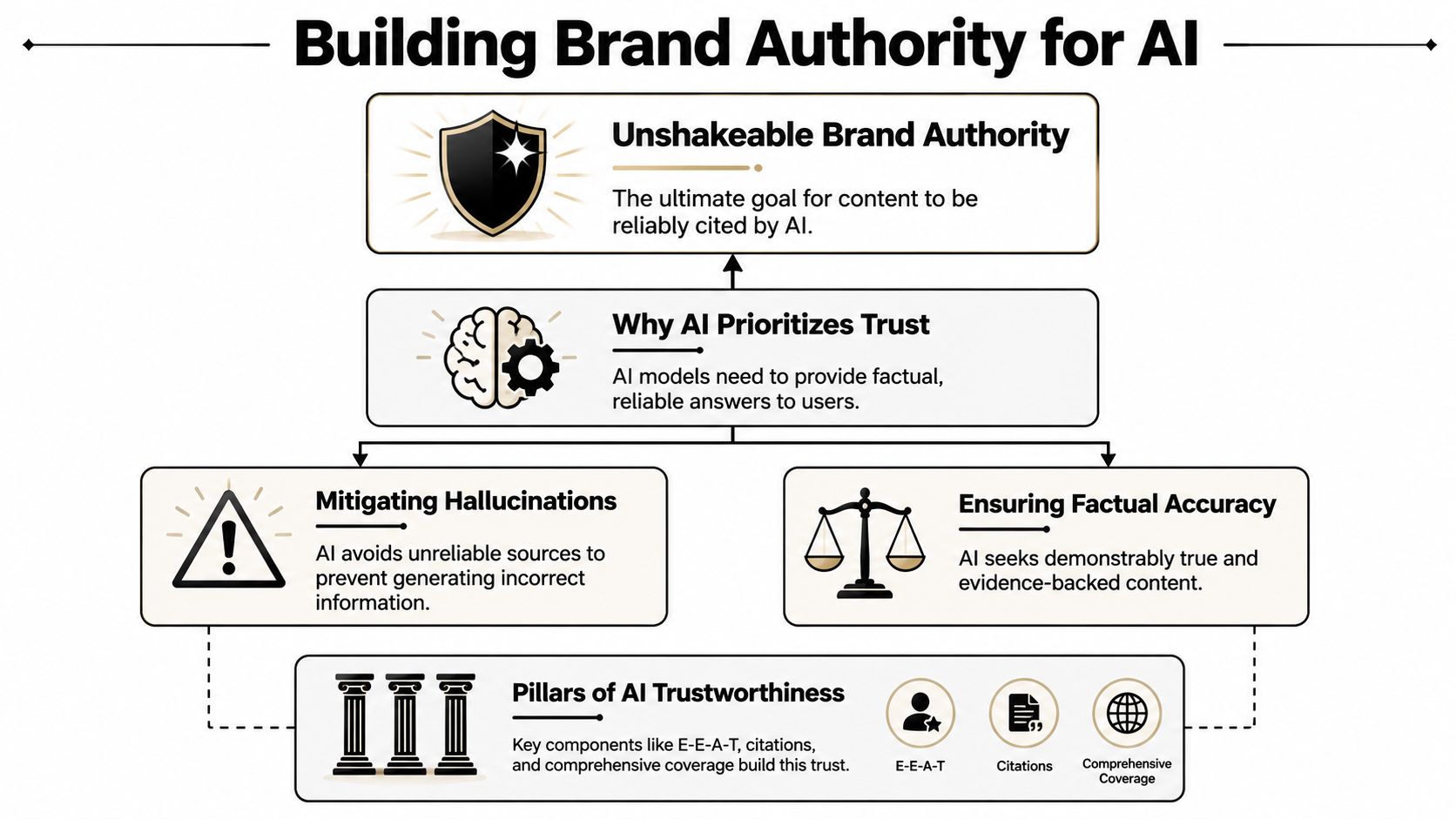
Building Unshakeable Brand Authority for AI
AI systems cite selectively because citation carries risk. If a model uses your content to answer a question, it's making a trust decision on behalf of the user. That means brand authority is no longer a soft marketing concept. It's part of the technical logic behind whether your content gets surfaced.
Being indexable is not the same as being citable
One of the biggest mistakes in modern SEO is assuming that crawlability equals visibility. It doesn't. As Search Influence notes in its discussion of AI search and citation likelihood, the gap between being indexable and being cited is a key challenge, because AI search shifts visibility toward citations and entity clarity, while systems still need high-quality, specific, machine-readable content to trust and summarize a source.
That distinction explains why some sites with plenty of indexed pages still fail to appear in AI-mediated answers. Their pages are discoverable, but they don't provide enough confidence signals.
The authority signals AI can interpret
For answer engines, authority isn't only about domain reputation. It's also about page-level signals and topic-level consistency.
The strongest patterns usually include:
- Expertise made explicit: Show who wrote the content, why they're qualified, and what firsthand perspective they bring.
- Topic depth: Build clusters that answer the main question, follow-up questions, objections, comparisons, and implementation details.
- Original contribution: Publish data, frameworks, checklists, examples, or informed analysis that isn't copied from every other site.
- Entity consistency: Use the same brand naming, service descriptions, and author details across the website and public mentions.
Businesses that want to strengthen this foundation should understand how E-E-A-T applies in AI-driven search environments, because trust signals now need to serve both human evaluators and machine interpreters.
What authority-building looks like in practice
A law firm doesn't become citable by publishing ten broad “what is personal injury” pages. It becomes citable by producing clear explanations of claim stages, documenting attorney credentials, explaining jurisdiction-specific issues, and offering trustworthy answers that a system can summarize without guesswork.
A healthcare brand doesn't become trustworthy because it uses medical keywords more often. It becomes trustworthy when pages clearly state review processes, author qualifications, and evidence-backed guidance.
If you're thinking beyond static content and toward customized user journeys, Kogifi for advanced website personalization is a useful example of how personalization and relevance can support a stronger overall digital footprint. Relevance doesn't replace authority, but it helps users engage more effectively once they arrive.
Authority is what turns a webpage from “available” into “safe to cite.”
What not to do
Three patterns consistently weaken AI trust:
- Thin topical expansion: Publishing many small pages with little substance.
- Anonymous expertise: Hiding authors, reviewers, or credentials.
- Generic claims: Saying you're a leader, expert, or trusted provider without proving it in the content itself.
The future of search engine optimization favors brands that make expertise legible. Not implied. Legible.
Structuring Your Data for AI Comprehension
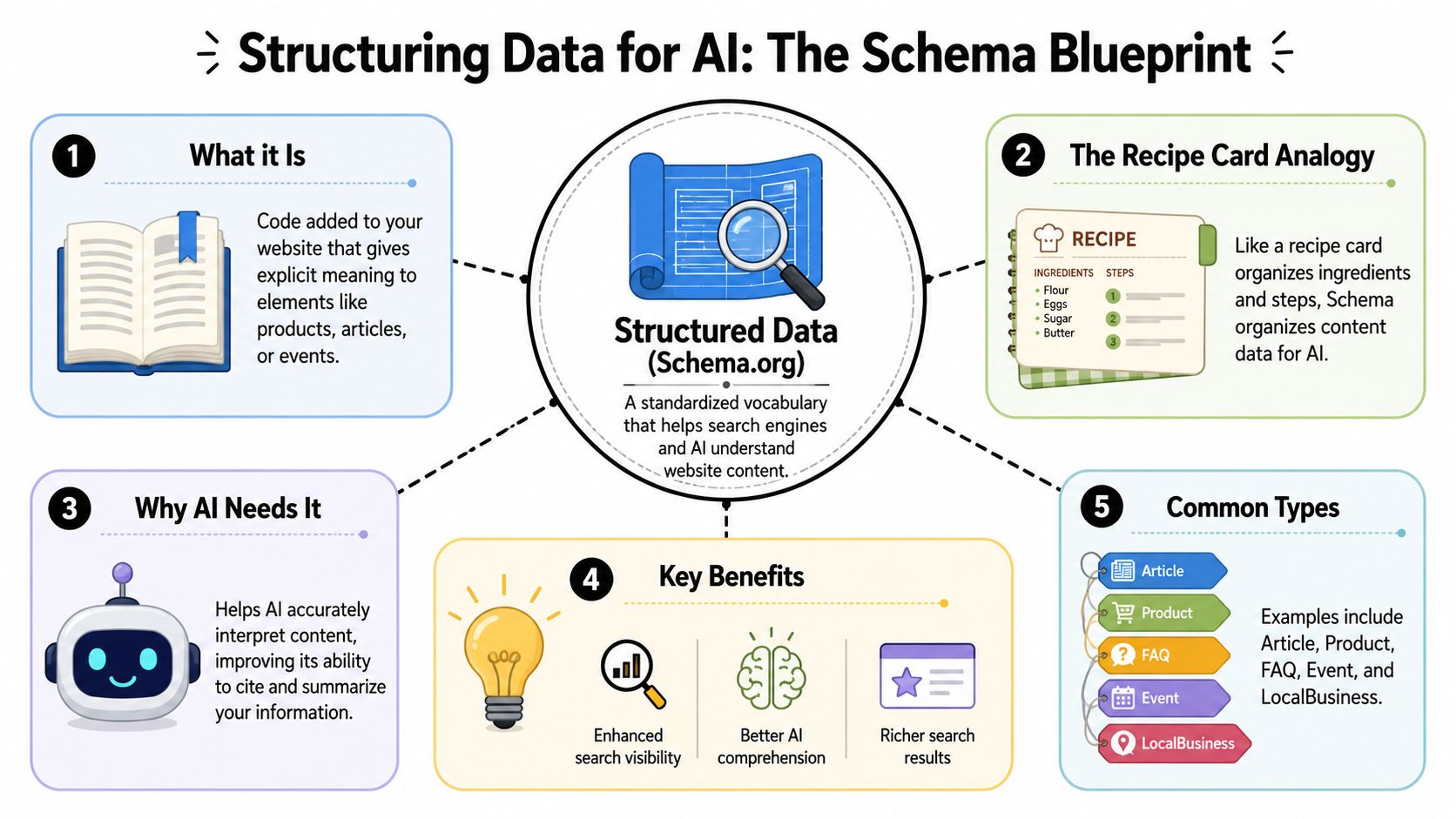
If authority is the trust layer, structured data is the translation layer. It tells machines what a piece of content is. Without it, an AI system has to infer relationships from raw text. With it, you label those relationships directly.
Think of Schema as a content label system
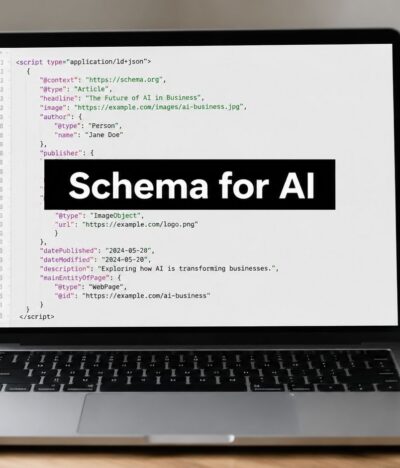
A simple way to explain Schema.org markup is this: it's the nutritional label for your page. The visible copy tells the story to people. The schema tells machines what each element represents.
An article can say, “Dr. Lee reviewed this guide.” Schema can clarify that Dr. Lee is a Person, that the page is an Article, that the organization behind it is an Organization, and that a question-and-answer section is a FAQPage. That extra layer reduces ambiguity.
Why Schema matters more in AI-mediated search
The payoff is no longer limited to rich snippets. According to IGEX Solutions' discussion of future SEO and structured data, content structured with Schema.org FAQPage and Article types can increase the probability of being cited in AI Overviews by up to 3.5x compared to unstructured text, because the markup defines the entity-intent relationship that vector-based retrieval systems require.
That matters because AI systems don't just retrieve matching keywords. They retrieve relationships, topics, entities, and answer fragments. Schema helps make those relationships explicit.
The schema types that matter most for many brands
Not every site needs every markup type. Most businesses should start with the basics that strengthen context and trust.
| Schema type | What it signals | Why it matters for AI |
|---|---|---|
Article |
This page is editorial content | Helps define the content type and its subject |
FAQPage |
These are direct questions and answers | Makes answer extraction easier |
Person |
This content is tied to a known expert | Supports expertise and authorship signals |
Organization |
This brand is a defined entity | Reinforces brand identity and publisher context |
A more detailed breakdown of implementation priorities appears in Raven SEO's guide to schema markup for stronger search visibility.
What implementation often gets wrong
Many teams add schema once and forget it. That usually leads to markup that's technically present but strategically weak. Good implementation is selective and aligned to page purpose.
Use schema where it sharpens meaning. Don't add irrelevant types just because a plugin makes it easy. If a page is a guide, mark it as a guide-like article structure. If it includes true question-and-answer content, use FAQPage. If an expert reviewed it, connect that expert clearly.
For product builders and technical teams thinking about machine-readable experiences more broadly, even outside publishing workflows, this guide to app ideas for developers is a useful reminder that structured information architecture matters across digital products, not just blog pages.
Field note: Schema works best when it reflects reality on the page. Markup should clarify content, not disguise it.
Your Practical Roadmap to Becoming an AI-Cited Source
Many organizations don't need another theory deck. They need a sequence. Becoming citable is a build process, and the order matters.
Start with the visual roadmap below, then use it as an operating checklist.
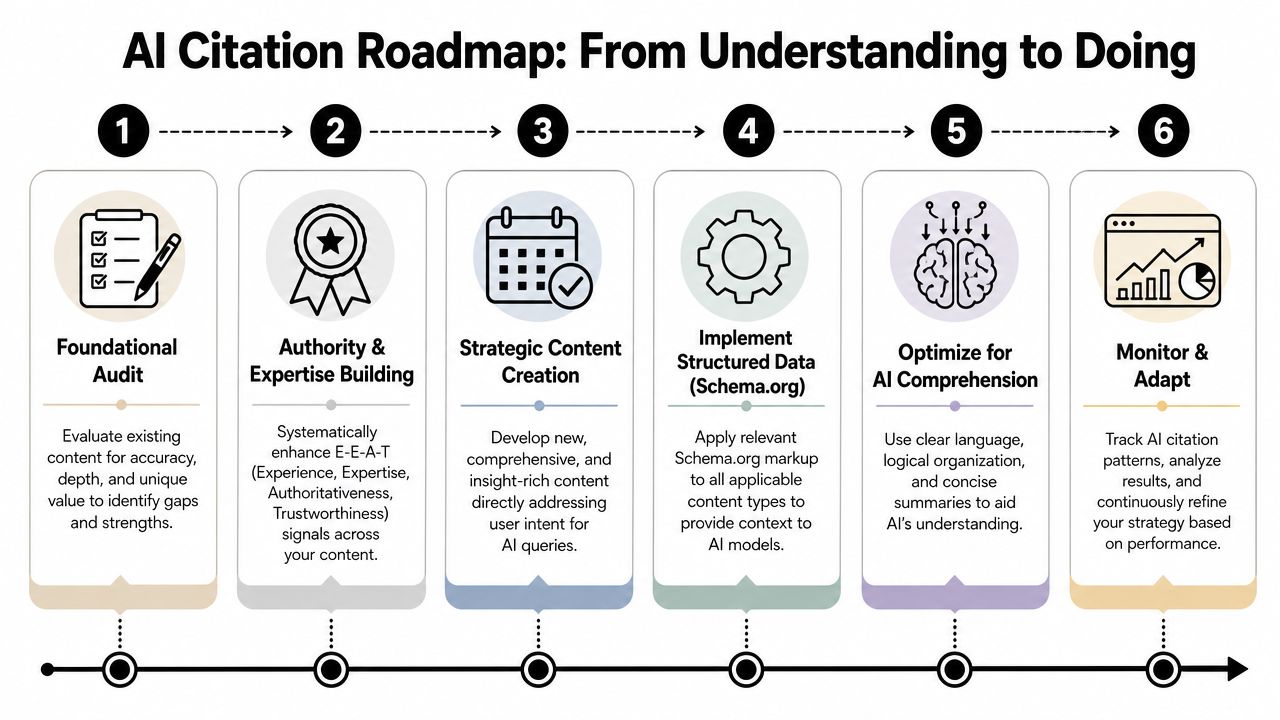
Step one through three
Run an entity audit
Search your brand, senior staff, products, and core services across search and AI interfaces. Look for inconsistency. If your brand is described three different ways across the web, machines will struggle to form a stable picture of what you do.Build context-rich topic clusters
Don't publish isolated keyword pages. Build content systems around real user tasks, comparisons, objections, and follow-up questions.Upgrade the answer layer on key pages
Add concise summaries, question-led subheads, and direct explanations. AI systems favor pages that can be understood in sections rather than pages that bury the answer deep in promotional copy.
Step four through six
A short walkthrough can help frame the execution mindset.
Implement granular schema
Add the schema types that match the actual content and entity structure of the page. Connect authors, organizations, and Q&A sections where they are present.Create citable assets
Publish material that deserves reference. That can include first-party observations, practical frameworks, original research, detailed process documentation, or strong expert commentary.Add AI-facing guidance where appropriate
According to this YouTube analysis on AI citations and LLM-ready content, content pages with step-by-step instructions, Q&A formats, and unique data points are cited in 68% of SGE-generated answers, while generic keyword pages are cited in less than 12%. The same source also notes that creating anllms.txtfile can instruct AI agents on which content to prioritize. That won't rescue weak content, but it can support a cleaner signal for strong content.
The work that usually creates the fastest lift
Not every action has equal value. In practice, these changes tend to matter first:
- Clarify your most important money pages: Service pages often need more explicit answers and better structure.
- Refresh high-trust educational content: Existing articles with authority can become stronger citation candidates with better formatting and schema.
- Reduce content redundancy: Multiple weak pages covering nearly the same topic confuse both users and machines.
- Document your process clearly: Step-by-step content is often easier for AI systems to cite because it resolves intent directly.
If your team needs help strengthening the source material itself, practical guidance on how to get content that supports search visibility can help align production with this more citation-focused model.
Measuring Success in the New Citation Economy
The hardest conversation in AI search usually comes after implementation. If clicks decline or flatten while visibility improves inside answer engines, how should a business judge performance?
The old dashboard isn't enough. Rankings, sessions, and click-through rate still matter, but they no longer describe the full outcome. As Toptal notes in its analysis of the future of search, brands need a new framework for tracking visibility across AI Overviews and conversational assistants, not just organic clicks, because most existing advice still doesn't offer practical attribution or decision rules as traditional rankings become less predictive.
What to track instead of relying on traffic alone
A more durable reporting model includes qualitative and quantitative indicators together:
- AI citation presence: Are your pages or brand mentioned in AI Overviews and answer engines for priority topics?
- Branded discovery: Are more people searching specifically for your company, product, or named experts?
- Entity consistency: Do search and AI systems describe your brand accurately and repeatedly?
- Knowledge ownership: Are your experts, services, and organization clearly connected across the web?
- Assisted conversion patterns: Are prospects arriving later in the journey but showing higher intent?
What leaders should ask their teams every month
The best reporting meetings now include sharper questions:
| Question | Why it matters |
|---|---|
| Where are we being cited, not just ranked? | Citation visibility often precedes the click |
| Which pages are easiest for AI to summarize? | Page structure affects answer inclusion |
| What topics do machines associate with our brand? | Entity clarity shapes discoverability |
| Which content deserves refresh, consolidation, or expansion? | AI visibility rewards source quality over volume |
The future of search engine optimization belongs to brands that can prove they were present in the decision journey, even when the journey didn't start with a website visit.
This is also where many businesses benefit from a baseline assessment. If you don't know how visible your brand is inside AI-mediated search, it's hard to know whether to invest first in schema, content restructuring, entity cleanup, or authority building. Tools and rankings can only tell part of that story. An AI visibility score framework is useful because it gives teams a starting point for that broader evaluation.
Raven SEO helps brands adapt to the future of search engine optimization with AI-ready technical SEO, structured data strategy, authority-focused content planning, and practical audits built for real business decisions. If you want a clear view of how visible your brand is in AI Overviews, conversational search, and machine-generated answers, start with a no-obligation consultation at Raven SEO. It's the fastest way to see where your current search strategy still works, where AI visibility is breaking down, and what to fix first.
FAQ
What is the future of search engine optimization?
The future of search engine optimization is moving beyond rankings alone. Brands still need strong technical SEO and useful content, but they also need to become citable sources for AI Overviews, LLMs, and conversational search tools.
What is Answer Engine Optimization?
Answer Engine Optimization, or AEO, is the practice of shaping content so AI systems can understand, trust, summarize, and cite it. It focuses more on entities, authority, structure, and direct answers than on keyword matching alone.
Why does schema matter for AI search?
Schema gives machines explicit context about what a page contains, who created it, and how the information is organized. That reduces ambiguity and can improve the likelihood that AI systems interpret the page correctly.
How should businesses measure SEO success in AI search?
Businesses should still monitor rankings and organic traffic, but they should also track AI citation presence, branded discovery, entity accuracy, and whether priority pages are appearing in AI-generated answer experiences.