

Often, URLs are only considered when something breaks. A page gets renamed. A migration goes sideways. A paid campaign appends tracking parameters everywhere. Suddenly the site has five versions of the same page, internal links point to mixed paths, and nobody's sure which version search engines should trust.
That used to be mostly an SEO hygiene problem. Now it's also an AI visibility problem.
When search systems, AI Overviews, and large language models evaluate a page, they don't see your brand the way a human does on a polished homepage. They process signals. URL clarity is one of the quiet signals that helps them understand what a page is, where it belongs, and whether it looks trustworthy enough to cite. If your URLs are messy, your content may still exist, but it becomes harder to classify, retrieve, and reuse with confidence.
Your URL Is Now Your Brand's Digital Address for AI
A URL used to function like a browser destination. Type it in, land on a page, move on. That view is outdated.
Today, a URL acts more like a machine-readable address for your content. It tells crawlers how your site is organized, hints at the topic of the page, and helps systems distinguish a clean canonical page from a noisy duplicate. In AI-driven discovery, that matters because retrieval depends on context, consistency, and trust.
A messy path like /page?id=84729&ref=summer doesn't say much. A clean path like /services/technical-seo does. One looks temporary and system-generated. The other looks intentional. That distinction shapes how easily your pages can be understood by search engines and AI systems.
Clean URLs support clean interpretation. When machines can classify a page faster, they can retrieve it with more confidence.
This shift is part of a broader move from optimizing only for clicks to optimizing for citations and mentions inside generated answers. A well-structured site gives search engines clearer pathways. It also gives AI systems a stronger foundation when they summarize, compare, and reference brand content.
That same principle shows up in adjacent technical signals. For example, teams fixing social metadata often discover that cluttered or inconsistent URLs create downstream issues with previews, sharing, and cache behavior. If you're dealing with that side of the stack, this guide on troubleshooting broken OG previews is useful.
For brands trying to future-proof discoverability, URL structure belongs inside a bigger visibility strategy that includes architecture, metadata, and content clarity. That's the same logic behind online presence optimization. The brand that wins in AI search isn't always the loudest. It's often the one that's easiest for machines to understand.
The Core Principles of Semantic URLs
A semantic URL tells humans and machines what to expect before they load the page. It operates similarly to a labeled folder in a filing cabinet. If the label is clear, anyone can find the document and understand where it belongs. If the label is cryptic, the whole system slows down.
Google's guidance is direct. It recommends descriptive URLs, hyphens between words, and as few parameters as possible because readable paths help users and crawlers understand page content more quickly. Google also advises against using long ID numbers in favor of readable words, which strengthens topical interpretation and keeps structure human-readable. You can review that guidance in Google's documentation on URL structure best practices.

Descriptive beats clever
If a page covers enterprise SEO audits, say that in the path. Don't hide the meaning behind internal codes, vague nouns, or CMS defaults.
Good semantic URLs usually do three things:
- Name the topic clearly by using readable words that reflect the page's actual subject.
- Match the content intent so a user can predict what they'll find before clicking.
- Avoid machine-only labels such as long IDs that mean nothing outside your database.
A URL isn't the place to be witty. It should be obvious.
Simplicity improves trust
Simple URLs reduce friction. They look cleaner in browsers, chat apps, shared docs, and AI citations. They also make internal governance easier because teams can maintain naming rules without debating every slug.
What usually works:
- Lower complexity with fewer unnecessary folders and fewer query strings.
- Stable naming that won't need to change every time a headline is updated.
- Readable separators by using hyphens instead of compressed text or inconsistent formatting.
Practical rule: If someone on your team can read a URL aloud and another person can guess the page topic, the structure is probably doing its job.
Consistency creates meaning at scale
Semantic URLs become more valuable as a site grows. A clear pattern across service pages, product pages, location pages, and resource content turns the site into a coherent map rather than a pile of pages.
That consistency also supports modern search behavior, where topical relationships matter. If your architecture reflects how subjects connect, it becomes easier to reinforce those relationships through internal links, breadcrumbs, and semantic search optimization.
The key idea is simple. A semantic URL isn't just a cleaner string. It's a durable classification signal.
Anatomy of a Future-Proof URL
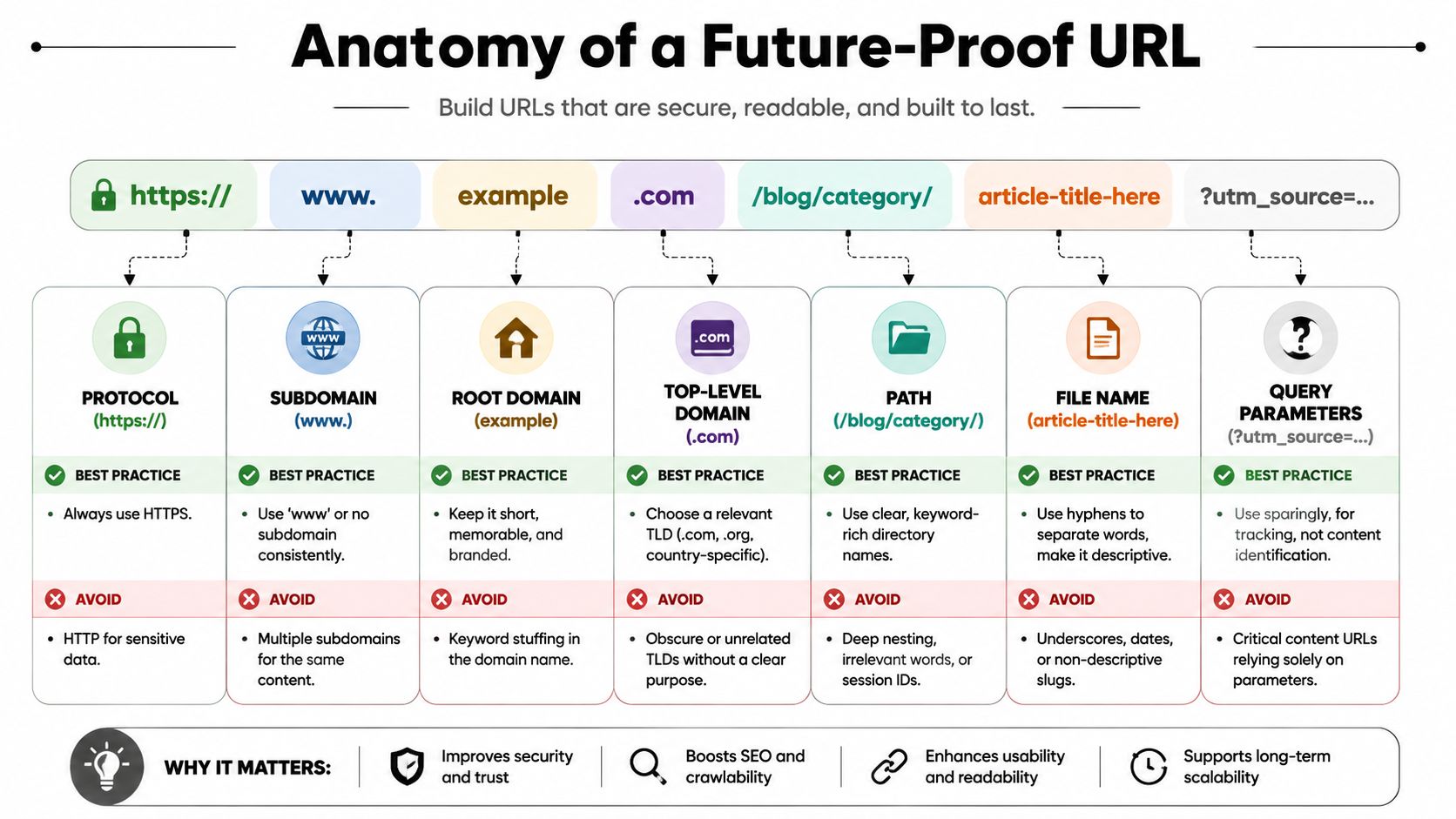
Every URL has parts. Some are branding choices. Others are technical signals. The trick is knowing which parts deserve discipline and which parts often create bloat.
The parts that shape perception
Take a URL like https://www.example.com/blog/technical-seo/url-structure-best-practices.
Each segment carries weight:
| Component | What it does | Best practice |
|---|---|---|
| Protocol | Defines secure access | Use HTTPS consistently |
| Subdomain | Separates a host variant | Stick with one version consistently |
| Root domain | Carries the brand | Keep it branded and memorable |
| Path | Shows hierarchy | Make folders logical and restrained |
| Slug | Identifies the page | Make it descriptive and concise |
The protocol and domain establish legitimacy. The path and slug communicate meaning. That's the part many organizations can improve quickly.
The slug does the heavy lifting
For SEO and AI retrieval, the slug is often the most visible content signal inside the URL. It should name the page clearly without stuffing every variation of the keyword into it.
One analysis covering 11.8 million SERPs found that pages with short, concise slugs ranked slightly higher. The same review recommends keeping slugs to 3–5 meaningful words and the full path to roughly 1–2 subfolders for usability and indexing performance, as summarized in Briskon's guide to SEO-friendly URL structure.
That doesn't mean every slug must hit an exact formula. It means shorter, clearer naming tends to create better signals than long title-like paths.
Do this
- Use topical words such as
/technical-seo-audit - Keep the meaning intact when trimming words
- Use hyphens to separate terms
Not this
- Auto-generated clutter like
/post-9847 - Overwritten title slugs like
/the-complete-ultimate-beginner-and-advanced-guide-to-technical-seo-audits - Mixed separators like
/technical_seoAudit
Lowercase and durable patterns win
Case inconsistency creates preventable duplication risk. A team shares /About-Us, another links to /about-us, and now the site sends mixed signals. Keep URLs lowercase and predictable.
Durability matters too. If the content is meant to stay relevant, avoid building short-term details into the slug. Dates, campaign labels, and temporary naming conventions often age badly. A URL should survive content refreshes without forcing redirect cleanups every quarter.
A good URL should still make sense a year from now, even if the headline changes.
This is where canonical planning matters. If different variants can exist through filters, tracking, or platform quirks, define the preferred version clearly and support it with a sound canonical URL strategy.
Structuring Your Site for Crawlers and AI
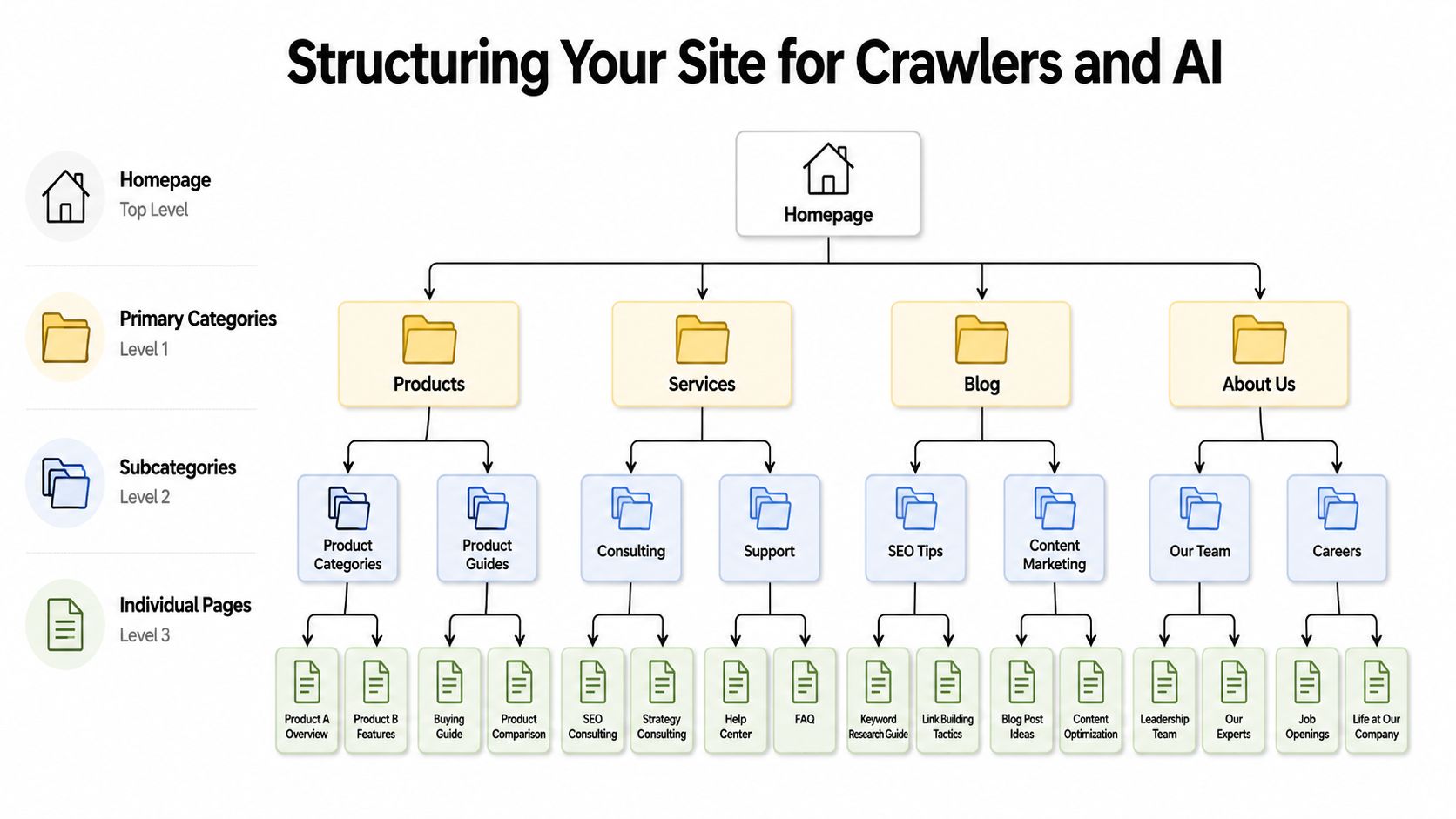
A strong URL on one page helps. A coherent structure across the whole site is what builds authority.
Search crawlers don't experience your website as a homepage mockup. They process it as a network of paths, folders, internal links, canonical hints, and redirect behavior. AI systems build on that same foundation when they try to infer which pages represent your main expertise and which ones are duplicates, variations, or low-priority branches.
Keep the hierarchy shallow and logical
A clean structure usually looks like this:
- Homepage to category with direct paths such as
/services - Category to subtopic where needed, such as
/services/technical-seo - Content beneath a clear parent when the relationship matters
What doesn't work well is excessive nesting. Long chains of folders often reflect internal org charts or CMS habits rather than user intent.
Guidance for scalable sites recommends keeping paths to roughly 1–2 subfolders deep and enforcing one preferred URL variant through 301 redirects and canonical tags so crawlers interpret architecture more efficiently. Screaming Frog summarizes that approach in its guidance on URL structure and duplicate signals.
Canonicals and redirects are structural tools
Most URL problems aren't created by one bad slug. They're created by multiple versions of the same page existing at once.
Common causes include:
- Tracking parameters added by campaigns or email tools
- CMS-generated variants with trailing slash changes or category duplicates
- Legacy paths left behind after redesigns
- Mixed internal linking to old and new versions
When a URL changes, use a 301 redirect from the old address to the preferred one. When alternate versions must remain accessible, use a canonical tag to identify the indexable source. Those are not optional cleanup items. They are part of architecture.
Build for users first, then reduce crawler ambiguity
A good folder structure is intuitive for humans. It also reduces the interpretive work search systems have to do.
Consider the difference:
| Stronger pattern | Weaker pattern |
|---|---|
/blog/technical-seo/site-migration-checklist |
/category/resources/articles/seo/technical/migration/page |
/services/content-strategy |
/srv/cnt?id=22 |
/locations/texas/dallas |
/index.php?page=loc&city=dallas |
The better pattern doesn't just look cleaner. It reinforces topic clusters, parent-child relationships, and business intent.
One more layer supports this work. Crawl control. If your site architecture is disciplined but crawlers still waste time on low-value paths, parameter combinations, or utility pages, review your robots.txt file strategy so your crawl budget aligns with your actual priorities.
From Clicks to Citations How URLs Impact AI Visibility
The old SEO model focused on ranking, clicks, and on-page engagement. Those still matter. But AI search adds another objective. Being cited as a trusted source inside generated answers.
That changes how foundational signals should be evaluated. A clean URL isn't only about appearance in a search snippet anymore. It supports retrieval systems that need to identify the most relevant version of a page quickly, connect it to the right topic, and trust that it represents a stable source.
Why AI systems favor clearer paths
LLMs and AI search layers don't "understand" your site the way a human brand strategist does. They rely on multiple overlapping cues:
- URL wording
- Page titles
- headings
- internal links
- structured data
- canonical signals
- context from surrounding pages
When those cues align, your content becomes easier to classify. A URL like /services/ai-search-optimization reinforces meaning. A URL like /page/1229 doesn't.
If the URL, title, schema, and internal anchor text all describe the same thing, the page becomes easier to trust and reuse.
URLs reinforce entity clarity
AI visibility becomes more strategic than traditional keyword placement. Search systems increasingly evaluate whether a page clearly belongs to a known entity, service, product, or topic cluster. Your URL contributes to that identity layer.
For example, if a page is marked up with schema describing a service, the URL should ideally support the same interpretation. When the path, headings, and structured data all point in the same direction, your page presents a more coherent knowledge object.
That's why URL work now belongs in the same conversation as structured data implementation. One defines machine-readable labels. The other creates machine-readable location and hierarchy. Together they improve how content is discovered, matched, and cited.
Brand authority is the real outcome
The practical upside isn't just cleaner indexing. It's stronger brand presence in AI-mediated discovery.
When an AI-generated answer cites a page, the source URL often functions as a credibility layer. Users may never browse your navigation. They may see your brand because your page was chosen as a reference. That means infrastructure once treated as technical housekeeping now affects awareness, trust, and category ownership.
Brands that treat URL structure as part of AI readiness are making a smarter bet than brands that wait until after a migration, a replatform, or a traffic drop. By then, the architecture problem has already become a visibility problem.
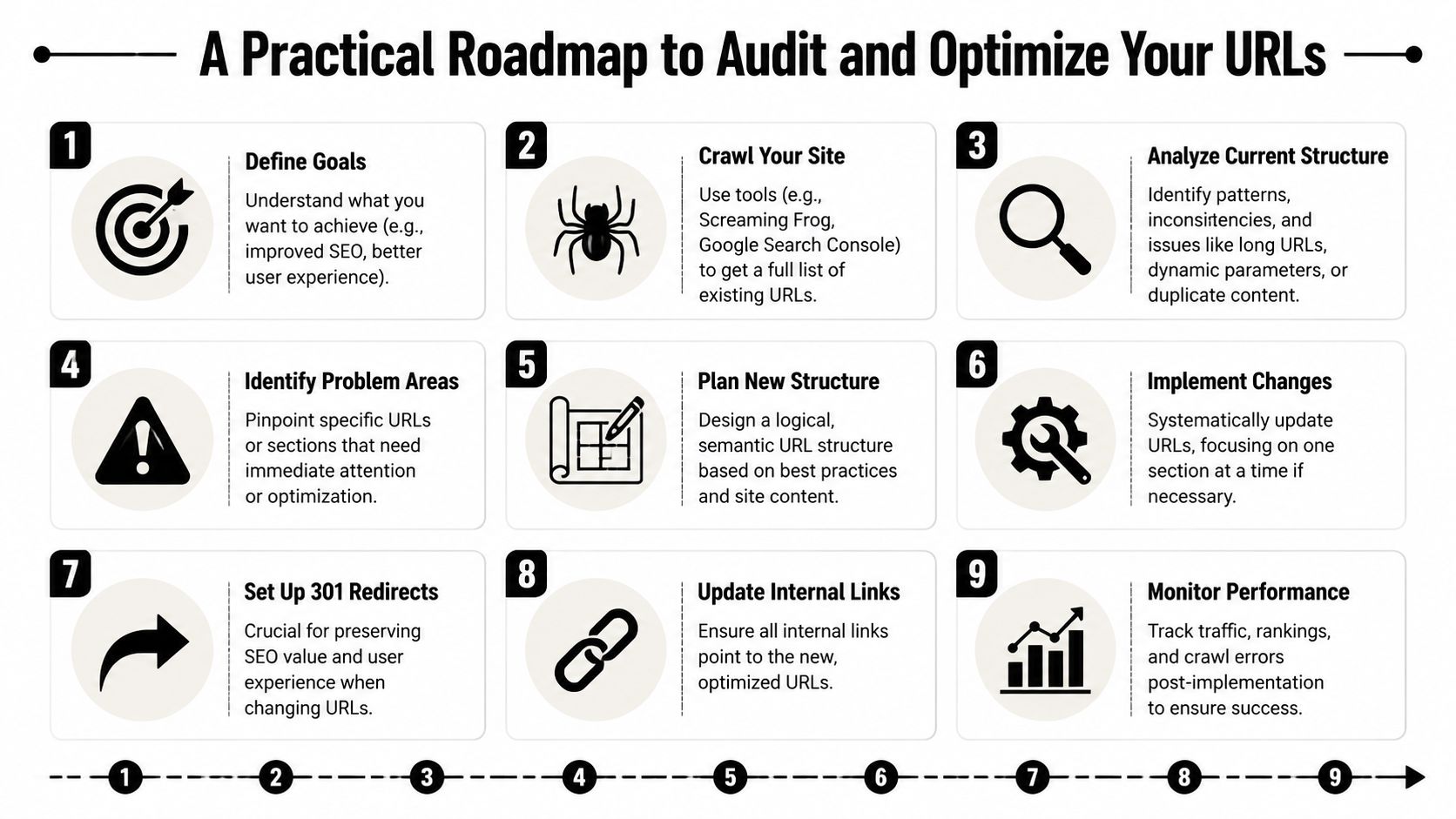
A Practical Roadmap to Audit and Optimize Your URLs
Most sites don't need a full rebuild. They need an orderly audit, a decision framework, and disciplined implementation.
Start with visibility, not guesswork.
Audit first, change second
Run a crawl with a tool such as Screaming Frog and export your full URL list. Add data from Google Search Console and your analytics platform so you can see which URLs matter most.
Then review the site in layers:
- Find duplication across trailing slash variants, parameterized pages, HTTP/HTTPS inconsistencies, or mixed casing.
- Spot weak slugs that use IDs, vague naming, or title-generated sprawl.
- Review folder logic and check whether categories still reflect the business and content model.
- Identify indexable noise such as search-result pages, tag archives, or utility URLs that shouldn't compete with core pages.
Prioritize what affects the business
Not every bad URL deserves immediate action. Focus first on pages with one or more of these characteristics:
- Revenue relevance such as product, service, or lead-generation pages
- Authority value such as pillar guides and high-trust educational content
- Visibility conflict where duplicate versions dilute signals
- Operational risk where future growth will multiply the problem
A poor URL on an archived blog tag isn't the same issue as fragmented canonical signals on your primary service pages.
Here's a simple decision view:
| Priority | Typical examples | Action |
|---|---|---|
| High | Core service pages, product pages, top guides | Clean slug, confirm canonical, redirect old variants |
| Medium | Blog categories, evergreen posts, location pages | Standardize patterns and update internal links |
| Lower | Utility pages, temporary assets, low-value archives | Deindex, consolidate, or leave untouched if harmless |
A walkthrough can help teams visualize the implementation flow before making changes:
Build the redirect map before publishing changes
For migrations, URL handling determines success or failure. Every changed URL needs a mapped destination. Internal links should be updated to point to the new address, not left to rely on redirects forever. Canonicals, XML sitemaps, breadcrumbs, and nav elements should all reflect the final version.
Treat URL changes like infrastructure work, not copy edits. If the redirect map is weak, the rollout is weak.
Once the cleanup is done, document the rules. New content should follow one URL standard for slugs, folders, lowercase usage, and canonical handling. That's how a one-time cleanup becomes a durable operating model.
Frequently Asked Questions on URL Structure
Should you change old URLs just to make them cleaner
Not always. If an older URL performs well and doesn't create duplication or clarity issues, leaving it alone may be the better choice. Change URLs when there's a clear structural reason, then redirect the old version properly.
Are dates in blog URLs a good idea
Usually no for evergreen content. Dates can make useful content look stale and often force future cleanup. They're more defensible for true news coverage, event reporting, or archives where time is part of the page's identity.
Do small business websites need strong URL structure
Yes. Small sites may have fewer pages, but they still need clean signals. A local service business, startup, or professional practice benefits from clear paths because users, crawlers, and AI systems all interpret those pages more easily.
Should keywords be included in every URL
Use relevant words where they improve clarity. Don't force exact-match phrases into every slug. The goal is descriptive language, not repetition.
What matters more, the slug or the folder structure
Both matter, but in different ways. The slug usually carries the direct topical label for the page. The folder structure shows how that page fits into the broader site architecture. Strong performance comes from alignment between the two.
If your site has grown through redesigns, CMS changes, or ad hoc content publishing, URL issues usually signal a bigger architecture problem. Raven SEO helps brands audit technical SEO, structured data, and AI visibility so their websites are easier for search engines and AI systems to understand, trust, and cite.