
Most businesses are still optimizing for a version of search that's already fading.
They chase rankings, traffic, and blue-link clicks while AI systems increasingly answer the question before the visit ever happens. That's the strategic mistake. The primary battleground in online presence optimization isn't just whether your page ranks. It's whether your brand gets selected, summarized, and cited by AI-driven search experiences.
The End of Search Engine Optimization As We Know It
Traditional SEO isn't dead. It's just no longer enough.
The old playbook assumed success meant winning a click. That worked when search was mostly a list of links. Now the biggest blind spot in online presence optimization is AI visibility, not just website traffic. Mainstream advice still leans on SEO basics, social posting, reviews, and directory consistency, but rarely explains how schema, entity clarity, and source credibility affect whether a large language model or conversational engine cites your brand, as noted by Adsmurai's guidance on online presence and AI visibility.

That changes the objective. You're no longer optimizing only for human visitors scanning results. You're also optimizing for systems that extract facts, compare sources, compress answers, and decide which brand deserves inclusion.
Ranking isn't the same as being usable by AI
A page can rank and still be useless to an AI engine.
That happens when the content is vague, the authorship is weak, the entity signals are messy, and the site gives machines no clean structure to interpret. If your service pages read like generic marketing copy, AI systems have very little to work with. If your business information conflicts across the web, your trust signals fracture.
Practical rule: If a machine can't confidently identify who you are, what you do, where you operate, and why you're credible, it won't cite you reliably.
Many teams also publish AI-generated copy at scale without editing it into something authoritative and readable. That's a fast way to flood your site with content that sounds complete but says very little. If you're using generative tools, learn how to optimize AI content for rankings without sacrificing clarity, accuracy, or trust.
AEO is the discipline that replaces SEO-only thinking
What's happening isn't a small channel update. It's a shift in search behavior and search interfaces.
The practical way to think about it is this. SEO helps you get discovered. AEO, or answer engine optimization, helps you get referenced. If you want the sharper breakdown between the two models, Raven SEO has already mapped that transition in this guide to AEO vs SEO in 2026.
If your current strategy stops at rankings, you're optimizing for visibility without influence. That gap is where brands disappear.
The Shift from Clicks to Citations
The easiest way to understand the new model is to stop thinking like a publisher and start thinking like a source.
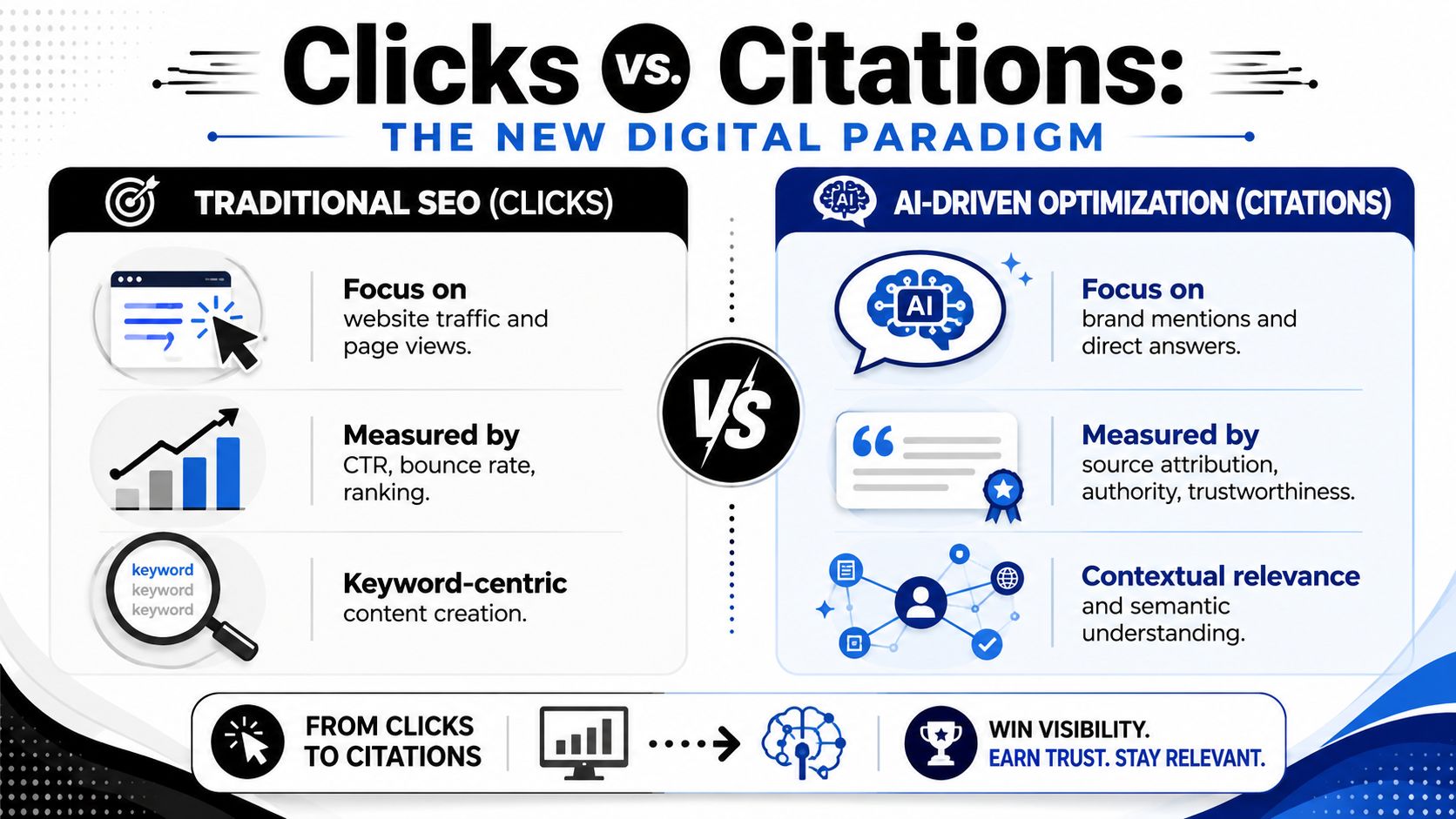
Traditional SEO is like getting your book into the library. That matters. AEO is like getting your book cited in a research paper. One earns shelf space. The other earns authority.
That distinction matters because discovery is already digital by default. WordStream reports that 97% of consumers search online for local products and services, which makes digital search the first evaluation layer for most businesses, even beyond strictly local buying behavior, as explained in WordStream's breakdown of online presence tactics.
What changed in the real world
Buyers don't always move through the old funnel anymore.
They ask a search engine, an AI overview, a chatbot, a voice assistant, or an embedded assistant inside another app. Those systems don't just list websites. They interpret, compare, and synthesize. That means your content has to be useful at the extraction layer, not just the click layer.
Here's the comparison that matters.
| Metric | Traditional SEO (Goal: Clicks) | AI Visibility (Goal: Citations) |
|---|---|---|
| Primary outcome | Website visit | Brand mention or source inclusion |
| Success signal | Ranking and click-through behavior | Citation, attribution, and answer inclusion |
| Content model | Keyword-targeted pages | Clear, source-worthy answers and entities |
| Technical focus | Indexability and on-page relevance | Machine-readable structure and entity clarity |
| Trust requirement | Enough to rank | Strong enough to be referenced directly |
Why citations carry more strategic weight
A click is transactional. A citation is reputational.
When an AI system includes your brand in a generated answer, it signals that your information was good enough to help form the response itself. That's a stronger role than merely appearing in a results page. If you want a useful outside perspective on this shift, this article on Understanding LLM content citation captures why mention-based visibility is becoming more valuable than raw impressions.
This video offers a practical lens on the same transition.
What businesses need to stop measuring in isolation
Traffic still matters. Rankings still matter. But they aren't enough on their own.
Teams need to start asking tougher questions:
- Can AI systems identify our brand entity clearly
- Do our pages answer questions directly enough to be quoted or summarized
- Is our authority visible beyond our own website
- Do our reviews, listings, authors, and structured data tell the same story
The old KPI was “Did they click?” The new one is “Did the system trust us enough to use us?”
That's the key pivot in online presence optimization.
How Generative AI Engines Cite Your Brand
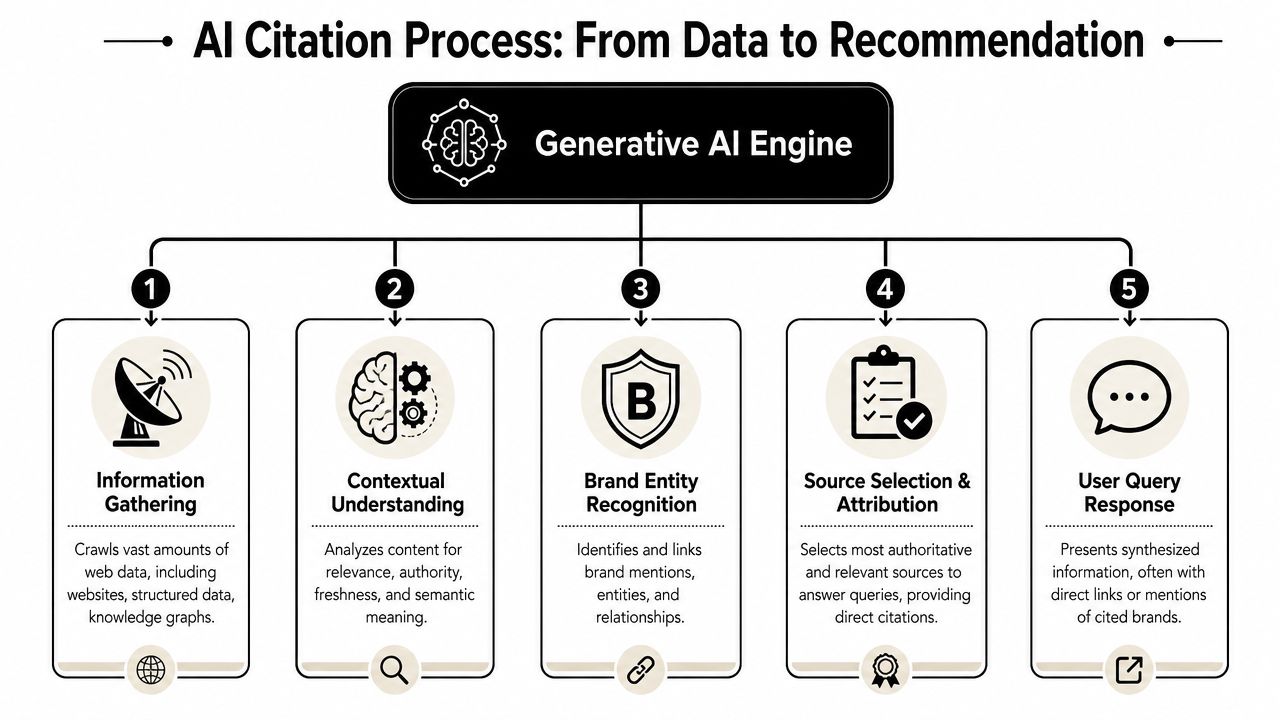
AI engines don't pull brands out of thin air. They rely on signals.
Some of those signals come from your website. Some come from the wider web. Some come from how consistently your business is described across platforms. When those signals align, your odds of being cited improve. When they conflict, your visibility weakens.
The signals that actually matter
Here are the core pillars of AI citability.
| Pillar | What AI engines look for | What brands should do |
|---|---|---|
| Entity clarity | A clear understanding of who the brand is | Use consistent naming, service descriptions, and organization details |
| Expertise | Evidence that qualified people created the content | Add expert authorship, bios, and topical depth |
| Trustworthiness | Signals that the information is dependable | Keep factual details consistent and transparent |
| Structured data | Machine-readable labels for people, products, services, and organizations | Implement schema that matches page content |
| Web corroboration | Supporting mentions beyond your own site | Build credible citations, listings, and references across the web |
Entity recognition comes first
If the system can't resolve your brand as a distinct entity, everything else gets harder.
Your legal name, brand name, service categories, locations, leadership, authors, and offers should line up everywhere they appear. This applies to your site footer, About page, author bios, business profiles, directory listings, and product or service pages. Inconsistent labels create ambiguity. Ambiguity kills citation confidence.
Authority has to be visible, not assumed
Many businesses claim expertise. Far fewer document it well.
That's where E-E-A-T signals matter in practice. Show who wrote the content. Explain why that person is qualified. Publish pages that answer real buying and decision questions in direct language. Remove thin content that exists only to target a phrase.
If your content sounds like anyone could have written it, AI engines won't treat it as a strong source.
Structured data reduces interpretation risk
Machines prefer explicit facts over inference.
Schema markup helps define your organization, services, products, FAQs, authors, and relationships in a format search systems can process more confidently. This doesn't guarantee citations, but it reduces uncertainty. And reducing uncertainty is a big part of becoming citable.
The rise of conversational discovery makes this urgent. HubSpot's 2026 marketing statistics report says 73.7% of marketers plan to maintain or increase investment in voice search optimization, a signal that brands are preparing for more conversational interfaces where concise, trustworthy answers matter most, as referenced in Advertising Savants' overview of online presence optimization.
The response layer rewards clean source material
Generative systems gather, interpret, compare, and then compose. That means your content needs to survive all four stages.
A good working standard looks like this:
- Be explicit: State what you do, who it's for, and where it applies.
- Be attributable: Put a real expert or business identity behind the page.
- Be structured: Use headings, schema, tables, and concise answers.
- Be consistent: Keep details aligned across every platform where your brand appears.
If you want to improve your chances in AI-driven result formats, this guide on how to rank in AI overviews is the right next read.
Your Practical Roadmap for AI Visibility
Most businesses don't need a total rebuild. They need a better operating model.
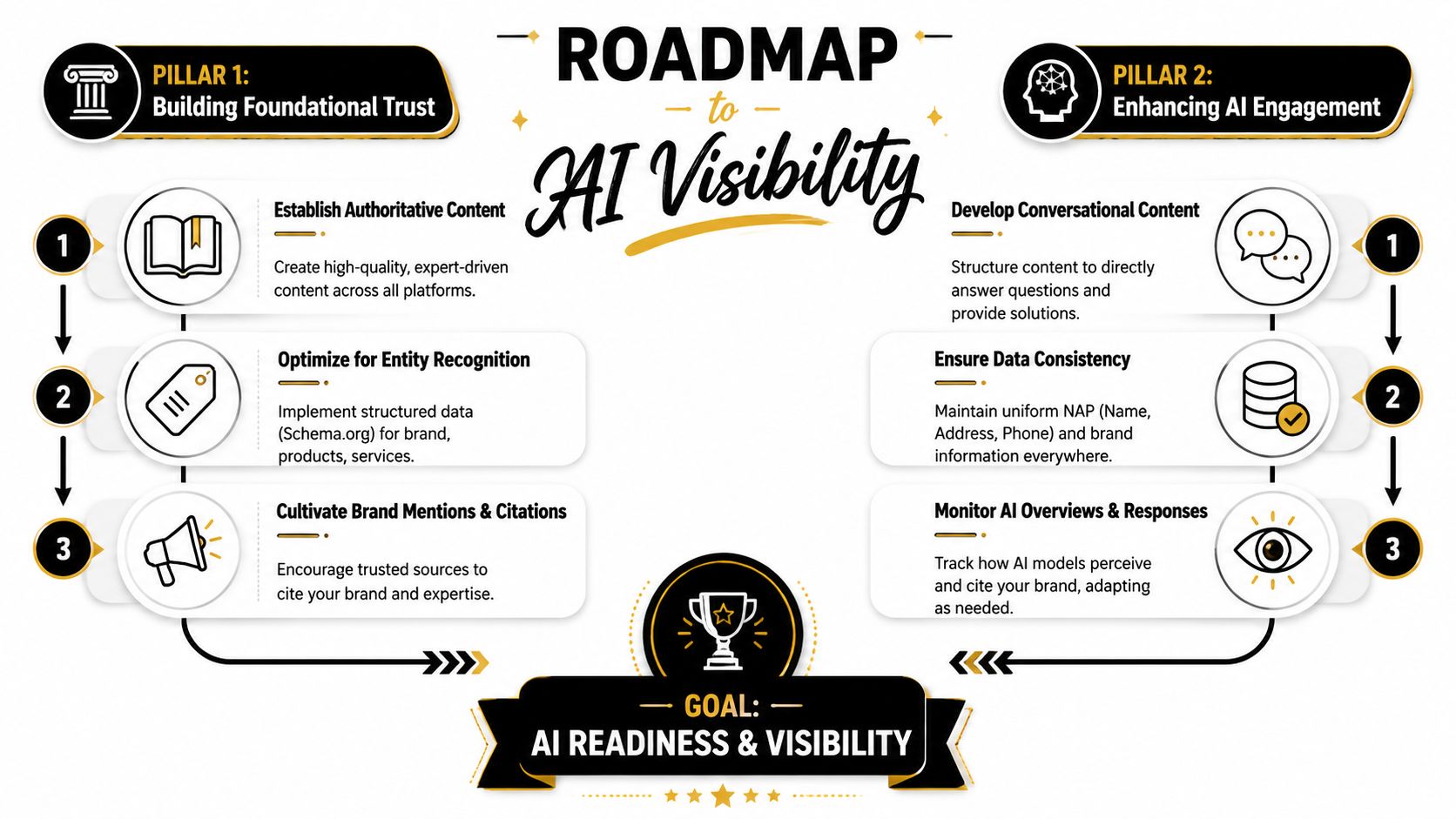
The fastest path to stronger AI visibility comes from two areas working together. First, build brand authority that other systems can trust. Second, fix the technical foundation that helps machines interpret your brand cleanly.
Pillar one builds brand authority
Authority isn't a slogan. It's a pattern.
If your website says one thing, your listings say another, and your social profiles barely explain what you do, your authority stays weak even if your design looks polished.
Use this framework:
| Action area | What to fix | Why it matters |
|---|---|---|
| Expert content | Publish content tied to real expertise | AI systems prefer identifiable, credible sources |
| Review profile | Strengthen review quality and recency across major platforms | Reviews support trust and corroboration |
| Brand consistency | Align naming, services, positioning, and bios everywhere | Consistency improves entity recognition |
| Citation presence | Earn mentions from credible industry and business sources | Third-party reinforcement strengthens authority |
| Answer readiness | Write pages that solve questions directly | Direct answers are easier to summarize and cite |
A few direct recommendations matter more than dozens of minor tweaks:
- Choose clear authorship: Add expert names, roles, credentials, and bios to important content.
- Tighten service pages: Replace generic claims with specifics about process, scope, and outcomes.
- Standardize your brand language: Keep your official business description consistent across channels.
- Audit weak pages: Delete, merge, or rewrite thin content that adds no authority.
Pillar two fixes the technical foundation
Many marketing teams lose momentum because the work feels too technical. It isn't optional.
Performance and crawl efficiency influence whether systems can access and interpret your content properly. Google's guidance emphasizes Core Web Vitals, mobile-first indexing, and clean site structure as foundational, and faster load times plus responsive design improve both engagement and machine interpretation, as summarized in this digital presence optimization guide.
Operational advice: Ask your team one simple question. “Can a search engine and an AI system crawl, understand, and connect our most important pages without guessing?”
If the answer isn't a clear yes, fix these first:
- Mobile-first performance: Your key pages need to work cleanly on phones, not just desktops.
- Site structure: Group services, locations, resources, and brand pages logically.
- Internal linking: Connect related pages so crawlers understand topical relationships.
- Schema implementation: Mark up organization, service, product, author, and FAQ elements where appropriate.
- Index hygiene: Remove broken paths, duplicate pages, and low-value archives.
What to ask your agency or internal team
You don't need to write schema or debug crawl logic yourself. You do need to ask better questions.
A strong shortlist looks like this:
- Where are our entity signals inconsistent
- Which pages are most likely to earn citations, and why
- Do our structured data types match our actual business model
- Which high-value pages are hard to crawl, slow to load, or poorly linked
- How are we monitoring AI overviews and answer-engine inclusion
For brands that want a structured approach, Raven SEO's AI visibility strategy outlines this work through AI-ready web design, technical SEO, and support for machine-readable discovery.
A Crash Course in Structured Data
If you only fix one technical area in online presence optimization, fix structured data.
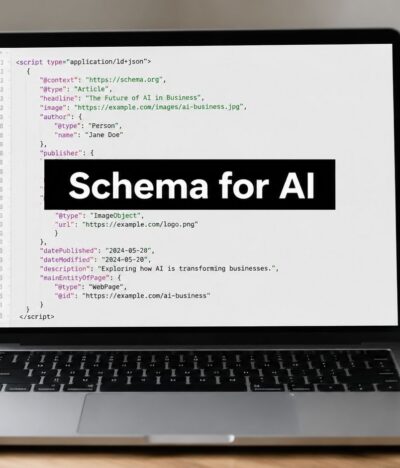
Schema markup is how you turn a page from “content a machine has to interpret” into “facts a machine can classify.” It's not decorative code. It's your brand's official fact sheet.
What schema actually does
Without structured data, a machine reads your page and has to infer what's important.
With structured data, you label the important parts directly. You identify your company as an organization, your team member as an author, your offer as a service, and your address as business information. That reduces ambiguity and improves consistency across search systems.
A plain-English example helps:
- Without schema: “Raven SEO helps businesses with AI-ready web design and technical SEO.”
- With schema: This business is an Organization. It offers specific Services. These pages are written by identifiable people. This location and brand name belong to the same entity.
The most useful schema types for service brands
Most small and mid-sized businesses don't need exotic markup. They need the basics done correctly.
Start with the schema types that support clarity:
- Organization schema: Defines the business itself.
- Local business or relevant business schema: Useful when location and service area matter.
- Service schema: Helps label what you provide.
- Person schema: Supports author and leadership credibility.
- FAQ schema: Useful when the questions reflect real user intent and the page content supports them.
- Article schema: Helps identify informational content and authorship.
Schema works best when it confirms reality. If the page doesn't clearly show the fact to a human reader, don't mark it up for a machine.
Where businesses usually get it wrong
They overcomplicate it, outsource it blindly, or apply markup that doesn't match the page.
A common failure is adding generic schema to every page without checking whether the visible content supports it. Another is forgetting that structured data must align with your broader digital footprint. If your site says one thing and your listings say another, schema won't rescue that mismatch.
This same logic shows up in marketplaces too. If you've ever optimized my listings on Amazon, you've already seen the principle in action. Clean attributes, consistent product details, and structured fields improve machine understanding. Your website needs the same discipline.
What to do next
Keep it simple and accurate.
Start by marking up your homepage, About page, service pages, and author profiles. Then validate that the markup reflects what users see. If your team needs a practical reference point, Raven SEO's guide to structured data for AI visibility is a useful place to start.
Becoming an Authoritative Source for the Future
Online presence optimization has changed from a traffic exercise into a trust exercise.
The brands that win in generative search won't be the ones with the loudest content output. They'll be the ones with the clearest identity, the strongest authority signals, and the most machine-readable digital footprint. That means cleaner structure, better authorship, stronger corroboration, and content designed to answer, not just attract.
This is the part many businesses resist because it feels less like marketing and more like infrastructure. That's exactly why it matters. AI systems don't reward vague branding. They reward clarity and credibility.
If you want to prepare for that future, start with your authority signals. Then tighten the technical layer that supports them. The framework behind E-E-A-T for AI visibility is a strong starting point because it forces the right question: why should a machine trust your brand enough to cite it?
Frequently Asked Questions About AI Visibility
Does AEO replace SEO completely
No. AEO doesn't replace SEO. It replaces SEO-only thinking.
You still need crawlable pages, solid internal linking, useful content, and technical performance. But those elements now support a broader goal. You're not just trying to rank a page. You're trying to become a source that AI systems can interpret and reference confidently.
How long does it take to improve AI visibility
It depends on how strong your current foundation is.
If your site already has clean structure, credible content, and consistent brand information, improvements can start with a focused cleanup and schema rollout. If your digital footprint is fragmented, expect a longer process. The work usually starts with entity consistency, page quality, and technical cleanup before citation opportunities improve.
What kind of business needs online presence optimization for AI search
Almost all of them.
Service businesses, healthcare practices, law firms, contractors, consultants, ecommerce brands, SaaS companies, and multi-location businesses all depend on digital discovery. If buyers ask questions online before contacting you, your brand needs to be understandable to both search engines and AI systems. That's the scope of modern online presence optimization.
If your business is still measuring success only by rankings and clicks, you're working from an outdated search model. Raven SEO helps brands audit their current AI visibility, strengthen structured data, and build a digital presence that's ready for citations, AI overviews, and conversational search. A no-obligation consultation is the fastest way to see where your brand is clear, where it's inconsistent, and what to fix first.