
Local SEO for auto repair shops is a set of strategies designed to make your garage the first one people see when they search online for help nearby. It’s a clear, straightforward process to put you at the top of Google when a driver in your neighborhood searches for something like “mechanic near me” or “brake repair.”
When done correctly, it turns those urgent, local online searches into real, paying customers and booked appointments, helping your business grow.
Why Your Shop Needs Local SEO to Compete
Not too long ago, a new customer found you through word-of-mouth or by flipping through the Yellow Pages. Today, their first move is pulling out a smartphone. The second that check engine light flashes on or they hear an unusual noise, they’re searching for an immediate, local fix.
If your auto repair shop doesn’t show up in that exact moment of need, you might as well be invisible.
Think of local SEO as the biggest, brightest sign on a busy digital highway. It ensures that when someone in your area needs a mechanic, your shop is the first one they see. Without it, you’re letting a steady stream of high-intent customers drive right past you and into your competitor’s service bay. This isn’t just marketing; it’s about being present and helpful when your customers are actively looking for a solution.
Connecting with Customers at the Right Moment
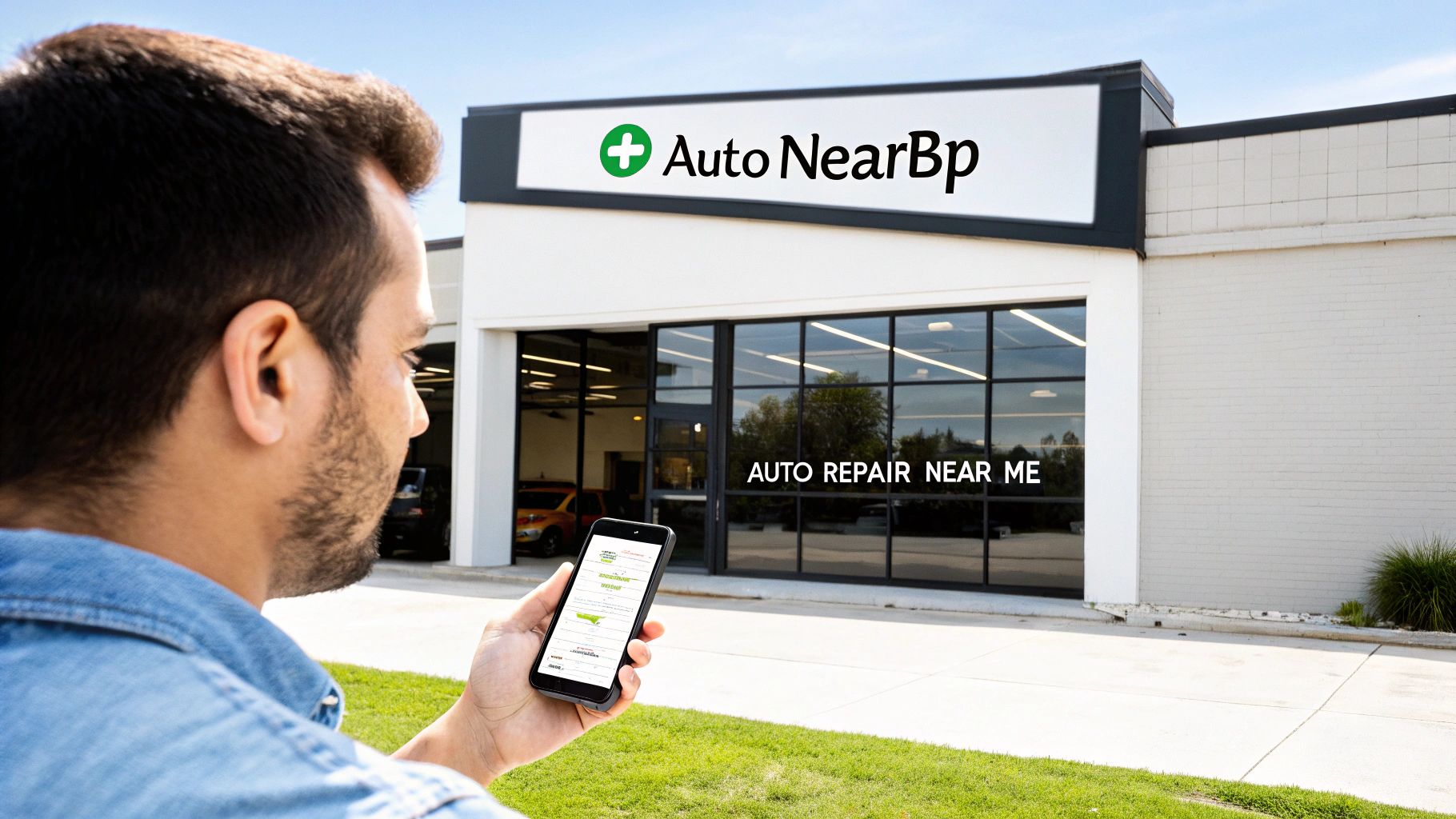
An effective local SEO strategy for an auto shop isn’t just about being seen—it’s about being seen at the perfect time. It connects you with drivers precisely when they have a problem and are ready to find a solution. This is accomplished with a few key tactics that build trust with both search engines and potential customers.
These core components work together:
- Google Business Profile (GBP): This is your digital storefront. It’s what shows up in Google Maps and local search results, giving people your address, hours, services, and phone number at a glance.
- Local Keyword Targeting: This means optimizing your website for the exact phrases customers are typing in, such as “brake repair in Baltimore” or “oil change near me.”
- Online Reviews: Building a solid bank of positive customer reviews is essential. It provides social proof and tells Google that you’re a trustworthy, high-quality shop.
When these elements are working in harmony, they create an online presence that attracts local traffic. For a deeper dive, it’s worth exploring specific local SEO strategies for the automotive industry.
The Sheer Volume of Local Searches
The number of people searching for local auto repair services online is substantial. Keywords like ‘mechanic near me’ and ‘auto repair near me’ generate up to 1,000,000 searches every single month around the world. Add in ‘car repair shops near me,’ and you’re looking at another 673,000 average searches on top of that.
This data makes it clear: local SEO is no longer optional. Customers aren’t looking for a mechanic across the country; they need fast, nearby solutions from someone they can trust.
When your shop appears for these critical local searches, you’re not just getting website clicks. You’re getting phone calls, requests for directions, and—most importantly—cars in your service bays. It’s a direct line to motivated customers.
Ultimately, investing in local SEO is about future-proofing your business. It helps establish a consistent flow of new customers and builds a digital asset that works for you around the clock. To get a better handle on the basics, check out our guide on why local SEO is important for small business.
The Core Parts of a Winning Local SEO Strategy
A winning local SEO campaign is like a perfectly tuned engine. It’s not one single part that does all the work; it’s a handful of critical components working in sync to power your shop’s online visibility. When everything works together, it drives a steady stream of local customers right to your service bays.
For any modern auto repair shop, a solid local SEO strategy is built on four essential pillars. These aren’t optional add-ons. They are the core systems Google and other search engines use to determine which shop is the most relevant and trustworthy answer when a local driver has a problem. Let’s look at exactly what these essential services are and why each one is indispensable.
Google Business Profile Optimization: Your Digital Front Door
Think of your Google Business Profile (GBP) as the digital front door to your shop. It’s often the first thing potential customers see, popping up in Google Maps and the local search results when someone types in “brake repair near me.” A neglected profile is like having a broken sign and locked doors—it simply sends customers down the street to your competitors.
Proper GBP optimization is more than just listing your name and address. It’s a detailed, ongoing process.
- Complete and Accurate Information: This means filling out every single field—from your exact service hours and holiday schedules to the types of payments you accept.
- Service & Product Listings: You should list every specific service you offer, like ‘A/C recharge,’ ‘transmission fluid change,’ or ‘check engine light diagnostic.’ This helps you appear for those exact searches.
- Regular Photo & Video Uploads: High-quality photos of your shop, your team at work, and happy customers with their fixed cars build instant trust and showcase your professionalism.
- Managing Q&As and Posts: You can proactively answer common questions right on your profile and use Google Posts to share special offers, seasonal tips, or shop updates.
A fully optimized profile is a magnet for local search traffic. To really dig in, check out our guide on making your Google Business Profile a local SEO powerhouse.
On-Page SEO: Fine-Tuning Your Website
If your GBP is the digital storefront, your website is your virtual service advisor. On-page SEO is all about tuning your website’s content and structure to convince search engines you’re the top local authority for auto repair. It’s about creating specific, highly relevant pages for each of your main services.
So, instead of a generic “services” page, an effective on-page strategy includes dedicated pages for “Brake Replacement in Springfield” or “Oil Change Services in Springfield.” This level of detail tells Google exactly what you do and where you do it, making it far more likely you’ll rank for those high-value local searches.
Local Citations and NAP Consistency
Imagine your shop’s Name, Address, and Phone number (NAP) as its official digital ID card. Local citations are mentions of this information on other websites and directories like Yelp, Bing Places, and auto-specific sites. The key here is absolute consistency.
If your shop is listed with different hours on Yelp, a slightly different name on another directory, and an old address somewhere else, it creates confusion. Search engines dislike inconsistency because it erodes their trust and can negatively impact your local rankings.
Ensuring your NAP is identical everywhere signals to Google that your business information is reliable. It’s a foundational task that builds authority and validates your physical location in your community.
Online Review Management: The Ultimate Social Proof
Finally, there’s online review management, which is the digital version of word-of-mouth. And it’s incredibly powerful. In fact, 88% of consumers trust online reviews just as much as a recommendation from a friend. A steady stream of recent, positive reviews is one of the strongest signals you can send to both potential customers and search engines.
A winning strategy here is more than just hoping for good feedback. It means actively encouraging happy customers to leave a review and—just as important—responding professionally to all feedback, both positive and negative. This engagement shows everyone that you care about customer satisfaction and run a reputable, active business. The lessons learned here can inform marketing efforts across the board. To see how these principles apply in a similar service-based industry, you can review proven strategies for lead generation for contractors, including local SEO tactics.
Your 90-Day Roadmap to Local SEO Success
Starting with local SEO can feel overwhelming. To make it manageable, the best agencies follow a structured plan. A proven approach is a 90-day roadmap that breaks the entire process into three distinct, goal-oriented phases.
This timeline clarifies how a professional service builds momentum for your auto repair shop. It starts with a solid foundation, moves into building authority, and finishes by amplifying your reputation to drive consistent, long-term growth. This isn’t about finding a quick fix; it’s about systematically building a powerful digital asset for your shop that brings in customers for years to come.
This flowchart lays out the core components of our 90-day strategy, showing the logical progression from foundational audits to authority-building and reputation management.
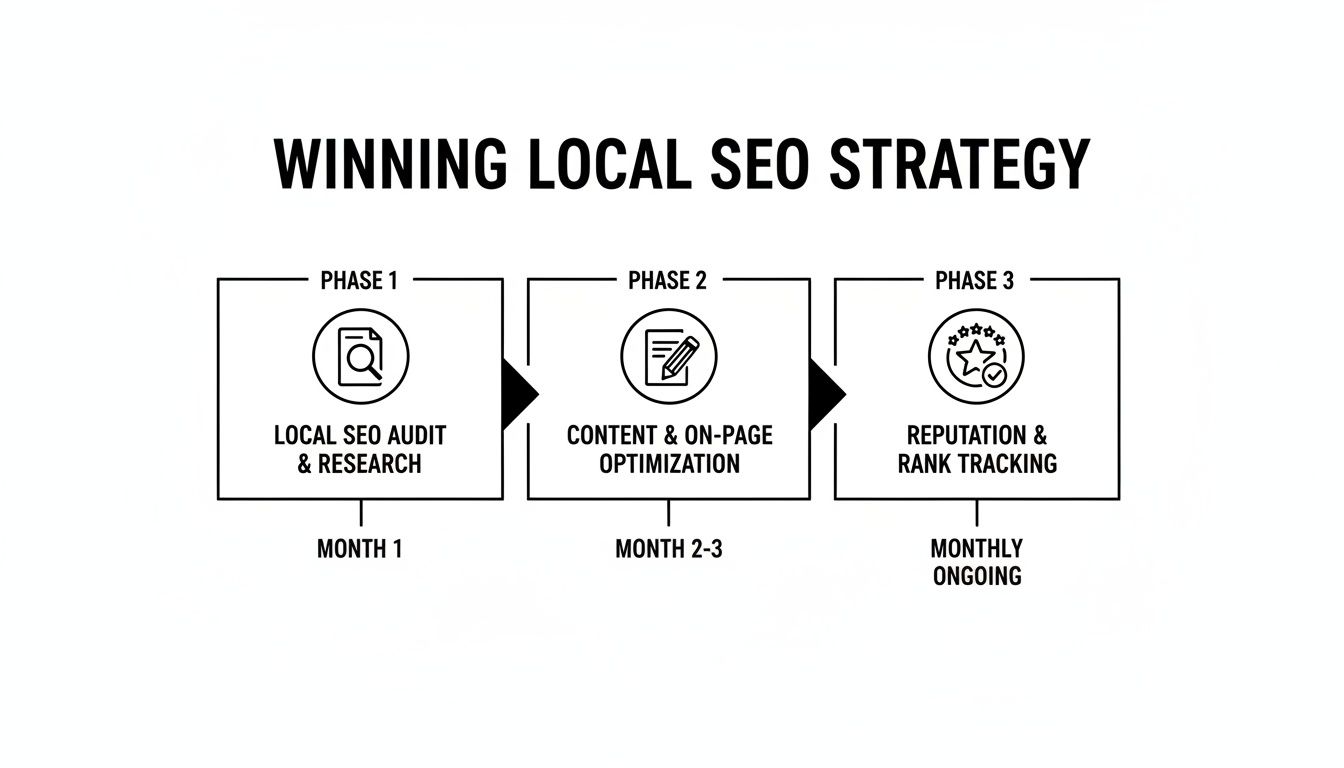
As you can see, each phase builds upon the last. This creates a compounding effect that strengthens your shop’s online presence and delivers better results over time.
To give you a clearer picture of what a real-world local SEO launch looks like, here’s a breakdown of the key activities and goals for each phase.
90-Day Local SEO Launch Plan for Auto Shops
| Phase | Timeline | Key Activities | Primary Goal |
|---|---|---|---|
| Foundation | Days 1–30 | GBP claim & optimization, full SEO audit, competitor analysis. | Control core digital assets and create a data-driven strategy. |
| Authority | Days 31–60 | On-page SEO implementation, local service page creation, citation building. | Build relevance and trust with search engines for your service area. |
| Amplification | Days 61–90 | Review generation system implementation, local content creation. | Generate social proof and attract customers with helpful content. |
This timeline shows how a well-structured campaign moves from fixing the basics to actively growing your shop’s authority and reputation online.
Phase 1: The First 30 Days
The first month is all about creating a rock-solid foundation. You can’t build a high-performance engine on a cracked block, and the same principle applies here. The goal is to claim and control your shop’s core digital assets while getting a crystal-clear picture of where you stand against the competition.
Key activities in this phase include:
- Google Business Profile (GBP) Claim & Optimization: This is the top priority. It involves claiming your listing, verifying ownership, and meticulously filling out every single section—from adding precise service categories like “Brake Repair” to uploading high-quality photos of your bays and team.
- Comprehensive Local SEO Audit: Next, we perform a deep dive into your current online presence. An audit uncovers technical website issues, evaluates your local keyword rankings, analyzes your backlink profile, and identifies any inconsistencies in your shop’s Name, Address, and Phone number (NAP) across the web.
- Competitor Analysis: You need to know who you’re up against. This step involves analyzing the top-ranking auto shops in your city to see what keywords they target, where their links come from, and how strong their review profiles are.
By the end of this phase, your shop will have a fully optimized digital storefront on Google and a clear, data-driven blueprint for the next 60 days.
Phase 2: Days 31 to 60
With the foundation set, the second month is all about building authority and relevance. This is where we start creating content and building signals that tell search engines you are a legitimate, expert auto repair business in your specific service area.
The focus shifts to two critical areas:
- Local On-Page SEO Implementation: Using the findings from the audit, we’ll create or optimize service pages on your website. That means having dedicated pages for “Transmission Repair in [Your City]” or “A/C Service in [Your Town],” each tailored with local keywords and clear calls to action.
- Citation Building Campaign: This involves systematically getting your shop listed in key online directories like Yelp, RepairPal, and other industry-specific sites. The goal is to ensure your business’s NAP information is 100% consistent everywhere it appears online, which builds tremendous trust with Google.
To perform these tasks effectively, agencies rely on specialized software. You can learn more about the leading options in this guide on the best local SEO tools available today.
Phase 3: Days 61 to 90
The final phase of the launch plan is all about amplification and reputation. With your technical foundation and on-page content in place, the focus turns to generating social proof and creating valuable content that attracts and helps potential customers. This is what solidifies your position as the local authority.
The main initiatives during this period are:
- Proactive Review Generation: We’ll implement a system to consistently ask happy customers for reviews on Google. This could involve automated email or text follow-ups that include a direct link to your review page, making it easy for them.
- Localized Content Creation: It’s time to start developing helpful blog content that answers common customer questions. Think of articles like, “5 Signs You Need New Brakes Before Winter in [Your City]” or “A Local Driver’s Guide to Seasonal Car Maintenance.”
By the end of 90 days, you will have a fully optimized local presence, a consistent citation profile, and active strategies for getting reviews and creating helpful content. This roadmap sets the stage for ongoing success, turning your initial investment into a reliable source of new customers month after month.
How to Measure SEO Success in Your Shop
If you’re investing in marketing, you need to see a clear return. It’s that simple. Forget confusing industry jargon and vague metrics like “impressions.” Measuring the success of local SEO services for auto repair shops really boils down to tracking the actions that lead to more business: more phone calls, more cars in the bays, and more revenue.
Think of it like running a diagnostic on a car. You wouldn’t accept a report that just says “engine is running.” You want specifics—performance data, fuel efficiency, and potential issues. Your SEO reporting should be the same way, giving you clear data that connects online activity to real-world results. This is how you see the true ROI and understand how SEO is driving your bottom line.
Key Performance Indicators That Matter
Your Key Performance Indicators (KPIs) are the vital signs of your marketing health. Don’t get bogged down in endless charts and graphs. Instead, focus on the handful of metrics that show actual customers are taking action and your shop is getting busier.
These are the essential KPIs every auto repair shop should be watching:
- Increase in Phone Calls: This is as direct as it gets. Tracking calls from your Google Business Profile shows exactly how many potential customers found you in local search and decided to reach out.
- Website Traffic from Local Searches: You want to see a steady climb in visitors finding your website through organic search. This isn’t paid traffic; it’s people in your area looking for your services.
- Clicks on “Get Directions”: This is a strong buying signal. When someone clicks the directions button on your Google profile, they aren’t just browsing—they’re planning a trip to your shop.
- Appointment Form Submissions: Tracking how many people fill out the “Book an Appointment” form on your website is a concrete measure of how well you’re turning online visitors into solid leads.
These KPIs are the bridge between your online presence and your offline revenue, giving you a tangible way to see your SEO efforts pay off.
Tracking Local Keyword Rankings
While rankings aren’t the only thing that matters, they are a crucial early indicator of success. Seeing your shop climb the search results for valuable local keywords is a clear sign the strategy is working. After all, you can’t get calls or clicks if customers can’t find you in the first place.
An effective SEO service will track your position for terms like “oil change in Austin” or “brake repair near me.” This data shows that you are becoming more competitive and visible at the exact moment a local customer needs your services.
This improved visibility is what fuels the KPIs that actually matter. Higher rankings lead to more people seeing your profile, which in turn generates more phone calls, direction requests, and website visits. For a complete overview of what to track, you can find valuable insights in this detailed guide on how to measure digital marketing success.
Connecting SEO to Your Bottom Line
Ultimately, the goal is to connect all this data back to your revenue. By tracking these specific KPIs, you can start to see the entire customer journey, from search to service. You can draw a straight line from an increase in local rankings to more phone calls, and then see how many of those calls turn into booked appointments.
This level of insight empowers you to make smart decisions about where to put your marketing dollars. It turns SEO from a vague, abstract concept into a measurable, predictable engine for growing your business, ensuring your investment is driving real, profitable results for your shop.
Choosing the Right Local SEO Partner
Picking an agency to handle your local SEO is just as important as hiring a master technician. The right partner can be your single greatest asset for growth. The wrong one can waste your time and money, leaving you right back where you started, or worse.
It’s important to look past slick sales pitches and focus on substance, experience, and honesty.
Your goal is to find a team that understands the urgent needs of someone with a car problem. They should know the huge difference between a person casually browsing for shops and a driver stuck on the side of the highway frantically searching “emergency tow and repair near me.”
This section will provide you with the information you need to vet potential partners and confidently choose a team that will actually grow your shop.
Key Questions to Ask Any Potential SEO Provider
Before you consider signing a contract, you should interview potential partners thoroughly. Think of it like bringing on a new service advisor. You need to know they have the skills, understand your business, and will communicate clearly.
Walking into that conversation with the right questions helps you control the narrative and get the answers that matter.
Here’s a practical checklist to get you started:
- Do you have experience with auto repair shops or other local service businesses? Ask for case studies or examples. An agency that already knows the auto repair world understands your customers and the keywords that actually book appointments, not just generate clicks.
- How will you measure success for my shop? Their answer should focus on business results—phone calls, direction requests, and booked jobs. If they only talk about website traffic or keyword rankings, ask how those metrics lead to more customers.
- Can you show me a sample of your reporting dashboard? A reputable partner will be happy to show you how they track progress. The report should be clean, easy to understand, and focused on the KPIs that impact your bottom line.
- What does your communication and support process look like? You need to know who your point of contact is and how often you’ll get updates. A good agency sets a clear communication rhythm from day one.
These questions are designed to cut through the marketing jargon and get straight to what a potential partner can actually do for your business.
Spotting the Red Flags
Knowing what to look for is only half the battle; you also need to know what to avoid. Some agencies use outdated tactics or make promises they can’t keep. Spotting these red flags early will save you a lot of trouble.
The most common red flag is a guarantee of a “#1 ranking on Google.” No reputable SEO professional can ever guarantee a specific ranking. Google’s algorithm is complex and constantly changing. A promise like that is a sign of inexperience or dishonesty.
Be wary of any agency that shows these warning signs:
- A Fixation on Vanity Metrics: If they spend more time talking about “impressions” or “click-through rate” than they do about phone calls and appointment forms, their priorities may not be aligned with your business goals.
- Lack of Transparency: Vague answers about their strategies or an unwillingness to share their process is a major problem. A true partner should be an open book about what they’re doing and why.
- One-Size-Fits-All Packages: Every auto shop is different. You have unique services, a specific service area, and different competitors. An agency pushing a generic, cookie-cutter SEO package isn’t going to provide the specific strategy you need to succeed.
Choosing the right partner for your local SEO services for auto repair shops is a serious investment in your future. By asking the right questions and keeping an eye out for red flags, you can find a team that acts as a true extension of your business—one that drives real results and keeps your service bays full.
Have Questions About Local SEO? Most Shop Owners Do.
Even after seeing a clear roadmap, it’s smart to have a few questions before you invest your hard-earned money into something new. For most mechanics, local SEO can feel like a different world from turning wrenches, and it’s easy to get bogged down in the terminology.
Let’s cut through the noise. Here are some of the most common questions we hear from shop owners just like you, answered in plain English. We want you to feel confident and fully informed before you make a decision.
How Long Does This Stuff Actually Take to Work?
This is always the first question, and the honest answer is: it depends. Think of it like tuning a high-performance engine. You don’t just hit a switch and get instant horsepower. You have to meticulously assemble the right parts and dial them in.
Some initial improvements, like fully optimizing your Google Business Profile, can bring in more calls in just a few weeks. But to build real, lasting momentum, you’re typically looking at 3 to 6 months to see a significant and steady climb in your rankings, website traffic, and booked jobs.
Local SEO is not a temporary, quick fix like running a newspaper ad. It’s a long-term investment in building a valuable digital asset for your shop that pays dividends for years to come. The results compound over time, creating a reliable source of new customers.
This steady approach builds your online presence on a solid foundation, making your shop more resilient when Google changes its algorithm or a new competitor appears.
Can I Just Do My Own Auto Shop SEO?
Absolutely. If you’re motivated, you can definitely tackle some of the basics yourself. Claiming your Google Business Profile, making sure your hours are correct, and responding to reviews are all great first steps that make a difference.
However, a complete strategy that drives serious, consistent growth is another matter. It involves technical website optimization, building a steady stream of local citations, creating service pages that Google loves, and digging into data to see what’s working. Honestly, just keeping up with Google’s constant updates is a full-time job.
Partnering with a provider of local SEO services for auto repair shops lets you focus on what you do best—diagnosing check engine lights and getting cars back on the road. While you’re managing the bays, a dedicated team is managing the complexities of getting your phone to ring.
What Should I Expect to Budget for Local SEO?
This is another important question, and the cost can vary. The right investment really depends on your situation—the size of your city, how many other shops you’re competing with, and how many services you want to be known for. A shop in a packed metro area will need a more aggressive plan than a shop in a smaller town.
A realistic budget for a professional, ongoing campaign should cover more than just a few one-off tasks. It should be a continuous effort that includes:
- Technical SEO: Making sure your website is fast, secure, and easy for Google to understand.
- Content Creation: Building out service pages and blog posts that attract local drivers looking for help.
- Authority Building: A consistent plan for building local citations and earning backlinks from other trusted sites.
When you look at pricing, try to focus on the value you’re getting, not just the dollar amount. A fair investment ensures you’re not just checking a box, but actively building a customer-generating machine that delivers a positive return month after month.
Is SEO Better Than Running Local Service Ads?
That’s a great question. The best way to look at it is that SEO and paid ads aren’t rivals—they’re teammates. Each one has a different job to do, and they work together perfectly.
Imagine you’re in a race.
- Local Service Ads (LSAs) are like hitting a nitrous button. You get an immediate, powerful burst of speed that puts you right at the top of the search results. You pay for that instant visibility, and it’s fantastic for getting quick leads to fill a slow week.
- Local SEO is like building a bigger, more powerful engine. It takes time and effort, but once it’s dialed in, it delivers sustainable, long-term power that keeps you ahead. This is the organic traffic you earn, and you don’t have to pay for every single click.
The smartest strategy is often using ads for those quick wins while you simultaneously build your SEO foundation. This approach gets you leads in the door now while setting you up for consistent, long-term growth. To get a better feel for one part of that foundation, check out our guide on effective local citation building services.
Ready to stop letting competitors get the calls that should be yours? The team at Raven SEO specializes in creating practical, results-driven local SEO strategies for businesses like yours. Schedule your no-obligation consultation today to get a clear roadmap for driving more bookings and growing your shop.