

For a career coach, SEO is all about showing up in search results the moment a potential client is looking for help. It’s an educational strategy that creates a steady stream of high-quality leads by connecting you with motivated professionals right when they need you. That makes it a far more powerful client magnet than endlessly posting on social media or pouring money into paid ads.
Why SEO Is Your Best Client Magnet
Let’s be honest: the feast-or-famine cycle of finding new clients is draining. One month you’re swamped, and the next you’re hustling for leads on LinkedIn or spending a fortune on ads that just don’t convert. That inconsistency is the biggest hurdle for most coaches, leading to a ton of stress and unpredictable income.
But what if you could flip that script? Imagine ideal clients finding you instead of the other way around.
These aren’t people just scrolling past your posts on social media. They’re actively typing things like “career coach for tech leaders” or “how to negotiate a higher salary” into Google. They have a specific problem and are looking for an expert to solve it. That’s the power of SEO for career coaches—it puts you right in front of people who are ready to take action.
The Problem with Traditional Outreach
So many coaches get stuck on a hamster wheel of methods that demand constant effort for diminishing returns. Does this sound familiar?
- Social Media: You have to post every single day just to stay visible. The moment you take a break, the leads dry up completely.
- Paid Ads: These can work, but they get expensive fast. You’re basically renting attention, and the costs can spiral without any guarantee of a return.
- Networking: Great for referrals, but it’s hard to scale and rarely predictable enough to build a business on.
These outbound tactics often feel like you’re shouting into the void, just hoping the right person happens to hear you. SEO turns that whole dynamic on its head.
Shifting from Chasing to Attracting
Search Engine Optimization transforms your website from a simple online brochure into a strategic asset that works for you 24/7. It’s not about flashy tricks; it’s about building a sustainable pipeline of clients who are already looking for what you offer. When you create genuinely helpful, educational content that answers their specific questions, you build authority and trust before they even book a call.
Of course, before diving into SEO tactics, it’s vital to have a rock-solid grasp of your own brand and business value. For a great read on understanding the essence of business coaching, this article offers some fantastic insights.
The data backs this up in a big way. Leads from organic search aren’t just more consistent; they’re also much higher quality.
Industry research shows that leads from SEO have a close rate of around 14.6%. In stark contrast, outbound leads (think cold calls or emails) convert at a dismal 1.7%. This means an SEO lead is more than eight times more likely to become a paying client, which massively lowers your cost to acquire a new customer.
This chart really puts the difference into perspective:
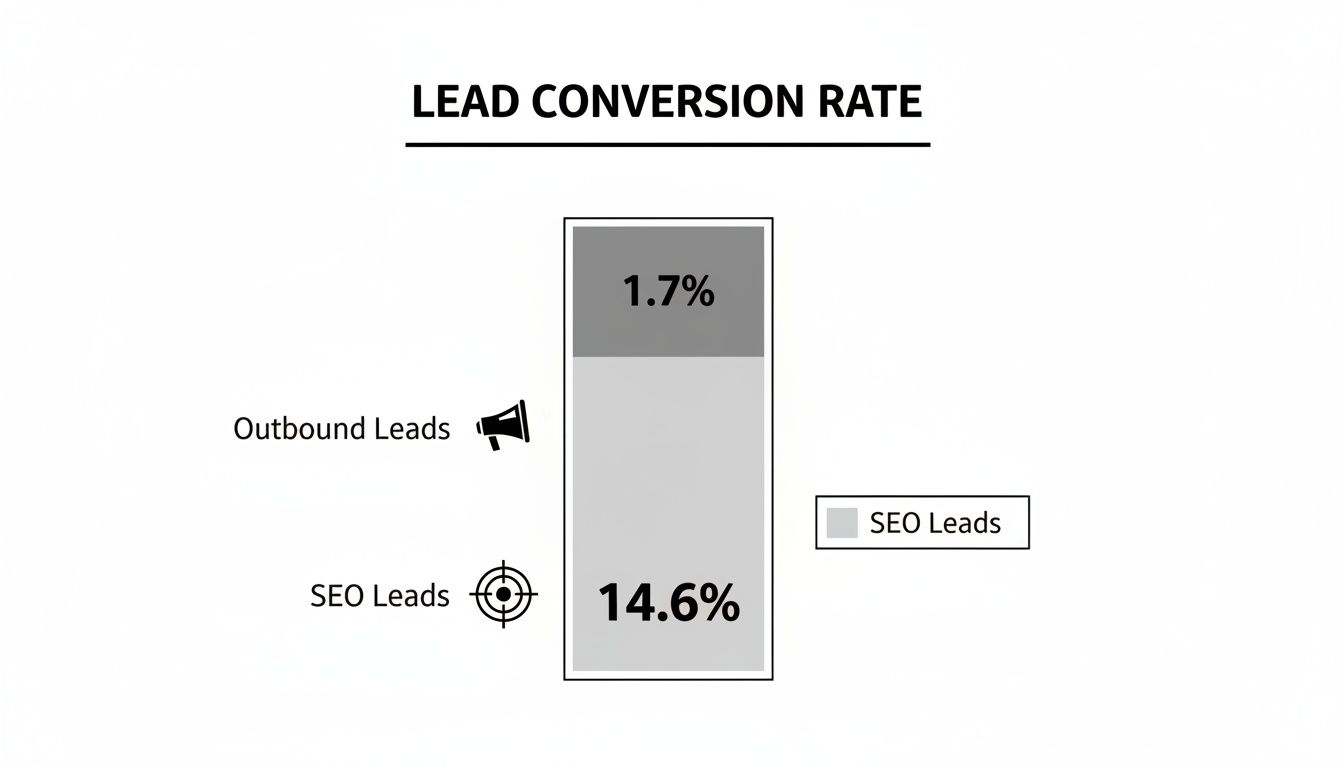
Lead Quality Comparison SEO vs Other Channels
To see just how different the leads are, this table breaks down the value of SEO compared to more traditional marketing efforts. It highlights why organic search is such a powerful and efficient channel for career coaches.
| Marketing Channel | Average Lead Conversion Rate | Relative Cost per Lead |
|---|---|---|
| SEO (Organic Search) | 14.6% | Low |
| Outbound Marketing | 1.7% | High |
| Social Media (Organic) | ~1-3% | Medium (Time) |
| Paid Ads (PPC/Social) | ~2-5% | Very High |
The takeaway here is simple but profound: Focusing on SEO attracts clients who are already halfway sold on your services. They’ve done their research, they know they have a problem, and they’re actively looking for an expert like you to help them solve it.
Finding Your Niche with Smart Keyword Research
If you try to be a career coach for everyone, you’ll end up being the coach for no one. That’s the hard truth. The real secret to winning at SEO isn’t about chasing massive traffic numbers; it’s about attracting the right traffic. We’re talking about finding the exact phrases your ideal clients are typing into Google when they’re past the “just browsing” stage and are ready to hire an expert.
Forget casting a wide net. Your job is to carve out a specific, profitable niche where you can become the undisputed authority. Instead of just “career coach,” get more specific. Think “career coaching for tech sales leaders” or “interview prep for senior engineers.” This kind of focus is what transforms your website from a simple online brochure into a client-generating machine.

Uncovering High-Intent Keywords
The trick here is to go after long-tail keywords. These are longer, more descriptive phrases—usually three or more words—that signal someone knows exactly what they’re looking for. Sure, they have lower search volume, but the person behind the search is much further along in their buying journey.
Someone searching for “career advice” is just kicking tires. But someone searching for “executive leadership coach for women in finance”? That person has a specific problem and is actively looking for the solution you provide.
Let’s break it down:
- Low-Intent (Tire-Kickers): Think “jobs,” “career change,” or “how to write a resume.” These searches are broad and usually come from people in the earliest stages of research.
- High-Intent (Ready-to-Hire): This is where the magic happens. Keywords like “career coach for software developers,” “salary negotiation help for managers,” or “best career coach near me” show a clear need and a readiness to invest.
Key Takeaway: The more specific the keyword, the higher the quality of the lead. By zeroing in on niche, long-tail keywords, you naturally filter out the casual browsers and connect directly with clients who are looking for your specialized expertise.
This strategic approach to SEO for career coaches is more important than ever. While not every coach is on board yet, the trend is clear. Industry data shows that roughly 50% of coaches are already using SEO, and about 59% are blogging to pull in traffic. This means there’s a huge opportunity for you to get ahead of the curve and stand out.
Practical Keyword Research Techniques
So, where do you find these golden keyword phrases? You don’t have to guess. There are a handful of simple methods and tools you can use to figure out what your ideal clients are searching for. The end goal is a curated list of keywords that perfectly aligns with your services and expertise. For a full breakdown of the process, you can check out our in-depth guide on how to do keyword research.
Here are a few ways to get the ball rolling:
- Brainstorm Your “Seed” Keywords: Start by jotting down the core themes of your coaching practice. Think about your ideal client. What’s their job title? What industry are they in? What keeps them up at night? Your list might include terms like “career transition,” “executive coaching,” “tech careers,” or “nonprofit leadership.”
- Lean on Free Keyword Tools: Take your seed keywords and plug them into free tools like Google Keyword Planner or Ubersuggest. They’ll spit back a list of related search terms, along with estimates for monthly search volume and how competitive each one is. Your sweet spot is finding phrases with decent search volume but lower competition.
- Spy on Your Competitors: Look up other career coaches who are already successful in your niche. You can use a tool like Ahrefs’ Free Keyword Generator to see which keywords are driving traffic to their sites. This is an absolute goldmine for finding proven terms that are already attracting your target audience.
Putting in the work on smart keyword research lays the foundation for an SEO strategy that doesn’t just bring you website visitors—it brings you clients who see your value and are ready to invest.
Turning Your Website Into a Client-Generation Machine
Once you’ve nailed down the golden keywords your ideal clients are typing into Google, the real work begins. It’s time to put those keywords to work on your website. Think of your website as your most dedicated employee—it should be working around the clock to attract, engage, and convert prospects into paying clients. This is where on-page SEO comes into play.
On-page SEO is the art of optimizing your individual web pages so they don’t just rank higher in search results, but actually persuade visitors to take the next step. Your site needs to be more than a digital brochure; it has to be a client-generation machine.
Optimizing Your Core Pages to Win Clients
Let’s be honest, some pages on your website do more of the heavy lifting than others. We’re going to focus on the big three: your homepage, services page, and ‘About’ page. Each one plays a unique role in guiding a potential client from a curious visitor to a booked consultation.
Getting these pages right creates a seamless experience that answers questions, builds trust, and makes it incredibly easy for someone to say “yes” to working with you. This is the heart of effective SEO for career coaches—it’s what bridges the gap between getting traffic and actually getting clients.
- Your Homepage: This is your digital handshake. It has to instantly answer three questions: Who are you? Who do you help? How do you help them? Use your main keywords here to state your value proposition clearly, like “Career Coaching for Tech Professionals.”
- Your Services Page: Don’t be vague. Instead of one generic list, break down what you offer. Create dedicated sections or even separate pages for each core service, like ‘Executive Leadership Coaching,’ ‘Interview Preparation,’ or ‘Salary Negotiation Strategy.’ This lets you target much more specific, long-tail keywords for each service you sell.
- Your About Page: This is often the second most visited page on a coach’s website. People hire people, not just a list of services. This is your chance to tell your story. Weave your keywords in naturally as you explain your background, your coaching philosophy, and what drives you to help professionals get ahead.
Crafting Titles and Descriptions That Demand a Click
Your SEO title (the blue link in Google search results) and meta description are your first impression online. You get one shot to convince a searcher to click on your link instead of the nine others staring back at them.
A great title grabs their attention, and a compelling meta description seals the deal by promising a solution to their problem.
Pro Tip: Treat your meta descriptions like ad copy. Speak directly to the searcher’s pain point and offer a clear benefit. Instead of “We offer career coaching services,” try something like, “Feeling stuck in your career? Our expert coaches help you land a job you love with proven strategies for career transition and growth.”
The Power of a Clear Call-to-Action
Every single page on your website needs to tell the visitor what to do next. This is your Call-to-Action (CTA). Without a strong, clear CTA, even the most interested prospect might just click away and disappear forever.
Your CTAs should be direct, action-oriented, and impossible to miss. Use bold, clear buttons that stand out.
- Weak CTA: “Contact us”
- Strong CTA: “Book Your Free Discovery Call”
- Weak CTA: “Learn more”
- Strong CTA: “Download My Salary Negotiation Guide”
By placing these CTAs strategically—at the end of your content, on your services page, and even in your website’s header—you make the path forward obvious. This smooth user experience is something search engines reward, and it’s absolutely critical for turning website traffic into real business.
It’s also important to link these core pages together logically. This helps both users and search engines understand your site’s structure and the relationship between your content. To dive deeper into this, you can learn about internal linking as your website’s secret weapon for SEO and user experience.
Creating Content That Connects and Converts
Content is the engine that drives your entire SEO strategy. It’s how you prove you know your stuff, build trust with potential clients, and give Google a real reason to send traffic your way.
But let’s be clear: this isn’t about churning out generic “5 tips to improve your resume” articles. Good content goes deeper. It solves the real, nagging problems your ideal clients are facing and cements you as the go-to authority in your coaching niche.
Think of your content less like a collection of random posts and more like a library of high-value resources. This library should be so genuinely helpful that a potential client feels they’ve already gotten value from you before they even think about booking a call. That’s how you turn passive readers into engaged prospects.

Go Beyond Blogs With Content Pillars
A content pillar is a massive, in-depth piece of content that covers a core topic related to your services. From this one huge piece, you can then break off and create dozens of smaller, related articles, social posts, or videos. This strategy helps you absolutely dominate a specific topic in the search results.
Instead of a quick 800-word post, aim to create the single best, most comprehensive guide on a specific challenge your clients face. Google loves this kind of depth, and it immediately positions you as a true expert.
For a career coach, pillar content could look like:
- An In-Depth Guide: “The Ultimate Guide to Navigating a Mid-Career Pivot into Tech”
- A Detailed ‘How-To’ Post: “How to Answer ‘Tell Me About Yourself’ Like an Executive Leader”
- A Resource Hub: “Every Tool and Template You Need for a Successful Job Search in 2024”
These monster pieces become long-term assets, pulling in traffic and leads for years. They also give you a perfect, high-authority page to link back to from your shorter blog posts, which strengthens your entire site’s SEO structure.
Ideas for High-Value Blog Posts
Your blog is where you consistently prove your expertise day in and day out, targeting a wide range of specific keywords along the way. Each post should be a mini-masterclass, offering actionable advice that solves one specific problem.
If you need a refresher on the fundamentals, we have a helpful guide on how to write SEO-friendly blog posts.
Here are some proven blog post ideas that work exceptionally well for coaches:
- Case Studies: Anonymize a client’s story (with their permission, of course) and walk through their journey from start to finish. Detail the specific challenges they faced, the strategies you implemented together, and the successful outcome. Think: “How a Marketing Manager Doubled Her Salary After Moving to a New Industry.”
- ‘Mistakes to Avoid’ Posts: These are absolute gold because they tap into a reader’s fear of messing up. A great example would be something like, “The 7 Subtle Interview Mistakes That Cost Senior Leaders the Job.”
- Niche-Specific ‘How-To’ Guides: Get super granular with your advice. Instead of a general post on resumes, write “How to Frame a Career Gap on Your Resume When Applying for SaaS Roles.”
These types of posts don’t just attract highly relevant search traffic; they build incredible trust by showcasing your specific expertise and proven results.
Expert Insight: Remember, Google’s E-E-A-T guidelines (Experience, Expertise, Authoritativeness, and Trustworthiness) are everything. The best way to demonstrate these qualities is by sharing unique insights, personal stories, and real-world client examples that bland, AI-generated content simply cannot replicate.
Create Lead Magnets That Actually Convert Visitors
A blog post can attract a visitor, but a lead magnet is what captures their information so you can continue the conversation. A lead magnet is just a free, valuable resource that someone gets in exchange for their email address. It’s the perfect bridge from casual reader to warm lead.
The best lead magnets offer a quick, tangible win. They should be directly related to the content the person was just reading, making the offer a complete no-brainer.
Effective Lead Magnet Examples for Coaches:
| Lead Magnet Type | Example for a Career Coach | Why It Works |
|---|---|---|
| Checklist | The Ultimate Salary Negotiation Checklist | Provides a clear, step-by-step process for a high-stakes conversation. It’s instantly actionable. |
| Template | 5 Proven “Thank You” Email Templates After an Interview | Saves the user time and provides a professionally vetted resource they can use immediately. |
| Worksheet | Career Clarity Worksheet: Find Your Professional ‘Why’ | Engages the user in self-reflection, giving them a small taste of the coaching experience. |
| Webinar/Video Training | Free 20-Minute Training: Master the STAR Method for Behavioral Interviews | Offers high-perceived value and lets you build a personal connection through video. |
By strategically placing these offers within your highest-traffic blog posts, you create an automated system for generating leads. Your content starts working for you 24/7, not just to inform, but to actively build your email list with qualified prospects who have already raised their hand for help.
Building Authority Beyond Your Website
A brilliant SEO strategy doesn’t stop at the edges of your website. To really cement yourself as an authority, you have to build your presence where your clients are already hanging out and looking for advice. This is all about sending powerful off-page signals that tell Google you’re a trusted, credible voice in the career coaching space.
This goes way beyond technical tweaks. It’s about actively building your personal brand and, if you serve a local area, your neighborhood reputation. When Google sees other reputable sources linking to you or mentioning your name, it gives your own website a massive authority boost, leading directly to better rankings and more client calls.

Dominate Local Search With Google Business Profile
If you work with clients in a specific city or region, your Google Business Profile (GBP) is non-negotiable. It is hands-down the most powerful free tool for attracting local clients. A well-optimized profile is what gets you into that valuable “Map Pack” when someone searches for a “career coach near me.”
Think of your GBP as a mini-website that lives directly on Google’s search results page. It’s often the very first impression a potential client will have of you.
To get the most out of it, make sure you:
- Fill Out Everything: Don’t skip any sections. Nail down your exact business name, address, phone number, hours, and write a detailed description of your coaching services. This description is a perfect place to naturally include some of your target keywords.
- Choose the Right Categories: Select “Career Counselor” as your primary category. Then, add secondary ones like “Life Coach” or “Business Management Consultant” if they fit what you do.
- Upload High-Quality Photos: You need a professional headshot, pictures of your office space (if you have one), and even some branded graphics that explain what makes your services unique.
Key Insight: Reviews are the lifeblood of your Google Business Profile. You need to actively and ethically ask every single happy client to leave you a review. A steady stream of positive feedback not only provides powerful social proof but is also a huge ranking factor for local search.
Turn LinkedIn Into an SEO Powerhouse
Your LinkedIn profile is so much more than a digital resume. It’s a powerful search engine in its own right and a massive asset for your personal brand. When you optimize your profile, you’re making it easier for potential clients, recruiters, and even media contacts to find you right on the platform.
Even better, a polished LinkedIn profile often ranks high in Google search results for your own name. This gives you another piece of digital real estate that you control on the first page of search results, reinforcing your professional credibility at a glance.
Using Outreach to Earn Valuable Backlinks
Backlinks—those links pointing from other websites to yours—are one of the most powerful authority signals you can send to Google. When you earn them from relevant, high-quality sites, it’s like getting a vote of confidence from others in your field. This is a core part of SEO for career coaches that builds ranking power for the long haul.
A simple but incredibly effective way to do this is through guest blogging. Start by identifying industry blogs, career advice websites, or online publications that your ideal clients are already reading. Reach out with a pitch for an article topic that showcases your unique expertise and delivers real value to their audience. For a full breakdown, our guide shows you how to build backlinks naturally without any spammy, outdated tactics.
Beyond guest posting, don’t forget to use professional platforms like LinkedIn to share your insights. Learning how to post articles on LinkedIn effectively can build your authority and drive engagement, turning your professional network into a source of potential clients. Every article you publish there is another doorway for people to discover your expertise and, ultimately, find their way to your website.
Measuring What Matters for Growth
Launching an SEO strategy without tracking your results is like coaching without listening to your client—you’re just guessing. To really know if your efforts are paying off, you need to cut through the noise and focus on the handful of metrics that actually move the needle for your business.
Forget getting lost in a sea of data. The only two tools you truly need to live in are Google Analytics and Google Search Console. They give you the clear, actionable insights you need to measure the success of your SEO for career coaches strategy. The goal isn’t just to see more traffic, but to attract the right traffic that turns into paying clients.
Key Metrics That Drive Your Coaching Business
Instead of chasing vanity metrics, let’s zero in on the data points that directly reflect business growth. For a much deeper dive, our guide on how to track website traffic has a complete overview.
Here’s what truly matters:
- Organic Traffic: This is the raw number of people finding you through Google searches. A steady upward trend here is a great sign that your content is resonating with your ideal clients.
- Keyword Rankings: Inside Google Search Console, you can watch your position for those high-intent keywords like “career coach for tech leaders.” Seeing these terms climb into the top 10 is a direct signal of progress.
- Goal Completions: This is the big one. In Google Analytics, you can set up goals to track how many visitors actually fill out your consultation form or download your lead magnet. This number tells you if your SEO is generating real business leads.
Crucial Takeaway: An increase in organic traffic is great, but an increase in consultation requests is what pays the bills. Always connect your SEO performance to tangible business outcomes.
The DIY Coach vs. Hiring an SEO Pro
Sooner or later, you’ll face a choice: keep managing your SEO yourself or bring in an expert. Modern SEO is a blend of content strategy, technical skills, analytics, and now, AI-assisted optimization. For coaches wearing the marketer hat, this means deciding whether to invest the time to learn these contemporary tools or outsource the work.
Given that skilled SEO support can be a significant investment—agencies often price projects in the low thousands—it’s a major business decision. You can get more insights on the state of SEO jobs and salaries on previsible.io.
Consider hiring a pro when:
- You’re spending more time on marketing than you are on coaching.
- Your growth has hit a wall and you can’t figure out why.
- You’re ready to seriously scale your client acquisition and need expert guidance to get there.
Frequently Asked Questions About SEO for Career Coaches
Diving into the world of SEO can feel a little like learning a new language. You’ve probably got some lingering questions. Let’s clear up a few of the most common ones that come up when career coaches start using search to grow their business.
How Long Does SEO Take to Work for a Coach?
This is the big one, and the honest answer is: patience is part of the strategy. While you can get instant visibility with paid ads, organic search is about building a long-term asset for your business.
Generally speaking, you can expect to see the first signs of life—some initial movement and early results—within 3 to 6 months. This isn’t a hard rule, but it’s a realistic window. That’s the time it takes for Google to find, crawl, and start understanding your new pages and content. The real magic happens over time as your consistent efforts start to compound.
Do I Need to Be a Tech Expert to Do SEO?
Absolutely not. This is probably the biggest misconception out there. While there are certainly technical parts to SEO, the heart of a great SEO strategy for career coaches is all about one thing: deeply understanding your clients and creating content that genuinely helps them.
Modern website platforms like WordPress, along with tools like the Yoast SEO plugin, handle most of the technical heavy lifting for you. Your real job is to focus on what you do best—providing expert guidance. Your focus should be on the human side of things, not on becoming a developer.
Key Takeaway: SEO for coaches is less about wrestling with code and more about generously sharing your expertise. If you can provide clear, valuable answers to the problems your ideal clients face, you’re already more than halfway there.
Is It Better to Focus on Blogging or Social Media?
It’s not really an either/or question, as they serve different purposes. But if we’re talking about building a sustainable, long-term engine for attracting clients, SEO-driven blogging wins, hands down.
Think of it this way: social media demands constant, daily effort to stay visible. The second you stop posting, the algorithm moves on, and the leads dry up. It’s a content treadmill.
An optimized blog post, on the other hand, is an asset. A single great article can rank for years, working for you 24/7 to attract your ideal clients while you sleep. It builds authority and trust in a way a fleeting social media post just can’t match.
Ready to turn your website into a client-attraction machine without the guesswork? Raven SEO provides strategic guidance and data-informed optimization to build sustainable growth. Schedule your free consultation today!