
If you're a Maryland roofer reading this, there's a good chance your week looks familiar. One day you're bidding a replacement in Towson, the next you're chasing a leak call in Baltimore, and by Friday you're wondering why the phone went quiet after spending money on ads, yard signs, and a website that looks decent but doesn't pull its weight.
That's where most roofing marketing companies get exposed. They sell activity. You need outcomes. You don't need another recycled home-services package that treats a roofer in Dundalk the same as a dentist in Columbia. You need a local system that earns trust fast, shows up where homeowners search, and turns traffic into booked estimates.
For Maryland contractors, the gap between being visible and being chosen is where the money is. The roof may be the product, but trust, timing, and local relevance are what close the job.
The Challenge for Maryland Roofers in 2026
A roofer in Baltimore County can do everything right on the production side and still lose jobs. The crew shows up. The estimate is fair. The workmanship is solid. But when a homeowner in Towson searches for a contractor after spotting stains on the ceiling, they usually call the company they see first and trust fastest.

That pressure isn't your imagination. The U.S. roofing contractor market is projected to reach $99.8 billion in 2026, with over 106,000 businesses competing for a share. At the same time, the median U.S. home age is nearing 40 years, and more than 80% of demand comes from re-roofing, which keeps competition intense for local leads in states like Maryland, according to roofing market statistics for 2026.
What that looks like in Maryland
In practical terms, that means a few things:
- Towson and surrounding suburbs often reward the contractor with the cleanest online reputation and the most polished website.
- Baltimore City neighborhoods can require sharper service pages, clearer financing language, and stronger review management because homeowners compare options quickly.
- Storm-driven pockets like Dundalk and Essex attract fast-moving competitors who flood search results and inboxes right after severe weather.
A growing market sounds good on paper. It is good. But it also brings more noise.
Practical rule: If a homeowner has to work to understand who you serve, what you do, and why you're trustworthy, they'll call the next roofer.
Why generic marketing breaks down
Most roofing marketing companies miss the local context. They run broad campaigns across an entire metro area, then wonder why lead quality drops. A contractor who wants replacement jobs in Towson, repair calls in Parkville, and storm work in Dundalk shouldn't use one generic message across every zip code.
Maryland roofers need sharper positioning than that. They need neighborhood-level relevance, service-specific pages, and a local search presence that feels established before the sales rep ever arrives.
That's why fundamentals matter more than gimmicks. If your local visibility is weak, your referral reputation isn't reflected online, or your website doesn't convert, every dollar you spend works harder than it should. A smart first step is tightening your local presence around the areas you want to own. Raven SEO's guide to local SEO best practices is a useful benchmark for that work.
Your Digital Foundation A Website That Converts Maryland Homeowners
A roofing website shouldn't act like a brochure. It should act like your best estimator on a good day. Clear, calm, credible, and built to answer the questions a Maryland homeowner has before they ever fill out a form.
Too many roofing marketing companies send paid traffic to sites that bury the phone number, use stock photos, and talk in generic slogans. That wastes attention. If someone lands on your site after searching "slate roof repair Baltimore" or "metal roofing Annapolis," they should know within seconds that they're in the right place.

Put trust above the fold
The top of the page does most of the heavy lifting. Before a homeowner scrolls, they should see:
- Your exact service focus such as roof replacement, storm repair, inspections, or gutters
- Your service area with real Maryland locations, not vague phrases like "serving the region"
- Trust signals such as Maryland licensing details, manufacturer certifications, financing options, and review highlights
- A direct next step like call now, request an inspection, or book an estimate
Roofing is a high-trust sale. Homeowners aren't buying a cheap impulse service. They're judging risk.
Show Maryland work, not generic roofing work
If your gallery only shows anonymous roofs with no context, you're missing a chance to build local confidence. A homeowner in Federal Hill wants to see craftsmanship that feels relevant to older housing stock. A homeowner in Howard County may respond better to cleaner suburban replacement projects with newer architectural shingles or metal options.
Use captions that ground the work in reality. Mention neighborhood, roof type, and project type in plain language. That doesn't need to be fancy. It needs to feel real.
A strong portfolio should include:
- Project variety for repairs, replacements, storm damage, and specialty materials
- Location context such as Baltimore, Towson, Annapolis, or surrounding communities
- Before-and-after visuals when available
- Short outcome summaries that explain the homeowner's problem and the solution
Homeowners don't just ask, "Can this company roof?" They ask, "Have they handled a house like mine?"
Build pages around services and places
One broad "Services" page won't carry your visibility or conversion goals. Separate your core offerings. Then align them with the places you serve.
A better structure looks like this:
| Page type | Better example |
|---|---|
| Service page | Roof replacement |
| Service page | Emergency roof repair |
| Service page | Metal roofing |
| Location page | Roofer in Towson |
| Location page | Roof repair in Baltimore |
| Combined intent page | Slate roof repair in Baltimore |
That structure helps users and search engines. It also makes your ad campaigns and local SEO much easier to manage later.
Remove friction from the estimate request
A lot of contractor sites ask for too much too soon. Long forms feel like work. Keep your main conversion points simple.
Good practice usually includes:
- Short forms that ask only for what's needed to start the conversation
- Clickable phone numbers on mobile
- Visible service area language so bad-fit leads self-filter
- Clear response expectations so the homeowner knows what happens next
If you're rebuilding or tightening your site, Raven SEO's overview of website design best practices is a practical place to compare your current setup against what converts.
What doesn't work
A few common mistakes show up over and over:
- Stock-heavy visuals that make the company feel interchangeable
- One-page sites that can't support local search or service-specific messaging
- Overwritten copy that talks about being "trusted" and "professional" without proving either
- No local proof from Maryland homeowners, neighborhoods, or completed jobs
A good roofing website doesn't win awards. It gets the right person to call.
Mastering Hyper-Local SEO for Maryland Roofers
Local SEO is where smaller Maryland roofers can still beat bigger competitors. Not by being louder. By being more relevant in the exact places they want to win.
If you want calls from Canton, Towson, Dundalk, or Glen Burnie, your online presence has to send clear local signals. That means your Google Business Profile, your website pages, your citations, and your reviews all need to point in the same direction.
Start with content that can actually rank
A lot of roofing sites look bigger than they are. They have dozens of pages, but most of them do nothing. For roofing SEO, 98% of roofing website pages generate zero traffic, and businesses that ignore local citations can face 25% ranking volatility, according to roofing SEO statistics and methodology.
That should change how you think about content. More pages isn't the goal. Better pages are.
Focus first on:
- High-intent service pages tied to actual buyer searches
- Location pages for towns and neighborhoods you actively serve
- Supporting articles that answer local homeowner questions
- Structured data such as RoofingContractor schema to help search engines understand your business
What to put in your Google Business Profile
For local roofers, your Google Business Profile is often the first impression. Treat it like a sales asset, not a citation you set up once and forget.
Make sure it includes:
- Accurate categories
- Real jobsite photos
- Service descriptions written in plain English
- Frequently updated posts
- Questions and answers that handle common objections
- A review process your team follows after every completed job
A roofer trying to rank for "roofer near Canton" or "roof repair Towson" needs a profile that looks active and trustworthy. Homeowners compare listings fast. Thin profiles lose.
Field note: The companies that dominate the map pack usually do the boring things consistently. Better photos. Better reviews. Better page alignment.
Build local pages like a Maryland operator
A location page should not be the same paragraph copied across ten towns. Homeowners can smell that. So can Google.
A useful local page includes local cues such as housing style, common roofing issues, and service expectations. For Baltimore, that might mean older rowhomes and leak diagnostics. For Towson, it might mean replacement, flashing, and storm-related repairs in established suburban neighborhoods.
Use topics that fit real search behavior:
- Common roofing problems in Baltimore City homes
- How Maryland homeowners should document storm roof damage
- When to repair vs replace an aging roof in Towson
- What to expect during a roof inspection in Anne Arundel County
For deeper page planning, Raven SEO's guide on hyper-local content strategy is worth reviewing.
Here’s a quick visual explainer before the next step:
Citations and local authority still matter
Roofing marketing companies sometimes overfocus on blog content and underinvest in local authority signals. That's a mistake. You need consistent business information across the web, especially in trusted local and industry sources.
For Maryland roofers, that can include:
- State and trade listings
- Industry associations
- Major business directories
- Manufacturer certification pages
- Local chamber or community listings where relevant
The goal isn't to spray your business into random directories. It's to reinforce legitimacy.
Reviews are part of SEO, not a side project
Review management often gets delegated until someone remembers it. That's too late. For roofers, reviews influence both visibility and conversion. They tell Google you're active, and they tell homeowners you're safe to call.
Create a review habit that is simple enough for your team to repeat. Usually that means asking at job completion, sending a direct link, and responding to every review in a professional tone.
The five-mile famous mindset
One of the most underrated ideas in roofing marketing is local dominance over broad reach. A small contractor doesn't need to be known everywhere in Maryland. They need to be known in the neighborhoods where they can respond fast, price confidently, and build referral density.
That means becoming the roofer people in a tight radius keep seeing:
- on Google
- in local reviews
- in neighborhood project photos
- in community relationships
- in search results for specific services
That kind of visibility is harder for generic agencies to build because it requires discipline, not just spend.
Smart Paid Advertising for Immediate Roofing Leads
A Towson homeowner wakes up to a ceiling stain after a hard overnight storm, grabs a phone, and searches "roof leak repair near me." If your ad shows up, the click is expensive. If the landing page is weak, the call goes to the next roofer.
That is paid search for Maryland roofers in 2026. It can fill a crew schedule fast, support storm-response work in Baltimore County, and help a contractor break into a neighborhood where competitors already have name recognition. It can also waste a month of margin in a week.
A lot of roofing marketing companies still run PPC like a generic home services account. They lump repair, replacement, and storm traffic into the same campaign, send every click to the homepage, and report raw lead volume as if every form fill has the same value. That approach breaks down fast in local markets like Dundalk, Parkville, and Towson, where service radius, job type, and response speed all affect whether a lead is worth buying.
Why roofing PPC gets expensive fast
Roofing clicks are rarely forgiving. High-intent searches attract aggressive bidding, especially after wind or hail events, and one sloppy setting can drain budget before lunch.
WordStream's Google Ads benchmarks for home services show how costly lead generation can get in competitive service categories, which is why campaign structure matters so much for roofers (Google Ads benchmarks by industry). In practice, the difference between a disciplined account and a messy one usually comes down to a few basics. Search intent is separated correctly. Location settings are tight. Negative keywords get updated. Calls are tracked. Sales feedback gets used.
Build campaigns around job economics, not convenience
A retail roof replacement in Towson is not the same as an emergency leak call in southeast Baltimore. Neither one behaves like storm-damage traffic after a weather event moves through Essex or Dundalk.
Separate campaigns by intent so budgets, ad copy, and landing pages match the job:
| Search intent | Better campaign direction |
|---|---|
| Emergency calls | Emergency roof repair in Towson |
| Replacement intent | Roof replacement Baltimore County |
| Storm demand | Storm damage roof inspection by affected area |
| Material-specific | Metal roofing contractor in Annapolis |
That setup gives you cleaner reporting and better budget control. It also protects the account from a common mistake. Emergency terms usually need fast-call conversion paths and aggressive mobile bidding, while replacement terms need stronger financing, warranty, and project-proof messaging.
The click is only half the job
Sending paid traffic to a generic homepage is one of the fastest ways to waste money.
A homeowner who searched for "emergency roof repair Towson" should land on a page built for that exact problem and that exact area. The page does not need fancy design. It needs a clear headline, local proof, fast contact options, trust signals, and a request form that works on a phone without pinching and zooming.
Good landing pages usually include:
- A headline that matches the search
- Photos from local jobs or recognizable Maryland neighborhoods
- Proof tied to the service, such as repair experience or replacement warranties
- A tap-to-call button placed high on the page
- Review snippets, certifications, and insurance language
- A short form for homeowners who do not want to call yet
After a storm, tight geo-targeting matters even more. Focus spend on ZIP codes and neighborhoods where crews can respond quickly and where the job mix makes sense for your margin. For a broader look at call handling and follow-up, these strategies for new roofing leads are a useful companion read.
Questions worth asking before you trust an agency with ad spend
Maryland roofers should ask harder questions than "How many leads can you get me?"
Ask these instead:
- How do you separate repair, replacement, and storm campaigns
- How do you handle budget changes when weather hits Baltimore County
- Will you build dedicated landing pages for priority towns like Towson or Dundalk
- What negative keywords do you use to block low-fit traffic
- How do you track call quality and closed revenue, not just form fills
- Who reviews search terms and lead quality each week
The answers tell you whether the agency understands roofing or just knows ad platform jargon.
Contractors who want a practical benchmark can review Raven SEO's Google Ads account structure and optimization best practices. It is a useful standard for judging whether an account is set up with real intent behind it.
Where paid campaigns usually fail
The failure points are predictable:
- Broad match keywords pull in low-intent traffic
- Ads run too far outside the service area
- Mobile pages load slowly or bury the phone number
- Repair, replacement, and storm traffic get mixed together
- No one feeds closed-job data back into the campaign
- Budget gets spread across Maryland instead of concentrated in profitable pockets
Paid ads work well for roofers who know their numbers and stay local with intent. In Baltimore and the surrounding counties, the winner is rarely the contractor with the biggest budget. It is usually the one with tighter targeting, faster follow-up, and landing pages that sound like they were built for the neighborhood where the search happened.
The Ultimate Checklist for Vetting Roofing Marketing Companies
Most contractors don't hire roofing marketing companies often enough to build a strong filter. That's why bad agencies keep winning. They know how to sound polished on a sales call. The issue is whether they understand roofing, local search, and the difference between a cheap lead and a profitable one.
When you're evaluating a marketing partner, don't ask whether they "do SEO" or "run ads." Ask how they think.
The questions that actually matter
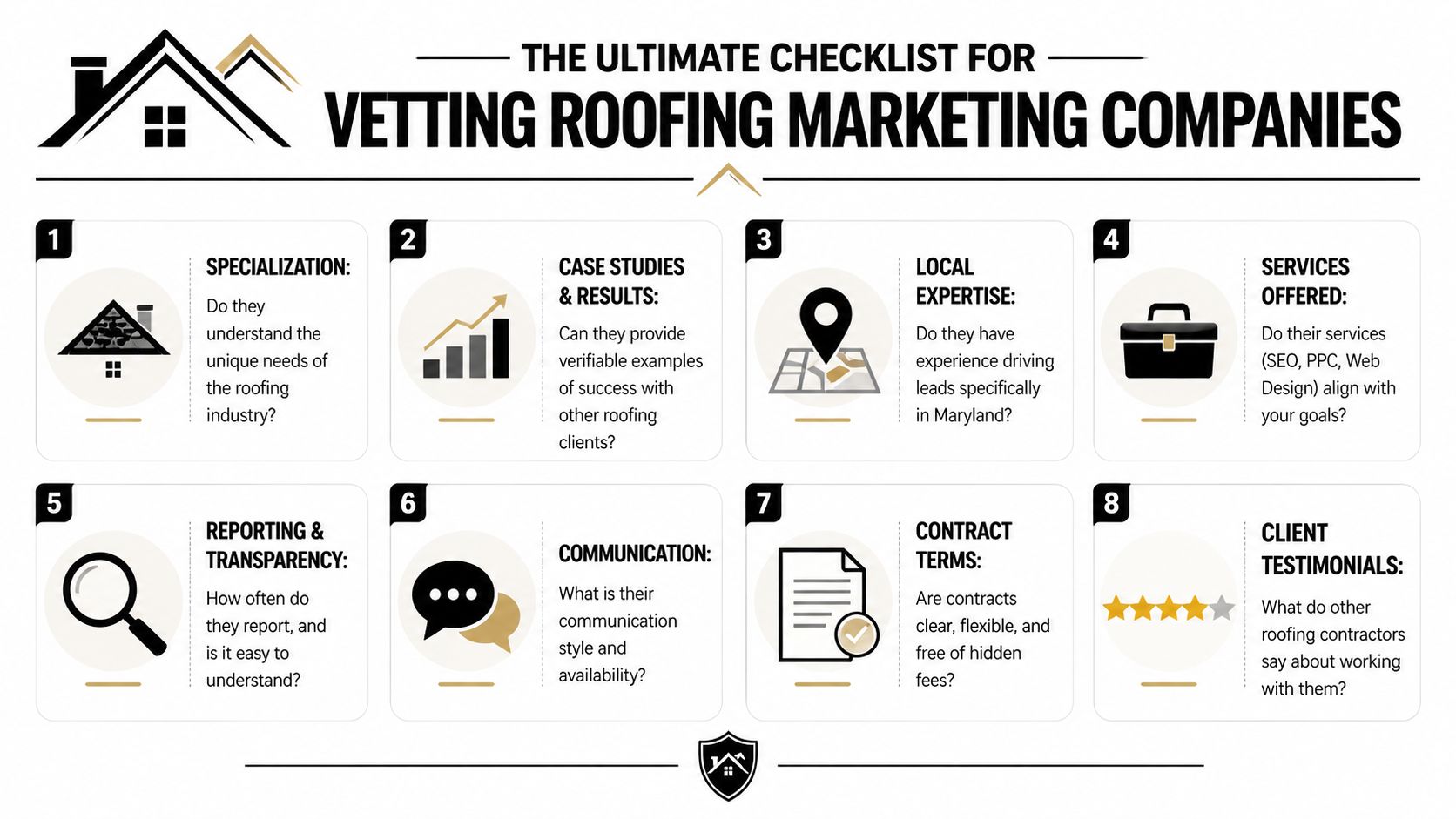
Use this checklist when you're talking to any agency:
Specialization
Ask whether they understand the sales cycle, seasonality, review pressure, and service-page needs of roofing companies.Case studies and results
Ask for examples they can walk you through. If they stay vague, that's a warning sign.Local expertise
Ask how they'd build visibility in Maryland markets like Baltimore, Towson, or Anne Arundel County. Specific answers beat generic ones.Service alignment
Make sure their strengths match your actual bottleneck. If your site doesn't convert, more traffic won't fix it.Reporting and transparency
Ask what gets reported each month. You want qualified leads, booked jobs, and channel quality. Not just traffic screenshots.Communication style
You need a partner who can explain decisions in plain English and respond when campaign conditions change.Contract terms
Read the fine print. Long contracts and vague deliverables usually favor the agency, not the roofer.Client feedback
Look beyond testimonials on their own site. Pay attention to how they respond to criticism too.
Vanity metrics vs business metrics
Many roofing companies often get caught in a trap: Agencies report impressions, clicks, ranking movement, and website sessions as if those metrics settle payroll. They don't.
The more useful questions are:
| Weak reporting question | Better reporting question |
|---|---|
| How much traffic did we get | Which channels produced qualified estimate requests |
| Did rankings improve | Did local visibility improve in target service areas |
| How many leads came in | Which leads were good fits and which turned into jobs |
If you're trying to sharpen how you evaluate results, this guide on how to measure marketing ROI is worth reading before you sign anything.
Screening advice: If an agency can't explain what success looks like in your business model, they won't recognize failure early enough to fix it.
Listen for operational understanding
A solid partner will ask about things like:
- your service radius
- your most profitable job types
- who answers the phone
- how reviews are requested
- which neighborhoods produce the best close rates
- what your website currently does poorly
That operational curiosity matters. Roofing marketing isn't separate from operations. It's connected to dispatch, estimates, close rates, and capacity.
If you want a tighter interview framework, Raven SEO's list of questions to ask before signing with a digital marketing agency gives you a practical shortlist to bring into the meeting.
How Raven SEO Partners with Maryland Businesses
A roofer usually doesn't need more marketing channels. They need fewer leaks in the system.
That's the practical lens Raven SEO uses with Maryland businesses. If the website isn't building trust, fix that first. If local search visibility is thin in the areas that matter, tighten that next. If paid ads are generating noise instead of qualified leads, rebuild the structure before spending harder.
What a useful partnership looks like
For roofing companies, that usually means aligning three things:
- Local visibility so homeowners in your actual service area can find you
- Conversion-focused web design so traffic turns into calls and estimate requests
- Clear reporting so you know which efforts support booked work
That approach matters because roofing growth isn't linear. Storm events shift demand. Neighborhood reputation compounds. Response quality changes lead value. A marketing partner should account for those realities instead of forcing every contractor into the same package.
Where strategy beats activity
A lot of agencies stay busy producing motion. New posts, generic reports, random ad tweaks. That can feel productive without solving the core problem.
Maryland roofers usually get more from a tighter model:
- better service and location pages
- stronger review systems
- smarter Google Ads structure
- cleaner local search signals
- clearer conversion paths on mobile
For businesses thinking beyond immediate lead flow, the same discipline applies to broader operations too. This article on strategies for scaling a business isn't roofing-specific, but it does a good job highlighting how growth gets harder when systems stay loose.
One practical note on tools
If you're auditing your current setup, one option in the market is Raven SEO, which provides services around SEO, web design, and paid search support for businesses that need a more structured digital foundation. The value isn't in adding complexity. It's in making each channel easier to measure and easier to improve.
The right fit is a partner who understands Maryland market conditions, speaks plainly, and can audit what's helping versus what's just taking budget. If your current marketing feels scattered, that's usually the first issue to solve.
Frequently Asked Questions About Roofing Marketing
How much should a roofing company budget for marketing
A Baltimore roofer trying to stay booked in a tight service area will not budget the same way as a company pushing into Towson, Dundalk, and the wider county. Budget follows the goal.
For most Maryland roofers, the better question is not "what percentage should I spend?" It is "what does one booked job cost me by channel, and can I repeat it profitably?" Some contractors can grow with a lean budget and strong referrals. Others need to spend more because they are entering new ZIP codes, adding crews, or trying to smooth out seasonality.
Set a budget for the essential elements first: a credible website, local search visibility, review generation, and a paid lead source you can measure. Then adjust based on close rate, average job value, and how competitive your target towns are.
Is SEO still worth it for roofers
Yes, especially for Maryland contractors who want leads beyond referral volume.
Local SEO helps you show up when homeowners search for terms tied to intent and location, such as roof repair in Towson or emergency roofer in Baltimore. According to Google's guidance on how local ranking works, relevance, distance, and prominence shape who appears in local results, which is why strong service pages, accurate business information, and real reviews still matter so much for contractors in neighborhood-driven markets like ours: How to improve your local ranking on Google.
SEO is slower than paid ads. It also keeps producing value after the initial work, which is why many roofers treat it as a core acquisition channel instead of a side project.
How long does roofing marketing take to work
Paid ads can bring calls in days if the campaign is set up well and the landing page does its job. SEO usually takes longer because Google needs time to crawl, compare, and trust the signals on your site and business profiles.
Some improvements show up faster than contractors expect. Cleaning up your Google Business Profile, fixing broken contact forms, tightening service pages, and asking for reviews after completed jobs can improve lead flow without a long wait.
The timeline depends on the starting point. A roofer in Baltimore with an outdated site and thin location coverage has a different path than a Towson contractor with a decent site that just needs sharper targeting.
Can I handle roofing marketing myself
You can handle parts of it, and many owners should.
Project photos, before and after documentation, review requests, financing updates, and service-area notes usually come straight from the field. That material is hard for an outside agency to fake well. The trouble starts when the work needs weekly consistency, technical fixes, call tracking, landing page testing, or ad management tied to actual job value.
If you are running estimates, managing crews, and dealing with supplier issues, marketing usually gets pushed to late evenings. That is when follow-up slips, pages stay outdated, and ad spend drifts.
What should I expect from roofing marketing companies
Expect clear answers and local judgment.
A good partner should explain how they plan to get leads in specific Maryland markets, why they are prioritizing certain towns, what they are tracking, and where your money is going. Ask how they would approach Baltimore differently from Towson or Dundalk. If the answer sounds like the same package for every roofer, keep looking.
You should also expect honest trade-offs. Brand-new websites take time. Cheap leads often close poorly. Broad service-area targeting can waste budget if your crews are strongest in a smaller radius. Good agencies say that out loud.
If you're a Maryland roofer and want a no-pressure look at what's helping or hurting your lead flow, talk to Raven SEO. We can review your website, local visibility, and paid search setup, then show you where the actual opportunities are.