

Building a website can feel a lot like building a custom home. It’s a huge project with a ton of moving parts, and if you don’t have a solid blueprint, things can go sideways fast. But just like any successful construction job, a great website starts with a clear plan.
This guide is your blueprint. We're going to demystify the entire journey, making the core stages of web development easy to understand with a simple, step-by-step roadmap. We’ll cover everything from surveying the land (that’s your initial planning) to picking out the paint colors (the design phase) and doing the final walkthrough (testing, of course).
For a business owner, getting a handle on this process is the first real step toward building a powerful online presence that actually brings in customers and helps you grow.
The Web Development Lifecycle at a Glance
The web development process isn't random; it's a structured lifecycle. Each phase builds on the one before it, ensuring the final product is strong, functional, and perfectly aligned with your business goals. Think of it as a well-organized assembly line where every step has a purpose.
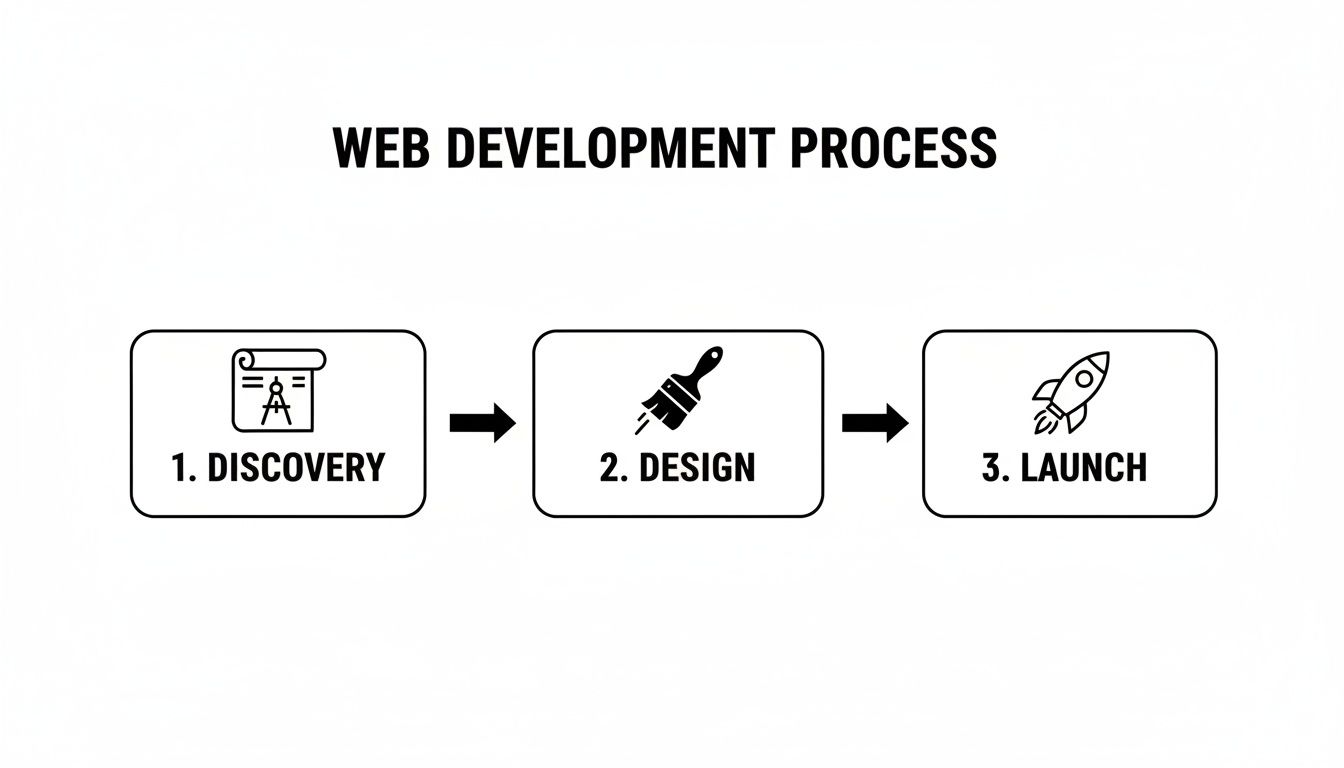
As you can see, a whole lot of thinking and planning happens long before a single line of code gets written. Skipping or rushing any of these early stages is a classic mistake that almost always leads to expensive fixes and frustrating delays down the road.
Why Following the Process Matters
A successful project doesn’t just fall into place by accident—it’s the result of meticulous planning and disciplined execution. Properly managing web development projects is what separates a smooth launch from a chaotic mess. It’s the discipline that ensures every piece of the puzzle fits together perfectly.
Think of the web development lifecycle as your project's GPS. It provides a clear route, shows you the necessary stops along the way, and helps you avoid wrong turns that waste time and money.
By sticking to this proven roadmap, you can turn a complex idea into a valuable business asset that works for you 24/7. It’s the same methodical approach we use here at Raven SEO to deliver websites that don’t just look great, but actually perform.
Before we dive deep into each of the 7 stages, let's start with a high-level overview. And if you're curious about how a new website fits into your bigger marketing picture, our guide on how to create a digital marketing strategy is a great place to start.
Understanding the Roots of Modern Web Development
To really get a handle on the stages of web development today, it helps to rewind the clock and see where it all began. The web didn’t just appear one day with the slick, interactive apps we tap and scroll through. Its origins were much simpler, built on a foundation that still offers some powerful lessons for businesses.
The whole journey kicked off in the early 1990s. Back then, the internet was mostly a playground for academics, but that was about to change. A guy named Tim Berners-Lee at CERN cooked up the essential building blocks like HTML and launched the world's very first website. By 1993, the technology was released to the public, and things exploded. The game-changer was Mosaic 1.0, the first web browser that was actually easy for regular people to use. For a deeper look at this evolution, check out some great insights on the history of web design on fireart.studio.
This early boom led straight into the first big tech showdown: the "browser wars."
The Shift from Static Pages to Interactive Sites
By the mid-9s, the rivalry between Netscape Navigator and Microsoft’s Internet Explorer was in full swing. This wasn't just corporate drama; their competition was a massive engine for innovation, giving us two technologies that are still the bedrock of web development.
- JavaScript (1995): This was a huge leap. For the first time, developers could add a layer of interactivity to websites. Suddenly, pages could react when you clicked something without having to reload, making the experience feel alive and dynamic.
- Cascading Style Sheets (CSS): CSS was introduced to separate a site's structure (HTML) from its looks. This meant designers could create sophisticated, consistent styles across an entire website—a principle that's still absolutely critical.
This era marked a fundamental change in thinking. Websites transformed from static, one-way information dumps—basically digital brochures—into interactive platforms. By 1995, giants like Amazon and eBay were already online, proving the web was a serious place to do business.
The Dawn of Search and Modern Strategy
While websites were getting more dynamic, another piece of the puzzle dropped in 1998: Google. Its launch completely changed how we find information online, and in doing so, it created the entire field of search engine optimization. If you're curious, you can explore our deep dive into what search engine optimization is to see how it works.
For any business today, this history holds a timeless lesson: a strong, functional, and discoverable foundation is everything. Those early static pages were the original "minimum viable products," built to do one thing well—deliver information clearly.
Understanding this evolution helps businesses in Baltimore and beyond invest their money wisely. Just like with those first websites, starting with a clean, SEO-friendly foundation is the key to long-term success. It’s the very principle behind our Swyft Sites at Raven SEO—we build and launch a professional, goal-focused website quickly, so you get the fundamentals right from day one, with a platform ready to grow alongside your business.
Stage 1: Planning and Discovery
Every great website starts long before a single line of code is written. This first phase, Planning and Discovery, is easily the most important part of the entire web development process.
Think of it like an architect drafting detailed blueprints before a construction crew even thinks about breaking ground. Trying to build a website without this stage is like building a house without a plan—it’s a surefire recipe for blown budgets, missed deadlines, and a final product that just doesn't work for your business.
This is where we nail down the "why" behind your website, translating your vision into a concrete, actionable strategy. We'll ask the big questions: What's the main purpose of this site? Who are we trying to reach? What do we need visitors to do?
Defining Your Project Goals and Audience
First things first, we need clear, measurable goals. A website without a specific objective is just a digital brochure floating aimlessly in cyberspace. Your goals have to be tied directly to real business outcomes.
Are you a Baltimore-based e-commerce shop aiming to boost online sales by 20% this year? Or maybe you're a Maryland home services company focused on generating 50 new qualified leads every month? Setting these targets up front gives us a North Star to guide every single decision that follows.
Once we know the what, we have to figure out the who. Getting a deep understanding of your target audience is non-negotiable. We do this by creating detailed user personas, which help us step directly into your customers' shoes. For example, a law firm in Annapolis might be targeting a 45-year-old business owner who values professionalism and clear, no-nonsense information. That single insight shapes the entire site's tone, design, and content.
Creating the Architectural Blueprint
With our goals and audience locked in, it’s time to map out the website's structure. We're not talking about colors or fonts yet; this is all about logic and flow. The two key deliverables here are the sitemap and user flows.
- Sitemap: This is a high-level diagram that shows every page on your website and how they're all connected. It’s the architectural blueprint that ensures your site is organized logically, making it a breeze for both your customers and search engines like Google to navigate.
- User Flows: These are simple diagrams that map out the exact path a visitor will take to complete a task, like buying a product or filling out a contact form. A well-thought-out user flow creates an intuitive, frustration-free experience, which is absolutely critical for getting conversions.
This foundational work is non-negotiable for a successful outcome. A detailed plan prevents scope creep, keeps the project on budget, and ensures the final website is a powerful business tool, not just an online placeholder.
Nailing these initial steps is what sets the stage for a smooth ride through the rest of the development lifecycle. For a deeper dive into this phase, check out our guide on effective website development project management to keep your project on day one.
At Raven SEO, we invest a significant amount of time in this discovery phase. We dig into your competitors, pinpoint opportunities, and build a strategic roadmap that aligns perfectly with your business goals. This meticulous planning is how we build websites that don't just look amazing—they deliver real, measurable results. Getting this stage right means everything else is built on a rock-solid foundation.
Stages 2 and 3: Design and Content Creation
With the project blueprint approved, we get to the fun part: bringing your website to life. This is where we move into the Design and Content Creation stages, the two most creative phases of the entire web development process. Think of it as the interior design and storytelling for your new digital home—this is where its personality truly begins to shine.
These two stages almost always happen in parallel because they’re completely codependent. A stunning design is useless without compelling content to fill it, and brilliant copy will never be read if it’s buried in a confusing, ugly layout. One can’t succeed without the other.
From Wireframes to High-Fidelity Mockups
The design journey starts by turning the sitemap and user flow diagrams from the planning stage into actual visual layouts. It’s a step-by-step process that moves from basic sketches to a pixel-perfect preview of the final site.
First up are wireframes. These are simple, black-and-white layouts that act as the skeleton for each page. They focus entirely on structure and functionality—where buttons go, how content is organized, what elements are needed—without getting distracted by colors, fonts, or images.
Next, we graduate to mockups. These are high-fidelity, full-color designs that breathe life into the wireframes. Mockups incorporate your brand’s color scheme, typography, logo, and imagery. While they’re still just static images, they give you a realistic preview of the final look and feel, allowing for crucial feedback before a single line of code is written.
The Art of UI and the Science of UX
The design stage is driven by two critical, often confused, disciplines: User Interface (UI) and User Experience (UX). They sound similar, but they tackle different parts of the puzzle.
- UI Design is all about the aesthetics—the look and feel. It covers the colors, fonts, icons, and spacing that make the site visually appealing and professional.
- UX Design is all about usability—how the site feels to use. It focuses on making sure the user’s journey is logical, intuitive, and completely frustration-free.
A great website needs both. UI is what catches the eye, but UX is what makes the site effortless to use. Without a solid UX, even the most beautiful site will fail to convert visitors into customers.
This laser focus on the user has its roots in the Web 2.0 boom from the mid-90s to the mid-2000s, which transformed the internet from static digital brochures into the dynamic, interactive platforms we use today. This era gave us standardized tools like JavaScript and CSS and saw the rise of Google in 1998, which made user relevance the new king of the web. This history underscores a principle we live by at Raven SEO: building websites for people first.
Creating SEO-Driven Content from Day One
While the designers are crafting the visuals, the content creation machine fires up. This includes every piece of text, every image, every video, and every downloadable guide that will live on your site. Treating content as an afterthought is one of the biggest—and costliest—mistakes you can make.
From the very beginning, your content needs to be SEO-driven. This means your copywriter and SEO strategist work hand-in-hand to weave target keywords into the copy naturally. They're focused on answering the questions your customers are actually asking and structuring the information in a way that appeals to both people and search engines.
For a Baltimore home services company, this means building out service pages that target searches like "emergency plumbing repair in Baltimore" or writing blog posts on topics like "how to prepare Maryland homes for winter." This ensures your new website is built not just to look good, but to be found. To see how this integrates into the broader design, check out our guide on website design best practices.
Stages 4 and 5: Development and Testing
This is where the rubber finally meets the road. All that time spent on planning, strategy, and design moves from static images and documents into a living, breathing website. The Development and Testing phases are where your digital storefront gets built and then put through its paces before you open the doors to the public.
Think of this as the construction crew arriving on site. They take the architect’s blueprints—the sitemaps and visual designs—and start framing the building, running the electrical, and installing the plumbing. This process is split into two key parts that work hand-in-hand: front-end and back-end development.

Building the Engine and the Exterior
These two sides of the development coin come together to create a seamless experience for your visitors. It’s a classic case of what you see versus what makes it all work.
-
Front-End Development: This covers everything your users see and interact with in their browser. Using languages like HTML for structure, CSS for styling, and JavaScript for interactivity, front-end developers bring the approved mockups to life. They make sure every button, form, and animation looks and behaves exactly as designed.
-
Back-End Development: This is the "under the hood" engine that powers the entire website. It includes the server, the database, and all the application logic. For a Maryland e-commerce store, the back-end is what processes payments, manages your inventory, and handles user accounts—all the critical functions customers don’t see but absolutely rely on.
These two parts are in constant communication. When a customer fills out a contact form on the front-end, it's the back-end that processes that information and sends it to the right place.
The Critical Testing and Quality Assurance Phase
Once the initial build is complete, the website is far from ready for launch. It first has to go through the crucial testing and quality assurance (QA) phase. This is like a home inspector meticulously checking every outlet, faucet, and window in a new house to find problems before the owners move in.
The goal here is simple: find and fix every bug before your customers do. A single broken form or a glitchy checkout process can cost you sales and damage your brand's reputation. A shocking 88% of online consumers are less likely to return to a site after a bad experience.
Quality assurance isn't just about finding bugs; it's a systematic process that guarantees the final product is stable, secure, and provides a flawless user experience on any device.
Our QA process is meticulous, covering several key areas to ensure a polished final product. Understanding what is involved in effective Quality Assurance (QA) in software development shows just how deep this process goes.
Our Multi-Point Testing Checklist
We test for much more than just the obvious errors. Our process validates the entire user experience from top to bottom, making sure your website is ready for the real world.
- Functionality Testing: We click every single button, test every link, and submit every form to make sure they all work exactly as intended.
- Compatibility Testing: The site is run through different web browsers (like Chrome, Firefox, and Safari) and operating systems to guarantee a consistent experience for everyone.
- Responsiveness Testing: We check the website on a variety of devices—desktops, tablets, and smartphones—to confirm the layout adapts perfectly to any screen size.
- Performance Testing: We analyze page load speeds and optimize images and code to ensure the site is fast and responsive. A slow website is a major conversion killer.
This rigorous testing phase is non-negotiable. For an even more detailed look at what goes into this process before launch, check out our guide covering 5 essential technical checks for a new website. By catching and resolving issues at this stage, we ensure your website launches smoothly and makes a professional first impression from day one.
Stages 6 and 7: The Launch and a Lifetime of Care
After all the meticulous planning, design, and development, your new website is finally ready to meet the world. The Launch and Maintenance phases are where your project transforms from a private blueprint into a public, living asset. This is the moment your digital doors swing open, but it's also the start of a lifelong journey.
Think of it like the grand opening of a new shop in Fells Point. The construction is done, the shelves are stocked, and the sign is polished. Now it’s time to unlock the doors and welcome your first customers. Launching a website is much the same—we’re moving all the finished files from a secure, private server to a live one where anyone can find you.
Executing a Flawless Launch
A smooth launch isn't about flipping a single switch. It’s a carefully orchestrated process, guided by a detailed pre-flight checklist to make sure everything works perfectly the second you go live. Skipping a single step here can lead to instant technical glitches, a terrible first impression for users, or even lost data.
Our launch process at Raven SEO is methodical, covering all those crucial final touches:
- Hosting Setup and Domain Configuration: We get your site settled on a reliable, high-performance server and ensure your domain name (your .com) points directly to its new home.
- Final Data Migration: Any last-minute content, like a new blog post or product update, is moved over to the live site.
- Analytics and Tracking Installation: We install tools like Google Analytics and Google Search Console. This is non-negotiable. It’s how you’ll track visitors, monitor performance, and gather the data needed to make smart business decisions.
- Security Measures: We implement essential security protocols, like setting up an SSL certificate (that little padlock in the browser bar) to protect your users’ data and give your SEO a nice little boost.
Going live is a huge milestone, but it's the starting line, not the finish line. The moment your website is public, the final and most enduring of the stages of web development begins: ongoing maintenance.
The Critical Importance of Ongoing Maintenance
Once your website is up and running, the work shifts from creation to preservation. Just like a brand-new car needs regular oil changes and tune-ups to keep running smoothly, your website requires consistent care to stay secure, fast, and functional. Neglecting it isn't an option—it’s a direct risk to your investment.
Ongoing maintenance is all about being proactive. It's a service designed to shield your website from a whole host of threats and performance issues. Without it, your site can quickly become slow, outdated, or even fall victim to a security breach, which can do serious damage to your brand's reputation and your bottom line.
Protecting Your Digital Asset
A comprehensive maintenance plan is the best insurance policy you can get for your website. It's a continuous process that buys invaluable peace of mind for busy business owners who don't have the time or technical expertise to manage it all themselves.
Here’s what a typical maintenance and support plan covers:
- Regular Backups: We create complete copies of your website's files and database. If anything ever goes wrong, we can hit the rewind button and restore it quickly with minimal downtime.
- Software Updates: We keep your content management system (CMS), plugins, and themes updated to their latest versions. This is one of the most critical steps for patching security holes and ensuring everything plays nicely together.
- Security Monitoring: We actively scan for malware, suspicious activity, and potential vulnerabilities to stop threats before they can ever cause damage.
- Performance Checks: We keep an eye on your site's loading speed and uptime, making small tweaks to keep it running lightning-fast for your customers.
These final stages of web development—launch and maintenance—are what turn your project from a one-time expense into a long-term, high-performing business asset. At Raven SEO, our managed support services are designed to handle all of this for you, so you can get back to what you do best: running your business.
Common Questions About the Web Development Process
Even with a detailed plan, building a website can bring up a lot of questions. We get it. Here are some of the most common ones we hear from business owners, with clear, straightforward answers to help you move forward with confidence.
Getting a handle on these key points will help you make smarter decisions, whether you're mapping out your very first site or planning an upgrade to an existing one.
What are the main deliverables in the design phase?
The two most important deliverables are wireframes and mockups. Wireframes are the basic, black-and-white structural blueprints for each page, focusing on layout and functionality. Mockups are the high-fidelity, full-color designs that show exactly what the final website will look and feel like, incorporating your branding, typography, and imagery.
How Much Does a New Website Cost?
Just like the timeline, the cost can vary wildly depending on what you need the site to do. A simple, template-based website could start in the low thousands, while a fully custom build with complex back-end functionality is a much more significant investment.
The price tag is influenced by a few key factors:
- Custom Design vs. Template: A unique, from-scratch design will cost more than starting with a pre-built template.
- Number of Pages: More pages mean more time for design, content creation, and development.
- Special Features: Things like e-commerce capabilities, custom calculators, or member portals all add to the cost.
- Content Creation: Are you providing all the text and images, or does the agency need to create them for you?
The only way to get a truly accurate cost is to go through the discovery process with a potential partner. A detailed proposal will break down all the costs tied to each stage of web development.
Which Is Better: A Custom Website or a Template?
The right choice really comes down to your specific needs, your budget, and your long-term goals. Each path has its pros and cons.
Website Templates (e.g., Squarespace, Wix, WordPress themes):
- Pros: They have a lower initial cost and are much faster to get live. They're a solid starting point for new businesses with straightforward needs.
- Cons: You’re limited in design and functionality. It's easy to outgrow a template, and they can be bloated with unnecessary code that kills your site speed.
Custom Websites:
- Pros: Built from the ground up to solve your exact business problems. They're fully scalable, unique to your brand, and optimized for performance and SEO from day one.
- Cons: A higher upfront investment and a longer development timeline.
For a Maryland professional services firm that wants to generate serious local leads, a custom site built for local SEO is almost always the better long-term investment.
Can I See the Website While It’s Being Built?
Absolutely. In fact, if an agency says no, that's a huge red flag. A transparent process is the mark of a good partner. Most developers work on a private "staging" or "development" server.
This setup lets you review progress at key milestones, give feedback on the design and functionality, and request changes long before the site is visible to the public. This collaborative approach ensures there are no surprises on launch day and that the final product is exactly what you envisioned.
Navigating the stages of web development can feel complicated, but with the right partner, it becomes a clear path to growing your business online. At Raven SEO, we guide businesses in Baltimore and beyond through every step, making sure your website isn't just a project, but a powerful asset built for results.
Ready to build a website that drives your business forward? Contact us for a no-obligation consultation today!