
Meta Title: Instagram Ads Agency for Maryland Small Businesses | Raven SEO
Meta Description: Learn how to choose and work with an instagram ads agency for real local growth in Maryland. Raven SEO shares practical budgeting, targeting, and reporting advice.
You’re probably here because you’ve boosted a few posts, watched money leave the account, and wondered why the shop down the street seems to own your local Instagram feed.
That’s a common spot for Maryland business owners. A restaurant in Canton is fighting for attention against every other food photo in the city. A home service company in Columbia is trying to stay visible while bigger brands blanket the market. A boutique in Hampden may have great products, but that doesn’t automatically turn into booked appointments or online sales.
An instagram ads agency can help, but only if the agency knows how to turn local attention into revenue. Not likes. Not vague “awareness.” Revenue. That means tighter audience targeting, stronger creative, cleaner reporting, and a realistic understanding of how people in places like Fells Point, Towson, Bethesda, and Annapolis buy.
Your Guide to Dominating Local Instagram Feeds
Local business owners often assume Instagram is too crowded to matter unless they have a huge brand budget. That’s the wrong read.
Instagram’s scale is massive. As of 2025, Instagram ads reach 1.74 billion users, equal to 21.3% of the global population, with over 200 million business profiles active and 62.7% of users following or researching brands on the platform, according to Instagram statistics compiled by Sked Social. That matters even for a Maryland business because your customers don’t separate “local” from “digital” anymore. They scroll, compare, click, and decide.
The local opportunity sits inside that bigger ecosystem. A person in Federal Hill might discover a nearby fitness studio through Reels, save a post, visit the website later, and book after seeing a retargeting ad. A parent in Towson may follow a tutoring company for weeks before filling out a lead form. Instagram influences those decisions long before someone calls your office.
Why local businesses struggle without a strategy
Most small businesses don’t fail on Instagram because the product is weak. They fail because the ad setup is loose.
Common problems look like this:
- Too broad a target: Ads try to reach all of Baltimore instead of separating neighborhoods, income patterns, or buyer intent.
- Weak offer matching: The creative doesn’t fit the audience. A brunch special for Fells Point shouldn’t sound like a law firm ad in Columbia.
- No follow-up path: The click lands on a slow page, a generic homepage, or a profile with no clear next step.
- Boosted-post thinking: Business owners chase visible engagement instead of a system.
A good local strategy starts with message fit. The same promotion won’t land the same way in Hampden and Harbor East. Different neighborhoods respond to different tone, visuals, and timing.
If you want a bigger-picture view of how paid social fits into your broader local growth plan, this guide on social media marketing and consulting is a useful next read.
Local Instagram ads work best when the creative feels like it belongs in the customer’s daily feed, not like a generic campaign copied from another city.
When to Hire an Agency vs DIY Instagram Ads
Some businesses should absolutely start on their own. Others should stop DIY today because the hidden cost isn’t ad spend. It’s owner time, missed leads, and messy execution.

If you’re a solo operator with one service, one core offer, and the time to learn Ads Manager, DIY can make sense for a while. You’ll get closer to customer language, test basic hooks, and learn what kind of comments or questions show up before the click.
But DIY breaks down fast when the business gets more complex. A med spa with multiple services, a contractor covering several counties, or a retail brand juggling in-store and online goals usually needs more structure than a few boosted posts can provide.
The simplest way to decide
Ask yourself these questions:
Are ads taking time away from sales or operations?
If campaign setup, creative testing, and weekly checks keep pulling you away from quoting jobs, serving customers, or managing staff, that’s usually the first signal.Have results flattened out?
Many owners hit a ceiling. The same audience sees the same creative, and performance gets stale.Do you need better targeting than the app gives you?
Targeting downtown Annapolis is one thing. Separating likely buyers in Bethesda from window shoppers is another.Can you explain what’s working?
If you can’t tell whether a campaign is driving leads, calls, purchases, or just cheap clicks, you’re flying blind.
When DIY still makes sense
DIY is still reasonable if these statements describe you:
- You have time to test: You can spend real time in Ads Manager each week.
- Your offer is simple: One core service, one audience, one location.
- Your expectations are grounded: You’re using ads to learn, not expecting instant scale.
- You’re comfortable with some waste: Early campaigns often teach through mistakes.
A helpful outside perspective is this comparison of in-house marketing vs agency guide, especially if you’re weighing whether to build capability internally or outsource it.
When an agency earns its keep
An agency starts making sense when the business needs consistency, not experiments.
That usually includes:
- Multi-location targeting
- Recurring creative production
- Lead tracking across calls, forms, and website actions
- Monthly optimization with clear accountability
Later in the process, business owners often realize they weren’t deciding between “cheap” and “expensive.” They were deciding between “managed” and “scattered.” If you’re sorting through that decision, this breakdown of in-house vs agency marketing is worth reviewing.
Here’s a quick walkthrough if you want the visual version before making the call:
A reliable test: If you’re asking, “Should I boost this post?” more often than “What funnel stage is this campaign serving?”, you’re probably at the point where agency support can help.
How to Find and Vet Your Maryland Instagram Ads Agency
Hiring an instagram ads agency is closer to hiring a key employee than buying software. You’re giving someone access to budget, brand voice, customer data, and sales momentum. That deserves scrutiny.
A polished proposal doesn’t tell you much. Plenty of agencies can talk about content calendars and impressions. The better question is whether they know how to build campaigns for the way Maryland businesses operate. A Baltimore restaurant, a Rockville dental practice, and a Severna Park home remodeler don’t need the same funnel or creative angle.
Questions that expose real skill
One of the best vetting filters is audience strategy. Advanced agencies use structured funnels built from first-party customer data, and precise audience layering can reduce budget waste by 30-40% compared to broad targeting, according to Prodigmar’s discussion of Instagram ad mistakes and ROI.
Ask direct questions like these:
How do you build audiences for a local service business?
Listen for custom audiences, retargeting logic, and staged messaging. If they only talk about age and location, that’s thin.How do you separate cold traffic from warm traffic?
A serious agency won’t run the same ad to everyone.What would your targeting look like for Fells Point versus Hampden?
This reveals whether they understand local nuance or just use generic geo pins.How do you use customer lists, website visitors, and engaged followers?
Better agencies usually have a clear answer here.When do you broaden an audience and when do you tighten it?
There should be logic, not guessing.
Red flags that should end the conversation
Some warning signs are immediate.
| Red flag | Why it matters |
|---|---|
| Guaranteed results | No agency controls auction dynamics, audience behavior, or your offer |
| Vague reporting promises | You need specifics on leads, purchases, booked calls, or other business outcomes |
| No process for creative testing | Instagram performance depends heavily on message and format changes |
| No questions about your margins or sales cycle | They can’t judge quality if they only talk about clicks |
| “We do everything the same way” | Maryland businesses in different categories need different approaches |
If you want another useful outside checklist, this piece on vetting Meta ad agencies helps frame the right questions before signing.
What a strong local-fit conversation sounds like
A good agency interview usually sounds practical, not flashy.
They’ll ask about:
- Your real service area: Not just “Maryland,” but where you close business.
- Your sales process: Calls, forms, walk-ins, booked consults, DMs.
- Your strongest offer: Discounts, financing, seasonal pushes, premium service tiers.
- Your customer differences by area: A campaign for Howard County may need a different tone than one for downtown Baltimore.
- Your existing data: Website traffic, past buyers, email lists, CRM tags.
Don’t hire the agency that talks the most. Hire the one that asks the sharpest questions before they touch your budget.
A useful internal benchmark is whether the agency can answer the kinds of questions outlined in this guide on 10 questions you absolutely must ask before signing with a digital marketing agency. If they get slippery there, keep looking.
Budgeting for Instagram Ads in the Maryland Market
A Baltimore business owner in Fells Point can waste a month’s ad budget faster than they expect. It usually happens the same way. The targeting is too broad, the offer is too vague, and the campaign gets judged on cheap clicks instead of booked jobs or store visits.
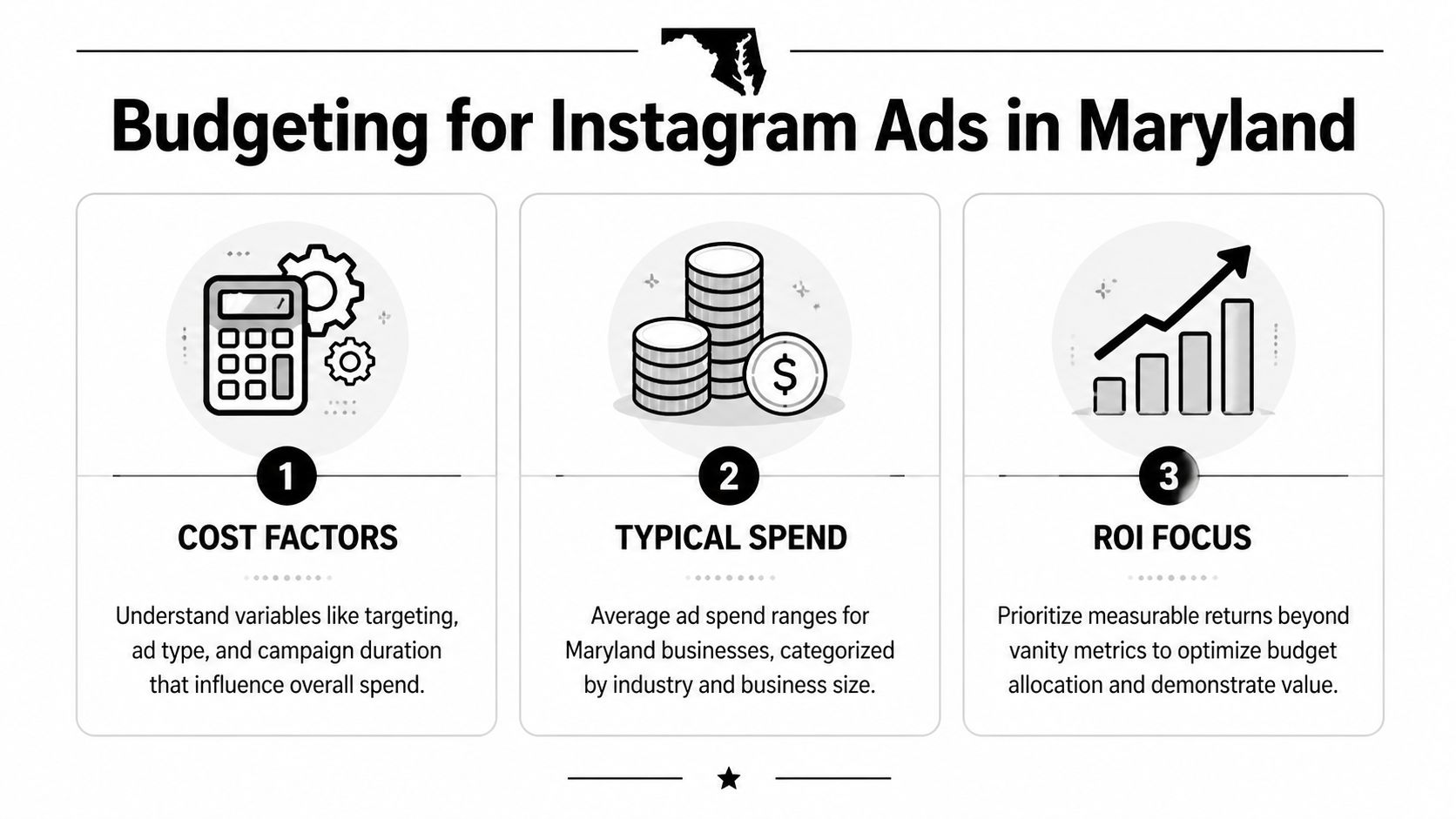
Budget planning works better when the budget is tied to a specific revenue goal. A Hampden boutique trying to drive weekend foot traffic needs a different plan than a Columbia med spa trying to book consultations, or a contractor trying to get leads from Anne Arundel County and Howard County.
Start with the job the budget needs to do
A small Instagram budget can work in Maryland. It just needs tight focus.
Use a smaller starting budget when the business has one clear offer, one service area, and one conversion action. That fits businesses like a local salon, dog groomer, math tutor, or home cleaner. In those cases, a concentrated campaign aimed at a few ZIP codes often beats a wider push across half the state.
For example, targeting Fells Point, Canton, and Harbor East together may make sense for a restaurant or retail brand with strong city appeal. That same setup would be sloppy for a roofer who only crews jobs in specific suburban pockets. Geography needs to match how the business makes money.
What changes as budgets grow
Once the budget moves past basic testing, the campaign usually needs more structure.
Mid-range budgets give room for creative testing, retargeting, and audience segmentation by location or intent. A Towson retailer may need one campaign for nearby shoppers, another for past website visitors, and a third for seasonal promotions. A law firm serving Baltimore County and Carroll County may need separate messaging because the audience mindset is different by area.
Larger budgets only help if the fundamentals are already working. If the offer is weak, the landing page is slow, or the targeting is loose, more spend just buys more wasted traffic. I see this a lot with local businesses that try to scale before they know which neighborhood, service line, or promotion produces profit.
Budget for more than ad spend
Media spend is only one line item.
A complete budget includes strategy, creative production, campaign setup, landing page adjustments, management, and reporting. Business owners sometimes compare agency proposals based only on the monthly ad spend recommendation, then get surprised when the cheaper option produces weak creative and thin reporting. A broader view helps. This overview of social media management rates gives useful pricing context when you are comparing service models.
It also helps to budget for local content input from your side. The campaigns that work in Maryland usually reflect real local context, not generic stock messaging. If you need a clearer sense of what that looks like, this guide on handling hyper-local content for Maryland campaigns is worth reviewing before creative starts.
A practical way to set expectations
Early campaigns should answer a few money questions fast.
- Which offer gets real response in your part of Maryland
- Which neighborhoods or counties produce qualified leads
- Which creative angle brings in buyers instead of casual engagement
- Which conversion path works best, calls, forms, DMs, or purchases
That is the point of the first stage. It is not about getting the cheapest click possible. It is about finding a repeatable path to revenue.
Budget rule: Put more effort into the offer, audience, and conversion path than into chasing low click costs.
The Maryland businesses that budget well usually stay disciplined. They track booked consults, purchases, calls, and lead quality. Likes and follows can be useful signals, but payroll is covered by revenue.
Collaborating on Creative and Hyper-Local Targeting
The best instagram ads agency relationships feel less like outsourcing and more like a working partnership. The business brings local truth. The agency translates that truth into creative, targeting, and testing.

A lot of ad campaigns miss because the business owner assumes “everyone nearby” is the audience. They’re not. A crab house in Dundalk, a boutique in Hampden, and a personal injury firm in White Marsh all serve local people, but they need different emotional hooks, different proof, and different call-to-action timing.
What good collaboration looks like
Take a Canton restaurant pushing weeknight traffic. The strongest creative probably won’t be a polished brand video. It may be a simple vertical clip showing the bar scene at the right hour, paired with a local-feeling offer and a caption that sounds like an actual person from the area wrote it.
Now compare that with a Towson tutoring company. That campaign likely needs parent-focused reassurance, not nightlife energy. The visuals might show a student working one-on-one, while the message emphasizes consistency, confidence, and the next academic milestone.
Those aren’t cosmetic differences. They change who stops scrolling.
How agencies sharpen creative without copying competitors
Good agencies don’t just browse ads and guess why something worked. Top agencies use tools like GetHookd to study competitor hooks and messaging patterns, then extract principles for original creative development, as explained in this overview of Instagram ads library platforms.
That matters because “competitive research” is often done poorly. Many businesses see a rival ad and mimic the visual. Better teams study the structure:
- What’s the first line doing?
- Is the hook built on urgency, curiosity, social proof, or local identity?
- Does the ad show the product fast, or build context first?
- What kind of CTA appears after trust is established?
Maryland examples that make the difference
Consider these local contrasts:
- Hampden boutique: The tone can be trend-aware, community-heavy, and visually stylized.
- Dundalk seafood spot: The ad may win with directness, appetite appeal, and a clear local special.
- Federal Hill fitness studio: The creative often needs social proof and a lifestyle cue.
- Columbia home service business: Trust, professionalism, and convenience usually matter more than aesthetic flair.
The ad doesn’t need to “look local” in a forced way. It needs to sound like it understands the buyer’s routine, budget, and reason for caring.
Creative collaboration also improves when the business shares specifics. Give the agency your best customer questions, your highest-margin services, your common objections, and the neighborhoods where close rates are strongest. That’s the raw material.
If you’re thinking about how this applies beyond ads, this perspective on hyper-local content is useful because the same neighborhood awareness shapes both organic and paid performance.
Measuring Success Beyond Likes and Follows
Likes are fine. Follows are nice. Neither pays the bills on its own.
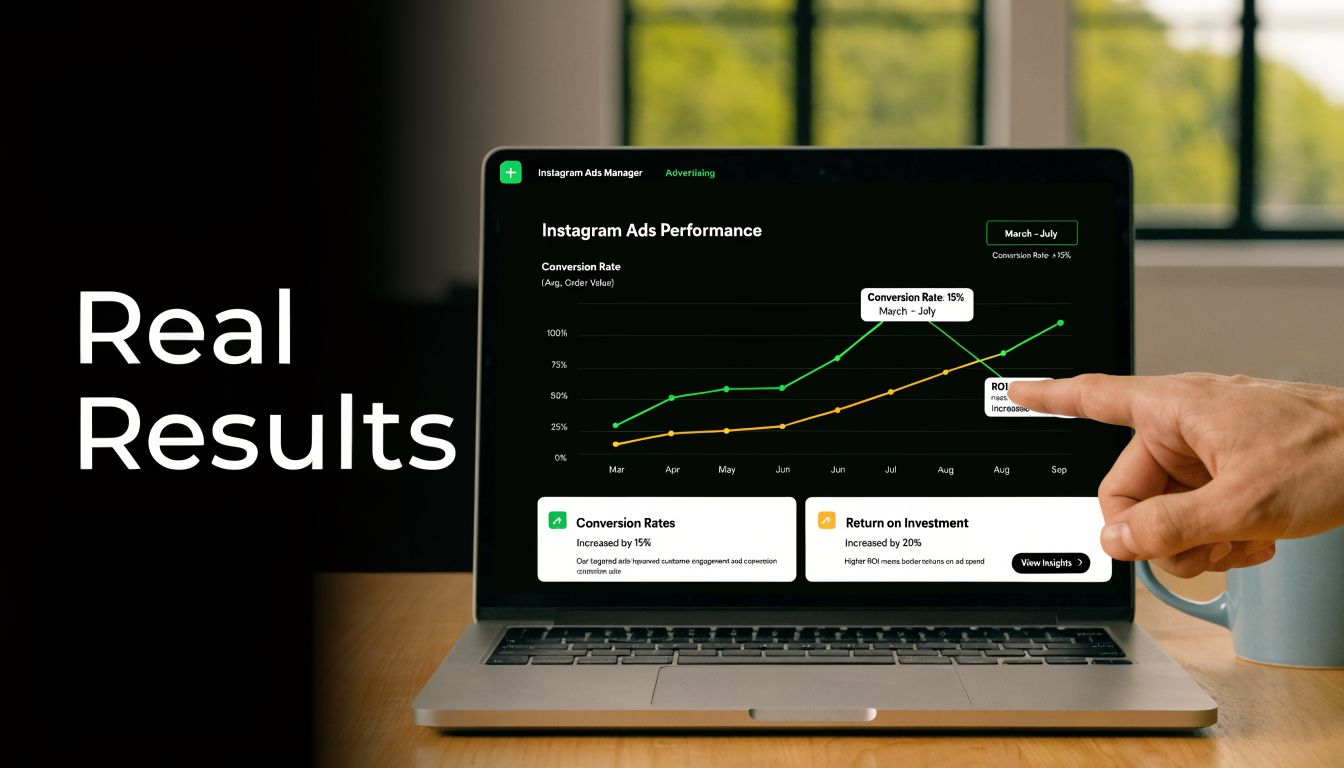
A serious instagram ads agency should report on business outcomes first. That means lead quality, booked appointments, purchases, cost per acquisition, and return on ad spend. If a monthly report leads with reach, impressions, and reactions while burying conversion data, something’s off.
What a strong report should include
A useful agency report should answer practical questions:
- How many qualified leads came in?
- Which campaign produced them?
- What did each lead or sale cost?
- Which creative angles pulled real response?
- Where did people drop off after clicking?
If you run a plumbing company in Baltimore County, the report should help you decide where to put the next month’s money. It shouldn’t read like a data dump.
Why account structure affects results
One of the biggest differences between average and skilled management is campaign structure. Agencies that consolidate fragmented campaigns to improve data concentration for Meta’s AI report measurable CPA improvements of 15-25% within 30 days of restructuring, according to Bastion Agency’s Instagram ads best practices.
That sounds technical, but the practical takeaway is simple. If the account is split into too many overlapping campaigns and ad sets, Meta gets weaker signals. Optimization gets muddy. Reporting gets harder to trust.
A cleaner structure usually includes:
- Fewer overlapping campaigns
- Clearer testing logic
- Better signal flow to the platform
- More dependable conversion tracking
What to ask in monthly reviews
Don’t just ask, “How are the ads doing?”
Ask these instead:
| Ask this | Why it matters |
|---|---|
| Which campaign is producing the best lead quality? | Cheap leads can still be weak leads |
| What did we learn from the losing creative? | The lesson matters as much as the winner |
| Are we seeing repeat exposure fatigue? | Audience wear-out hurts efficiency |
| Is tracking clean enough to trust decisions? | Bad data leads to bad budget moves |
| What’s the next optimization step? | Reporting should lead to action |
A report should help you make the next business decision. If it only tells you what happened, it’s incomplete.
You should also expect some discussion of tracking setup, including website events and server-side data flow where appropriate. If the agency can’t explain how it validates conversions, hold them there.
For a broader framework, this guide on how to measure digital marketing success gives a good lens for evaluating whether your reporting is decision-worthy.
Frequently Asked Questions
How long should I give an instagram ads agency before judging results
Give it 60 to 90 days. That gives enough room for setup, tracking checks, creative testing, audience refinement, and one or two rounds of budget shifts based on lead quality, not just click volume.
In the first few weeks, a good agency is still getting the account into shape. That can mean cleaning up old campaigns, fixing conversion tracking, tightening the geography, and separating a broad Maryland audience from a tighter one like Fells Point, Canton, or Hampden. If you judge performance too early, you end up grading the build phase like it was the final result.
What to watch during that test-and-learn window is simple. Are they explaining what they tested, what failed, what improved, and what they plan to change next? If yes, the process is usually healthy. If all you get is reach, impressions, and vague optimism, that is a problem.
Should my business focus on Reels, Stories, or feed ads
Use the format that fits how your customer makes a decision.
A restaurant in Baltimore might use Stories for daily specials because the format creates urgency and works well for same-day traffic. That same restaurant could use Reels for kitchen-to-table videos because motion, sound, and plating shots help sell appetite. A law firm usually needs a different approach. Feed ads often work better there because testimonials, case types, and a clear call to action build trust better in a static or lightly animated format.
Most local businesses should test more than one placement, but they should not run the same creative everywhere and hope Meta sorts it out. Stories need quick hooks. Reels need movement in the first seconds. Feed ads need a clear headline and proof that the business is credible.
Can an agency help if I only serve a small part of Maryland
Yes, and sometimes that is an advantage.
A smaller service area usually makes the message sharper. A home services company that only wants leads from Towson, Parkville, and Nottingham should not pay for traffic from the entire Baltimore metro. A neighborhood gym in Federal Hill should sound different from one trying to pull members from Columbia or Bethesda. Better local fit usually improves response quality.
The agency should also know where tight targeting helps and where it can hurt. If the audience gets too narrow, delivery can stall and costs can rise. In those cases, I usually widen the radius a bit, keep the copy local, and let the offer do more of the filtering.
What should I prepare before talking to an agency
Bring the information that affects revenue.
That means your main offer, service areas, average sale value, close rate if you know it, top-selling services or products, website link, ad account access, and any past campaign history. If leads were cheap but turned into no-shows, bad fits, or low-ticket jobs, say that upfront. That saves time and keeps the strategy grounded in actual business goals.
It also helps to bring one practical constraint. Maybe you only want jobs inside Anne Arundel County. Maybe your schedule is full on weekends. Maybe your team cannot handle more than 15 leads a week. Those details matter because a good agency is not just trying to get more responses. They are trying to get the right volume, from the right places, at a cost your business can support.
If you want a practical second opinion before hiring an instagram ads agency, Raven SEO can help you think through the fit. Their team works with businesses that need clearer strategy, stronger reporting, and a more disciplined path from local visibility to revenue.