
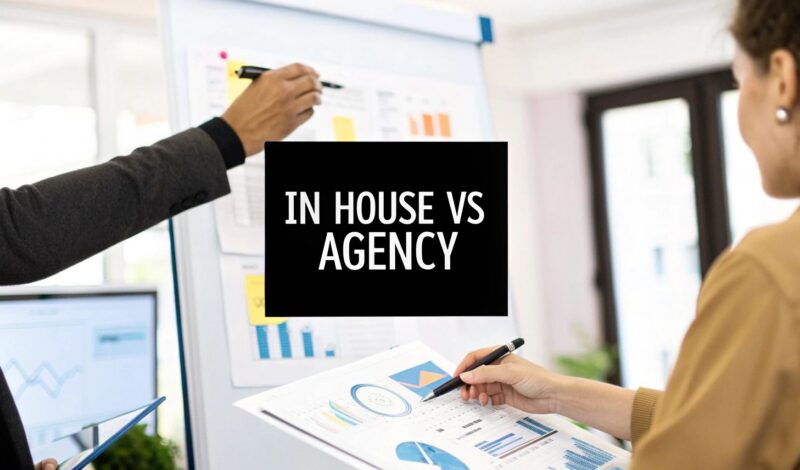
At its core, the difference is simple. An in-house marketing team is part of your company's DNA, fully immersed in your culture. Partnering with a marketing agency gives you instant access to a team of outside specialists. The right choice really comes down to what you value more right now: deep brand integration and direct control, or a broad, ready-to-go skillset without the hiring headaches.
Choosing Your Marketing Path: In-House or Agency
Deciding between building an in-house team and hiring an agency is a major strategic move, not just a line item in the marketing budget. This choice shapes your spending, your team's capabilities, and how quickly you can get campaigns off the ground. It's about picking an operating model that actually fits where your company is today—your cash flow, your people, and your goals for the future.
For most small and mid-sized businesses, especially those fighting for attention in a competitive market like Baltimore, this isn't about a simple pros-and-cons list. It’s a serious look at the trade-offs.
Key Decision Factors at a Glance
An in-house team means you get deep brand knowledge and can walk down the hall to talk to them. An agency brings a diverse, pre-built talent pool and the flexibility to ramp your marketing up or down as needed. To make the right call, you have to weigh each option against what your business actually needs.
This simple decision tree can help you visualize the main questions you should be asking.
As the flowchart shows, the best path often comes down to the resources you already have, how fast you want to grow, and whether you need specialized skills immediately.
The core question isn't just "which is better?" but rather "which is better for my business right now?" The answer today may be different a year from now as your company evolves.
A Structured Comparison
To get past the high-level overview, let's break down the practical differences. This table contrasts the two models across a few critical areas, helping you see where each one has a clear edge.
| Feature | In-House Marketing Team | Marketing Agency |
|---|---|---|
| Primary Strength | Deep brand immersion and cultural alignment. | Access to specialized talent and scalable resources. |
| Control Level | High. Direct oversight of daily tasks and priorities. | Moderate. Collaborative control based on agreed-upon strategy. |
| Onboarding Speed | Slow. Requires recruiting, hiring, and training. | Fast. Can often start within weeks of signing a contract. |
| Cost Structure | Fixed overhead (salaries, benefits, tools). | Predictable retainer or project-based fees. |
As you think about your marketing operations, you'll need to decide whether to hire an agency or manage in-house for tasks like podcast guesting. Each approach offers unique benefits depending on the task's complexity and required expertise.
Ultimately, the goal is to build a marketing function that drives results. For guidance on finding the right external partner, check out our guide on how to choose a digital marketing agency. It provides a clear framework for vetting potential partners.
Analyzing the True Cost of Your Marketing Investment
When you’re weighing an in-house hire against a marketing agency, looking at a monthly salary versus a retainer fee is like only seeing the tip of the iceberg. The real financial picture is far more complex. To make a smart decision for your Baltimore-based business, you have to dig deeper and analyze the fully-loaded cost of each option.
An in-house hire brings a long list of associated expenses that stretch well beyond their paycheck. These "hidden costs" add up fast, turning what seems like an affordable salary into a major financial commitment. This is the true price of building an internal team from scratch.
In contrast, an agency’s retainer is built to be more inclusive. It bundles expertise, tools, and operational overhead into a single, predictable monthly fee, giving you a much clearer path for budget forecasting.
Unpacking the Full Cost of an In-House Hire
Hiring a marketing manager involves much more than just their salary. The total investment includes a whole range of direct and indirect expenses that are easy to overlook but are absolutely critical for a realistic budget.
Let’s break down these often-unseen costs:
- Recruitment and Onboarding: Finding the right person takes time and money. This includes fees for job postings, recruiter commissions (which can be 15-25% of the first year's salary), and the internal hours spent sifting through resumes and conducting interviews.
- Compensation and Benefits: Beyond the base salary, you’re on the hook for payroll taxes, health insurance, retirement contributions, and paid time off. These benefits typically tack on another 25-40% to the base salary.
- Essential Tools and Software: A modern marketer needs a serious toolkit. This means subscriptions to SEO software like Ahrefs or Semrush, analytics platforms, social media schedulers, and email marketing services, which can easily run into thousands of dollars annually.
- Ongoing Training and Development: The marketing world moves at lightning speed. To keep your employee's skills sharp, you'll need to fund ongoing training, industry conferences, and professional development courses.
These numbers reveal a tricky cost-benefit analysis. A fully-staffed in-house marketing employee costs significantly more than agency services when you factor in total compensation. A $100,000 agency engagement might deliver a certain level of output, but achieving that same capacity with a full-time hire could cost closer to $400,000 once you account for salaries, benefits, training, software, and overhead. Plus, recruiting skilled marketers in a competitive area like Maryland remains a huge challenge, with top candidates commanding premium salaries and taking months to onboard before they're fully productive.
The Financial Advantage of an Agency Partnership
Partnering with a marketing agency like Raven SEO consolidates many of these variable expenses into one predictable cost. An agency retainer gives you access not just to one person, but to a whole team of specialists in areas like SEO, paid ads, content creation, and web design.
An agency’s value isn’t just in the work it produces, but in the hidden costs it absorbs. You get access to a full team and enterprise-level tools without the direct overhead of hiring, training, and equipping them yourself.
This model lets your business tap into a deep well of expertise right away. The agency has already vetted its team, invested in top-tier software, and built efficient workflows. This means your marketing investment starts generating returns much faster, without the long and expensive ramp-up period that comes with a new hire. To get a better handle on the returns you can expect, you might find our guide on how to calculate marketing ROI helpful.
True Cost Breakdown: In-House Hire vs. Agency Retainer
To put the financial difference in black and white, let's compare the estimated annual costs of a single mid-level in-house marketing manager to a typical comprehensive agency retainer. This isn't just salary vs. fee; it's a look at the total investment.
| Cost Factor | In-House Marketing Manager (Annual) | Agency Retainer (Annual) |
|---|---|---|
| Base Salary / Retainer Fee | $80,000 | $60,000 |
| Benefits & Payroll Taxes (30%) | $24,000 | $0 (Included in retainer) |
| Recruitment & Onboarding | $12,000 (One-time, averaged) | $0 (Included) |
| Software & Tools | $5,000 | $0 (Included) |
| Training & Development | $2,000 | $0 (Included) |
| Total Annual Cost | $123,000 | $60,000 |
As the table clearly shows, the fully-loaded cost of one in-house generalist can easily be more than double the price of an agency retainer that provides an entire team of specialists. For many small and medium-sized businesses in Maryland, this financial efficiency makes partnering with an agency a clear strategic advantage.
Evaluating Speed and Access to Specialized Talent
When you're comparing in-house vs. agency marketing, one of the most practical questions is: how fast can you actually get things moving?
Building an internal team is a deliberate, often slow-moving process. It involves posting jobs, sifting through résumés, interviewing, hiring, and then a lengthy onboarding period. In sharp contrast, bringing an agency on board gives you immediate access to an entire team of specialists who are already vetted, trained, and ready to go.
This difference in "speed to execution" is a massive competitive advantage. If you're a Baltimore business trying to jump on a sudden market trend or respond to a competitor's new campaign, waiting months to hire the right marketing manager simply isn’t an option. An agency can start hammering out a strategy within days and get initial campaigns live in a matter of weeks, letting you be proactive instead of constantly playing catch-up.

The Challenge of Building In-House Expertise
Let’s be honest: hiring for specialized marketing roles like SEO, paid media, or content strategy is tough. The talent pool is incredibly competitive, and the best candidates come with hefty price tags. Even when you find the right person, they face a steep learning curve getting up to speed with your brand, internal processes, and specific goals.
More often than not, an in-house marketing manager is hired to be a generalist—a jack-of-all-trades. While they're incredibly valuable, they probably don't have the deep, niche expertise needed to master Google’s ever-changing algorithms or the complex bidding strategies behind a successful PPC campaign.
This creates a serious knowledge gap. Your team might know your brand inside and out, but they may lack the technical chops to execute sophisticated digital strategies. The result is a marketing effort that’s competent but rarely exceptional, leaving critical growth opportunities on the table.
Immediate Access to a Diverse Skill Set
When you hire an agency, you’re not just getting a single marketer; you’re tapping into an entire team of specialists. This collective brainpower covers the full marketing spectrum, making sure every piece of your strategy is handled by a pro with deep, focused experience in that specific area.
A typical agency team includes:
- SEO Specialists who live and breathe search algorithms, technical site audits, and keyword strategy.
- PPC Experts dedicated to optimizing your ad spend, A/B testing creative, and squeezing every drop of ROI from your budget.
- Content Strategists who know how to craft compelling stories that actually attract and convert your ideal customers.
- Web Developers and Designers who make sure your digital storefront is not only beautiful but also functional and user-friendly.
This instant access to a diverse skill set completely bypasses the time-consuming and expensive process of trying to build this kind of team from scratch. For a deeper look at how these teams function, our guide explains in detail how SEO agencies work to drive results. This structure means your business can launch advanced, multi-channel campaigns from day one.
A key benefit of an agency is staying ahead of the curve. An expert partner invests heavily in continuous training to master algorithm updates and platform changes, providing cutting-edge strategies an internal generalist simply doesn't have the capacity to develop.
Recent trends show that businesses are prioritizing speed more than ever. One report found that 64% of companies agree that agencies offer better access to specialized talent compared to in-house teams. But the real shift is in what they value most: in just one year, "specialized expertise" as the top agency benefit dropped from 41% to 31%, while "faster execution" jumped into the lead at 38%.
For a Maryland-based company, this speed and expertise translate directly into a stronger market position. Instead of spending six months trying to build a team, you can spend that time capturing market share, generating leads, and growing your revenue with the support of a dedicated, expert partner like Raven SEO.
Balancing Control, Communication, and Scalability
The operational side of things is often where the in-house vs. agency marketing debate gets really interesting. It’s easy to see the appeal of an in-house team. The biggest draw is having total brand immersion and direct, immediate communication. When your marketing lead is just a desk away, they are completely absorbed in your company culture.
That tight integration is a huge asset. Your team lives and breathes your brand every single day, giving them a deep, instinctual grasp of your voice, values, and customers. Decisions can be made on the fly, and feedback loops are instant, which lets you pivot and adjust campaigns in real-time.

But that closeness comes with a risk: internal blind spots. It’s a common pitfall. When a team is too close to a brand, they can lose their objectivity. This can lead to creative stagnation or an echo chamber where the same old ideas get recycled. They might struggle to see the brand from an outsider's perspective—which is exactly how every new customer sees it.
Structured Communication with an Agency Partner
This is where bringing in an agency flips the script. A dedicated partner like Raven SEO doesn't rely on hallway conversations. Instead, we establish a structured rhythm for communication and transparent reporting right from the start. Even though we’re an external team, the goal is to operate as a seamless, accountable extension of your company.
Instead of just informal chats, you get a system built for clarity:
- Scheduled Strategy Sessions: We set up regular, dedicated meetings to dig into performance, plan upcoming campaigns, and make sure we’re perfectly aligned on your goals.
- Clear Reporting Dashboards: You’ll have access to real-time data showing exactly how campaigns are performing against the metrics that actually matter to your bottom line.
- Dedicated Points of Contact: Communication is streamlined. You always know exactly who to talk to for updates, questions, or new ideas.
This disciplined approach brings a level of accountability that can be hard to replicate internally. It combines the fresh, objective perspective of an outsider with the reliability of a well-integrated partner, shaking off the creative fatigue that can settle into in-house teams. As you weigh these operational styles, understanding how to build an effective marketing department organizational structure is crucial for maximizing internal efficiency and preparing for growth.
An agency provides a valuable external viewpoint, challenging assumptions and introducing new strategies that an internal team might overlook. This blend of outside expertise and structured communication can often lead to more innovative and effective marketing campaigns.
The Critical Advantage of Scalability
Frankly, the most compelling argument for an agency often comes down to scalability. An agency gives you elastic resources. You can scale your marketing efforts up or down with incredible flexibility, which is a massive advantage for any growing business in Maryland facing shifting market demands or seasonal sales cycles.
Think about a Baltimore-based ecommerce store gearing up for the holidays. They might need to triple their ad spend and content output. With an agency, that’s just a strategic adjustment. The people, processes, and tools are already in place to handle that increased workload without missing a beat. For more complex efforts like a full website redesign, having solid website development project management is the key to a smooth, on-time launch.
Trying to do that with an in-house team? It can be a logistical nightmare. You’d be looking at hiring temporary staff or completely overloading your existing employees—both are inefficient and expensive options. An agency partnership removes these HR headaches entirely. You can ramp up for a major product launch or scale back during a slow quarter without the administrative burden of hiring or layoffs. That kind of agility keeps your business nimble and lets you turn market changes into opportunities instead of operational headaches.
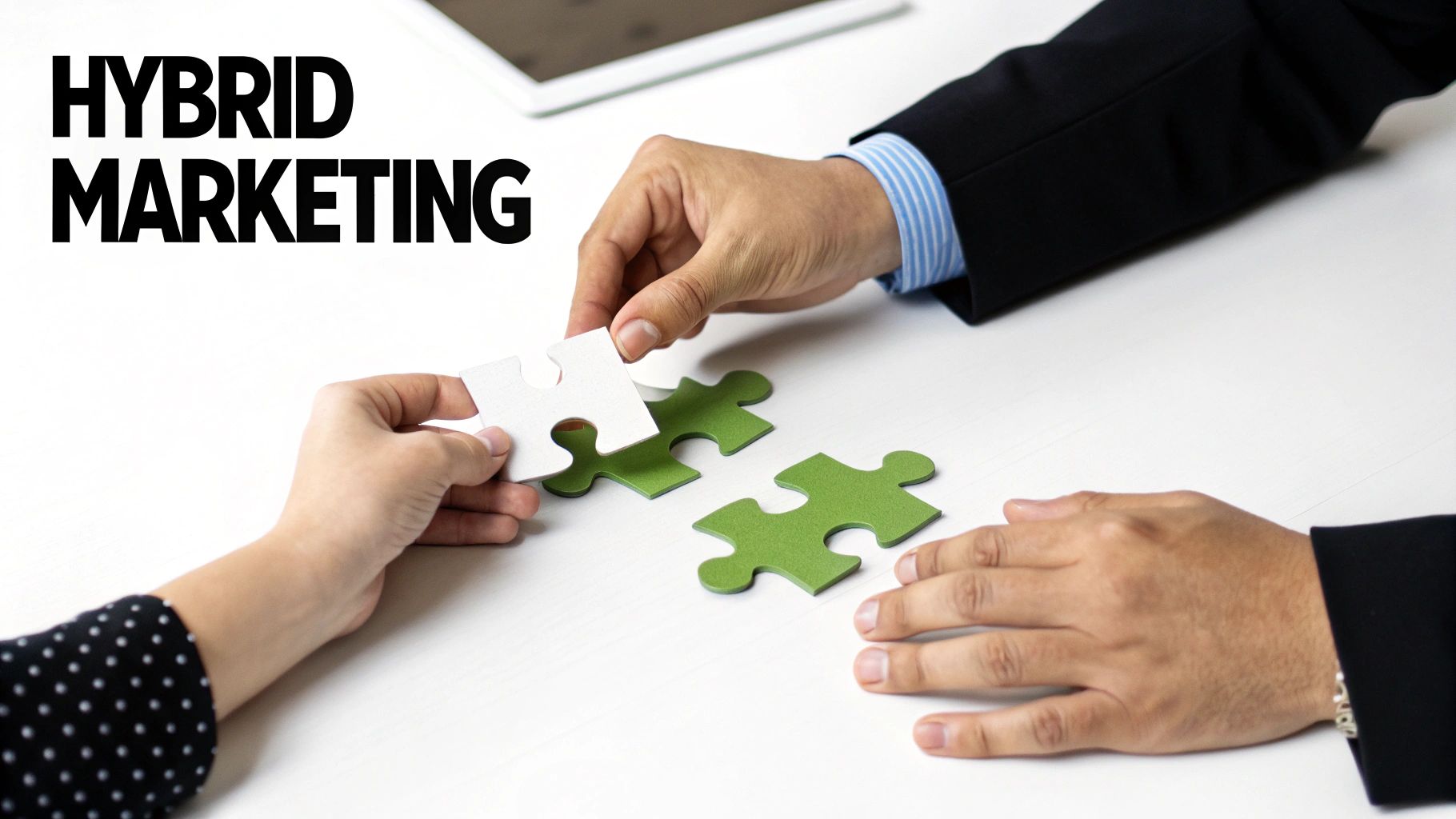
Adopting a Hybrid Marketing Model for Growth
The whole in-house vs. agency marketing debate often feels like a false choice, pushing businesses to pick a side when they don't have to. The truth is, the smartest and most agile strategy today is often a hybrid model that pulls the best from both worlds to create a real engine for growth.
This approach acknowledges that you shouldn't have to choose between deep, intrinsic brand knowledge and specialized, external expertise—you can have both. It’s all about building a marketing function that is truly greater than the sum of its parts.
How the Hybrid Model Works in Practice
A hybrid model isn't about just splitting tasks down the middle; it's a strategic partnership. This structure lets your in-house team focus on what they do best—understanding your brand, your customers, and your core business goals—while leaning on an agency for specialized skills and raw execution power.
Here are a few common scenarios where this works beautifully:
- Brand Manager + Technical Agency: Your in-house marketing manager steers the ship, defining brand strategy, voice, and campaign goals. An agency partner like Raven SEO then executes the highly technical parts, like a complex local SEO campaign, paid advertising, or a new web development project.
- Content Team + SEO Agency: An internal team creates authentic, on-brand content that truly speaks your language. The agency then provides the data-driven keyword research, technical optimization, and backlinking strategies needed to make sure that content actually gets discovered.
- Generalist Team + Project-Based Agency: Your small in-house team handles the day-to-day marketing grind. When a big initiative comes up—think a full website redesign or a major product launch—you bring in an agency to manage that specific, resource-heavy project from start to finish.
This kind of collaboration lets you fill critical skill gaps without the long-term cost and commitment of hiring a stable of full-time specialists.
Gaining the Best of Both Worlds
The biggest win with a hybrid structure is its ability to deliver targeted expertise exactly where you need it, when you need it. You keep direct control over your core brand messaging while accessing a deep bench of specialists who live and breathe the latest algorithm changes and industry trends.
The hybrid model changes the in-house vs. agency conversation from "either/or" to "how do we combine them for the best result?" It gives you the control of an internal team with the scalability and specialized talent of an agency.
This flexibility is a complete game-changer for growing businesses here in Baltimore. Instead of trying to build a massive, expensive internal department from scratch, you can strategically augment the team you already have. The result is a more efficient, cost-effective, and ultimately more powerful marketing operation. Our work on integrated marketing campaign examples shows just how powerful combining different channels and teams can be.
This isn't just a theory; it's quickly becoming the new standard. The hybrid marketing model has surged in popularity, with adoption jumping from 36% to 46% in a single year, making it the most common strategy for businesses. During that same period, fully in-house marketing dropped from 38% to 32%, and fully outsourced models fell from 26% to 22%. You can discover more about these marketing trends and what they reveal about business priorities.
For companies in Maryland looking to scale intelligently, Raven SEO is the ideal partner for a hybrid approach. We’re built to integrate seamlessly with your existing team, providing the targeted expertise you need in web design, local SEO, or performance marketing to hit your growth goals.
Still Have Questions? Let's Clear Things Up
Choosing between building an in-house team and hiring an agency is a huge decision, and it’s perfectly normal to have some lingering questions. Even after weighing the costs, talent, and control, many business owners I talk to in Baltimore are still working through a few key uncertainties. Let's tackle the most common questions head-on.
What's the main difference between an in-house team and an agency?
The primary difference lies in their structure and focus. An in-house team consists of employees who are fully dedicated to your company, deeply embedded in its culture and long-term vision. A marketing agency is an external partner that provides a team of specialists with diverse expertise across various industries and marketing channels. The in-house team offers brand immersion, while the agency provides scalability and immediate access to specialized skills.
How do I know when my business is ready for an agency?
A business is typically ready for an agency when marketing tasks become too complex or time-consuming for the current team, or when you need specialized expertise (like technical SEO or advanced PPC) that you don't have internally. If you have a marketing budget but can't justify hiring multiple full-time specialists, an agency provides a cost-effective way to access that talent and scale your efforts quickly.
Is it cheaper to hire an in-house marketer or an agency?
While an agency's monthly retainer might seem higher than a single employee's salary at first glance, it's often more cost-effective in the long run. The true cost of an in-house employee includes salary, benefits, payroll taxes, recruitment fees, training, and expensive software subscriptions. An agency bundles all of these costs—plus access to an entire team of experts—into one predictable fee, which frequently offers a higher ROI for a similar or lower total investment.
What are the biggest benefits of a hybrid marketing model?
A hybrid model offers the best of both worlds. It allows your in-house team to focus on high-level strategy, brand voice, and customer insights, while the agency partner executes specialized, technical tasks. This approach provides the brand control and cultural alignment of an in-house team combined with the scalability, specialized expertise, and fresh perspective of an agency, creating a more powerful and flexible marketing operation.
Ready to figure out if an agency partnership is the right next step for your business? Raven SEO offers a no-obligation consultation to understand your goals and build a practical roadmap for growth. Let's start the conversation at https://raven-seo.com.