
Choosing the right digital marketing agency doesn’t start with a Google search. It starts with a hard look in the mirror. Before you even think about evaluating potential partners, you need to get crystal clear on your own business needs, goals, and what you’re willing to spend. This foundational work is what makes sure you find an agency that can deliver real results, not just a slick sales pitch.
Defining What Success Looks Like for Your Business
Before you start interviewing agencies, the single most important step is to look inward. Vague goals like "we need more traffic" or "we want a better online presence" are a recipe for a failed partnership. They're impossible to measure and almost always lead to disappointment. This guide is designed to be educational and easy to read, helping you make an informed decision.
Think of it like hiring a contractor to build a house. You wouldn't just tell them to "build something nice." You'd hand them a detailed blueprint, specify the number of rooms, and agree on a budget. The same principle applies here. You need to create the blueprint for your marketing success before anyone can start building.
From Vague Ideas to Tangible Goals
Your first job is to turn those broad business objectives into specific, measurable marketing goals. This is how you connect marketing efforts directly to your bottom line, ensuring every dollar you spend has a clear purpose. If your main business goal is to increase overall revenue by 20% this year, what marketing outcomes will get you there?
Here’s how to translate those fuzzy wishes into concrete targets:
-
Instead of: "We need more website traffic."
-
Try: "Increase organic website traffic from non-branded keywords by 40% within the next 12 months."
-
Instead of: "We want more leads."
-
Try: "Generate 150 marketing qualified leads (MQLs) per month from our paid search campaigns by the end of Q3."
-
Instead of: "Our e-commerce store needs to do better."
-
Try: "Improve the e-commerce conversion rate from 1.5% to 2.5% and reduce cart abandonment by 10% over the next six months."
Giving an agency specific targets like these provides a clear finish line. They know exactly what you expect and can build a real strategy designed to hit those numbers. This process of setting clear benchmarks is fundamental. To get a better handle on this, it’s worth learning more about how to measure digital marketing success and pick the right KPIs.
A great agency won't just ask you what you want; they'll help you define what you need. If a potential partner doesn't press you for specific numbers and business outcomes during the initial conversation, consider it a red flag.
Aligning Your Budget with Reality
Once your goals are set, it’s time to talk about money. It’s a conversation some business owners shy away from, but being upfront here is non-negotiable. An agency must know what resources they have to work with to build a realistic strategy. A $2,000 monthly budget requires a completely different plan than a $20,000 monthly budget.
This diagram breaks down the simple but critical flow of defining what success actually means.
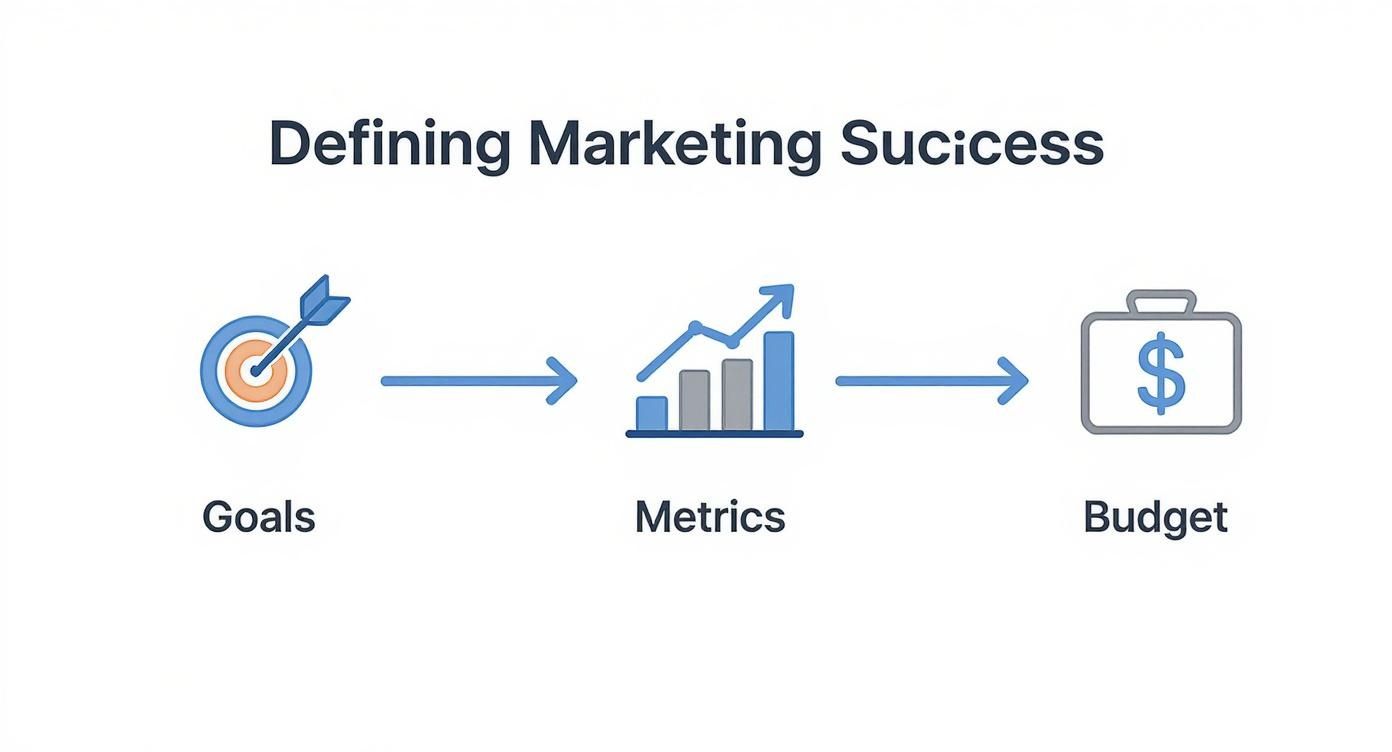
As the visual shows, a solid marketing plan is a balanced equation. Your ambitions need to be backed by measurable KPIs and funded by a realistic budget.
When you approach agencies with this framework—clear goals, specific metrics, and a defined budget—you immediately position yourself as a serious, strategic client. It lets them skip the guesswork and get right to building a plan that can actually move the needle, making the whole selection process smarter and more efficient.
Matching Agency Expertise With Your Specific Needs
Once you have a clear picture of your business goals, the next step is finding an agency with the right toolkit to get you there. This is a critical step. Not all marketing agencies are created equal; they come with their own unique specializations, from highly technical SEO and paid advertising to creative branding and social media.
Hiring any agency for any marketing task is like asking a plumber to rewire your house—they might know the basics, but you need a specialist for the best results.
An agency that excels at running viral TikTok campaigns probably doesn't have the deep technical chops for a complex local SEO strategy. That’s why you must dig into an agency’s core services and see if they align directly with the goals you've already defined.

Differentiating Specialists From Generalists
A "full-service" agency sounds appealing, but it can sometimes mean they're a jack-of-all-trades and master of none. The key is to spot true expertise versus a thin layer of knowledge spread across too many disciplines.
Here’s how to tell the difference:
- Look at Their Team: Do they have dedicated specialists for different services? An agency with a Head of SEO, a PPC Manager, and a Content Strategist is far more likely to have deep expertise than one where a single "digital marketer" handles everything.
- Examine Their Tools: Ask about the technology they use. Serious SEO specialists will live in advanced tools like Ahrefs, Semrush, or Screaming Frog. A sophisticated paid media team will be proficient with programmatic advertising platforms and advanced analytics suites.
- Check Their Thought Leadership: Do they publish detailed blog posts, case studies, or white papers on the specific services you need? Content that shows a deep, nuanced understanding is a fantastic sign of genuine expertise.
Why Industry Experience Is a Game Changer
Beyond service specialization, industry-specific experience can be a massive advantage. An agency that has already worked with businesses in your niche—whether it’s e-commerce, home services, or B2B software—comes to the table with a huge head start.
They already understand your market's unique challenges, your competitors' tactics, and, most importantly, your customers. This means they spend less time learning the basics of your industry and more time executing strategies that actually work.
For instance, an agency with a portfolio of successful dental clients already knows the ins and outs of HIPAA compliance in marketing and understands the patient journey. To effectively reach your ideal customer, you first need to understand them inside and out. You can learn more by checking out our guide on how to create buyer personas to get a better sense of your target audience.
An agency with niche experience can often anticipate market trends and challenges before you do. Their familiarity with your audience and competitive environment allows them to be proactive rather than reactive, delivering a much higher strategic value.
Aligning With Current Market Trends
Staying aware of broader industry trends also helps in making a smart choice. As of 2025, the digital marketing industry is growing at about 5% annually. While this is a slight slowdown from previous years, it’s still a sign of a healthy and expanding sector.
More importantly, service trends show that agencies offering AI-powered solutions have grown from 10% in 2023 to 17% in 2025, showing that forward-thinking agencies are adopting new technologies. There’s also renewed client demand for core services like SEO, paid media, branding, and content marketing, with each growing its market share by 4-6%.
Choosing an agency that is not only specialized but also aligned with these growth areas ensures you're partnering with a firm that is investing in the future.
Ultimately, finding the right match is about aligning an agency’s proven strengths with your specific, measurable business goals. A specialist with experience in your industry won't just be a vendor; they will be a strategic partner who can help you navigate your market and achieve sustainable growth.
Look Beyond the Sales Deck to Verify an Agency’s Chops
Any agency gunning for your business will show up with a polished sales deck and a few killer case studies. That’s table stakes. But here's the thing: case studies are highlight reels. They show you the agency’s best work, framed in the best possible light. They’re a starting point, not the finish line.
To really know if an agency can walk the walk, you have to get your hands dirty. You need to peek behind the curtain, scrutinize the data, and talk to the people who’ve been in the trenches with them. This isn't about being cynical; it's about being smart with your investment.

Unpack the Metrics Behind Their Wins
A case study that boasts "we increased traffic by 200%!" sounds great, but it's a vanity metric without context. Your job is to poke holes in these big, glossy numbers and understand the how and why behind them. A truly great agency will be excited to show you their work, not just recite the final score.
Don't be afraid to get granular. Start asking questions that peel back the layers:
- "What were the client’s actual business goals when you started? How did you align your strategy to hit those?"
- "Can you show me the specific KPIs you tracked? I'm interested in things like cost per acquisition (CPA) or return on ad spend (ROAS), not just traffic."
- "What was the biggest unexpected roadblock you hit during this campaign, and how did your team adapt?"
- "What did the client's competitive landscape look like? Were you starting from scratch or building on existing momentum?"
When an agency can confidently break down their process, challenges, and real-world business impact, it’s a clear sign they were deeply involved in the strategy—not just pulling a few good-looking stats for a presentation.
The Unfiltered Truth: Client References
Case studies are curated. Phone calls with past or current clients? Not so much. This is where you get the real story on an agency's communication, responsiveness, and what it’s really like to work with them day-to-day.
Any agency worth its salt will gladly provide references. If they hesitate or make excuses, consider it a massive red flag.
When you get a reference on the phone, skip the generic "Were you happy with them?" questions. You need to dig deeper to understand the relationship.
Pro Tip: Don't just ask to speak with their happiest clients. A truly confident agency won't shy away from connecting you with a client from a project that had a few bumps. How they navigate a tough situation is often more revealing than how they handle an easy win.
Here are a few powerful questions to get the conversation started:
- On Communication: "How proactive was the team with updates and reports? Did you ever feel like you were in the dark?"
- On Strategy: "Did you feel like they really took the time to understand your business, or was it more of a one-size-fits-all approach?"
- On Results: "Beyond the metrics in the case study, how did their work actually impact your bottom line?"
- On the Relationship: "What was the single best part of working with them? And if you could change one thing about their process, what would it be?"
This is also how you can validate an agency's claimed expertise and authority. Hearing it directly from a fellow business owner gives you a perspective a sales pitch never will. This real-world proof is exactly what search engines look for, too. To see how Google evaluates this, you can learn about the power of E-E-A-T in crafting high-quality content.
Taking the time to verify performance is the most critical step in this process. It's how you ensure your decision is based on proven ability, not just a polished pitch.
Agency Vetting Checklist
To keep your evaluation systematic, use a checklist to assess an agency’s portfolio and track record. This helps you compare different agencies using the same criteria and spot potential issues before you sign a contract.
| Evaluation Area | What to Look For | Red Flags |
|---|---|---|
| Case Studies | Specific, quantifiable results (e.g., ROAS, CPL, conversion rate). Clearly defined business goals and challenges. | Vague claims ("increased engagement"), vanity metrics (impressions, traffic without context), or results that seem too good to be true. |
| Client References | Willingness to provide 2-3 relevant references. Positive feedback on communication, strategy, and problem-solving. | Hesitation to provide references. Vague or lukewarm feedback from past clients. Inability to connect you with a current client. |
| Industry Relevance | Demonstrable experience and success in your industry or with similar business models (e.g., e-commerce, B2B SaaS). | No relevant experience. Applying a generic "cookie-cutter" approach to a specialized industry. |
| Metric Transparency | Openness to discussing the specific KPIs, tools, and reporting methods used. Ability to explain how their work directly impacted client revenue. | Evasive answers about specific metrics like CPA or LTV. Focus on top-of-funnel metrics without connecting them to business goals. |
Using a structured approach like this ensures you’re not swayed by a slick presentation alone. It forces you to focus on what really matters: their proven ability to deliver tangible results.
Asking the Right Questions in Agency Interviews
Okay, you’ve vetted their portfolios, checked a few references, and now it’s time for the interview. This is where a potential partnership really comes to life. It's your chance to see how an agency thinks on its feet, how they tackle problems, and honestly, whether you'll even enjoy working with them.
A great interview isn't just a Q&A about their services. It’s a strategic conversation that peels back the layers of their canned sales pitch. You need to flip the script from them selling you to you evaluating them as a potential strategic partner. This means asking questions that force them to stop reciting their brochure and start applying their brainpower to your business.

Go Beyond "What Do You Do"
Forget asking about their list of services. You already saw that on their website. Instead, frame your questions around your specific goals and pain points. This approach instantly reveals if they were actually listening during your initial calls.
Here are a few powerful, problem-focused questions to get the real conversation started:
- "Our goal is to boost qualified leads by 30% in the B2B tech space. What would your initial 90-day game plan look like?"
- "We’ve really struggled to connect with the 25-35 year old demographic on social media. What specific channels and content ideas would you recommend to actually engage them?"
- "Right now, our cost per acquisition (CPA) is hovering around $75. Based on our industry, what do you think is a realistic target, and how would you get us there?"
- "Walk me through your process. What happens when a campaign is underperforming after the first month? How do you troubleshoot and pivot?"
Questions like these make an agency think, not just talk. Their answers will tell you more about their strategic chops, creativity, and understanding of your market than any slick presentation ever could. For a deeper dive, check out our guide on the top 10 questions you absolutely must ask before signing with a digital marketing agency.
Understanding Their Process and Communication Style
The day-to-day working relationship is just as critical as the big-picture strategy. A mismatch in communication styles can turn a promising partnership sour fast, so get this sorted out upfront.
Get into the nitty-gritty of how they operate:
- Who will be our main point of contact?
- What does your standard reporting look like, and how often will we see it?
- How do you take client feedback and work it into the ongoing strategy?
- What project management tools do you use to keep us in the loop on progress?
A solid agency will have clear, confident answers. They should be able to walk you through a well-defined process for communication and collaboration that leaves you feeling secure, not confused.
Spotting the Red Flags Before It's Too Late
Just as important as asking the right questions is knowing how to read between the lines and spot the warning signs. Some red flags are subtle, others are screaming alarms.
Be very wary of any agency that:
- Makes Outlandish Promises: Guarantees like "#1 on Google in 30 days" are not just unrealistic; they're a sign of either dishonesty or amateurism. Real digital marketing is a long game.
- Gives Vague, Evasive Answers: If they can't clearly explain their process or how they'll tackle your specific challenges, they probably don't have a coherent strategy. All fluff, no substance.
- Uses High-Pressure Sales Tactics: A great partner acts like a consultant, not a used car salesman. If you feel rushed to sign a contract, it’s a major red flag. They should be focused on understanding your needs, not just closing a deal.
- Lacks Transparency on Pricing: They need to clearly break down their pricing model, what’s included, and what might cost extra. No surprises.
The stakes are high. With digital now accounting for 72.7% of all ad spending, and 84% of CMOs admitting they struggle to run effective campaigns, you need a truly competent partner. An agency showing these red flags is not equipped to navigate that complexity.
Ultimately, you have to trust your gut. If a conversation feels off or their answers seem too good to be true, they probably are. The interview is your single best tool for finding a partner who will be an asset to your growth, not just another expense.
Making Sense of Pricing Models and Contracts
So, you’ve interviewed a few agencies, and things are looking promising. Now comes the part where the rubber meets the road: money and paperwork. This is where a great potential partnership can become a reality or fall apart completely.
Figuring out pricing structures and combing through contracts isn't the most exciting part of the process, but it’s absolutely critical. Getting this right sets you up for a transparent, healthy relationship from day one. Choosing a model isn't about finding the rock-bottom price; it's about making sure the agency's incentives are perfectly aligned with your business goals. The wrong fit here can lead to constant frustration and that nagging feeling you’re just not getting what you paid for.
Decoding Common Pricing Models
Most digital marketing agencies operate on one of a few core pricing models. Each has its pros and cons, and the best one for your business really depends on the scope of your needs and how predictable your marketing efforts are.
Let’s break down the most common ones you'll see.
- Monthly Retainer: This is the industry standard for a reason. You pay a fixed fee every month for an agreed-upon set of services and deliverables. It’s perfect for long-term, ongoing work like SEO, content marketing, or social media management because it allows the agency to plan resources and build momentum over time.
- Project-Based Fee: Got a specific, well-defined project with a clear start and end? Think a website redesign or an e-commerce platform launch. A project-based fee is a one-time, fixed price for that specific job, giving you complete cost certainty right from the start.
- Performance-Based Pricing: With this model, the agency's compensation is tied directly to the results they generate. This could be a percentage of ad spend or a fee per qualified lead. It’s a great way to align your success with theirs, but it requires crystal-clear tracking and can sometimes get expensive if a campaign becomes wildly successful.
To help you decide, let's look at how these models stack up against each other.
Comparison of Agency Pricing Models
A breakdown of common digital marketing agency pricing models to help businesses choose the best fit.
| Pricing Model | Best For | Potential Downside |
|---|---|---|
| Monthly Retainer | Ongoing, long-term partnerships (SEO, content, social media) where momentum is key. | Can be inefficient for small, one-off tasks; requires a clear scope to avoid "scope creep." |
| Project-Based Fee | Clearly defined, one-time projects with a definite start and finish (e.g., website builds, audits). | Less flexible if project requirements change mid-stream; not suited for ongoing optimization. |
| Performance-Based | Campaigns with easily trackable, direct-response goals (e.g., lead generation, e-commerce sales). | Can become very expensive; may incentivize short-term gains over long-term brand building. |
Choosing the right model is about aligning incentives. A retainer works when you need a strategic partner for the long haul, while a project fee is perfect for hitting a specific, short-term goal.
Scrutinizing the Contract Fine Print
Once you've landed on a pricing model, the contract becomes the official blueprint for your partnership. A well-written contract protects both you and the agency by laying out clear expectations, responsibilities, and the rules of engagement. Rushing this step is a classic mistake that can cause major headaches down the road.
Never sign anything until you’ve carefully reviewed these key sections:
- Scope of Work (SOW): This is the most important part of the entire document. It should spell out exactly what services the agency will provide, including specific deliverables, timelines, and how often you'll communicate. A vague SOW is a massive red flag.
- Contract Length and Termination Policy: Get clear on the initial commitment term (is it six months or a year?) and, more importantly, the process for ending the partnership. A fair termination clause will usually require 30- or 60-day written notice from either party.
- Ownership of Data and Work: This is non-negotiable. The contract must state that you own all your data, your accounts (like Google Analytics and Google Ads), and any creative work produced. You should never be in a position where an agency can hold your assets hostage.
- Reporting and KPIs: The contract should specify which metrics will be tracked and how often you'll get performance reports. This ensures accountability and helps you see how your investment is paying off. To get the most out of these reports, it’s smart to understand how to calculate marketing ROI yourself.
A transparent contract is the foundation of trust. If an agency gets cagey about clarifying a clause or pushes back on reasonable requests for ownership, it’s a good sign their interests aren't aligned with yours. Walk away.
The digital marketing industry is enormous—the global market was valued at around $667 billion in 2024 and is expected to hit $786 billion by 2026. With over half of many company budgets now dedicated to paid media, where 89% of agencies rank PPC as a top service, the financial stakes are incredibly high. This reality makes a clear, fair contract absolutely essential to protect your investment.
A Few Final Questions Before You Sign
Even with the perfect roadmap, a few nagging questions can pop up right before you make a final decision. That’s completely normal. Choosing the right agency is a big commitment, and getting clarity on these last few points is what separates a good choice from a great one.
Think of this as your final gut check. We'll tackle the most common questions business owners ask before they sign on the dotted line, making sure you feel confident you've found a true partner, not just another vendor.
How Long Should a Contract Be?
This really boils down to the kind of work you need done. For long-term plays like SEO or content marketing, a 6- to 12-month initial contract is pretty standard. Why? Because organic growth isn't an overnight thing. It takes time to build momentum, and this timeframe gives an agency enough runway to implement their strategy and actually show you meaningful results.
On the other hand, if you're hiring an agency for a specific, one-off project like a website redesign or a deep-dive marketing audit, a project-based contract with a clear start and end date makes more sense. I'd be wary of any agency pushing for a contract longer than a year right out of the gate, especially without a proven track record.
A fair contract should protect both of you. It needs to be long enough for the agency to deliver real value, but flexible enough for you to make a change if the partnership isn't a fit. A 30- to 60-day termination clause is a totally reasonable ask.
What Is a Realistic Budget for a Small Business?
There’s no magic number here, because a "realistic" budget is one that's tied directly to your goals. For a small business dipping its toes in the water, a monthly retainer somewhere between $2,000 and $5,000 for a single focused service—like local SEO or social media management—is a common starting point. If you're looking for a comprehensive, multi-channel strategy, that number will naturally be higher.
The most important thing is to shift your mindset from "cost" to "value." The cheapest agency is rarely the best deal. An inexpensive partner that delivers zero results is infinitely more expensive than a pricier one that generates a powerful return on investment (ROI). Figure out what you can comfortably invest and be upfront with potential agencies about your financial guardrails.
How Quickly Should I Expect to See Results?
This is easily the most common question I hear when someone is learning how to choose a digital marketing agency, and the answer is always, "it depends on the channel."
- Paid Advertising (PPC): You’ll see action almost immediately. Traffic, clicks, and impressions can start rolling in within days of a campaign launch. But don't mistake activity for results—it usually takes a couple of months to dial in the campaigns for profitability and high-quality leads.
- Search Engine Optimization (SEO): This is the marathon, not the sprint. You can typically expect to see some initial movement in rankings and traffic within 4 to 6 months. The really significant, business-moving results often start showing up after 6 to 12 months of consistent work.
- Content Marketing: Much like SEO, building a loyal audience and generating leads through content is a long game. You'll see early signs of life, like social shares and comments, within a few months, but tying that activity to tangible business impact will take longer.
Any agency promising you the moon overnight is waving a massive red flag. A great way to set realistic expectations is by keeping up with industry insights. Agency blogs are fantastic for this; you can often find valuable, no-nonsense advice on platforms like branditok's blog that helps you understand what's truly achievable.
Ready to partner with an agency that understands your vision and is committed to your growth? Raven SEO provides tailored digital marketing strategies that deliver measurable results. Whether you need a comprehensive plan or targeted support, we're here to help your business get found online. Start a conversation with us today.