
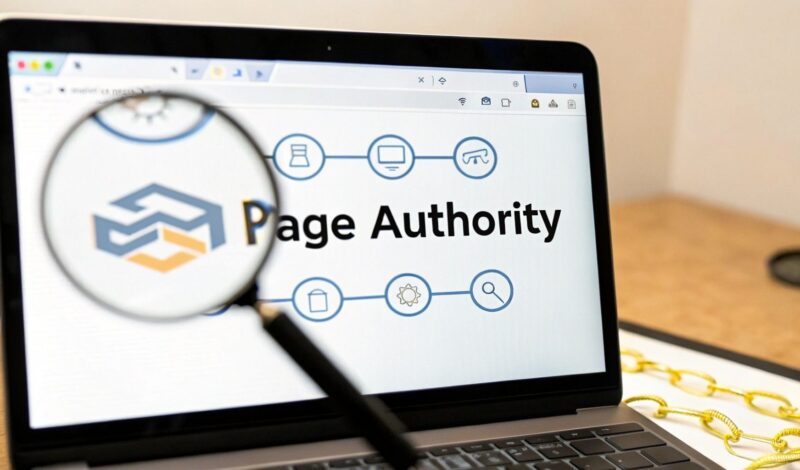
Alright, let's cut through the SEO jargon. What exactly is Page Authority (PA)?
Think of it as a predictive score that estimates how well a single, specific page on your website is likely to rank in the search results. Developed by the SEO experts at Moz, this metric runs on a 1-100 logarithmic scale. That fancy term just means it gets exponentially harder to climb the ladder—jumping from a 20 to a 30 is a lot easier than pushing from a 70 to an 80.
Understanding Your Page Authority Score
If your website is the entire book, then Page Authority is the reputation and influence of one powerful chapter. While other metrics look at your whole site's strength, PA zooms in on the ranking potential of an individual URL.
This is a huge deal. Why? Because people don't land on your "website"—they land on a specific page that promised to answer their question.
The score is whipped up from over 40 different factors, but the main ingredient is the page's backlink profile. At the end of the day, pages with stronger, more authoritative links pointing to them tend to have higher PA scores. It's also critical to make sure the page aligns with what users are actually looking for, as detailed in this great article on What Is Search Intent in SEO?.
To give you a quick snapshot of what PA is all about, here’s a simple breakdown:
Page Authority At a Glance
The table below breaks down the essential attributes of the Page Authority metric.
| Attribute | Explanation |
|---|---|
| Metric | Page Authority (PA) |
| Developed By | Moz |
| Scale | 1-100 (Logarithmic) |
| Focus | Ranking potential of a single page (URL). |
| Primary Factor | The quality and quantity of backlinks to that specific page. |
| Key Use | A comparative metric for analyzing a page's strength against competitors. |
This summary captures the core of PA: it's a page-specific, link-driven score used for competitive analysis.
Key Aspects of Page Authority
To really get a feel for Page Authority, you need to grasp a few core ideas that shape how it's used in a smart SEO strategy. If you hit any other unfamiliar terms, our essential SEO glossary can help clear things up.
Predictive, Not Prescriptive: This is a big one. PA predicts ranking potential; it doesn't cause it. Google doesn't peek at your PA score. However, it's so closely correlated with high rankings because it measures the stuff Google does care about, like high-quality backlinks.
Comparative Metric: A "good" PA score is completely relative. The goal isn't to chase a perfect 100. The real goal is to have a PA score that's competitive with, or even better than, the pages currently ranking for the keywords you're targeting.
Page-Specific Focus: PA zeroes in on the authority of one URL at a time. This makes it an incredibly useful tool for figuring out which of your most important pages—your top products, key services, or cornerstone content—need the most attention.
Page Authority provides a vital snapshot of a page’s link equity and competitive strength. It shifts the focus from broad domain-level metrics to the granular performance of the pages that actually drive conversions and traffic.
How Moz Calculates Your Page Authority Score
So, where does that Page Authority number actually come from? It isn't just pulled out of thin air. Moz uses a pretty sophisticated machine learning model to come up with the score, and its main job is to predict how well a single page will rank in search results. Think of it as an expert detective, looking at a ton of clues to figure out a page's ranking power.
The model is designed to mimic how Google might view a page's credibility based on the "votes" it gets from across the web. While it sifts through dozens of different signals, the most important one by far is backlinks.
Each link pointing to your page acts like a recommendation or an endorsement from another site. The more high-quality, relevant recommendations a page gets, the more authoritative it looks, and the higher its PA score climbs.
This visual breaks down that core relationship pretty well—backlinks are the fuel that powers a page's authority and, ultimately, its potential to rank.
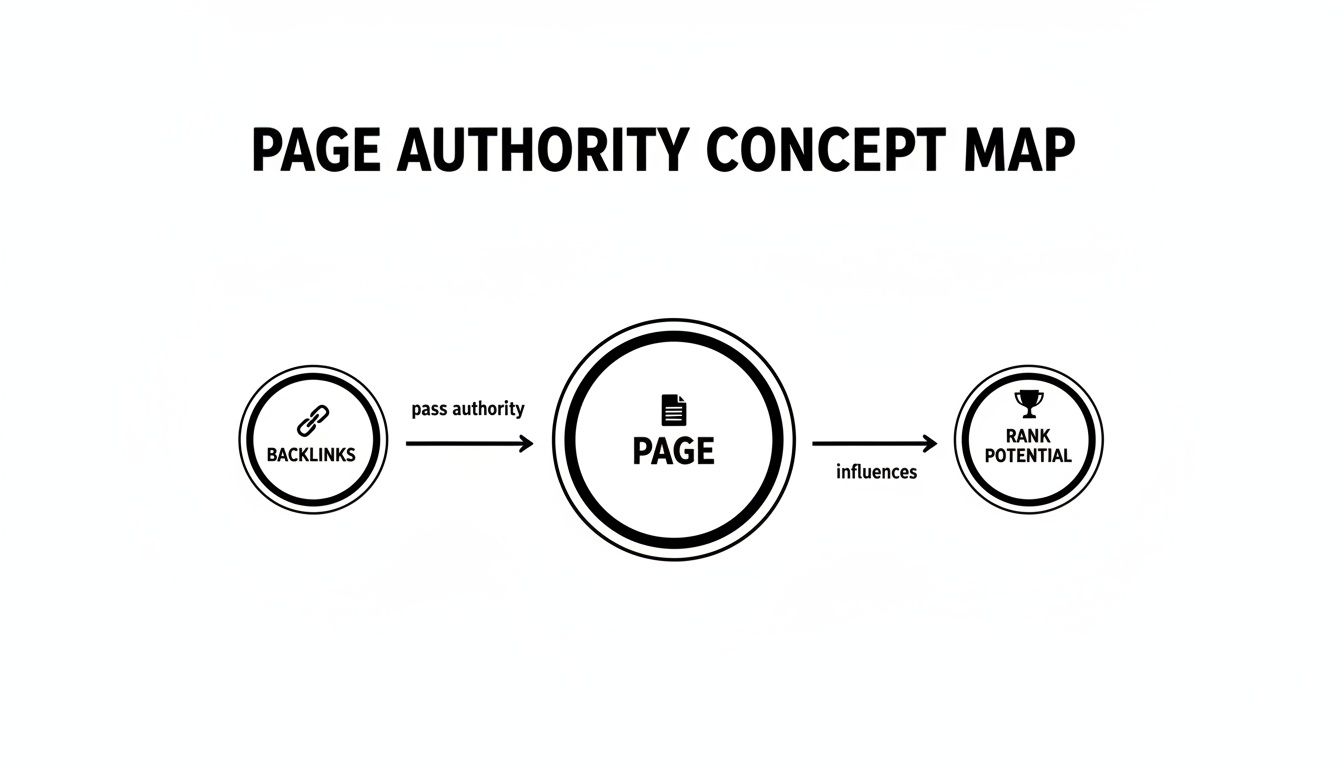
As you can see, backlinks are the foundation. They build up a page's perceived value, which is what gives it the strength to compete in the search results.
The Key Ingredients in the PA Formula
While Moz keeps the exact recipe under lock and key, we know the main ingredients that have the biggest impact. Getting a handle on these will demystify what Page Authority is all about.
Quality of Linking Domains: This is huge. A single link from a powerhouse site like a major news publication is worth way more than hundreds of links from brand-new, unknown blogs. The model gives a ton of weight to links from sources that have already built their own credibility.
Quantity of Linking Root Domains: It’s not just about the total number of backlinks, but the number of unique websites linking to you. Getting 10 links from 10 different reputable domains is a much stronger signal to search engines than getting 10 links from the same website.
It’s More Than Just a Link Count
The backlink profile is the star of the show, but other factors play a supporting role. The machine learning model, which Moz has been refining since the early 2010s, actually crunches data on over 40 different factors from its massive web index. This includes things like the number of unique linking domains and spam signals to generate the final score, which is on a 1 to 100 logarithmic scale.
The context of the link also matters. A link from an article about digital marketing pointing to your SEO services page is a fantastic signal of relevance. Even the specific clickable text in the link, known as anchor text, gives search engines important clues. You can learn more about how anchor text influences SEO in our detailed guide.
All these little pieces of information get fed into the model to produce that one predictive score we call Page Authority.
Page Authority vs. Domain Authority: What's the Difference?
It’s one of the most common points of confusion in SEO: what’s the real difference between Page Authority (PA) and Domain Authority (DA)?
They sound similar, and both use that familiar 1-100 scale, but they measure two completely different things. Getting this distinction right is key to building a smarter, more effective SEO strategy.
Think of it like this: your website is a bestselling book series, like Harry Potter.
Domain Authority (DA) is the reputation of the entire series. It’s the combined power of all seven books, the author's fame, and the global brand recognition. It tells you how likely any book in that series is to be a hit.
Page Authority (PA), on the other hand, is the strength of just one specific book, like The Goblet of Fire. It zooms in on that single story, predicting its individual ranking power based on the acclaim and references (links) pointing directly to it.
Here's a quick table to break down the key differences at a glance:
Page Authority (PA) vs. Domain Authority (DA)
| Metric | Page Authority (PA) | Domain Authority (DA) |
|---|---|---|
| What It Measures | The predictive ranking strength of a single, specific page. | The predictive ranking strength of an entire website or domain. |
| Scope | Granular and page-specific. | Holistic and domain-wide. |
| Key Influencing Factor | The quality and quantity of external links pointing to that one page. | The quality and quantity of external links pointing to the entire domain. |
| Primary Use Case | Assessing the strength of individual service pages, blog posts, or product pages. | Evaluating the overall authority and competitive strength of a website. |
This table shows that while DA gives you the big picture, PA is where you can get tactical and make a real impact on your most important pages.
Granular vs. Holistic View
The core difference really comes down to scope. DA gives you that big-picture, holistic view of your entire domain's strength, while PA offers a much more granular, page-level analysis.
This distinction is crucial for focusing your efforts. While building overall DA is a marathon, not a sprint, concentrating on the PA of your most important pages—like a key service page or a top-selling product—can deliver faster, more targeted results.
It means you can elevate a single high-value page to outrank competitors, even if your overall site DA is a bit lower than theirs.
While both metrics are valuable, Page Authority allows you to be surgical with your SEO efforts. You can concentrate your link-building resources on the pages that directly drive revenue and conversions.
How They Influence Each Other
PA and DA don't exist in a vacuum; they have a symbiotic relationship. A high Domain Authority gives every new page you publish a stronger starting point—a kind of "head start" in the SERPs.
Conversely, as you build up the Page Authority of individual pages with high-quality backlinks, that strength contributes back to your overall Domain Authority. Think of it as a rising tide lifting all ships.
Historically, Moz introduced PA back in 2011 to give SEOs a more specific metric than the site-wide DA. Their own data shows that pages with a PA score that exceeds their site's DA by 10+ points tend to outperform averages by 25% in competitive niches. You can learn more about the history of Page Authority from Moz and see how they developed these metrics to work together.
This highlights a powerful strategy: focus on creating standout content that earns exceptional backlinks. A single, high-PA page can become a powerhouse for your site. These pages often take the form of in-depth guides, and you can check out our guide on what is a pillar page to see how they function as authority-building assets.
By understanding the difference between PA and DA, you can prioritize your efforts and build authority exactly where it matters most.
Why Tracking Page Authority Is a Smart Business Move
It’s easy to get lost in SEO metrics, but connecting the dots between a number like Page Authority and actual business growth is what really matters. A strong PA isn't just a vanity score; it’s directly tied to better search engine visibility. Better visibility means more organic traffic, which leads to more qualified leads and, ultimately, more sales.
Think of it this way: a page with high authority is like having a storefront on the busiest, most desirable street in town. Search engines see that authority and are far more likely to show your page to potential customers who are actively looking for exactly what you sell.
From Metric to Money Maker
A real-world example makes this connection crystal clear. Imagine a local Baltimore roofing company that has a dedicated page for "emergency roof repair." If that single page has a high PA, it stands a much better chance of showing up at the top of the search results when a homeowner is frantically Googling for help during a storm.
That top spot captures an urgent, high-intent customer at the precise moment they need a solution. A simple search turns directly into a paying job. This is how Page Authority drives revenue, and it’s why truly understanding the return on investment (ROI) of SEO is so critical for any business owner.
Using PA as a Competitive Analysis Tool
Beyond just driving your own traffic, Page Authority is an incredibly powerful tool for sizing up the competition. It lets you benchmark your most important pages—think product pages, service descriptions, or key landing pages—against your direct rivals. By seeing exactly where you stand, you can spot strategic gaps and opportunities.
Tracking Page Authority reframes SEO from a technical task into a core business activity. It provides a clear roadmap for outranking competitors on the pages that matter most to your revenue.
For small businesses, this can be a game-changer. Let's say a Baltimore law firm's service page has a PA of 25, but they’re getting beat by competitors sitting at a PA of 45. A targeted campaign to build links from high-authority Maryland directories could realistically boost that score by 10-15 points in about six months. That jump could drive 30-50% more organic traffic to that page. You can dig deeper into these SERP performance correlations on getlinko.com.
This kind of data-driven approach means you can stop guessing and start focusing your resources where they’ll have the biggest impact on your bottom line.
Proven Strategies to Increase Your Page Authority
Alright, you understand what Page Authority is and why it matters. Now for the fun part: putting that knowledge to work.
Boosting your PA score is a marathon, not a sprint, but focusing on the right moves builds lasting authority and drives real results. Think of these tactics as your playbook for turning a low-PA page into a high-visibility asset.
First things first: you have to create "link-worthy" content. This means developing pages that are so genuinely valuable, insightful, or unique that other websites want to link to them naturally. Think original research, exhaustive guides, or free tools that solve a real problem for your audience.
Exceptional content is the foundation of any successful link-building campaign. Without it, even the best outreach efforts are dead on arrival.

Master Your Internal Linking Structure
Not all authority has to come from the outside. You can strategically channel the link equity you already have from your strongest pages to weaker ones through internal linking. An internal link is simply a link from one page on your website to another.
Pinpoint the pages on your site that already have high Page Authority. These are usually your homepage, popular blog posts, or cornerstone articles. From these high-PA pages, add relevant, contextual links pointing to the pages you want to boost. This acts like an internal vote of confidence, passing some of that hard-earned authority along.
Earn High-Quality Backlinks
Earning backlinks from other reputable websites is the single most powerful way to increase your Page Authority. This is where your link-worthy content really gets to shine. But you can’t just publish something and cross your fingers; you need a proactive game plan.
Here are a few proven methods:
- Guest Posting: Write genuinely useful articles for other respected blogs in your niche and include a link back to a relevant page on your site.
- Digital PR: Create compelling stories, data, or infographics and pitch them to journalists and bloggers. When they cover your story, they'll often link back to you as the source.
- Broken Link Building: Find dead links on other websites and reach out to the site owner, suggesting your relevant page as a better replacement. It's a win-win.
Building a strong backlink profile is a continuous effort. You can learn more about how to build backlinks naturally in our comprehensive guide.
Audit and Remove Toxic Backlinks
Just as good links can lift your PA score, bad ones can absolutely tank it. Toxic backlinks come from spammy, low-quality, or completely irrelevant websites. Regularly auditing your backlink profile is non-negotiable for maintaining a healthy score and protecting your site's reputation.
A key insight into Page Authority reveals its strong predictive power for organic traffic. Moz reports that pages with a PA over 50 capture 60% more search visibility than those under 30. A healthcare provider's blog starting at PA 15 can reach 35 in 4-6 months with 20-30 quality backlinks, correlating to a 40% traffic surge. You can discover more insights from Moz's latest updates to see the full picture.
Use SEO tools to identify these harmful links. If you find any, the first step is to contact the site owner and ask for removal. If that doesn't work (and it often won't), you can use Google's Disavow Tool to tell the search engine to ignore them. A clean backlink profile ensures your authority isn't being undermined by sketchy associations.
How to Check and Monitor Your Page Authority
So, you understand what Page Authority is. That's the first step. But the real magic happens when you start tracking it consistently to see how your hard work is paying off. Luckily, checking your PA score is pretty straightforward with the right tools.
The most direct route is to go straight to the source: Moz. Their tools are the industry standard for this metric, and you can get started for free.
The Best Tools for the Job
Your main tool here will be the Moz Link Explorer. It’s as simple as it sounds. You just plug in the exact URL of the page you want to check, and it spits back a ton of useful data, including that all-important Page Authority score.
If you want instant insights while you're browsing, the MozBar browser extension is a game-changer. Once it’s installed, it overlays PA and Domain Authority scores on the search results and on any page you visit. This is incredibly handy for quickly sizing up your own pages or getting a peek at your competitors' authority on the fly.
The Moz toolset lays the PA score out clearly, giving you an immediate benchmark. You can see exactly where your page stands and how it stacks up against the other pages ranking for your target keywords.
Looking Beyond Moz's PA
While Moz created Page Authority and it's widely respected, it’s always smart to get a second opinion. Looking at similar metrics from other major SEO platforms gives you a more well-rounded picture of a page’s strength. Think of it like getting quotes from multiple contractors—they all measure things a little differently, but together they tell a complete story.
Ahrefs' URL Rating (UR): This is the direct counterpart to PA from Ahrefs. It also runs on a 0-100 logarithmic scale and is laser-focused on measuring the strength of a single URL's backlink profile.
Semrush's Authority Score: While Semrush is better known for its domain-level score, its tools provide deep, page-specific data on backlinks and overall page health that helps you assess a page's authority.
Why Consistent Monitoring is a Must
Checking your Page Authority once gives you a snapshot. Tracking it over time gives you the whole movie.
This isn’t a one-and-done task. The key to making PA a useful part of your strategy is consistent tracking over time.
Pop open a simple spreadsheet and start logging the PA for your most important pages—your cornerstone blog posts, top-selling product pages, and critical service pages. Make it a habit to check these scores once a month.
Doing this turns PA from a static number into a dynamic progress bar for your SEO efforts. You’ll be able to draw a direct line from your link-building campaigns to a tangible increase in your page’s authority, proving that what you're doing is actually working.
Common Questions We Hear About Page Authority
To wrap things up, let's tackle a few of the most common questions marketers and business owners have about Page Authority. These quick answers should clear up any lingering confusion and help you put this metric to work.
What Is a Good Page Authority Score?
There's no single number that counts as a "good" score. Since Page Authority is all about comparison, what really matters is how you stack up against the competition in your specific industry.
The best way to figure this out is to analyze the PA of the pages already ranking on the first page for your target keywords. A "good" score is one that's in the same ballpark as theirs—or even better. If the top players all have a PA around 40, then your goal should be to push for 45.
How Long Does It Take to Improve Page Authority?
Improving Page Authority is a marathon, not a sprint. It’s the result of consistent, high-quality SEO work over time, not an overnight fix.
Generally, you can start to see some meaningful movement within three to six months after you kick off a dedicated content and link-building strategy. How fast you see results really depends on how competitive your industry is and the quality of the backlinks you're able to earn.
Key Takeaway: Page Authority is a metric created by Moz to predict how well a page might rank. It isn’t a direct ranking factor used by Google. However, it's a great indicator of ranking potential because it's built on factors Google does care about, especially the quality and quantity of backlinks.
Can My Page Authority Score Decrease?
Absolutely. A Page Authority score isn't set in stone; it can and does fluctuate. There are a few key reasons your score might dip.
This can happen if Moz updates its algorithm, which causes a recalibration across the board. Your score could also drop if you lose some valuable backlinks, or if your competitors seriously step up their own link-building game, effectively raising the bar for everyone else. Remember, PA is just one piece of the puzzle, and understanding overall rank tracking gives you a much bigger picture of your SEO health.
Ready to boost your page authority and climb the search rankings? The expert team at Raven SEO creates data-driven strategies that build real authority and drive measurable growth for businesses in Baltimore and beyond. Start with a no-obligation consultation today!