

A winning digital marketing strategy doesn’t kick off with picking a social media platform or brainstorming ad copy. It starts with an honest, hard look at your business itself. Without a solid game plan built on clear goals and a real understanding of the market, even the most brilliant campaigns will fall flat, wasting both time and money. This first phase is all about grounding your future moves in reality, not guesswork. This guide from Raven SEO will walk you through the essential steps.
Building a Foundation for Digital Growth
Before you can figure out how to get there, you need to know exactly where you're going. Vague wishes like "get more customers" or "increase sales" just won't cut it—they’re impossible to act on. The most effective strategies are always built on S.M.A.R.T. goals. This simple framework turns fuzzy ambitions into crystal-clear targets that guide every decision you make.
Set Your Sights with S.M.A.R.T. Goals
Think of S.M.A.R.T. goals as the GPS coordinates for your entire marketing plan. They give you direction and, just as importantly, a way to know if you've arrived.
- Specific: Nail down exactly what you want to achieve. Instead of "more website traffic," a better goal is "increase organic search traffic from homeowners in the Baltimore area."
- Measurable: How will you track your progress? A great goal is "generate 20 qualified project leads per month through our website's contact form."
- Achievable: Is this goal realistic with your current resources? If you're a brand new business, aiming for 10,000 Instagram followers in a month is a fantasy. But 500 engaged local followers? That's a solid, achievable start.
- Relevant: Does this goal actually support your bigger business objectives? If your main objective is to land more high-value commercial contracts, focusing all your energy on residential leads is a strategic mismatch.
- Time-bound: Give yourself a deadline. For example, "Achieve a 15% increase in online appointment bookings by the end of Q3."

This foundational discovery work ensures every part of your marketing plan is built to succeed right out of the gate. Below is a simple table to help you organize these core components.
Table: Core Components of a Digital Strategy Foundation
| Component | Key Question to Answer | Example for a Baltimore Plumber |
|---|---|---|
| S.M.A.R.T. Goals | What specific, measurable business outcome do we want to achieve? | "Increase online bookings for emergency leak repairs in Baltimore County by 25% within 6 months." |
| Unique Selling Proposition (USP) | What makes us the obvious choice over our competitors? | "We offer 24/7 emergency service with a guaranteed 60-minute response time anywhere in the city." |
| SWOT Analysis | What are our internal strengths/weaknesses and external opportunities/threats? | Strength: Highly experienced team. Weakness: Outdated website. Opportunity: New housing developments. Threat: A new competitor with lower prices. |
| Competitive Landscape | Who are our top 3 competitors and where are they winning online? | Competitor A ranks #1 for "Baltimore plumber," Competitor B runs aggressive Google Ads, Competitor C has great reviews on Yelp. |
Taking the time to answer these questions honestly provides the raw material you need to build a strategy that's not just creative, but effective.
Uncover Your Unique Market Position
Once you've got your goals locked in, you need to get a clear picture of your place in the market. A SWOT analysis (Strengths, Weaknesses, Opportunities, Threats) is a classic for a reason—it’s a straightforward but incredibly powerful tool. This isn't just some business school homework; it gives you actionable insights that will directly shape your entire strategy.
Your strengths might be a killer local reputation or a highly skilled team. Weaknesses could be an ancient website or a tiny marketing budget. For a Baltimore contractor, an opportunity could be a new city grant for home renovations, while a threat might be two new competitors setting up shop nearby.
This analysis shows you where you can win and where you need to play defense. For instance, if you identify your website as a major weakness, a great first step is to check out our guide on the 5 essential technical checks for a new website.
A SWOT analysis isn't about listing things you already know. It's about connecting the dots to find a strategic advantage. If your strength is amazing customer service and a competitor's weakness is a string of bad online reviews, your strategy should be to amplify your customer testimonials everywhere.
This self-assessment has to be paired with a hard look at your competition. See what they're doing online. What keywords are they ranking for? What kind of content are they putting out? Are they running ads? The point isn't to copy them, but to find the gaps they've left wide open—gaps your business can strategically fill.
With global digital ad spend projected to soar past $740 billion by 2026, simply throwing more money at the problem isn't a strategy. It's about spending smarter. You can learn more about current and future digital marketing trends to stay ahead of the curve.
Getting to Know Your Ideal Baltimore Customer
Once you’ve set clear, data-driven goals, the next logical step—and arguably the most critical—is to figure out exactly who you’re talking to. An effective strategy speaks directly to the right people. This means digging deeper than vague descriptions like "small business owners" and building detailed buyer personas that feel like real people.
Think of a buyer persona as a detailed profile of your ideal customer, built from market research and real data you already have. It’s a character sketch that outlines their motivations, their goals, and, most importantly, the specific problems they’re trying to solve. Having this level of clarity informs every blog post you write and every ad you run.

This process is what ensures your marketing budget is spent connecting with people who are actually likely to buy. It’s the difference between shouting into a void and having a productive conversation with a future customer.
From Demographics to Motivations
Basic demographics are just a starting point. Knowing your target customer is a 35-year-old living in Baltimore is one thing; understanding why they urgently need what you offer is what really moves the needle. You're trying to uncover the human story behind the data.
Let’s imagine a Baltimore-based accounting firm. Instead of casting a wide, generic net, they could create a persona for "Sarah the Startup Founder."
- Who is Sarah? She’s a 32-year-old founder living in Federal Hill who just landed her first round of seed funding.
- What keeps her up at night? She’s an expert in her own industry but feels completely lost when it comes to quarterly taxes, payroll, and managing cash flow.
- Where does she go for help? She listens to business podcasts during her commute and Googles things like "bookkeeping services for startups in Baltimore" late at night.
All of a sudden, the firm’s marketing strategy snaps into focus. They can now write blog posts answering Sarah's exact questions, run targeted LinkedIn ads aimed at new founders, and even sponsor a local startup event. This persona-driven marketing is infinitely more powerful than generic ads.
A well-developed buyer persona tells you not just who your customer is, but what keeps them up at night. Your marketing should be the solution to that problem.
Researching Your Audience
Building accurate personas means you can't rely on guesswork. You need to blend quantitative data with qualitative insights to avoid making assumptions. A fundamental step in this process is learning How to Identify Your Target Audience for sustainable growth.
Here are a few practical ways to get the information you need:
- Survey Your Current Customers: Just ask them. Send a simple survey about their goals, their biggest challenges, and how they first heard about you.
- Interview Your Sales Team: Your sales folks are on the front lines. They have incredible insight into the common questions, objections, and pain points they hear every single day.
- Use Your Analytics Tools: Google Analytics is a goldmine for demographic and interest data about the people already visiting your website.
- Monitor Social Media: Take a look at your competitors' followers. What are they talking about? What questions are they asking in relevant Facebook groups or on Reddit?
Pulling all this information together helps you build a complete, actionable picture of your ideal customer. For a deeper dive into the specific steps and tools for this process, check out our complete guide on how to create buyer personas that drive real results. Once you know exactly who you’re talking to, every other part of your strategy becomes sharper, more focused, and far more effective.
Choosing Your Most Powerful Marketing Channels
Once you know who you're talking to, the big question becomes where to talk to them. It’s tempting to try and be everywhere at once, but spreading your budget thinly across every platform is a surefire way to get nowhere fast. The real art is in picking the channels that give you the biggest bang for your buck.
Not every channel makes sense for every business. Think about it: a local Baltimore restaurant is going to crush it with Local SEO and a visually-driven platform like Instagram, pulling in hungry diners from the neighborhood. On the other hand, a national B2B software company would be wasting its time there. They’ll see far better results from a sharp focus on SEO, LinkedIn, and in-depth content that speaks directly to decision-makers.
Owned Channels Are Your Greatest Assets
Before we jump into the nitty-gritty of platforms, let's talk about your owned media. These are the digital assets you have total control over: your website, your blog, and your email list.
Social media and paid ads are fantastic for reaching new faces, but you’re essentially renting space on someone else's land. Algorithms change, organic reach plummets, and suddenly you're cut off from the very audience you worked so hard to build.
Your website and email list? Those are yours. They give you a direct, unfiltered line to your most loyal prospects and customers. Building these assets isn't just a good idea; it should be a core part of your long-term game plan.
Your website isn't just a digital brochure; it's the central hub of your entire marketing universe. Every other channel—social, paid, email—should be engineered to drive qualified traffic right back to it, where you control the experience and the call to action.
There's a reason data-driven strategies often start with search and owned channels. They consistently deliver a higher return. Recent reports show that websites, blogs, and SEO accounted for 16% of the channels delivering the highest ROI. Even more telling, a staggering 91% of marketers said SEO directly improved their website's performance. You can discover more insights on digital marketing ROI to see how these trends are shaping modern strategies.
Matching Channels to Business Goals
So, how do you pick the right mix? It all comes down to aligning your channels with your business model and those buyer personas we talked about. Let's break down the core players.
-
Search Engine Optimization (SEO): This is the long game. It’s all about earning organic visibility on search engines like Google to capture people actively looking for what you offer. SEO is foundational for almost everyone, but it’s especially vital for local service providers, B2B companies, and e-commerce stores.
-
Paid Ads (PPC): Pay-per-click ads on platforms like Google Ads or Meta give you immediate visibility. They're perfect for generating leads quickly, promoting a sale, or targeting a very specific demographic with laser precision. PPC shines when you have a clear conversion goal, like a form fill or a product sale.
-
Social Media Marketing: Think of social media less as a sales tool and more as a community-building machine. It excels at brand awareness and engagement, reaching audiences based on their interests. Visual brands live on Instagram, while B2B companies build their authority on LinkedIn. For a primer on this channel, you can explore our guide on social media marketing basics.
-
Content Marketing: This is about creating genuinely valuable stuff—blog posts, videos, guides—to attract and educate your audience. Content is the fuel for your SEO, gives you something to share on social, and builds trust over time. It’s a must-have for businesses with a longer sales cycle or in complex industries where education is key.
-
Email Marketing: Here’s your tool for nurturing leads and keeping customers coming back. By sending targeted messages straight to their inbox, you can guide people through the buying process and encourage repeat business. It consistently remains one of the highest-ROI activities you can do.
Building an Integrated Channel Mix
The most effective strategies don’t treat these channels like separate islands. They weave them together, making each one stronger.
For example, you might run a PPC campaign to get instant traffic to a killer blog post (Content Marketing). That post then captures email sign-ups (Email Marketing) and gets promoted across your social platforms (Social Media Marketing). All the while, the blog post itself is built to rank organically over time (SEO), creating a sustainable traffic source long after you've turned the ads off.
This integrated approach creates a marketing engine that’s far more powerful than the sum of its parts.
Weaving Your Content and Campaigns into a Cohesive Plan
You've identified your ideal customer and pinpointed the best channels to reach them. Now it's time to build the engine. This is where we move from high-level strategy to an actionable roadmap for your content and campaigns—the stuff that actually drives traffic and brings in leads.
Without a plan, you're just creating one-off blog posts and random social updates. A real strategy is built around topic clusters. This involves creating a main "pillar" page on a broad subject, then supporting it with several in-depth articles on related subtopics. This structure is a massive signal to search engines that you're an expert in your field.
Mapping Content to the Buyer's Journey
Your content has to meet people where they are. Someone just realizing they have a problem needs entirely different information than someone who's ready to pull out their credit card. Mapping your content ideas to the buyer's journey ensures you're providing the right value at the right time.
- Awareness Stage: The customer knows they have a problem but might not know what to call it. Your content here should be purely educational. Think "how-to" guides, checklists, and informational blog posts that answer their initial questions.
- Consideration Stage: They've defined their problem and are now researching solutions. This is where you can offer comparison guides, case studies, and deeper articles that show off your approach without a hard sell.
- Decision Stage: The customer is ready to choose a provider. Your content should make it an easy choice to go with you. Think free consultations, powerful testimonials, and detailed service pages that leave no questions unanswered.
This simple infographic shows how different channels can work together to guide a customer through this process.
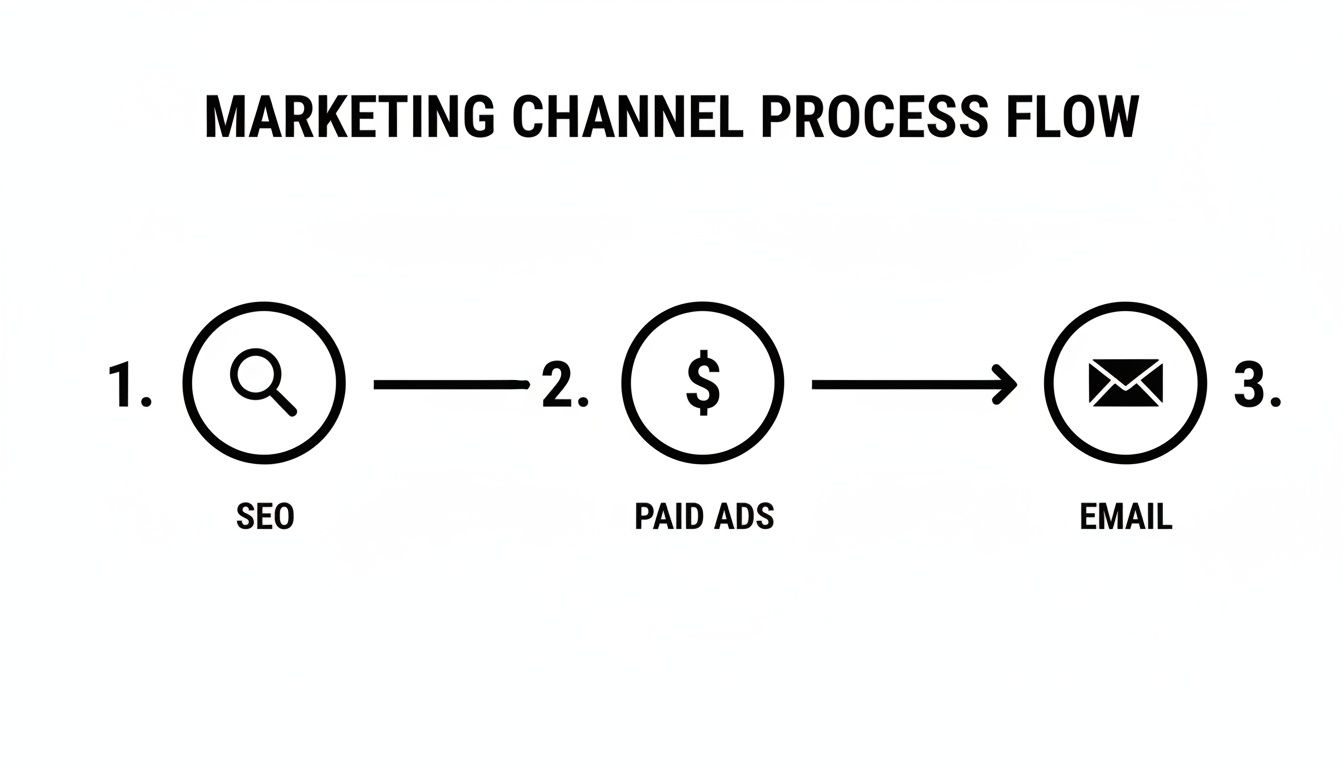
You can see how a strategy might start with broad-reach SEO, capture immediate interest with paid ads, and then build a lasting relationship through email.
A Real-World Baltimore Example
Let's bring this to life with a local real estate agent in Baltimore whose main goal is to attract first-time homebuyers.
Instead of just writing random articles about the market, they decide to build an entire campaign around the topic cluster of "buying your first home in Baltimore."
The best campaigns feel less like marketing and more like a helpful, guided experience. Each piece of content—from a blog post to an email—should feel like the next logical step in solving the customer's problem.
Their roadmap could look something like this:
- Pillar Content (Awareness): First, they write a massive cornerstone blog post titled "The Ultimate Guide to Buying Your First Home in Baltimore." This long-form article covers everything from neighborhood pros and cons to understanding closing costs.
- Supporting Content (Consideration): Next, they create a series of shorter blog posts and videos that all link back to that main pillar page. Topics might include "5 Common Mistakes First-Time Baltimore Homebuyers Make" or "Comparing FHA vs. Conventional Loans in Maryland."
- Campaign Activation (Decision): Finally, they run a targeted Facebook ad campaign promoting a free downloadable "First-Time Homebuyer Checklist." This captures email leads, who are then automatically entered into an email sequence offering a free consultation.
This integrated approach makes sure their big-picture vision translates into a steady pipeline of content that delivers real value. For a deeper look at building out your content efforts, check out the principles in a modern content marketing strategy guide.
To keep it all organized, you'll need a schedule. We've got you covered—you can learn exactly how to create a content calendar in our detailed guide, which will help you turn this roadmap into a month-by-month action plan.
Budgeting and Measuring Your Marketing ROI
A strategy without a way to measure it is just a guess. The final, critical piece of your plan is figuring out how to fund your efforts and, more importantly, how to prove they're actually working.
This is where you draw a straight line from your marketing activities to your business's bottom line. It requires a smart balance—weighing the long-term, foundational growth that comes from SEO against the immediate, predictable returns from paid advertising. Neither is "better," they just serve different strategic purposes.
Let's break down a practical framework for assigning your budget, identifying the Key Performance Indicators (KPIs) that truly matter, and setting up a reporting system that lets you make data-backed decisions.
Allocating Your Marketing Budget Wisely
First things first: you need to decide where your dollars will have the biggest impact. While many small businesses dedicate a percentage of their revenue to marketing, how you split that budget across channels is what makes or breaks your strategy.
A great starting point is the 70-20-10 rule. It’s a simple, balanced approach that keeps your main engine running while still leaving room for innovation.
- 70% of your budget goes to your proven, core marketing activities. These are the channels you already know deliver consistent results, like Local SEO for a Baltimore contractor or Google Ads for an e-commerce store.
- 20% is for experimenting with new channels or strategies. This could mean testing out LinkedIn ads, launching a video content series, or exploring a new social media platform your audience is flocking to.
- 10% is for high-risk, high-reward experiments. Think of these as the big swings that might fail completely but could also uncover a massive new growth opportunity.
This framework ensures you’re not just maintaining the status quo but actively looking for your next big win.
Focusing on Metrics That Matter
It's way too easy to get distracted by "vanity metrics" like social media likes or total website visits. These numbers can feel good, but they don't tell you if your marketing is actually making you money.
Instead, you need to anchor your reporting in KPIs that tie directly to business objectives. The goal is to move beyond tracking activity and start measuring real impact.
The most important question your marketing data can answer is: "For every dollar we spend, how many dollars are we getting back?" If you can't answer that, you're flying blind.
Here are a few essential KPIs that every business should be tracking:
- Customer Acquisition Cost (CAC): This is the total cost of your marketing and sales efforts to acquire one new customer. The goal? Keep this number as low as possible.
- Customer Lifetime Value (CLV): This metric predicts the total revenue your business can expect from a single customer account. A healthy business model requires your CLV to be significantly higher than your CAC.
- Return on Ad Spend (ROAS): For paid campaigns, this shows how much revenue you generate for every dollar you spend on ads. It’s a direct measure of your campaign's profitability.
- Conversion Rate: This is the percentage of users who take a desired action, like filling out a contact form or making a purchase. Optimizing this is key to getting more value from your existing traffic.
You can dive deeper into these core numbers by exploring our detailed guide on measuring your return on marketing investment.
A modern digital marketing strategy also has to plan around AI and automation. A significant 68% of marketing executives report a positive return on their AI investments. On the paid side, things are getting trickier; 49% of advertisers say campaign management has become more difficult than it was two years ago, and 72% of them name 'efficient growth' as their main goal.
With digital channels now accounting for around 70–74% of global ad spend—and expected to exceed $800 billion annually by 2026—businesses without a structured, AI-aware strategy risk wasting budget in automated ad auctions they don't fully control.
Key Performance Indicators by Marketing Channel
Choosing the right KPIs for each channel is crucial. You can't measure the success of an SEO campaign with the same yardstick you use for a paid social ad. This table breaks down the most impactful metrics to focus on for each channel, helping you accurately measure ROI and strategic success.
| Channel | Primary KPI | Secondary KPI | Why It Matters |
|---|---|---|---|
| SEO | Organic Traffic & Conversions | Keyword Rankings, Backlink Growth | Measures direct business impact from search visibility and tells the story of long-term authority building. |
| Paid Ads (PPC) | Return on Ad Spend (ROAS) | Click-Through Rate (CTR), Cost Per Conversion | Directly links ad spend to revenue, while secondary metrics help diagnose and optimize campaign performance. |
| Social Media | Engagement Rate | Follower Growth, Reach | Shows how well your content resonates with your audience, which is a leading indicator of brand loyalty. |
| Email Marketing | Conversion Rate (from clicks) | Open Rate, Click-Through Rate (CTR) | Connects email efforts directly to sales or leads, with open/click rates indicating list health and content relevance. |
| Content Marketing | Leads Generated (from content) | Time on Page, New vs. Returning Users | Measures how effectively your content turns readers into prospects and gauges how engaging your material is. |
By tracking these specific metrics, you move from a vague sense of "what's working" to a clear, data-driven understanding of how each part of your strategy contributes to the bottom line. This clarity is what allows you to double down on your winners and intelligently refine the rest.
Got Questions About Your Digital Strategy? We've Got Answers.
Building a digital marketing strategy for the first time can feel like you're trying to assemble a complicated piece of furniture with confusing instructions. Even with a solid roadmap, you’re bound to have questions.
We get it. We’ve rounded up some of the most common questions we hear from business owners right here in Baltimore and beyond to give you straightforward answers that will help you move forward.
How much should a small business budget for digital marketing?
There’s no magic number here, but a reliable benchmark for most small businesses is to set aside 7-12% of your total revenue for marketing. If you're a new business trying to make a splash, or you're in a cutthroat market like parts of Maryland, you'll want to lean toward the higher end of that range to get the initial traction you need.
The most important thing is to start with a budget you can actually sustain month after month. Don't spread yourself thin. Pick one or two channels where you know your ideal customers hang out and focus your spend there.
By measuring everything from day one, you’ll quickly see what's working. You can then confidently reinvest your profits back into the channels that are delivering a real return, letting you scale up smartly.
How long does it take to see results from a digital marketing strategy?
This is the million-dollar question, and the answer really depends on the channels you've chosen. A smart strategy doesn't put all its eggs in one basket; it blends different timelines for a mix of quick wins and long-term growth.
- Paid Advertising (PPC): This is your sprinter. You can get traffic, leads, and even sales almost as soon as you launch a campaign on platforms like Google Ads. The catch? The results are directly tied to your ad spend. When you turn the ads off, the traffic spigot closes.
- SEO and Content Marketing: This is your marathon runner. It can easily take 4-6 months before you start seeing a meaningful climb in search rankings and a real uptick in organic traffic. The payoff, however, is huge. The results you build are sustainable, creating a consistent flow of leads that keeps coming long after the initial work is done.
A great digital marketing strategy doesn't force you to choose between short-term wins and long-term growth. It strategically balances both, using paid channels to generate immediate cash flow while building a strong SEO foundation for sustainable success.
Can I do digital marketing myself, or should I hire an agency?
You can absolutely build a foundational strategy yourself using guides just like this one. For a lot of small business owners, going the DIY route is a great way to start. It forces you to get to know your customers on a deeper level and learn the marketing fundamentals firsthand.
But as your business grows, you're going to hit a wall.
Effectively managing multiple channels, keeping up with Google's constant algorithm mood swings, and diving into the technical weeds of optimization requires deep expertise and—more importantly—a ton of time.
That's usually when bringing in an agency makes sense. Partnering with a team gives you instant access to specialists, sophisticated tools, and a group of people whose only job is to focus on your growth. It frees you up to do what you do best: run your business. The right agency isn't just a vendor taking tasks off your plate; they become a strategic partner laser-focused on hitting your business goals.
Ready to turn your strategic plan into real-world results? Raven SEO specializes in creating and executing digital marketing strategies that drive measurable growth for businesses in Baltimore and beyond. Whether you need a comprehensive plan or targeted support for SEO, paid ads, or web design, our team is here to help. Schedule your no-obligation consultation today and let’s build a roadmap for your success.